
Knowledge – Fish
Arapaima (Pirarucu): Features, way of life, protection
The arapaima (Arapaima gigas), called pirarucu in Brazil and paiche in Peru, is one of the largest freshwater fish on Earth. It lives in the floodplains of the Amazon and has to gulp air at the surface every few minutes. Because of overfishing it is listed in CITES Appendix II.
In short: According to the catch calendar the best time is October to March. Good spots on the lake: surface and sunken tree. Proven baits: large flies on 6/0 to 8/0 hooks, as adult arapaima feed almost only on fish. It is listed in CITES Appendix II. In Guyana it is listed as a protected aquatic animal, and it may only be caught there with a licence from the fisheries authority (Fischereibehörde); sport fishing releases every fish. Step by step: Fishing for arapaima.
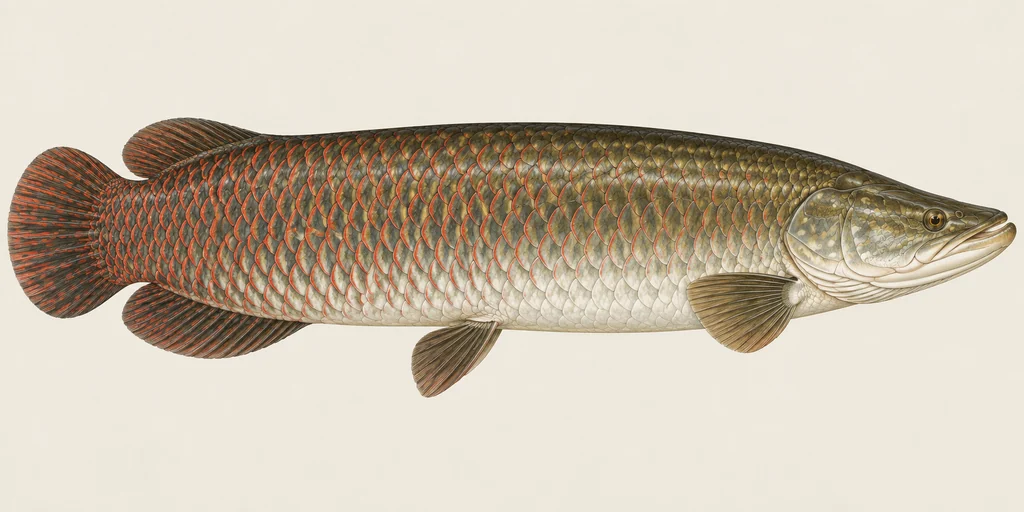
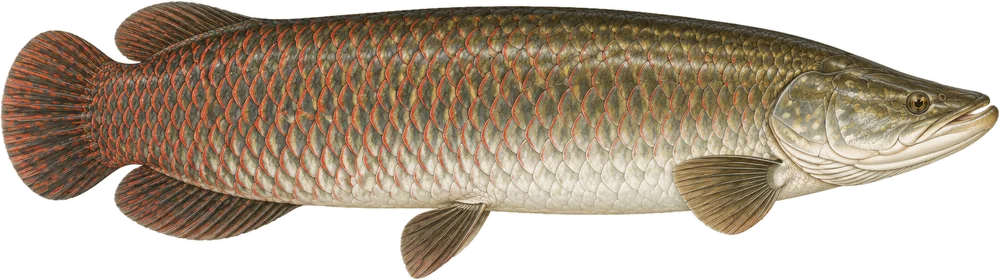
- Rear edge of the scales conspicuously red, stronger towards the tail
- Dorsal and anal fins far back, almost opposite each other, just in front of the tail fin
- Olive-brown back, silver-grey towards the belly
Catch chances through the year
- Hardly any chance
- Possible
- Good
- Peak season
- Spawning (observe the closed season)
Editorial assessment for the native range (Rupununi in Guyana (catch and release)), not a measured value and not a guarantee. The rules of the country you are travelling to are binding.
How to recognise it
The body is long and laterally flattened, and the dorsal and anal fins sit far back just in front of the tail fin. Adult fish are olive-brown on the back, turning silver-grey towards the belly. The red edge on the rear margin of the scales is typical.
Outside the spawning season males and females look the same. In the breeding season the scales of the males turn a stronger red, especially on the jaw.
The arapaima belongs to the bonytongues: its tongue is bony and toothed. The swim bladder serves as the main breathing organ, and the gills are small in relation to the body.
FishBase gives 200 kg as the greatest published weight. A study from Guyana estimates that fish of 3 m in length can weigh around 327 kg there. Because of overfishing an arapaima over 2,4 m is rare today.
Head to head: arapaima or silver arowana?
| Feature | Arapaima | Silver arowana |
|---|---|---|
| Dorsal and anal fins | sit far back, just in front of the tail fin | long, reaching almost to the tail fin |
| Colour | olive-brown back, scales with a conspicuous red edge at the rear | silver when adult |
| Mouth | large, barbels not described in the sources | pointing steeply upwards, two barbels at the tip of the lower jaw |
| Size | over 3 m and over 200 kg possible | up to 90 cm and 6 kg |
In the water a large arapaima is hard to mistake: size, red scale edges and the far-back fins stand out at once. Juveniles have a blotchy pattern, which they keep until about their first year. The silver arowana from the same rivers stays much smaller, has a steeply upturned mouth and two barbels at the tip of the lower jaw.
Systematics is harder. For a long time the genus was regarded as having a single species. After studies in Brazil and Guyana, researchers around Donald Stewart consider all four previously described species valid; how they are distributed is still open (Castello and Stewart 2010). The fish from Guyana is now sometimes listed as Arapaima arapaima.
Where it lives
The arapaima is native to the Amazon basin, and the largest stocks live in the floodplains of rivers with turbid, sediment-rich water. This habitat makes up only about 2 per cent of the basin.
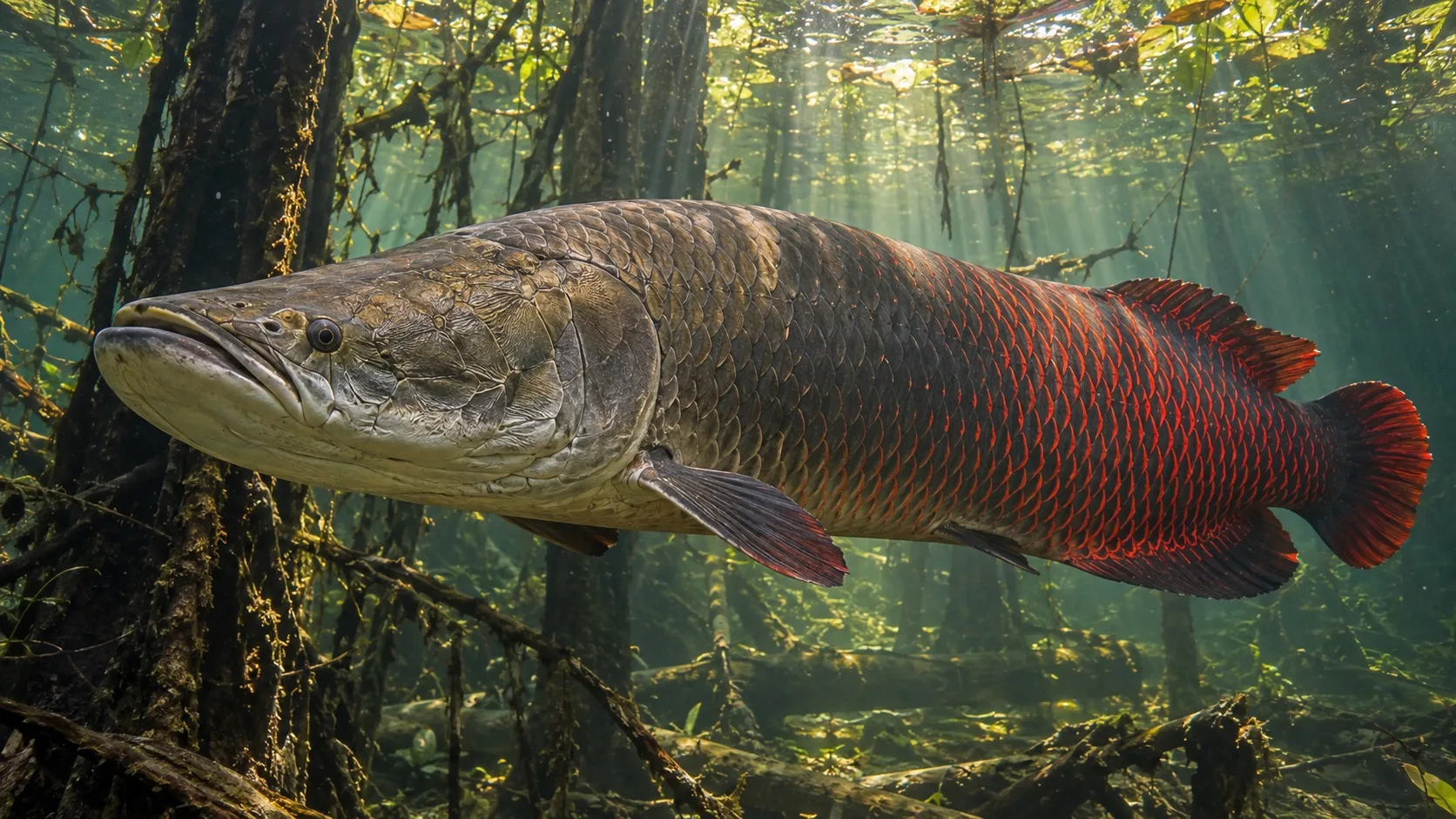
It changes position with the water level. In the low-water season, in the central Amazon roughly from September to January, the fish gather in lakes and channels. As the water rises they move into the flooded forest.
In parts of Peru and Bolivia it is not native but was introduced through farmed fish. It has also been introduced to China, Cuba, Mexico and Thailand, among others. According to a University of Florida study, its lower lethal water temperature is 16 °C.
Holding spots in the picture
Choose the time of day: the picture shows where the species holds. We do not show German seasons for travel fish; the bars give the chance of a catch for each month. Tap a fish or a spot in the list to bring it closer. The picture is schematic and AI-generated, and every water is different.
Chance of a catch per month according to the catch calendar
- J
- F
- M
- A
- M
- J
- J
- A
- S
- O
- N
- D
Spawning season
In the lake
Sunken tree
The arapaima (pirarucu) is found here all year round.
Just below the surface
The arapaima (pirarucu) is found here all year round.
The arapaima lives in the floodplains of turbid, sediment-rich Amazon rivers. In the dry season with low water, in the central Amazon roughly September to January, many fish gather in a small space in lakes and channels. When the water rises they spread out in the flooded forest and spawn in shallow hollows, mostly on sand.
Depth: As an air breather it surfaces every 5 to 15 minutes. The gulping of air can be heard and shows where it stands.
Size comparison: AI-generated drawing, schematic.
How it breathes, hunts and spawns
The arapaima is an ambush predator. It sucks in smaller fish with a rapid expansion of the mouth cavity. Adults feed mainly on fish, including armoured catfish, knifefish and characins. Juveniles under 50 cm also take insects, crustaceans and molluscs.
As an obligate air breather it has to come to the surface: typical intervals are 5 to 15 minutes. The audible gulping of air gives away its position.
Pairs form at spawning time. In the central Amazon they spawn between December and May, when the water rises. Both partners dig a shallow hollow, and in a study in the Mamirauá reserve 95 per cent of the nests lay on sand. The male then guards the young for about three months. Females mature at a length of around 1,7 m. In their first year juveniles already reach 70 to 100 cm.
When and where the season is
The season depends on the water level, not the calendar. In the central Amazon the arapaima is caught mainly at low water, roughly from September to January. Then the fish crowd into lakes and channels.
With the rising water the fish spread out into the flooded forest and the spawning season begins. For these months IBAMA in Brazil has set a closed season (Schonzeit), and in the state of Amazonas fishing is only permitted in approved management areas anyway. In Guyana, where sport anglers catch and release arapaima, the rainy season floods savannah and forest in the Rupununi from May to August. From September to April the water falls, the fish are then stranded in cut-off residual lakes of the floodplain, and that is when they are fished for there.
How it is caught
Step by step: Fishing for arapaima: tips on baits, rigs and tackle – season, holding spots, baits, tackle and rules on one page.
Traditionally the pirarucu is harpooned in the Amazon. Today gill nets dominate, alongside hand lines and traps. Because the fish surfaces to breathe, experienced fishers can see where it holds and can pick larger animals deliberately.
For sport anglers the arapaima is mainly a topic in Guyana. The agriculture ministry there finalised protocols and a draft law for catch and release in the North Rupununi in 2016. Where you may fish is decided by the authority and the local communities.
Fly fishing in Guyana is the best studied: in a study on the Rupununi, sport anglers caught the fish on class 12 fly rods and large flies on hooks sized 6/0 to 8/0, then released them. Plan your tackle and landing for a fish that can weigh well over 100 kg.
Watch for the air gulps: The arapaima shows at the surface every 5 to 15 minutes. Watch calm lakes and channels for a while before you cast.
Keep the fight short: Researchers in Guyana are studying how the fight stresses the fish, because it can impair metabolism and survival. Keep the fight short and hold the fish in the water when releasing it.
Suitable lures
Large flies on 6/0 to 8/0 hooks, as adult arapaima feed almost only on fish.
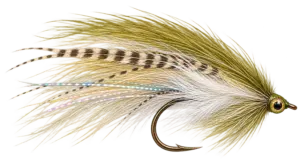
AI-generated illustrations. A click opens the lure’s page.
Only where angling is officially permitted; CITES Appendix II, strictly regulated in Brazil, protected in Guyana and only with a licence.
Which rules apply
The arapaima is listed in Appendix II of the Washington Convention on endangered species (CITES). Cross-border trade requires an export certificate from the country of origin. The IUCN Red List classes the species as data deficient, and the assessment dates from 1996.
In Brazil the environment agency IBAMA has introduced a minimum size (Mindestmaß), a closed season (Schonzeit) and fishing bans for several states, in the state of Amazonas since 1996. Fishing there today is done under community management: the communities count and monitor the stocks and fish in a controlled way. According to the environment ministry around 5.500 people take part (Ministério do Meio Ambiente).
Licences and fishing rules differ by country, state and area. The information given by the competent authority on the spot is binding: in Brazil IBAMA and the state authorities, in Guyana the fisheries authority (Fischereibehörde) in the agriculture ministry. There the arapaima is on the list of protected aquatic animals of the Fisheries (Aquatic Wild Life Control) Regulations: catching it is only allowed with a licence from the fisheries authority, and anyone who catches one by accident must report it (as of October 2026).
Frequently asked questions (FAQ)
How often does an arapaima have to take air?
It is an obligate air breather and typically surfaces every 5 to 15 minutes. The swim bladder takes over breathing, as the gills alone are not enough.
May you fish for arapaima in Brazil?
In the state of Amazonas open fishing has been banned since 1996. Fishing takes place under community management regulated by the authority. The competent authority on the spot can tell you whether and where sport angling is allowed.
How big does an arapaima get?
A good 3 m and around 200 kg is the order of magnitude, and up to 327 kg is estimated in Guyana. Fish over 2,4 m are rare today because of overfishing.
Sources
The rating of catch chances is an editorial assessment. The facts come from these sources, and the text is worded in our own words. The illustration is an original design by Angel Momente in the style of a natural history plate (AI-generated, see the AI notice).
- FishBase: Arapaima gigas
- Castello & Stewart (2010), J. Appl. Ichthyol.: Assessing CITES non-detriment findings procedures for Arapaima in Brazil
- Castello (2008), J. Fish Biol.: Nesting habitat of Arapaima gigas in Amazonian floodplains (Instituto Mamirauá)
- University of Florida IFAS Extension: Candidate Species for Florida Aquaculture: Arapaima (FA236)
- Ministério do Meio Ambiente (Brasilien): Chamada Pública PSA Pirarucu
- Ministry of Agriculture Guyana: Catch & release Arapaima legislation completed
- SUNY ESF: A Giant Among Giants (Arapaima im Essequibo-Becken)
- University of Michigan, Animal Diversity Web: Arapaima gigas
- IAAAM 2016 (Berzins et al.): Stress Physiology of Catch and Release Arapaima Sport Fishing in Guyana
- Lennox, Brownscombe, Cooke & Danylchuk (2018), Fisheries Research 207: Post-release behaviour and survival of recreationally-angled arapaima (Guyana)
- Laws of Guyana, Fisheries Act Cap. 71:08: Fisheries (Aquatic Wild Life Control) Regulations, Schedule (Arapaima), L.R.O. 1/2012 (FAOLEX)
- FishBase: Osteoglossum bicirrhosum (Silber-Arowana, zur Unterscheidung)
Created with AI support from the sources listed. Figures only appear in the text if a source gives them. Last updated: 27 October 2026. Found a mistake? Write to us. Who is behind this site: About me.
More in the lexicon
- All fish species at a glance
- Catch calendar – month, water temperature and profile for 93 species
- Line calculator – breaking strain after the knot, drag guideline, backing
- Angling methods