
Knowledge – Fish
Fishing for spiny dogfish
You should not fish for spiny dogfish: the small shark is endangered and is not fished for on purpose here. Here you can read how to recognise it, where it lives and what to do if one takes your bait anyway.
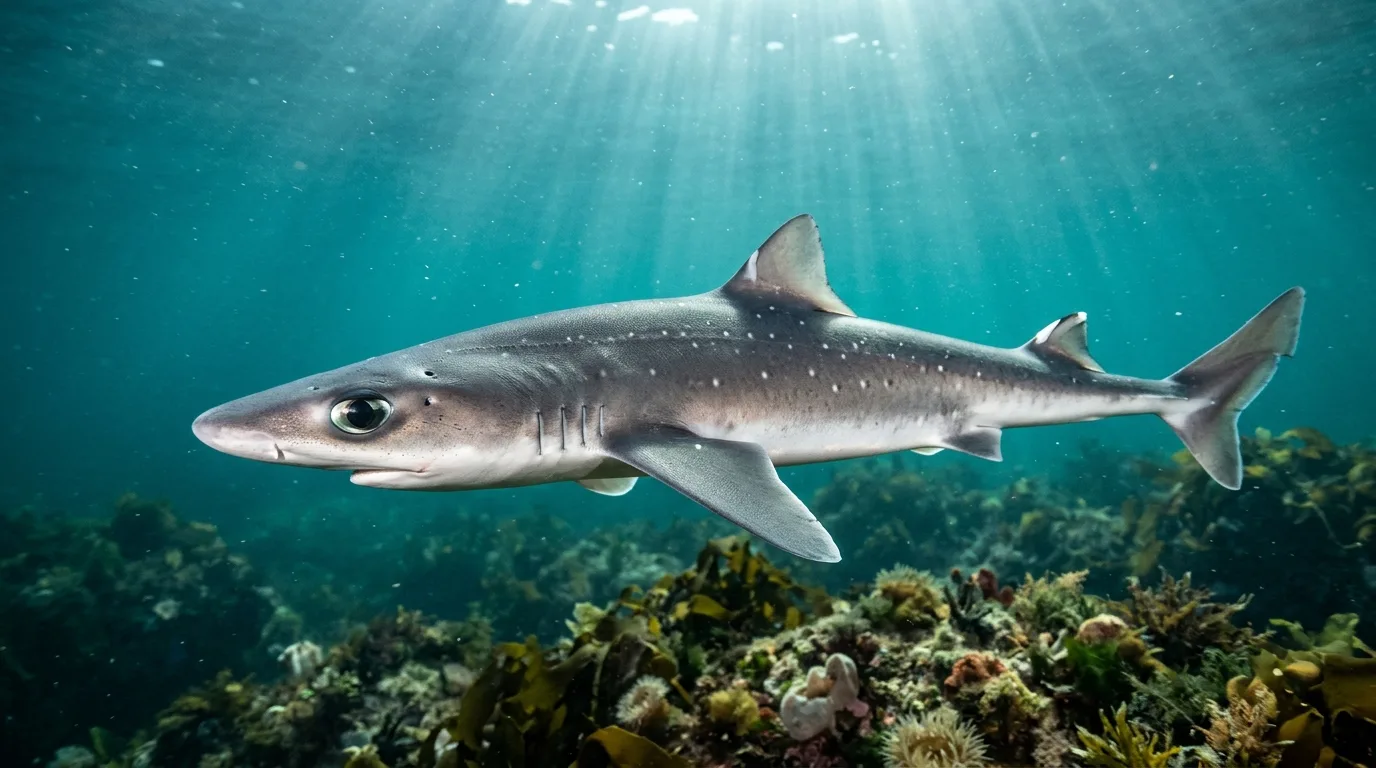
According to the Red List of 2025 the spiny dogfish is endangered in Germany and is not a target species. Norway protects it from recreational anglers all year round (as of October 2026). Because it is threatened, it is recommended not to take it but to release it gently.
Quick to recognise
A very slender, grey to blue-grey shark with a short, pointed snout and often white spots on the sides. A strong spine sits in front of each dorsal fin; around one metre in length is usual.
Why it is not a target fish
The Red List of marine fish of 2025 lists it as endangered, and HELCOM classes it as critically endangered for the Baltic Sea. It grows slowly, matures late and has only a few young after a gestation of 18 to 24 months, so it copes poorly with overfishing. The Red List also names anglers as one of the ways in which the species is caught. In Norway it is on the list of species that sea anglers may not fish for at any time of year.
Where it lives
On the coast
It lives on the continental shelf and its upper slopes, mostly close to the bottom, but it also hunts in open water. It occurs in the North Sea and only occasionally in the German Baltic Sea.
| All year round | deep water, edge, open water |
|---|
Holding spots in the picture
Choose a season and time of day: the picture shows where the species sits then. Tap a fish or a spot in the list to bring it closer. The picture is schematic and AI-generated, every water is different.
On the coast
Drop-off
Spiny dogfish is found here all year round.
Deep, colder water
Spiny dogfish is found here all year round.
Open water, mid-water
Spiny dogfish is found here all year round.
The spiny dogfish lives on the shelf and its upper slopes, mostly near the bottom. When hunting it also rises into open water and up to the surface. In the German Baltic Sea it appears only very rarely.
Winter: This is when the young are born. In winter pregnant females seek out sheltered, shallow bays to give birth there.
Depth: Usually 50 to 300 metres; FishBase gives records down to almost 2000 metres. It mostly stays close to the bottom.
Size comparison: AI-generated drawing, schematic.
Do not confuse
Other small sharks live in the North Sea too. The tope (Hundshai) has no spines in front of the dorsal fins and no pale spots, and the small-spotted catshark (Kleingefleckter Katzenhai) carries many dark dots. On the spiny dogfish two dorsal spines and a missing anal fin come together.
If it bites anyway
First watch out for the spines: on board or on land it curls quickly and can sting with them. Remove the hook in the water or at the ship’s side if you can, do not grip it in front of the dorsal fins and keep the time out of the water short. Released spiny dogfish are considered hardy and have a good chance of survival.
Rules
For the spiny dogfish our overview of the states gives no figures for minimum size (Mindestmaß) or closed season (Schonzeit). That does not mean you may catch or keep it: protection is governed by state fisheries law and nature conservation law.
On the coast the rules of the coastal states apply, partly with their own catch restrictions: North Sea coast, Baltic coast of Schleswig-Holstein and Baltic coast of Mecklenburg-Western Pomerania.
The regulation and your fishing permit (Erlaubnisschein) are what count. Lake Constance, the Rhine and the coast, for example, have their own rules: Fishing waters in Germany.
Text AI-assisted, summarised from these pages: Spiny dogfish (profile), Releasing a fish.