
Knowledge – Fish
Spurdog: Features, threat status, handling bycatch
The spurdog (Squalus acanthias) is a slender shark growing to around 1,6 metres, with a strong spine in front of each of its two dorsal fins. It was once the most common shark in the North Atlantic, and in Germany it is now classed as endangered. Nobody targets it here, but if you catch one by accident you should be able to identify it with confidence and handle it properly.
In short: Endangered in Germany (Red List 2025), protected all year round in Norway for sea anglers, not a target species. The spines in front of the dorsal fins can cause painful wounds. What to do with an accidental catch: Spurdog as bycatch.
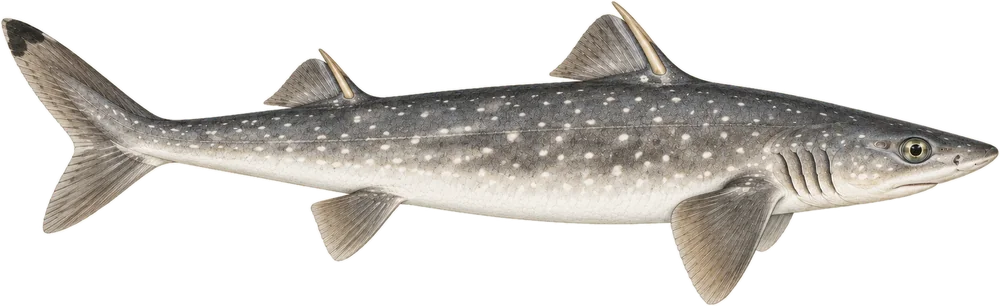
- A strong spine directly in front of the first and the second dorsal fin, the first dorsal fin is larger
- Grey to blue-grey back with irregularly scattered white spots on the sides, pale belly
- No anal fin between the pelvic fins and the tail, dark patch at the tip of the upper tail lobe
Catch chances through the year
- Hardly any chance
- Possible
- Good
- Peak season
- Spawning (observe the closed season)
Editorial assessment for waters in Germany, not a measured value and no guarantee. Spawning time is not the same as the legal closed season.
Species profile and sources in the catch calendarAll species compared month by monthThe rules of your federal state
How to recognise it
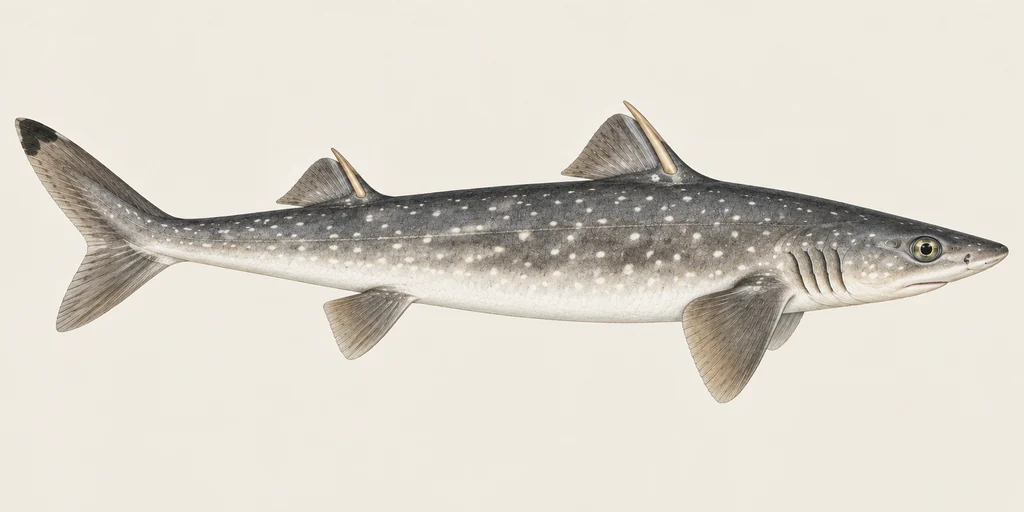
The spurdog has an elongated, very slender body and a short, pointed snout. The back and flanks are grey to blue-grey, often with irregularly scattered white spots along the sides. The belly is pale to white. A dark patch at the tip of the upper tail lobe stands out.
Its surest feature is in the name: a strong spine sits in front of each of the two dorsal fins. The first dorsal fin is larger than the second. There is no anal fin.
The Thünen-Institut gives maximum values of 160 centimetres, 9,1 kilograms and 75 years. FishBase puts the usual length at about one metre. According to FishBase, most fish in the North Atlantic live only 20 to 24 years. Males are 60 to 70 centimetres long when they mature, females 75 to 90 centimetres, and the females grow larger overall.
Side by side: spurdog, smooth-hound or small-spotted catshark?
| Feature | Spurdog | Smooth-hound | Small-spotted catshark |
|---|---|---|---|
| Spines in front of the dorsal fins | one in front of each | none | none |
| Anal fin | absent | present, about as large as the second dorsal fin | present |
| Markings | grey to blue-grey, white spots on the sides | grey above, white below, no spots | many distinct dark spots |
| Size according to FishBase | up to 200 cm, the Thünen-Institut gives 160 cm | up to 195 cm | up to 100 cm, usually around 60 cm |
Other small sharks also occur in the North Sea. The smooth-hound has no spines in front of the dorsal fins and is grey above and white below, without pale spots. The small-spotted catshark has a pattern of many distinct dark spots instead of white ones. The spines in front of both dorsal fins, together with the missing anal fin, set the spurdog apart from both.
Where it lives
The spurdog lives in temperate and cool seas worldwide. In the eastern Atlantic its range runs from Iceland and Russia to Morocco, including the North Sea and the western Baltic Sea. In the German Baltic it turns up only occasionally and at long intervals.
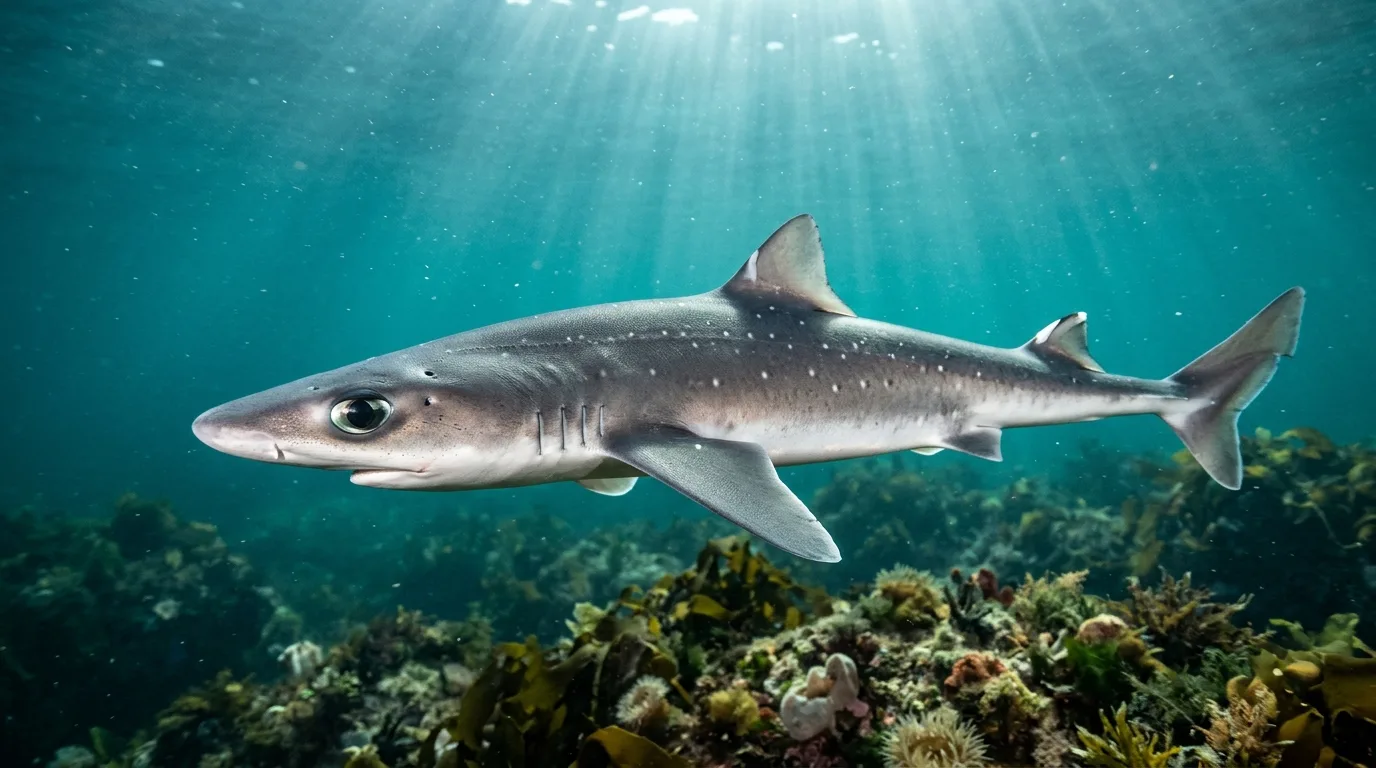
It inhabits the continental shelf and the upper slopes. FishBase gives depths down to almost 2000 metres, with 50 to 300 metres typical. It mostly stays close to the bottom but also hunts in open water and near the surface. It tolerates brackish water, but leaves bays and river mouths when they become too fresh or too warm.
Its migrations follow the water temperature, with 7 to 15 degrees preferred. Tagged fish from the northern North Sea moved to the Norwegian coast in winter and to Scotland in summer. In Norwegian waters the species has been appearing more often in recent years.
Holding spots in the picture
Choose a season and time of day: the picture shows where the species sits then. Tap a fish or a spot in the list to bring it closer. The picture is schematic and AI-generated, every water is different.
On the coast
Drop-off
Spiny dogfish is found here all year round.
Deep, colder water
Spiny dogfish is found here all year round.
Open water, mid-water
Spiny dogfish is found here all year round.
The spiny dogfish lives on the shelf and its upper slopes, mostly near the bottom. When hunting it also rises into open water and up to the surface. In the German Baltic Sea it appears only very rarely.
Winter: This is when the young are born. In winter pregnant females seek out sheltered, shallow bays to give birth there.
Depth: Usually 50 to 300 metres; FishBase gives records down to almost 2000 metres. It mostly stays close to the bottom.
Size comparison: AI-generated drawing, schematic.
How it lives and has its young
Spurdogs travel in shoals that once numbered thousands of fish. These groups are often separated by size and sex. Shoals of large pregnant females in particular were easy for commercial fishing to catch. The spurdog eats what it finds: mainly herring, sardines, mackerel, cod and flatfish, plus squid, bristle worms, crustaceans, sea cucumbers and jellyfish. It can sense the weak electric fields of its prey.
Reproduction is extremely slow. The young first develop in eggs, hatch inside the mother and are born alive. Gestation lasts 18 to 24 months. A litter has 1 to 20 pups, usually 4 to 8, measuring 20 to 33 centimetres at birth. In the north-east Atlantic they are born in winter, and the females gather in sheltered shallow bays for this.
Depending on the region, females mature only at 10 to 35 years, males at 6 to 14 years. Slow growth, late maturity and few offspring make the species very vulnerable to overfishing.
Is there a season?
There is no angling season for the spurdog here. The species is endangered in Germany and not a target fish.
As bycatch it can take the hook when sea fishing in the North Sea or in Norway. In Norway it is protected all year round, and every spurdog goes straight back into the water there. The Red List explicitly names anglers as one of the ways the species is caught.
You will find the monthly overview of all species and the water temperature check in the catch calendar.
What to do with a bycatch
As bycatch: Fishing for spurdog? – why the species is not a target fish and what to do with an accidental catch.
Nobody fishes for spurdog on purpose.
If one does end up on your hook, watch the spines first. In the water the spurdog is harmless to people. On a boat or on land, however, it can quickly curl round and stab with its spines. According to the Thünen-Institut, a venom can enter through the wound; it is usually only mildly irritating but in exceptional cases causes severe allergic reactions. This advice is no substitute for medical care.
Remove the hook in the water if you can, or right at the side of the boat, and do not grip the shark by the spines. Spurdogs are considered hardy, and released fish have a good chance of survival.
Hands off the spines: Do not hold the body bare-handed in front of the dorsal fins. Long-nosed pliers and a wet cloth help keep the fish calm.
Keep it brief: The less time the fish spends on board, the better. Take photos only if the shark stays in or just above the water.
Suitable lures
We deliberately show no baits for this species.
Endangered in Germany: do not target it, free an accidental catch carefully because of the spines and release it gently.
Protection and rules
The 2025 Red List of German marine fish lists the spurdog as endangered; before that it was considered critically endangered. For the whole Baltic Sea the Helsinki Commission (HELCOM) has classed it as critically endangered since 2013. The International Union for Conservation of Nature (IUCN) rates it as vulnerable worldwide and, according to the Thünen-Institut, as endangered in Europe.
From 2011 to 2022 the spurdog could not be targeted in EU and UK waters. Because the stock in the north-east Atlantic has recovered, targeted fishing has been possible again since 2023. According to the Thünen-Institut, the agreement between the EU and the United Kingdom provides for catch limits and a maximum landing length intended to protect mature females. In Norway the spurdog is protected all year round for sea anglers and may not be fished for (as of October 2026). The current list is kept by the Fiskeridirektoratet.
For anglers in Germany the following applies: the fisheries regulation of your coastal state (Bundesland) and your fishing permit (Erlaubnisschein) are what count; you will find a list of links to the official sources in the catch calendar. Because the species is threatened, we recommend not keeping a hooked spurdog and releasing it gently.
What closed season, minimum size and harvest slot mean and where to find them is explained on the page Closed season and minimum size explained.
Frequently asked questions (FAQ)
Is the spurdog venomous?
There is a spine in front of both dorsal fins. A sting can introduce a venom into the wound that is usually only mildly irritating but rarely causes strong allergic reactions. This is no substitute for medical care.
May I fish for spurdog in the North Sea?
In Germany it is endangered and not a target fish. You release an accidental catch gently, and the rules of your coastal state are binding. In Norway it is protected all year round for sea anglers.
What is a Schillerlocke?
This is the German name for the smoked belly flaps of the spurdog. The marinated back meat is sold as Seeaal.
Sources
The rating of catch chances is an editorial assessment. The facts come from these sources, and the text is worded in our own words. The illustration is an original design by Angel Momente in the style of a natural history plate (AI-generated, see the AI notice).
- Thünen-Institut, Fischbestände online: Dornhai (Biologie, Merkmale, Gift, Verbreitung, IUCN)
- Thünen-Institut, Fischbestände online: Nordostatlantischer Dornhai (Bestand, Management, EU- und norwegische Regeln)
- Rote-Liste-Zentrum: Dornhai (Rote Liste der Meeresfische Deutschlands 2025: stark gefährdet)
- FishBase: Squalus acanthias (Größe, Alter, Tiefe, Wanderungen, Fortpflanzung)
- Store norske leksikon (Universität Oslo): pigghå (Rote Liste Norwegen)
- FishBase: Galeorhinus galeus (Hundshai, zur Unterscheidung)
- FishBase: Scyliorhinus canicula (Kleingefleckter Katzenhai, zur Unterscheidung)
- Fiskeridirektoratet: Meeresangeln in Norwegen, Regeln (ganzjährig geschützte Arten)
Created with AI support from the sources listed. Figures only appear in the text if a source gives them. Last updated: 27 October 2026. Found a mistake? Write to us. Who is behind this site: About me.
More in the lexicon
- All fish species at a glance
- Catch calendar – month, water temperature and profile for 93 species
- Line calculator – breaking strain after the knot, drag guideline, backing
- Angling methods