
Knowledge – Fish
Brook trout fishing
Fishing for brook trout means searching cold, clear streams, reading the current and offering flies that imitate its prey. Here is the way there in nine steps, each with a link to the detailed page.
 Choose another fish117 fish with guides
 EelOff-peak season
 EelpoutPossible
 IdePossible
 ArapaimaGood
 GraylingPeak season
 Atlantic salmonSpawning time, please spare
 Brown troutSpawning time, please spare
- Brook troutSpawning time, please spare
 BarbelOff-peak season
 BarramundiSpawning season
 Greater amberjackGood
 Topmouth gudgeonOnly as bycatch
 Blue marlinSpawning season
 BonefishSpawning season
 BonitoGood
 BreamOff-peak season
 Dusky grouperOnly as bycatch
 CobiaPossible
 Spiny dogfishOnly as bycatch
 CodPeak season
 ChubPeak season
 MinnowOnly as bycatch
 European sturgeonOnly as bycatch
 FlounderPeak season
 PerchPeak season
 Largemouth bassGood
 Ballan wrasseOnly as bycatch
 Yellowfin tunaSpawning season
 Giant trevallyGood
 Prussian carpPossible
 BrillPossible
 Gilthead breamSpawning time, please spare
 Golden doradoSpawning season
 Golden mahseerOnly as bycatch
 Dolphinfish (mahi-mahi)Good
 Grass carpPossible
 Great barracudaGood
 GudgeonPossible
 White breamPossible
 DaceOff-peak season
 PikePeak season
 HalibutOff-peak season
 HerringPossible
 GarfishOut of season
 Huchen (Danube salmon)Possible
 Crucian carpOnly as bycatch
 CarpOff-peak season
 RuffeOff-peak season
 VendaceOnly as bycatch
 DabPeak season
 GurnardPossible
 Coley (saithe)Peak season
 Chinook salmonHardly any chance
 King mackerelSpawning season
 LingPeak season
 TuskOff-peak season
 MackerelPossible
 Bighead carpOut of season
 WhitefishPossible
 Conger eelOff-peak season
 Sea troutSpawning time, please spare
 Grey mulletPossible
 Murray codSpawning season
 MuskellungeGood
 Common nasePossible
 Nile perchPossible
 PayaraPossible
 Peacock bassPeak season
 PermitGood
 WeeverOnly as bycatch
 PollackOff-peak season
 BurbotOff-peak season
 AspPossible
 Red snapperSpawning season
 Rainbow troutPeak season
 RoosterfishGood
 RoachPeak season
 RedfishOut of season
 Bluefin tunaOnly as bycatch
 RuddPossible
 Russian sturgeonOnly as bycatch
 HaddockOff-peak season
 SnakeheadPossible
 TenchOff-peak season
 SpirlinOnly as bycatch
 PlaiceOff-peak season
 Greenland halibutOnly as bycatch
 Round gobyOnly as bycatch
 SwordfishGood
 Lake troutSpawning time, please spare
 HakeSpawning time, please spare
 Alpine charSpawning time, please spare
 MonkfishPossible
 SoleOff-peak season
 SailfishGood
 Silver carpOut of season
 SnookPeak season
 PumpkinseedOnly as bycatch
 SpratOnly as bycatch
 Atlantic wolffishSpawning time, please spare
 TurbotPeak season
 SterletOnly as bycatch
 SmeltOnly as bycatch
 Horse mackerelPossible
 TaimenGood
 TarponGood
 TigerfishSpawning season
 BleakPossible
 WahooGood
 Wels catfishOff-peak season
 WhitingPeak season
 Sea bassOff-peak season
 ZanderPeak season
 White-eye breamOnly as bycatch
 Blue breamOnly as bycatch
 Brown bullheadPossible
 VimbaOnly as bycatch
Season in October according to the catch calendar, an estimate and not a guarantee of a catch. The fish pictures are reduced natural-history plates and AI-generated.
Best time
From April to June, in the morning, during the day and in the evening.
In January: Slim chancesIn February: Slim chancesIn March: PossibleIn April: Peak seasonIn May: Peak seasonIn June: Peak seasonIn July: GoodIn August: GoodIn September: GoodIn October: Possible, spawningIn November: Slim chances, spawningIn December: Slim chances, spawning
Good spot
- River: pools, riffles and undercut bankspools, riffles and undercut bankspools, riffles and undercut bankspools, riffles and undercut banks
- Lake: sunken tree, shelf edge and surfacesunken tree and shelf edgesunken tree, shelf edge and surfacesunken tree and shelf edge
Starter tackle
- Rod: 2,40–2,70 m, rated 5–6; shorter on overgrown streams
- Line: fly line rated 5–6, mostly floating, with a sinking tip for deep spots
- Hooks: streamers size 6–12, nymphs and dry flies small, matched to the insect
- Rod: light spinning rod
- Line: thin line or leader with a breaking strain of about 2–3 kg (4–6 lb)
- Hooks: single hooks, barbless if possible
In short
In short: The best time to catch brook trout is from April to June, in the morning, during the day and in the evening. Good spots in the river: pools, riffles and undercut banks; in the lake: sunken trees and shelf edges. Proven baits: nymphs and small dry flies; where allowed, the smallest spoons and spinners.
Quick to recognise
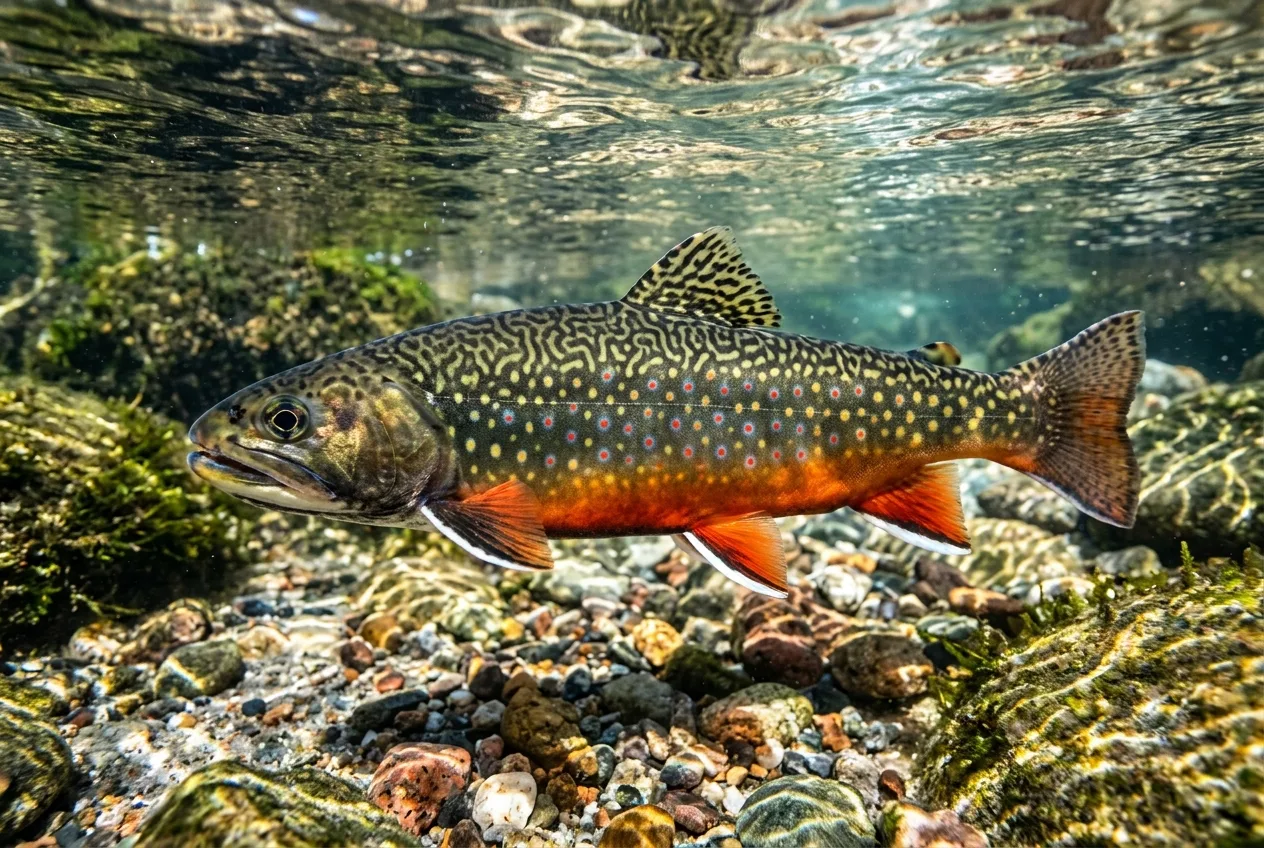
A salmonid from eastern North America that you recognise by its marbled back and the white-and-black edging of its fins. It usually measures 20 to 40 centimetres, and in Europe rarely grows larger than 50.
When
It goes best from April to June and stays good until September. From October to December it spawns over gravel bars. Whether a closed season (Schonzeit) applies then is regulated by your federal state (Bundesland). Unlike other trout, it feeds more heavily by day.
- JanHardly any chance
- FebHardly any chance
- MarPossible
- AprPeak season
- MayPeak season
- JunPeak season
- JulGood
- AugGood
- SepGood
- OctPossible, spawning
- NovHardly any chance, spawning
- DecHardly any chance, spawning
Peak seasonGoodPossibleHardly any chanceSpawning season
Spring tactics
As soon as the water warms up, the brook trout feeds noticeably more, and spring is considered the best time. Small dry flies, streamers, small metal lures and, where allowed, worms then catch fish close to the bank too.
Summer tactics
It needs cold water and avoids warmth. In lakes it then moves down into the depths, while in a stream you will find it more at cold inflows and on shaded stretches. If the stream is warm, it is better to leave the fish in peace.
Autumn tactics
In early autumn the chances rise once more before the spawning season begins in October. Whether it is protected then is regulated by your federal state (Bundesland). You leave spawning fish and gravel bars in peace.
Winter tactics
Spawning continues into December, after which they hardly bite any more. Do not wade across gravel at this time; the eggs are developing there.
Is it biting today?
In January: Out of seasonIn February: Out of seasonIn March: PossibleIn April: Peak seasonIn May: Peak seasonIn June: Peak seasonIn July: Shoulder seasonIn August: Shoulder seasonIn September: Shoulder seasonIn October: Spawning, please spare the fishIn November: Spawning, please spare the fishIn December: Spawning, please spare the fish
Today’s catch index needs JavaScript. Season and spawning time are in the catch calendar.
From the blog: Freshwater fish in Germany: which species you catch where
Where it is now
In the river
The brook trout mostly stays in a short stretch of pool and riffle. It rests in the pool and moves into the riffle and fast water to feed. It seeks cover under scoured banks, branches and deadwood.
How to go about it: Brook trout live in cold, clear streams and upper reaches fed by spring water. They hold at cover such as rocks, deadwood and undercut banks, the larger ones in deep pools. Because they spook easily, you go upstream and keep your shadow off the water.
| All year round | pools, riffle, undercut bank |
|---|
In the lake
In lakes and ponds it likes to hide in the dark under peaty edges and sunken trunks and snaps at food from there. Edges near an inflow are rewarding, because food drifts in there. When it gets warm, you find the fish at the cold inflow.
How to go about it: In forest lakes and ponds brook trout grow considerably bigger than in the stream. Sometimes they hold close to cover such as overhanging peaty edges and wood, sometimes they roam freely through the water. In summer heat you look for them at cold inflows or in cool water just above the oxygen-poor depths, and in spring and autumn closer to the surface.
| All year round | sunken tree, shelf edge |
|---|---|
| Spring extra | Surface |
| Autumn extra | Surface |
Biting time: in the morning, during the day and in the evening. What that looks like on the water is shown by the picture of the swims just below.
Holding spots in the picture
Choose the season and time of day: the picture shows where the species stands then. Spots outlined in red apply only in the chosen season. Tap a fish or a spot in the list to bring it closer. The picture is schematic and AI-generated, every water is different.
Catch chance in springPeak season
Catch chance in summergood
Catch chance in autumnpossiblespawning, observe closed seasons
Catch chance in winterhardly any
- J
- F
- M
- A
- M
- J
- J
- A
- S
- O
- N
- D
Spawning season
Active time According to the Vermont fisheries authority, the brook trout feeds more heavily by day than brown and rainbow trout. The environmental authority of New York State, by contrast, names low light as the best time to fish: early in the morning, late in the day and under overcast skies.
Active time According to the Vermont fisheries authority, the brook trout feeds more heavily by day than brown and rainbow trout. The environmental authority of New York State, by contrast, names low light as the best time to fish: early in the morning, late in the day and under overcast skies.
Active time According to the Vermont fisheries authority, the brook trout feeds more heavily by day than brown and rainbow trout. The environmental authority of New York State, by contrast, names low light as the best time to fish: early in the morning, late in the day and under overcast skies.
Not a main time According to the Vermont fisheries authority, the brook trout feeds more heavily by day than brown and rainbow trout. The environmental authority of New York State, by contrast, names low light as the best time to fish: early in the morning, late in the day and under overcast skies.
In the river
Undercut bank, overhanging branches, timber
Brook trout are present here all year.
Gravelly shallow (riffle)
Brook trout are present here all year.
Pools, deep spot
Brook trout are present here all year.
The brook trout stays loyal to its spot in cold, clear streams and often spends its life in a single stretch of pool and riffle. It rests in pools and feeds in riffles and in fast current. It finds cover under undercut banks, branches and deadwood, but needs fewer hiding places than the brown trout.
Spring: catch chances according to the catch calendar possible in March, peak season in April and May.
Summer: catch chances according to the catch calendar peak season in June, good in July and August. In summer it often takes terrestrial insects such as grasshoppers too.
Autumn: catch chances according to the catch calendar good in September, possible in October, slim in November. Spawning falls in this period, so observe closed seasons (Schonzeit). Spawning takes place from October to December on gravel bars with a strong flow over them, often in upper reaches near springs. In this period the species is protected in many places.
Winter: catch chances according to the catch calendar slim. The spawning season runs into December. After that the fish, loyal to its spot, stays in its stretch of pool and riffle. Whether fishing is permitted in winter is regulated by the fishing permit (Erlaubnisschein).
In the lake
Shelf edge
Brook trout are present here all year.
Sunken tree
Brook trout are present here all year.
Just below the surface
Brook trout are present here only in spring and autumn.
In lakes and ponds the brook trout seeks shade under sunken wood and along overhanging peaty edges, from where it lies in wait for food. Edges where an inflow enters and washes in food are especially productive. According to the Vermont authority, it mostly stays in shallow, spring-fed areas.
Spring: catch chances according to the catch calendar possible in March, peak season in April and May. In spring it often holds near the surface, especially when insects hatch.
Summer: catch chances according to the catch calendar peak season in June, good in July and August. As the water warms, the fish gather at cold inflows and spring outlets. Accounts differ on depth: the New York authority describes a retreat into cool, deeper water just above the oxygen-poor bottom layer, the Vermont authority rather shallow spots cooled by groundwater.
Autumn: catch chances according to the catch calendar good in September, possible in October, slim in November. Spawning falls in this period, so observe closed seasons (Schonzeit). In autumn it comes back up. At the same time the spawning season begins, during which it is protected in many places.
Winter: catch chance according to the catch calendar hardly any.
Depth: In lakes and ponds, according to the same authority, it stays rather in shallow, spring-fed areas. In heat it seeks cold spring outlets instead of retreating into the depths.
Size comparison: AI-generated drawing, schematic.
How
In its home waters it is popular above all with fly anglers, and the patterns derive from its food. With a light spinning rod you guide small spinners and spoons slowly past its spots.
Easiest way
To start with, a light spinning rod with a small spinner or spoon is enough. Walk slowly upstream along a cool, shaded stream and cast the lure into the deeper pools, next to big rocks and under scoured banks.
Nymph and dry fly on the stream
The classic way for brook trout, imitating its main food of larvae and terrestrial insects.
- Cover and current
Look for spots behind big rocks, at sunken wood and under scoured banks. Riffles with a stony bottom and pools are also worthwhile, because the current carries food to it there.
- Approach from downstream
Work your way upstream, moving slowly and steadily. That way you approach the fish from behind and they notice you later.
- After the hatch
If there are insects on the water and fish are rising, use a suitable dry fly. Otherwise fish a weighted nymph that drifts close to the bottom.
- Let it drift free
Let the fly drift past rocks, roots and overhanging bushes without the line dragging it. It pays to place a dry fly close to structure in the water.
- Lift briefly
If the dry fly disappears or the nymph line stops, lift the rod with a short pull.
- Away from cover
Pull the fish quickly out of roots and rocks. With the mostly small stream fish the fight is short.
- Unhook wet
Land it with a small landing net or directly in the water, and remove the hook without lifting the fish out if it is to go back.
Small spinner in the pool
For larger brook trout that hold in deep pools and move into the shallows only to feed.
- Deep pools
The larger fish stay in deep holes and under cover. They visit shallow stretches only briefly to feed, and the small ones usually hold there.
- Keep it small
Use small spinners, spoons or slim crankbaits. The brook trout eats whatever comes in front of its mouth, but small lures match its prey in the stream.
- Cast upstream
Cast diagonally upstream beyond the pool so that the lure is carried down into the depths by the current and runs past the cover.
- Slowly along the bottom
Guide the lure calmly and deep through the pool and close past the cover, instead of pulling it high above the fish.
- Striking
A tug on the line is signal enough; strike briefly at once. A single hook without a barb is easier to remove afterwards.
- Keep it short
Leave the fish in the water for unhooking, or lift it out only for as short a time as necessary. Handle it only with wet hands.
What with
Nymphs stand for insect larvae, dry flies for terrestrial insects and small streamers for small fish. In summer it also takes terrestrial insects such as grasshoppers. Which baits are allowed is regulated by the fishing permit (Erlaubnisschein).
- Nymphall season, when no fish are rising
Aquatic insects are its main food, and a weighted nymph drifts to where it picks up the larvae.
- Dry flyspring and summer during an insect hatch
When insects hatch, it takes them at the surface, and a small dry fly then catches at any time of day.
- Streamerspring and autumn, at cover and in deep pools
Larger brook trout also eat small fish, and a streamer worked with twitches imitates this prey.
Tackle
A fly rod for the fly, or a light spinning rod of around two metres with thin line and a swivel in front of the lure. The pages on fly rods and spinning rods show what matters for rating, length and casting weight.
Nymph and dry fly on the stream
Small spinner in the pool
- Rod
- light spinning rod
- Reel
- small fixed-spool reel
- Line
- thin line or hooklength with a breaking strain of about 2–3 kg (4–6 lb)
- Leader
- Monofilament or fluorocarbon with a breaking strain of 2–3 kg
- Hooks
- Single hook, preferably barbless
- Weight, float, lead
- small spinners, spoons and mini crankbaits
More on tackle
Common mistakes
- Walking downstream past the fish: Anyone walking downstream is spotted early. Move upstream, slowly and without sudden movements.
- Shadow on the water: A shadow over the pool is enough to make the fish vanish. Stay low and stand so that the sun is not behind you.
- Fishing only the shallows: That is where the small fish usually sit. You will find the bigger ones in deep pools and under cover, so work your lure all the way there.
- Lure too big: In a small stream the fish and their prey are small. Small spinners, spoons and flies work better than big crankbaits.
- Fishing in warm water: Above about 20 °C you will hardly find any brook trout, and every fight puts them under extra strain. Take a thermometer along and move to cooler upper reaches, or stop fishing.
Rules
Each federal state (Bundesland) sets its own closed season (Schonzeit) and minimum size (Mindestmaß). Choose your state; the values come from our state pages.
Baden-Württemberg
Our overview for Baden-Württemberg does not list the brook trout. What applies there is on the page Fishing in Baden-Württemberg, with the places in that state.
Bavaria
- Minimum size
- –
- Closed season
- none
- Note
- no protection rules
As of October 2026. All rules, exceptions and sources: Fishing in Bavaria.
Berlin
Our overview for Berlin does not list the brook trout. What applies there is on the page Fishing in Berlin, with the places in that state.
Brandenburg
Our overview for Brandenburg does not list the brook trout. What applies there is on the page Fishing in Brandenburg, with the places in that state.
Bremen
Our overview for Bremen does not list the brook trout. What applies there is on the page Fishing in Bremen, with the places in that state.
Hamburg
Our overview for Hamburg does not list the brook trout. What applies there is on the page Fishing in Hamburg, with the places in that state.
Hesse
Our overview for Hesse does not list the brook trout. What applies there is on the page Fishing in Hesse, with the places in that state.
Mecklenburg-Western Pomerania
Our overview for Mecklenburg-Western Pomerania does not list the brook trout. What applies there is on the page Fishing in Mecklenburg-Western Pomerania, with the places in that state.
Lower Saxony
Our overview for Lower Saxony does not list the brook trout. What applies there is on the page Fishing in Lower Saxony, with the places in that state.
North Rhine-Westphalia
Our overview for North Rhine-Westphalia does not list the brook trout. What applies there is on the page Fishing in North Rhine-Westphalia, with the places in that state.
Rhineland-Palatinate
Our overview for Rhineland-Palatinate does not list the brook trout. What applies there is on the page Fishing in Rhineland-Palatinate, with the places in that state.
Saarland
Our overview for Saarland does not list the brook trout. What applies there is on the page Fishing in Saarland, with the places in that state.
Saxony
Our overview for Saxony does not list the brook trout. What applies there is on the page Fishing in Saxony, with the places in that state.
Saxony-Anhalt
Our overview for Saxony-Anhalt does not list the brook trout. What applies there is on the page Fishing in Saxony-Anhalt, with the places in that state.
Schleswig-Holstein
Our overview for Schleswig-Holstein does not list the brook trout. What applies there is on the page Fishing in Schleswig-Holstein, with the places in that state.
Thuringia
Our overview for Thuringia does not list the brook trout. What applies there is on the page Fishing in Thuringia, with the places in that state.
The regulation and your fishing permit (Erlaubnisschein) are what count. Lake Constance, the Rhine and the coast, for example, have their own rules: Fishing waters in Germany.
After the catch
Playing and landing
Strike briefly and pull the fish straight out of cover; the fight itself is usually short. Land it with a small landing net, handle it only with wet hands and remove the hook in the water if you can. A fish of legal size that you are allowed to keep is stunned and killed straight away; all others you return gently, supporting them until they swim off.
Before you keep a fish, check the back, dorsal fin and fin edges so that you can tell it apart from a brown trout with certainty. Any fish that is going back you unhook with wet hands or a disgorger directly in the water. A fish of legal size that you are keeping is stunned and killed straight away.
Frequently asked questions
Which baits for brook trout?
Small spinners, spoons and mini crankbaits, plus nymphs, dry flies and streamers. Where natural bait is allowed, worms and insects such as grasshoppers also catch fish.
What water temperature does the brook trout like?
It prefers about 10 to 18 °C. Above roughly 20 °C you will hardly find it; it then moves to springs, cold tributaries or deeper layers.
When is the best time for brook trout?
Spring, when the water warms up and the fish feed more. It stays good until early autumn; they spawn from October.
Which fly rod for brook trout?
A rod of 2,40 to 2,70 m for line class 5 to 6 covers both stream and lake. On narrow, overgrown streams a shorter rod is easier to cast.
Where do brook trout hold in a stream?
Behind big stones, by dead wood, under undercut banks, and the bigger ones in deep pools. They come into riffles and shallower water to feed.
Similar species
If you catch brook trout, you can fish for these species with similar tackle:
 Fishing for rainbow troutPeak season
 Brown trout fishingSpawning season, please spare
 Fishing for Alpine charSpawning season, please spare them
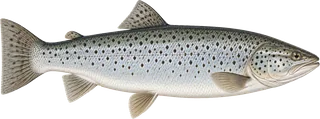 Sea trout fishingSpawning season, please spare
Sources
Correct as of October 2026. The practical knowledge comes from 7 sources, summarised in our own words.
View all 7 sources
- Guide to Brook Trout Fishing in Adirondack Ponds · New York State Department of Environmental Conservation (Behörde)
- Brook Trout – Species Information · Maine Department of Inland Fisheries and Wildlife (Behörde)
- Brook Trout · Vermont Fish & Wildlife Department (Behörde)
- Great Lakes 4-H Fact Sheet: Brook Trout · Michigan State University Cooperative Extension (Universität)
- Fishing Tips for Trout · North Carolina Wildlife Resources Commission (Behörde)
- Fishing for Brook Trout (non-native) · California Department of Fish and Wildlife (Behörde)
- Nachhaltig fischen – Tipps für Angler:innen · Umweltbundesamt Österreich (mit österreichischen Landesfischereiverbänden)
Text AI-assisted, based on the sources named and these pages: Brook trout (profile), Fly fishing, Spinning, Dry fly, Wet fly.