
Knowledge – Fish
Grass carp fishing
Fishing for grass carp means: on warm, windless summer days, first spot the fish, then feed particles further out and present the bait on the bottom. Here is the route there in nine steps, each with a link to the detailed page.
 Choose another fish117 fish with guides
 EelOff-peak season
 EelpoutPossible
 IdePossible
 ArapaimaGood
 GraylingPeak season
 Atlantic salmonSpawning time, please spare
 Brown troutSpawning time, please spare
 Brook troutSpawning time, please spare
 BarbelOff-peak season
 BarramundiSpawning season
 Greater amberjackGood
 Topmouth gudgeonOnly as bycatch
 Blue marlinSpawning season
 BonefishSpawning season
 BonitoGood
 BreamOff-peak season
 Dusky grouperOnly as bycatch
 CobiaPossible
 Spiny dogfishOnly as bycatch
 CodPeak season
 ChubPeak season
 MinnowOnly as bycatch
 European sturgeonOnly as bycatch
 FlounderPeak season
 PerchPeak season
 Largemouth bassGood
 Ballan wrasseOnly as bycatch
 Yellowfin tunaSpawning season
 Giant trevallyGood
 Prussian carpPossible
 BrillPossible
 Gilthead breamSpawning time, please spare
 Golden doradoSpawning season
 Golden mahseerOnly as bycatch
 Dolphinfish (mahi-mahi)Good
- Grass carpPossible
 Great barracudaGood
 GudgeonPossible
 White breamPossible
 DaceOff-peak season
 PikePeak season
 HalibutOff-peak season
 HerringPossible
 GarfishOut of season
 Huchen (Danube salmon)Possible
 Crucian carpOnly as bycatch
 CarpOff-peak season
 RuffeOff-peak season
 VendaceOnly as bycatch
 DabPeak season
 GurnardPossible
 Coley (saithe)Peak season
 Chinook salmonHardly any chance
 King mackerelSpawning season
 LingPeak season
 TuskOff-peak season
 MackerelPossible
 Bighead carpOut of season
 WhitefishPossible
 Conger eelOff-peak season
 Sea troutSpawning time, please spare
 Grey mulletPossible
 Murray codSpawning season
 MuskellungeGood
 Common nasePossible
 Nile perchPossible
 PayaraPossible
 Peacock bassPeak season
 PermitGood
 WeeverOnly as bycatch
 PollackOff-peak season
 BurbotOff-peak season
 AspPossible
 Red snapperSpawning season
 Rainbow troutPeak season
 RoosterfishGood
 RoachPeak season
 RedfishOut of season
 Bluefin tunaOnly as bycatch
 RuddPossible
 Russian sturgeonOnly as bycatch
 HaddockOff-peak season
 SnakeheadPossible
 TenchOff-peak season
 SpirlinOnly as bycatch
 PlaiceOff-peak season
 Greenland halibutOnly as bycatch
 Round gobyOnly as bycatch
 SwordfishGood
 Lake troutSpawning time, please spare
 HakeSpawning time, please spare
 Alpine charSpawning time, please spare
 MonkfishPossible
 SoleOff-peak season
 SailfishGood
 Silver carpOut of season
 SnookPeak season
 PumpkinseedOnly as bycatch
 SpratOnly as bycatch
 Atlantic wolffishSpawning time, please spare
 TurbotPeak season
 SterletOnly as bycatch
 SmeltOnly as bycatch
 Horse mackerelPossible
 TaimenGood
 TarponGood
 TigerfishSpawning season
 BleakPossible
 WahooGood
 Wels catfishOff-peak season
 WhitingPeak season
 Sea bassOff-peak season
 ZanderPeak season
 White-eye breamOnly as bycatch
 Blue breamOnly as bycatch
 Brown bullheadPossible
 VimbaOnly as bycatch
Season in October according to the catch calendar, an estimate and not a guarantee of a catch. The fish pictures are reduced natural-history plates and AI-generated.
Best time
In August, especially in the morning and evening.
In January: Slim chancesIn February: Slim chancesIn March: Slim chancesIn April: PossibleIn May: Good, spawningIn June: Good, spawningIn July: Good, spawningIn August: Peak seasonIn September: GoodIn October: PossibleIn November: Slim chancesIn December: Slim chances
Good spot
- Lake: weed bed, open water and reed edgeweed bed, open water and surfaceweed bed and open waterweed bed and open water
- River: groyne pockets and calm baygroyne pockets and calm baygroyne pockets, calm bay and deep poolsgroyne pockets and calm bay
Top baits
Starter tackle
- Rod: carp rod of about 3,60 m with a test curve of about 2,5 lb; in a current 3,60–3,90 m with 3–3,5 lb
- Line: monofilament 0,30–0,35 mm, at least 150 m on the spool; in rivers with a shock leader of about 0,50 mm
- Hook: sharp and fine-wired, size 4–6 on lakes; in rivers strong hooks of size 1–2
- Rod: medium carp rod
- Line: monofilament of about 0,30 mm, greased so that it floats
- Hook: size 6, pushed through the crust
In short
In short: The best time to catch grass carp is August, especially in the morning and evening. Good spots on a lake: weed bed and open water; on a river: groyne pockets and calm bay. Proven baits: hard-boiled maize and tiger nuts on the hair on the bottom, and boilies too on waters where a lot of boilie fishing is done.
Quick to recognise
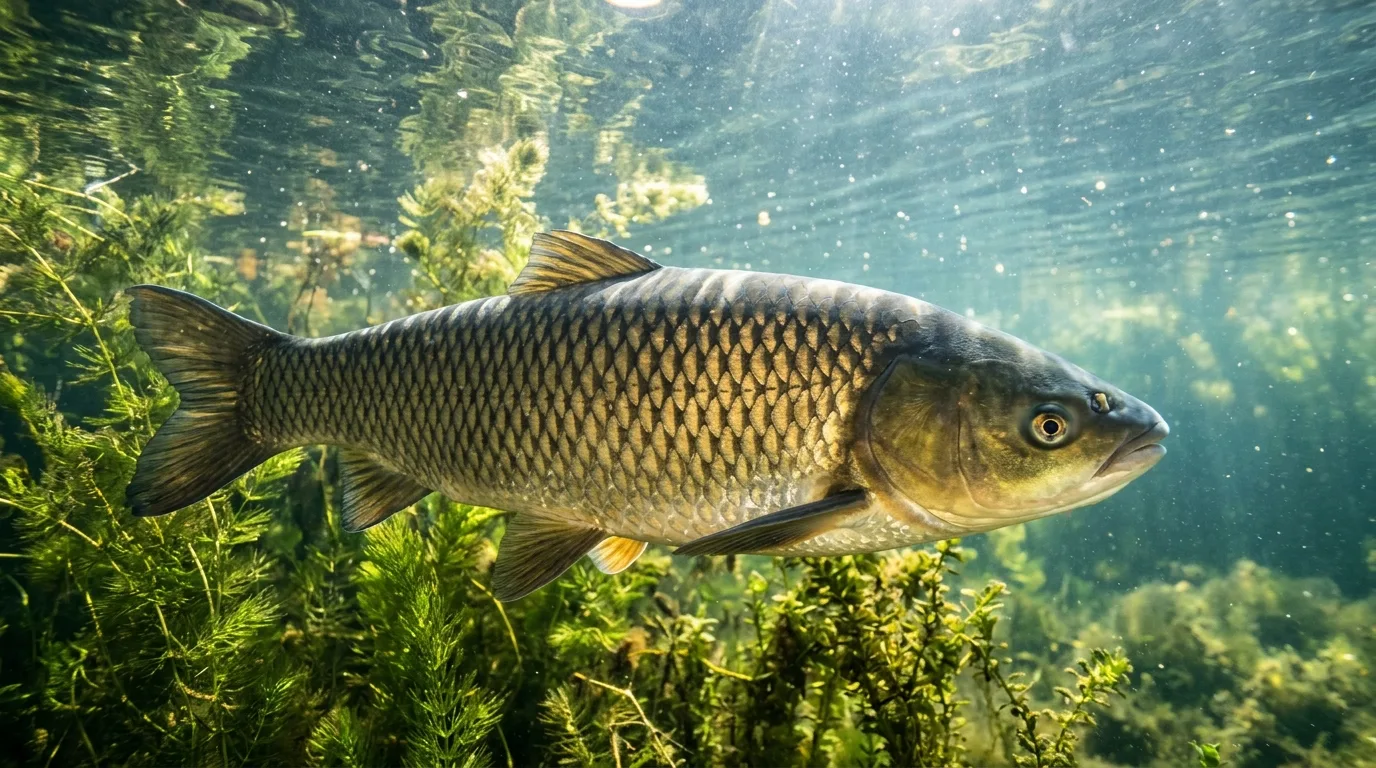
A carp relative from East Asia, also called white amur or grass fish, that gives itself away on the surface on windless days with its small, triangular dorsal fin. It grows up to 150 centimetres long; the angling press quotes 130. It has been in Germany since 1965, and all populations go back to stocking; the Bundesamt für Naturschutz lists it on its management list of invasive species as unstable, and it is not on the EU’s Union list.
When
August is best; May to July and September are good. The angling press recommends targeted sessions at water temperatures clearly above 20 degrees and on a windless lake; below about 13 degrees it only eats the bare minimum. In its homeland it spawns from May to July; in Germany natural reproduction is practically ruled out.
- JanHardly any chance
- FebHardly any chance
- MarHardly any chance
- AprPossible
- MayGood, spawning
- JunGood, spawning
- JulGood, spawning
- AugPeak season
- SepGood
- OctPossible
- NovHardly any chance
- DecHardly any chance
Peak seasonGoodPossibleHardly any chanceSpawning season
Spring tactics
From April or May the appetite returns. On lakes, May and June are a good time, because the other carp are spawning then; at around 18 to 22 degrees, look for shallower, weedy areas. On rivers, shallow stretches and inside bends are worth fishing now.
Summer tactics
Hunger grows with every degree, and on rivers you catch well even in great heat. In still water, oxygen can run short in a long heatwave, and then grass carp feed less; a change in the weather or a thunderstorm downpour gets them moving again.
Autumn tactics
During the day the fish look for shade, and on rivers they tend to hold in deeper pools. Cut the amount of feed back clearly as the temperature falls.
Winter tactics
In cold water the grass carp eats very little, and targeted sessions hardly pay off. An exception is waters with warm-water discharge, where it bites in the cold season too.
Is it biting today?
In January: Off seasonIn February: Off seasonIn March: Off seasonIn April: PossibleIn May: Spawning, please spare the fishIn June: Spawning, please spare the fishIn July: Spawning, please spare the fishIn August: Peak seasonIn September: Minor seasonIn October: PossibleIn November: Off seasonIn December: Off season
Today’s catch index needs JavaScript. Season and spawning time are in the catch calendar.
Where it is now
In the lake
Grass carp seldom travel along the bank, more often at a distance through the middle of the lake, and in waters with plant growth. In high summer they often stand high, then the dorsal fins show, and polarised glasses help with the search. So you set up your baited spot further out.
How to go about it: Early in the day small groups like to stand in the shallows that catch the sun first, later in bays where the wind pushes warm surface water. Fish only for fish that are moving; sunbathing grass carp are rarely looking for food.
| All year round | Weed bed, open water |
|---|---|
| Spring extra | reed edge |
| Summer extra | Surface |
In the river
On rivers, look for groyne fields and oxbows where they save energy, and also for weedy backwaters of large rivers.
How to go about it: Good spots are groyne fields with a depth of 3 to 4 m at the head and plants in the shallower part, the slack water behind islands and connected backwaters. In the main stream the current washes the feed away quickly, so there you need very heavy leads and plenty of feed, because white fish join in.
| All year round | Groyne pockets, calm bay |
|---|---|
| Autumn extra | Pools |
At the pond
How to go about it: In clear ponds and pools full of weed, grass carp find so much food that targeted fishing becomes difficult. A generous, pre-baited spot and a floating bait that does not vanish in the weed improve your chances.
Biting time: mainly in the morning and in the evening. What that looks like at the water is shown by the picture of the holding spots just below.
Holding spots in the picture
Choose the season and time of day: the picture shows where the species stands then. Spots outlined in red apply only in the chosen season. Tap a fish or a spot in the list to bring it closer. The picture is schematic and AI-generated, every water is different.
Catch chances in springpossible
Chance of a catch in summergoodSpawning, observe the closed seasons
Catch chance in autumnpossible
Catch chance in winterhardly any
- J
- F
- M
- A
- M
- J
- J
- A
- S
- O
- N
- D
Spawning season
Active time The grass carp feeds mainly at dawn and dusk.
No peak time The grass carp feeds mainly at dawn and dusk.
Active time The grass carp feeds mainly at dawn and dusk.
No peak time The grass carp feeds mainly at dawn and dusk.
In the lake
reed edge
Grass carp are present here in spring only.
Water lilies and weed bed
Grass carp are present here all year round.
Open water
Grass carp are present here all year round.
Just below the surface
Grass carp are present here in summer only.
Grass carp prefer large, still or slow-flowing waters with plant growth, because they feed mainly on higher water plants. Specialist articles differ on how close to the bank they come: according to one they rarely feed near the bank and tend to keep their distance from it, while according to others they look for shallow, sunny spots, bays and, in spring, weedy margins.
Spring: according to the fishing calendar, catch chances are slim in March, possible in April and good in May. In May and June, when the carp spawn, grass carp move into shallower, densely weedy margins and eat the fresh reed shoots. Zones one to two metres deep are also worth fishing then.
Summer: according to the fishing calendar, catch chances are good in June and July and peak in August. The spawning season falls in this period, so observe the closed seasons (Schonzeit). In high summer, at water temperatures well above 20 °C, grass carp often stay at the surface. Then the small, triangular dorsal fins show above the water.
Autumn: according to the fishing calendar, catch chances are good in September, possible in October and slim in November. When the water temperature falls below about 13 °C, grass carp eat only the bare minimum.
Winter: catch chance according to the catch calendar hardly any.
In the river
Pools, deep spot
Grass carp are present here in autumn only.
Groyne scour hole
Grass carp are present here all year round.
Calm bay with aquatic plants
Grass carp are present here all year round.
In rivers, grass carp prefer places that save energy, in groyne fields and oxbows. FishBase also names the weedy backwaters of large rivers as habitat.
Spring: according to the fishing calendar, catch chances are slim in March, possible in April and good in May. In spring, grass carp on rivers often stand in shallow areas and inside bends, and the baits then lie very close to the bank.
Summer: catch chances according to the catch calendar are good in June and July, with August the peak season. The spawning season falls in this period, so observe the closed seasons.
Autumn: according to the fishing calendar, catch chances are good in September, possible in October and slim in November. In autumn they tend to retreat to deeper pools.
Winter: catch chance according to the catch calendar hardly any.
Depth: FishBase gives a depth range of 0 to 30 metres.
Size comparison: AI-generated drawing, schematic.
How
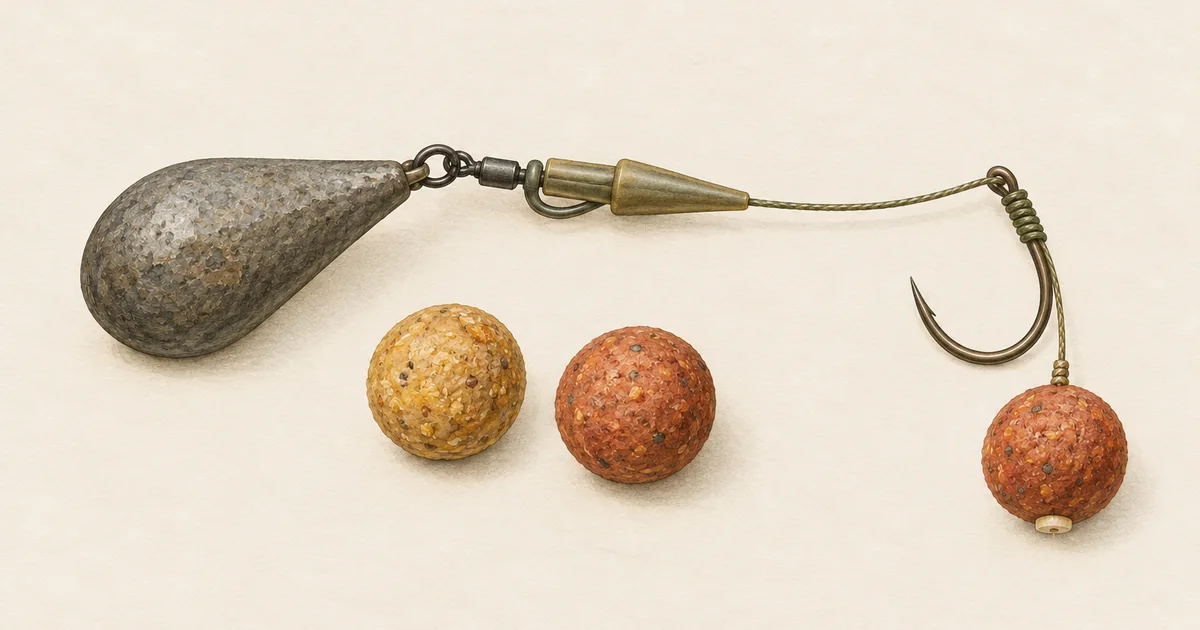
The usual method is bottom fishing from a stationary position as for carp, with a fixed lead and a short hair rig: the figures given are 20 to 25 centimetres of braid as hooklength, a hair of about one centimetre and 110 to 140 grams of lead, so that the hook takes hold in the hard mouth. The fish suck the bait in very slowly, so the bite alarm often gives only a few beeps. Check the hook point after every bite, because a missed strike usually scares off the whole shoal.
Easiest way
To start, a carp rod of about 3,60 m with 0,30 to 0,35 mm monofilament, a fixed lead of just over 100 g and a short hair rig with two grains of sweetcorn and a floating artificial grain are enough. On a warm summer day, feed boiled hard maize where you see the grass carp moving. Then sit calmly and watch for small twitches on the bite indicator.
Fixed lead and hair over particles
Targeted bottom fishing from May to September, on lakes as well as large rivers.
- Watch first
Look for weedy areas and use polarised glasses to see where the grass carp are moving. In May and June they are often shallower zones with young reed, in high summer shady spots under overhanging trees.
- Let the maize mature
Boil the hard maize and leave it covered in the cooking water for one to four days, until it smells slightly sour. Pre-bait two to three times, over an area of a few square metres, because grass carp travel in groups.
- Heavy fixed lead
A fixed lead of 120 to 160 g helps the sharp hook take hold in the hard mouth. The braided hooklength is about 25 cm long, and a lead on a short side arm gives the fish some play at the bite.
- Just above the feed
Thread a few grains of sweetcorn onto the hair and add a floating artificial grain or some buoyant foam. That way the bait hovers just above the carpet of feed and is often the first to be taken.
- Watch for drop-back bites
Grass carp pick up their food and spit it out at once when they feel resistance, so the tip often twitches only briefly. Hang light bite indicators on the slightly sagging line and strike as soon as one drops back.
- Plan for power
The grass carp often comes in quietly at first and then bolts with full force. On a river you keep it away from the edge and out towards the channel, otherwise the line breaks.
- Tend the spot at once
Net the fish with a large, soft net and lay it on a wet mat. Then cast straight back to the same spot, because a second grass carp is often feeding there.
Bread on the surface
The sight-fishing method on hot, windless days, when grass carp patrol just below the surface.
- Look for patrols
Look with binoculars and polarised glasses for grass carp cruising to and fro below the surface. Fish that simply stand motionless in the sun rarely take anything.
- Feed bread first
Throw a few cubes of bread or crusts onto their path and wait until they are slurped up. Only then is the rig worth using.
- Free line
At short range you tie the hook straight onto the greased, floating main line. Further out, a clear bubble float provides the necessary casting weight.
- Never cast directly at them
A splashing bait scares the fish. Cast well behind them or onto their swimming path and draw the bait in slowly.
- Wait a moment
When a grass carp takes the bread, it pulls it down with a small swirl. Then do not strike at once but with a short hesitation.
- Finish the fight quickly
With strong line and a medium carp rod you take the fish by surprise before it uses up its strength.
What with
Hard-boiled maize and tiger nuts are the usual baits. On the hair, two or three tiger nuts are enough, of sweetcorn you take five at most, and hard-boiled maize and tiger nuts in a ratio of seven to three are suitable as feed. Where a lot of boilie fishing is done, grass carp also bite on those.
- Sweetcorn & particlesMay to September, as feed and on the hair
Boiled hard maize that has been left to turn slightly sour attracts grass carp strongly and can be presented with a floating grain just above the feed.
- Boilieson large lakes and in rivers, usually as a 20 mm ball
Sweet or fruity boilies and those with an algae content are often taken by grass carp without a long period of getting used to them.
- Breadhot, windless days, when the fish cruise near the surface
Crusts from rolls or white bread float for a long time, survive a hard cast and are taken as food without any need to get used to them.
Tackle
You fish with the bottom rod. Set the drag so that it gives line on strong runs, especially when the fish sees the net near the bank, and have a well-padded unhooking mat ready, because it also thrashes hard on land.
Fixed lead and hair over particles
- Rod
- Carp rod of about 3,60 m with a test curve of about 2,5 lb; in a current 3,60–3,90 m with 3–3,5 lb
- Reel
- robust fixed-spool reel with a smooth drag, with a fast line retrieve on rivers
- Line
- Monofilament 0,30–0,35 mm, at least 150 m on the spool; in rivers with a shock leader of about 0,50 mm
- Leader
- Braid about 20–25 cm, around 25 lb breaking strain, coated over mussels and stones
- Hooks
- sharp and fine-wired, size 4–6 on lakes; in rivers strong hooks of size 1–2
- Weight, float, lead
- Fixed lead 120–160 g, clearly more in a flowing river
Bread on the surface
- Rod
- medium carp rod
- Line
- Monofilament of about 0,30 mm, greased so that it floats
- Leader
- Fluorocarbon; with a bubble float, a monofilament slightly thinner than the main line
- Hooks
- Size 6, pushed through the crust
- Weight, float, lead
- without weight on a free line, further out a light, clear bubble float
Common mistakes
- Cast straight at fish you can see: The splash scares the nervous grass carp. Cast at a distance behind the fish or onto their swimming path and draw the bait in carefully.
- Hooklength lying on the water: Heavily fished grass carp recognise a hooklength lying on the surface, even a fluorocarbon one. Set the rig up so that only the bait touches the water.
- Too much resistance at the bite: When a grass carp feels the lead or a taut line, it spits the bait out at once. Hang very light bite indicators on the slightly sagging line and give the lead a short side arm.
- Feeding by the kilo in the heat: In a long spell of heat a lake often runs short of oxygen and the fish eat little. Feed sparingly and wait for a change in the weather.
- Rods laid down too loosely in a current: Grass carp on rivers often bite hard, and every ship tugs at the line. Set the drag or free spool tighter than on a lake and secure the rod rest.
Rules
Our country overview has no figures for a minimum size (Mindestmaß) or closed season (Schonzeit) for the grass carp. That does not mean there are no rules: individual countries and water regulations protect the species or set their own limits.
What applies in your country is on the country pages under Fishing waters in Germany.
The regulation and your fishing permit (Erlaubnisschein) are what count. Lake Constance, the Rhine and the coast, for example, have their own rules: Fishing waters in Germany.
After the catch
Playing and landing
Strike as soon as the bite indicator twitches or drops back, because grass carp quickly let go of the bait when they feel resistance. Finish the fight quickly with strong tackle and keep the drag set finely so that a late run gets line. Land the fish with a large, soft net, lay it on a wet mat and lift it horizontally with wet hands.
Whether you may return a grass carp and whether stocking is permitted is regulated differently by state law and water regulations; if in doubt, ask the club or the fisheries authority (Fischereibehörde), and never stock fish on your own initiative. A fish of legal size that you may take is stunned and killed at once. The firm, white flesh can be boiled and fried and is also suitable for smoking.
Frequently asked questions
Which bait is best for grass carp?
On the bottom, matured hard maize on the hair catches reliably, along with sweet or fruity boilies. On the surface a bread crust is the first choice, and anyone who wants to avoid bycatch tries a lettuce leaf.
When do grass carp bite best?
In warm water from May to September, and over the day mainly early in the morning and in the evening, and in mild nights after dark too. Night fishing is banned in some countries and on some waters, so check your fishing permit (Erlaubnisschein).
Which rig for grass carp?
A fixed-lead rig with a short braided hooklength and a sharp, fine-wired hook. A heavy lead of 120 to 160 g drives the hook into the hard mouth.
How do you catch grass carp on the surface?
On hot days look for cruising fish, feed a few pieces of bread and offer a crust on a free line or with a bubble float. Never cast directly at the fish, and strike with a slight delay.
Which line for grass carp?
Monofilament of 0,30 to 0,35 mm, no thinner than 0,25 mm and at least 150 m on the spool. In rivers with mussels and stones, a shock leader of about 0,50 mm goes in front of it.
Similar species
If you catch grass carp, you can fish for these species with similar tackle:
 Fishing for breamShoulder season
 Fishing for tenchShoulder season
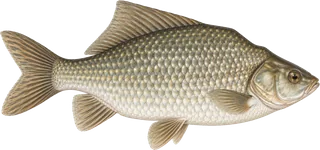 Prussian carp fishingPossible
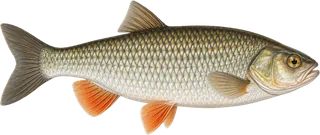 Chub fishingPeak season
Sources
Status: October 2026. The practical knowledge comes from 6 sources, summarised in our own words.
View all 6 sources
- Graskarpfen angeln: Fang die vegetarischen Giganten · BLINKER (Thomas Talaga)
- Graskarpfen: So angelt man sich einen Vegetarier · FISCH & FANG (Benjamin Gründer)
- Steckbrief Grasfische: Angeln auf Graskarpfen und Co. · BLINKER (Joshua Zettelmeier)
- Graskarpfen: Maximale Belastung für die Nerven – aber mit diesen Tricks lohnt es sich · BLINKER (Thomas Pruß, mit Marcus Türk)
- Graskarpfen: Oh L´Amur · FISCH & FANG (Detlef Leither)
- Fische landen: Wie nutze ich Kescher, Lip-Grip und Co.? · BLINKER (Redaktion)
Text AI-assisted, based on the sources listed and these pages: Grass carp (profile), Bottom fishing, Sweetcorn & particles, Bottom rod.