
Knowledge – Fish
Fishing for rainbow trout
Fishing for rainbow trout means looking for them in the current or at the inflow, laying the bait in their path and reckoning with their leaps in the fight. Here is the way there in nine steps, each with a link to the detailed page.
 Choose another fish117 fish with guides
 EelOff-peak season
 EelpoutPossible
 IdePossible
 ArapaimaGood
 GraylingPeak season
 Atlantic salmonSpawning time, please spare
 Brown troutSpawning time, please spare
 Brook troutSpawning time, please spare
 BarbelOff-peak season
 BarramundiSpawning season
 Greater amberjackGood
 Topmouth gudgeonOnly as bycatch
 Blue marlinSpawning season
 BonefishSpawning season
 BonitoGood
 BreamOff-peak season
 Dusky grouperOnly as bycatch
 CobiaPossible
 Spiny dogfishOnly as bycatch
 CodPeak season
 ChubPeak season
 MinnowOnly as bycatch
 European sturgeonOnly as bycatch
 FlounderPeak season
 PerchPeak season
 Largemouth bassGood
 Ballan wrasseOnly as bycatch
 Yellowfin tunaSpawning season
 Giant trevallyGood
 Prussian carpPossible
 BrillPossible
 Gilthead breamSpawning time, please spare
 Golden doradoSpawning season
 Golden mahseerOnly as bycatch
 Dolphinfish (mahi-mahi)Good
 Grass carpPossible
 Great barracudaGood
 GudgeonPossible
 White breamPossible
 DaceOff-peak season
 PikePeak season
 HalibutOff-peak season
 HerringPossible
 GarfishOut of season
 Huchen (Danube salmon)Possible
 Crucian carpOnly as bycatch
 CarpOff-peak season
 RuffeOff-peak season
 VendaceOnly as bycatch
 DabPeak season
 GurnardPossible
 Coley (saithe)Peak season
 Chinook salmonHardly any chance
 King mackerelSpawning season
 LingPeak season
 TuskOff-peak season
 MackerelPossible
 Bighead carpOut of season
 WhitefishPossible
 Conger eelOff-peak season
 Sea troutSpawning time, please spare
 Grey mulletPossible
 Murray codSpawning season
 MuskellungeGood
 Common nasePossible
 Nile perchPossible
 PayaraPossible
 Peacock bassPeak season
 PermitGood
 WeeverOnly as bycatch
 PollackOff-peak season
 BurbotOff-peak season
 AspPossible
 Red snapperSpawning season
- Rainbow troutPeak season
 RoosterfishGood
 RoachPeak season
 RedfishOut of season
 Bluefin tunaOnly as bycatch
 RuddPossible
 Russian sturgeonOnly as bycatch
 HaddockOff-peak season
 SnakeheadPossible
 TenchOff-peak season
 SpirlinOnly as bycatch
 PlaiceOff-peak season
 Greenland halibutOnly as bycatch
 Round gobyOnly as bycatch
 SwordfishGood
 Lake troutSpawning time, please spare
 HakeSpawning time, please spare
 Alpine charSpawning time, please spare
 MonkfishPossible
 SoleOff-peak season
 SailfishGood
 Silver carpOut of season
 SnookPeak season
 PumpkinseedOnly as bycatch
 SpratOnly as bycatch
 Atlantic wolffishSpawning time, please spare
 TurbotPeak season
 SterletOnly as bycatch
 SmeltOnly as bycatch
 Horse mackerelPossible
 TaimenGood
 TarponGood
 TigerfishSpawning season
 BleakPossible
 WahooGood
 Wels catfishOff-peak season
 WhitingPeak season
 Sea bassOff-peak season
 ZanderPeak season
 White-eye breamOnly as bycatch
 Blue breamOnly as bycatch
 Brown bullheadPossible
 VimbaOnly as bycatch
Season in October according to the catch calendar, an estimate and not a guarantee of a catch. The fish pictures are reduced natural-history plates and AI-generated.
Best time
In June and in October, above all in the morning and in the evening.
In January: Possible, spawningIn February: Possible, spawningIn March: Possible, spawningIn April: Possible, spawningIn May: Possible, spawningIn June: Peak seasonIn July: PossibleIn August: PossibleIn September: GoodIn October: Peak seasonIn November: Possible, spawningIn December: Possible, spawning
Good spot
- River: Main current and poolsMain current and poolsMain current and poolsMain current and pools
- Lake: JettyJettyJetty and open waterJetty and deep bottom
Top baits
Starter tackle
- Rod: sbirolino or match rod 3,30–4,60 m, casting weight up to about 30 g, soft tip
- Line: monofilament around 0,20 mm
- Hook: size 8–12, fine-wire
- Rod: spinning rod of around 2,50 m with a light tip action; on a small stream a short UL rod
- Line: monofilament 0,18–0,22 mm, on a small stream also 0,16 mm
- Hook: single hooks; where barbs are allowed, they hold leaping fish more securely
- Rod: around 2,50 m, class 5–6
- Line: floating fly line WF 5–6
- Hook: streamers around size 10, large streamers size 2–6
In short
In short: The best time to catch rainbow trout is in June and in October, above all in the morning and in the evening. Good spots on the river: main current and pools; on the lake: jetty. Proven baits: spoons, small soft lures, trout paste; on the river nymphs, wet flies and streamers. In Baden-Württemberg the rainbow trout has a closed season (Schonzeit) from 1 October to 28 February, in Bavaria from 15 December to 15 March with a minimum size (Mindestmaß) of 26 centimetres (as of October 2026). Other federal states (Bundesland) regulate it differently; before fishing, check the rule of your own state and of the water.
Quick to recognise
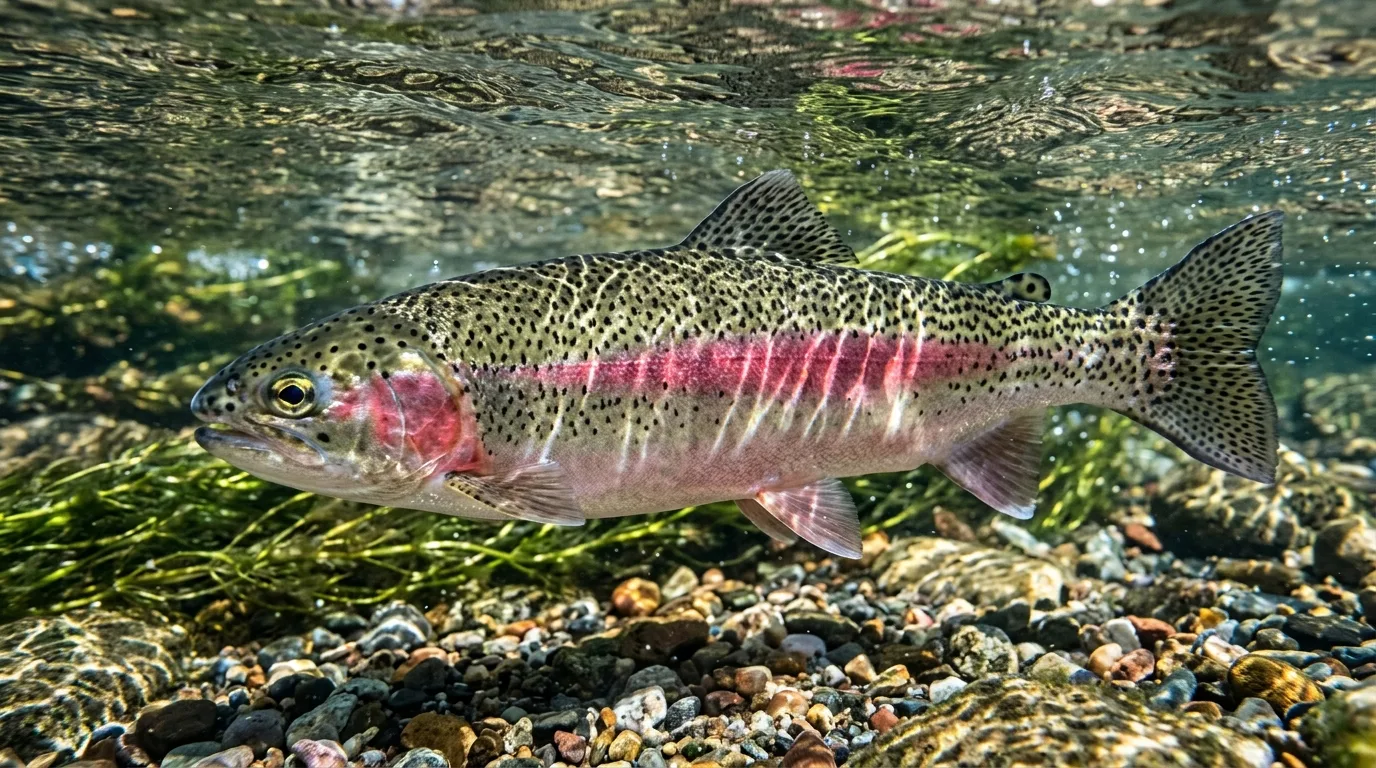
A trout from North America that you recognise by the pink longitudinal band and the spots on the tail fin. Fish of 25 to 60 centimetres are common; according to the LFV Bayern they grow up to 75 centimetres.
When
You can catch it all year round; in the monthly calendar June and October lead, and September is good too. When it spawns depends on the strain; the figures range from October to May. During the day it feeds most in the early morning and in the evening.
- JanPossible, spawning season
- FebPossible, spawning season
- MarPossible, spawning season
- AprPossible, spawning season
- MayPossible, spawning season
- JunPeak season
- JulPossible
- AugPossible
- SepGood
- OctPeak season
- NovPossible, spawning season
- DecPossible, spawning season
Peak seasonGoodPossibleHardly any chanceSpawning season
Spring tactics
Many strains spawn into spring; whether the species is then protected in open waters is regulated by your federal state (Bundesland). At the trout lake the fish often sit close to the shore in spring because the water warms up there first, and they bite all day in mild weather.
Summer tactics
In hot weather the bites come mainly early in the morning and late in the evening; during the day the fish sit in the shade, deeper, or at inflows and springs with more oxygen. On the river the fly now often catches better than the spinner.
Autumn tactics
Until the first frosty nights temperature and oxygen are right; the fish roam the whole water and bite throughout the day. They mostly sit in open water, just below the surface on mild days.
Winter tactics
The colder the water, the deeper and more sluggish the fish sit, often at the deepest spots. Then work the bait extremely slowly just above the bottom, or offer floating paste or waxworms on a bottom-feeler rig 10 to 50 centimetres above the bottom.
Are they biting today?
In January: Spawning, please spare themIn February: Spawning, please spare themIn March: Spawning, please spare themIn April: Spawning, please spare themIn May: Spawning, please spare themIn June: Peak seasonIn July: PossibleIn August: PossibleIn September: Off-peak seasonIn October: Peak seasonIn November: Spawning, please spare themIn December: Spawning, please spare them
Today’s catch index needs JavaScript. Season and spawning time are in the catch calendar.
From the blog: Trout lake in winter: rigging a buoyant bait and setting the right bait height · Freshwater fish in Germany: which species you catch where
Where it sits now
In the river
Unlike the brown trout it does not look for cover but sits freely in the current, often just above the bottom in mid-river. Deep channels, pools and the spray below waterfalls are also rewarding. It has no fixed spot and travels far upstream in search of food.
How to go about it: On the river you cover a lot of stretch with spinner and streamer, because the fish change position. If a spot goes quiet after a bite, move on instead of fishing it for long.
| All year round | Main current, pools |
|---|
In the lake
On a lake look for stream inflows and springs on the bottom, plus dam walls and jetties where small fish gather. The fish roam, mostly into the wind, and rising fish show you where they are at the moment.
How to go about it: In reservoirs and natural lakes the fish like to chase shoals of young fish and gather at inflows where fresh water arrives. From the shore you need baits with casting distance, such as a streamer behind the sbirolino or a small, heavy spoon.
| All year round | Jetty |
|---|---|
| Autumn extra | Open water |
| Winter extra | deep bottom |
At the pond
How to go about it: At a trout pond the fish are stocked and often already well fished. Combine an actively worked rod with a sbirolino and a rod laid down with a floating bait, and if possible come a few days after weekends and public holidays, when the fish are calmer.
Biting time: mainly in the morning and in the evening. What that looks like at the water is shown by the picture of the holding spots just below.
Waters with rules for rainbow trout
Holding spots in the picture
Choose the season and time of day: the picture shows where the species stands then. Spots outlined in red apply only in the chosen season. Tap a fish or a spot in the list to bring it closer. The picture is schematic and AI-generated, every water is different.
Catch chance in springpossibleSpawning season, observe closed seasons
Catch chances in summerpossible
Catch chance in autumngood
Catch chances in winterpossiblespawning season, observe the closed seasons
- J
- F
- M
- A
- M
- J
- J
- A
- S
- O
- N
- D
Spawning season
Active time The rainbow trout feeds most in the early morning and evening hours.
Not a prime time The rainbow trout feeds most in the early morning and evening hours.
Active time The rainbow trout feeds most in the early morning and evening hours.
Not a prime time The rainbow trout feeds most in the early morning and evening hours.
In the river
Pools, deep spot
Rainbow trout are found here all year round.
Free current in mid-river
Rainbow trout are found here all year round.
Unlike the brown trout, the rainbow trout sits in the open current, often just above the bottom in mid-river. Other spots are deep channels, pools and the foaming water below waterfalls. It is not faithful to one spot and travels long stretches upstream.
Spring: catch chances according to the catch calendar: possible. Spawning falls in this period, so observe the closed seasons (Schonzeit). Spring is regarded as a good time to fish.
Summer: catch chances according to the catch calendar peak season in June, possible in July and August. The species tolerates warmer, lower-oxygen water than the brown trout. According to FishBase it is not usually stocked in waters that warm to over 25 °C in summer.
Autumn: catch chances according to the catch calendar good in September, peak season in October, possible in November. Autumn too is regarded as a good time to fish.
Winter: catch chances according to the catch calendar: possible. Spawning falls in this period, so observe the closed seasons (Schonzeit). The spawning time depends on the strain and, according to the Landesfischereiverband Bayern, runs from October to May. Spawning takes place over gravel bottoms in the upper reaches, but in our waters the species rarely reproduces naturally.
In the lake
jetty, sheet piling, harbour
Rainbow trout are found here all year round.
Deep bottom
Rainbow trout are only found here in winter.
Open water
Rainbow trout are only found here in autumn.
In a lake the rainbow trout stays at stream inflows and bottom springs, and also at dam walls and jetties. It roams, mostly into the wind.
Spring: catch chances according to the catch calendar: possible. Spawning falls in this period, so observe the closed seasons (Schonzeit). In spring the fish often sit close to the shore because the shallow water warms up there first. Bites then come throughout the day.
Summer: catch chances according to the catch calendar peak season in June, possible in July and August. In high summer they seek cooler, oxygen-rich water at inflows and springs and in the shade. They are most likely to bite early in the morning and late in the evening.
Autumn: catch chances according to the catch calendar good in September, peak season in October, possible in November. Until the first frosty nights the fish are very active, roam the whole water and mostly sit in open water.
Winter: catch chances according to the catch calendar: possible. Spawning falls in this period, so observe the closed seasons (Schonzeit). In the cold they sit sluggishly at the deepest spots. Then the bait lies quietly just above the bottom.
Depth: In cold lakes and reservoirs it often stays at medium depths.
Size comparison: AI-generated drawing, schematic.
How
With a spinning rod you do not need such accurate casts as for brown trout, and it takes the bait firmly itself. With the fly rod you catch it in rivers and lakes, often better than with metal in summer.
Easiest way
The first catch comes most easily at a trout lake: a sbirolino of 15 to 20 grams, behind it a hooklength of about 2 metres of 0,16 to 0,18 millimetres and a piece of trout paste that spins as you retrieve. Cast far out and wind in slowly and steadily.
Sbirolino at the trout lake
The most widely used method at trout lakes from spring to autumn: you draw a spinning bait through large areas of water and so find the depth of the fish.
- Away from the crowd
Watch for inflows, pond outlets (monks) and overhanging trees. If all rigs land in the middle of the lake, the water closer to the shore is often worth trying, provided it is deep enough there.
- Sbirolino and hooklength
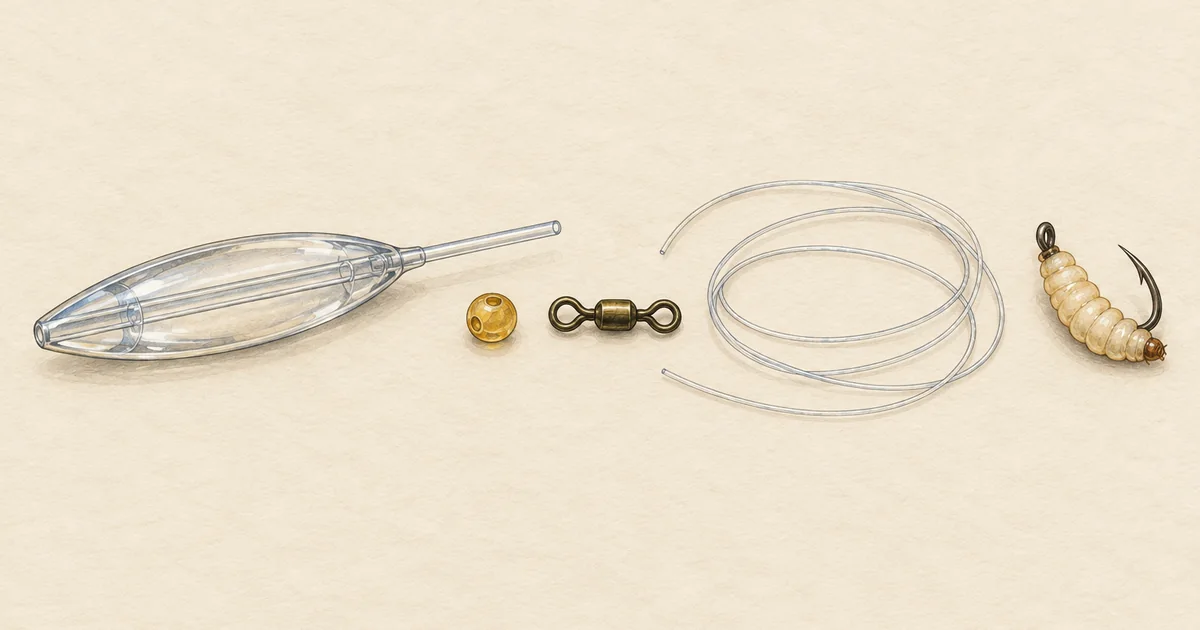
Thread the sbirolino on the main line so it runs freely, followed by a bead and a triple swivel against line twist. On a hooklength of 1,2 to 2 metres, a split shot about 15 to 40 centimetres from the hook sets the running depth.
- Lures that spin
Shape the paste into a small spoon or propeller, or thread two waxworms on in an L shape. Before the first cast, check at the bank that the bait rotates when pulled.
- Far out
Cast far out and let the sbirolino sink according to the model. Floating models stay shallow, fast-sinking ones run about three to six metres deep.
- Troll slowly
Wind in steadily and slowly; pulled faster, the rig runs shallower. If it stays quiet, change the sink rate or the weight spacing and stick with the setting that brings a bite.
- Let it run first
A bite shows as a short tug of the rod tip. Then open the bail and strike gently only once the trout takes line.
- Soft drag
A fine hooklength only withstands hard runs with a softly set drag. If the fish jumps, lower the rod towards the water.
- Big landing net
Take a landing net that can cope with heavy stocked fish, and have it ready before you cast.
Spinners and spoons in the river
For rainbow trout in streams and rivers: you search actively for the roaming fish, even if your casts are only moderately accurate.
- Channels and bends
Fish the channels and the tail of a pool first, then outside bends with waving weed and narrow spots where bushes squeeze the river.
- Swivel in front
Clip a small spinner, spoon or mini crankbait onto a swivel so the fine line does not twist.
- Cast upstream
Cast diagonally upstream and let a spoon sink into the deeper channel. In a larger river the lure can also work across and with the current.
- Feel the rotation
Retrieve the lure very slowly until you feel it turning in the rod tip. On active days a lure that moves briskly triggers the fish more.
- Keep tension at once
The bite comes as a hard tug. Strike briefly and keep the line tight afterwards, because the trout will try to shake the hook.
- Absorb the jumps
The fish often jumps after only a few turns of the handle. Give line through the soft drag and keep the rod low; that way the hook pulls out less often.
- Wading net
Land the trout with a small wading net before it bolts into the next channel.
Streamer and nymph
Often more productive than metal in summer, on rivers, reservoirs and trout lakes; the streamer is the easier way in.
- Follow the rings
Watch which way the rings travel, because rainbow trout feed on the move. In rivers, fast-flowing, clear stretches are worth fishing.
- Simple hooklength
To start with, a 9 ft leader with a 0,18 tip on a floating line is enough. If you fish only sinking flies, a leader of one metre will do.
- Size 10 streamer
Use a lightly weighted size 10 streamer or a gold-head nymph. Change colour and depth if nothing happens.
- Roll cast
A roll cast of about ten metres is usually enough. When you can see the fish, place the nymph roughly two metres above it.
- Twitch with pauses
Let the streamer sink and retrieve it in short pulls, sometimes faster, sometimes slower, with pauses in between. In a river you let it drift across the current.
- Every twitch counts
If the line twitches sideways or you feel a tug, strike at once with a short, firm pull.
- Allow the runs
Expect jumps, long runs and quick changes of direction. Let the fish take line and only draw it in once it calms down.
What with
With the fly, the streamer is the easier way in; you place the dry fly a little ahead of the rings, because the fish do not stay in one spot. With a spinning rod, small spinners and spoons, above all in silver or gold. On a trout lake, floating dough fished on the bottom or under a float catches fish, as do insects such as the grasshopper.
- Bait pasteall year on a trout lake, in winter buoyant bait fished on the bottom
Shaped like a small propeller, it spins when towed, and being buoyant it hovers above mud and weed, where a bait lying on the bottom would disappear.
- Streamersummer and autumn, in lakes as in rivers
It imitates the fry that rainbow trout hunt on purpose, and is more forgiving than the dry fly.
- Nymphin rivers when no fish are rising
A gold-head nymph sinks quickly to the fish on the bottom and, when you can see a fish, can be drifted right in front of it.
Tackle
A spinning rod of about 2,50 metres with fine line and the drag set soft, because the fish often jumps during the fight. For the fly, a rod rated 5 to 6 of similar length is enough. The pages on spinning rods and fly rods help with the choice.
Sbirolino at the trout lake
- Rod
- Sbirolino or match rod 3,30–4,60 m, casting weight up to about 30 g, soft tip
- Reel
- Fixed-spool reel with a smooth drag
- Line
- monofilament around 0,20 mm
- Leader
- 1,2–2,5 m, 0,16–0,18 mm; on difficult days down to 0,12 mm, then play the fish very carefully
- Hooks
- size 8–12, fine-wire
- Weight, float, lead
- Sbirolino 15–30 g; split shot on the hooklength
Spinners and spoons in the river
- Rod
- Spinning rod of about 2,50 m with a light tip action; on a small stream a short UL rod
- Reel
- small fixed-spool reel, drag set soft
- Line
- monofilament 0,18–0,22 mm, 0,16 mm on a small stream too
- Hooks
- single hooks; where barbs are allowed, they hold jumping fish more securely
- Weight, float, lead
- spinners size 0–2, small spoons and mini crankbaits
More on tackle
- Spinning rod: choose length, casting weight and action
- Float rod: match, Bolognese and pole
- Fly rod: choose line class, length and action
- Line calculator
- Fishing line: monofilament, braid or fluorocarbon?
- Spooling a reel properly – without line twist
- Wading net: the small landing net for wading
- Disgorger: unhooking quickly and gently
Common mistakes
- Casting to the middle of the lake like everyone else: If your neighbours‘ rigs land in the middle, the fish are often along the edge. Fish closer to the bank as long as it is deep enough there, and search inflows and trees.
- Casting into the middle of a shoal: A cast straight into a shoal at the surface scatters it. Work your way up to the fish from the edge.
- Dough spiral in the cold: In cold water dough turns tough and firm. Leave the spiral off then and strike harder so the hook point gets through.
- Hours at the same depth: The running depth often matters more than the bait. Slide the split shot a few centimetres every quarter of an hour until you find the layer the fish are holding in.
- Split shot crimped too hard: A shot pinched on hard damages the thin hooklength. Squeeze it on only lightly or use a weight fixed with silicone tubing.
Rules
Each federal state (Bundesland) sets its own closed season (Schonzeit) and minimum size (Mindestmaß). Choose your state; the values come from our state pages.
Baden-Württemberg
- Minimum size
- –
- Closed season
- 1.10.–28.2.
As of October 2026. All rules, exceptions and sources: Fishing in Baden-Württemberg.
Bavaria
- Minimum size
- 26 cm
- Closed season
- 15.12.–15.3.
As of October 2026. All rules, exceptions and sources: Fishing in Bavaria.
Berlin
Our overview for Berlin does not list the rainbow trout. What applies there is explained on the page Fishing in Berlin, which covers the state’s spots.
Brandenburg
Our overview for Brandenburg does not list the rainbow trout. What applies there is explained on the page Fishing in Brandenburg, which covers the state’s spots.
Bremen
Our overview for Bremen does not list the rainbow trout. What applies there is explained on the page Fishing in Bremen, which covers the state’s spots.
Hamburg
Our overview for Hamburg does not list the rainbow trout. What applies there is explained on the page Fishing in Hamburg, which covers the state’s spots.
Hesse
Our overview for Hesse does not list the rainbow trout. What applies there is explained on the page Fishing in Hesse, which covers the state’s spots.
Mecklenburg-Western Pomerania
Our overview for Mecklenburg-Western Pomerania does not list the rainbow trout. What applies there is explained on the page Fishing in Mecklenburg-Western Pomerania, which covers the state’s spots.
Lower Saxony
Our overview for Lower Saxony does not list the rainbow trout. What applies there is explained on the page Fishing in Lower Saxony, which covers the state’s spots.
North Rhine-Westphalia
Our overview for North Rhine-Westphalia does not list the rainbow trout. What applies there is explained on the page Fishing in North Rhine-Westphalia, which covers the state’s spots.
Rhineland-Palatinate
Our overview for Rhineland-Palatinate does not list the rainbow trout. What applies there is explained on the page Fishing in Rhineland-Palatinate, which covers the state’s spots.
Saarland
Our overview for Saarland does not list the rainbow trout. What applies there is explained on the page Fishing in Saarland, which covers the state’s spots.
Saxony
Our overview for Saxony does not list the rainbow trout. What applies there is explained on the page Fishing in Saxony, which covers the state’s spots.
Saxony-Anhalt
Our overview for Saxony-Anhalt does not list the rainbow trout. What applies there is explained on the page Fishing in Saxony-Anhalt, which covers the state’s spots.
Schleswig-Holstein
Our overview for Schleswig-Holstein does not list the rainbow trout. What applies there is explained on the page Fishing in Schleswig-Holstein, which covers the state’s spots.
Thuringia
Our overview for Thuringia does not list the rainbow trout. What applies there is explained on the page Fishing in Thuringia, which covers the state’s spots.
The regulation and your fishing permit (Erlaubnisschein) are what count. Lake Constance, the Rhine and the coast, for example, have their own rules: Fishing waters in Germany.
After the catch
Playing and landing
With natural bait on a sbirolino, you strike only when the trout takes line; with a spinner or streamer, strike at once. In the fight it often jumps and changes direction quickly; a soft drag and a rod held low keep it on the hook. Land it in the net, handle it only with wet hands, and unhook fish in their closed season (Schonzeit) or fish that are too small in the water. A fish of legal size that you may keep is stunned and killed straight away.
Fish that have to go back are unhooked with wet hands in the water. A trout of legal size that you take home is stunned and killed straight away; the firm flesh tastes good fresh or smoked. At a trout pond the operator’s rules apply as well.
Frequently asked questions
What hook size for trout on a trout lake?
Sizes 8 to 12 are usual, rather 12 for a single maggot. A fine-wire hook is easy to hide in dough or waxworms.
How long should the hooklength be with a sbirolino?
Usually 1,2 to 2 metres, and 2 to 2,5 metres with shallow-running sbirolinos. Because of the long hooklengths, the rod should measure at least 3,30 metres.
When do rainbow trout bite best?
Through the day mainly early in the morning and in the evening, also good after a thunderstorm or in light rain. On a trout lake in autumn the bites are spread over the whole day.
What line strength for rainbow trout?
For spinning, a monofilament of 0,18 to 0,22 millimetres, 0,16 on a small stream. On a trout lake a hooklength of 0,16 to 0,18 millimetres, down to 0,12 for very cautious big fish with an extremely gentle fight.
How deep do trout sit in winter?
The colder the water, the deeper, often at the deepest points of the lake. Then present the bait 10 to 50 centimetres above the bottom and hardly move it.
Similar species
If you catch rainbow trout, you can fish for these species with similar tackle too:
 Brook trout fishingSpawning season, please spare
 Brown trout fishingSpawning season, please spare
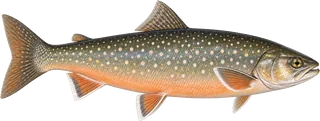 Fishing for Alpine charSpawning season, please spare them
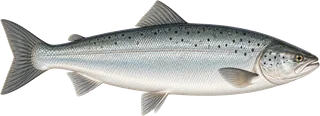 Atlantic salmon fishingSpawning season, please spare
Sources
As at October 2026. The practical knowledge comes from 13 sources, summarised in our own words.
View all 13 sources
- Steckbrief Regenbogenforelle · BLINKER (Redaktion)
- Zielfisch Forelle: So fangen Sie am Forellensee · FISCH & FANG (G. Baumann)
- Forellensee-Einmaleins · FISCH & FANG (Gastbeitrag P. Lönartz)
- Forellenteich: Die besten Montagen · RUTE & ROLLE (T. Keibel)
- Tipp: So geht Sbirolino · RUTE & ROLLE (Redaktion)
- Fit für den Forellensee: Forellen an der Oberfläche · BLINKER (F. Schlichting)
- Faul zur Forelle: Mit Naturködern passiv am Forellensee angeln · BLINKER (Redaktion)
- Spoons auf Abwegen: Gelöffelte Forellen am Bach · BLINKER (Redaktion)
- Spinnfischen mit dem Spinner: Ein Guide für Anfänger · BLINKER (J. Müller)
- Jetzt werde ich Fliegenfischer: Zum ersten Mal auf Regenbogenforelle · BLINKER (C. Leppin)
- Fliegenfischen: Welche Fliegen brauche ich als Einsteiger? · BLINKER (M. Werner)
- LFV Fischlexikon: Regenbogenforelle · Landesfischereiverband Bayern
- Nachhaltig fischen – Tipps für Angler:innen · Umweltbundesamt Österreich (im Auftrag des BMLUK, mit österreichischen Landesfischereiverbänden)
Text AI-assisted, based on the sources named and these pages: Rainbow trout (profile), Spin fishing, Fly fishing, Bait dough, Dry fly.