
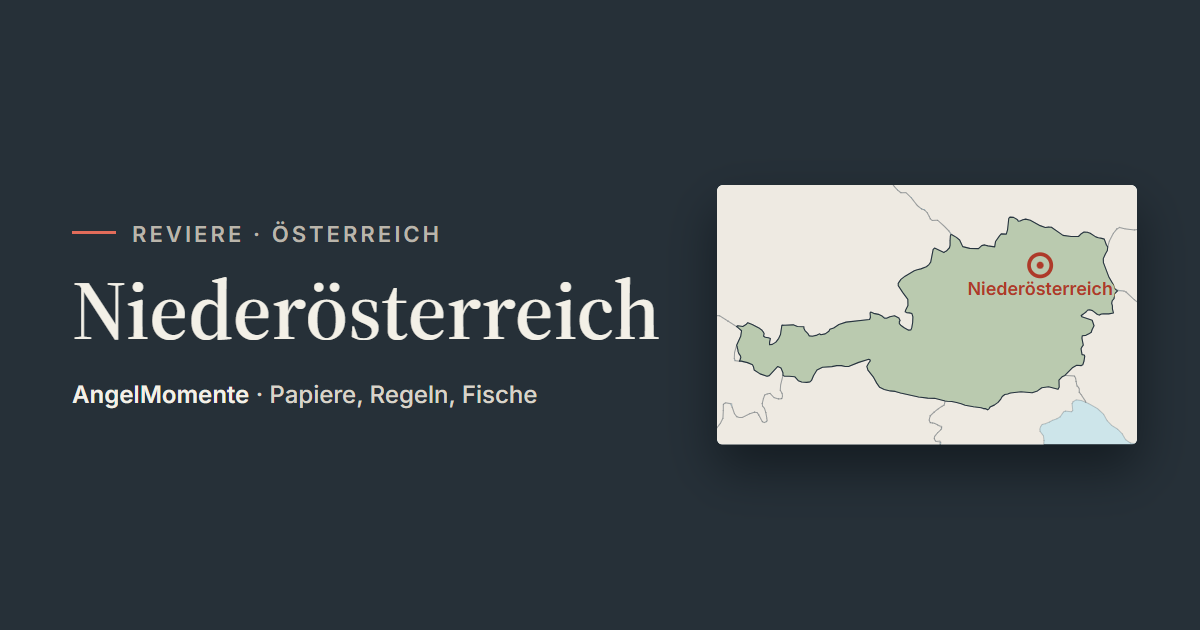
Waters · Austria
Fishing in Lower Austria
For fishing in Lower Austria the waters range from the Ybbs, Erlauf and Schwarza in the uplands, via the Kamp with its three reservoirs, to the Thaya and March on the border in the north and east. There are also lakes and fish ponds, and the Danube has its own profile.
- Papers
- Fishing guest card with photo ID and the lessee’s licence
As of October 2026
At a glance
- Papers
- Fishing guest card with photo ID and the lessee’s licence
| Fish | Minimum size | Closed season | Note |
|---|---|---|---|
| Pike | 50 cm | 1.2.–30.4. | |
| Zander | 35 cm | 1.4.–31.5. | |
| Wels catfish | 60 cm | 1.6.–30.6. | |
| Carp | 35 cm | none | wild carp 1.5.–30.6. |
| Tench | 25 cm | 1.6.–30.6. | |
| Brown trout | 25 cm | 16.9.–15.3. | |
| Rainbow trout | 25 cm | 1.1.–15.3. | |
| Grayling | 30 cm | 1.3.–30.4. | |
| Huchen (Danube salmon) | 75 cm | 1.3.–31.5. | |
| Barbel | 30 cm | 1.5.–15.6. | |
| Common nase | 35 cm | 16.3.–31.5. | |
| Burbot | 35 cm | 1.12.–29.2. |
NÖ Fischereiverordnung 2002; the first and last day count as part of the closed season. The authority may deviate for individual beats, and the licence may be stricter. As of October 2026. What counts are the regulation and your fishing permit (Erlaubnisschein).
Location and waters Kamp reservoirs, Ybbs, Erlauf, Thaya and March
The fisheries act assigns the beats to five beat associations by river basin:
- Association I: Kamp, Krems, Lainsitz and Ysper.
- Association II: March, Thaya and Tulln.
- Association III: Ybbs with the Lunzer Seen, Erlauf with the Erlaufsee.
- Association IV: Pielach and Traisen.
- Association V: Schwarza, Piesting, Triesting and Leitha.
Lakes and ponds:
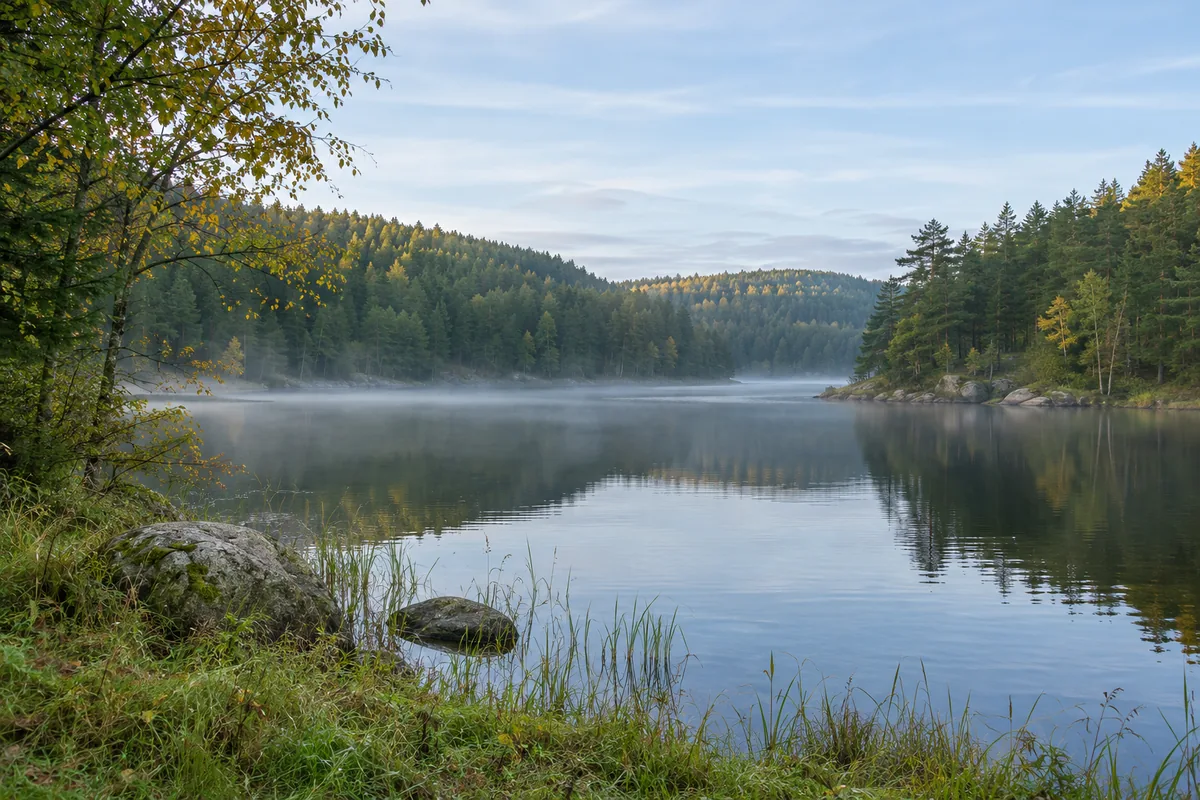
- Kamp reservoirs: Thurnberg was built in the 1950s as part of the chain of power stations on the Kamp and is about 3.5 km long. Dobra was created in 1956. Ottenstein and Dobra are up to about 50 metres deep. Fishing takes place on both.
- Lunzer See: a natural glacial trough lake, up to about 34 metres deep. Boats and divers are also out on it.
- Erlaufsee: on the border with Styria, about 58 ha and up to about 38 metres deep, with the Erlauf flowing through. More in the profile Styria.
- Ponds: The Herrenteich in Litschau, for example, 24 ha in size, is still an extensively managed fish pond where people also fish.
Fish and best time Trout, grayling, huchen, pike and zander
More than 60 fish species live in the province. For individual beats the lessees name:
- Ybbs: brown trout, grayling, huchen, pike, common nase and rainbow trout.
- Große Erlauf including the Erlaufklause reservoir: brown trout, grayling, char, zander, pike, carp, wels catfish and rainbow trout.
- Schwarza: brown trout, grayling and bullhead.
- Lunzer See: brown trout, lake trout, pike, perch, chub (called Aitel in Austria) and roach. Aitel is the chub.
- Großer Kamp: brown and rainbow trout, carp, pike, chub (Aitel), barbel and dace.
- Thaya, March and Leitha: carp, pike, zander, wels catfish and tench everywhere, and on the March and Leitha barbel too.
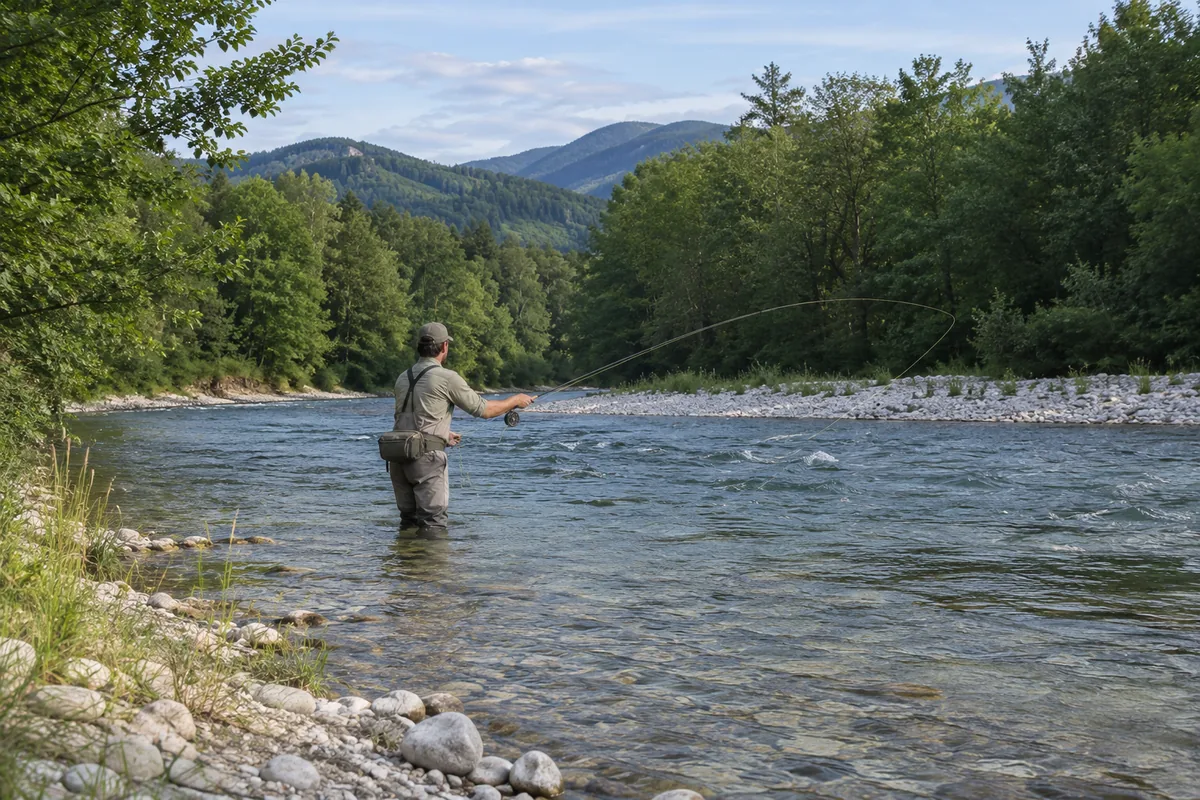
The Thayatal National Park protects 26 kilometres of the Thaya, and its residents include brown trout and noble crayfish. Which species bite when is shown by the catch calendar.
Papers and permit Fishing guest card, licence and day card in Lower Austria
Under the NÖ Fischereigesetz 2001 you carry two papers while fishing and show them to the fisheries inspectors or the police on request:
- Fishing guest card with official photo ID: You get it together with the licence directly from the lessee if you can credibly show your knowledge. The easiest way is a foreign fishing certificate, so take your German fishing licence with you. The card is valid across the province, for at most 30 days in the calendar year from issue. You sign it before your first cast and receive a list of closed seasons and Brittelmaß sizes with it.
- Licence: It is made out in your name, names the beat and the period of validity and cannot be transferred. The licence comes with a catch report, which you fill in and hand to the lessee. For a single day it is usually called a day card (Tageskarte) in the fishing spot list of the provincial association, less often a day licence (Tageslizenz).
- Children under 14: They need a licence and fish only with an adult next to them who carries fishing documents of their own.
Not every lessee issues guest cards. The fishing spot list of the provincial association shows for each beat whether the guest card is available there, and names the contact. Who holds the fishing rights on a water is shown in the fisheries register; outside the beats, the municipality or the tourist board will know.
The annual fishing card requires the association’s fishing course. A foreign fishing certificate replaces it only with reciprocity and residence abroad, with the levy and the association fee paid. On ponds used for fish farming you do not need a card, but you do need the operator’s licence. More on the principle under Fishing permit and water map.
Special rules Closed seasons, Brittelmaß sizes and bait
Closed seasons and Brittelmaß sizes are set out in the NÖ Fischereiverordnung 2002. The box “At a glance” shows the values for the most important species. The first and last day count as part of the closed season; length is measured from the tip of the head to the end of the tail fin. Protected all year round are, among others, Frauennerfling, Perlfisch, sabre carp, Streber, blue bream and all lampreys. During the closed season you may neither target a species nor keep it. The authority may set different times and sizes for individual beats, so read your licence carefully (Closed season and minimum size explained).
Live bait is allowed only if it consists of unprotected invertebrates. Crustaceans are banned as bait altogether, as are echo sounders, artificial light sources and set lines. Set rods are never left unattended, and you do not fish in fish passes. The thick-shelled river mussel is strictly protected.
As a visiting angler you may walk on banks in order to fish, at your own risk. If a plot is fenced, you notify the owner beforehand. In the Thayatal National Park you must keep to the paths. In its nature zone any interference with nature is forbidden; in the nature zone with management measures, fishing is permitted only according to the national park’s plan. So find out before buying a licence whether your stretch lies in the national park. On the Erlaufsee you ask which part of the lake the licence covers.
As of October 2026. What counts are the NÖ Fischereigesetz 2001, the NÖ Fischereiverordnung 2002, the NÖ Nationalparkgesetz and the conditions on your licence.
Safety
On the three Kamp reservoirs the water level fluctuates daily because the power stations use them as storage. Below the Czech pumped-storage power station near Vranov, and so also in the Thayatal National Park, the flow of the Thaya rises daily from at least 2.8 to 30 to 45 cubic metres per second. Do not wade far out there.
Water level, flow and water temperature are published by the province in real time under Wasserstandsnachrichten, along with flood forecasts for all larger rivers. More under Bank and waders and Boat and life jacket.
Related
- Fishing on a river, fishing on a reservoir and fishing on a lake
- Fishing in Austria: papers in all federal states, plus the Danube, Vienna, Upper Austria and Lake Neusiedl
- Returning fish and fly fishing
- In the fish lexicon: huchen, grayling, pike, zander and carp
Sources
- NÖ Fischereigesetz 2001 (zuletzt geändert durch LGBl. Nr. 104/2025) und NÖ Fischereiverordnung 2002 (LGBl. Nr. 93/2015)
- Landesrecht Niederösterreich (RIS): NÖ Nationalparkgesetz und Verordnung über den Nationalpark Thayatal
- Amt der NÖ Landesregierung: Fischerei, Wasserstandsnachrichten und Hochwasserprognosen und Nationalpark Thayatal
- NÖ Landesfischereiverband: Fischergastkarte, Angelplätze, Fischarten in NÖ und Frequently asked questions
- Badegewässerprofile von Sozialministerium und Land bei der AGES: Stausee Ottenstein, Dobrastausee, Thurnberger Stausee, Lunzer See, Herrenteich und Erlaufsee
- Nationalpark Thayatal: Die Thaya, Kurz & bündig und Tipps für Ihren Besuch
Guide without guarantee, as of October 2026. What counts are the Lower Austrian fisheries law, the NÖ Nationalparkgesetz and the conditions on your licence.