

Waters · Austria
Fishing on the Danube in Austria
Fishing on the Danube in Austria means fishing roughly 350 km of river from the border near Passau through Upper Austria, the Wachau and Vienna to the border with Slovakia. Ten power stations dam it, and it flows freely only in the Wachau and east of Vienna. Three state laws apply to fishing, plus special rules in the Donau-Auen National Park.
- Papers
- Fishing card (Fischerkarte) or guest card of the state and licence for the district
- Fishing seasons
- OÖ from 1.4. to 31.5. only from 1 h before sunrise to 1 h after sunset; in the national park by day only
As of October 2026
At a glance
- Papers
- Fishing card (Fischerkarte) or guest card of the state and licence for the district
- Licence and permit
- OÖ: guest fishing card and licence from the water manager, information from the Oö. Landesfischereiverband
- NÖ: Fischergastkarte from the holder of the fishing rights, information from the NÖ Landesfischereiverband
- Vienna: Fischergastkarte from the holder of the fishing rights, information from the Wiener Fischereiausschuss
- Fishing seasons
- OÖ from 1.4. to 31.5. only from 1 h before sunrise to 1 h after sunset; in the national park by day only
| Fish | Minimum size | Closed season | Note |
|---|---|---|---|
| Zander | 35 cm | 1.4.–31.5. | OÖ 50 cm, 1.2.–31.5.; W 45 cm; national park NÖ 45 cm, from 1.1., at most 8 a year |
| Pike | 50 cm | 1.2.–30.4. | OÖ 60 cm, until 31.5.; W 55 cm; national park NÖ only 55–80 cm, 1.1.–31.5. |
| Wels catfish | 60 cm | 1.6.–30.6. | OÖ 80 cm, W 85 cm |
| Huchen (Danube salmon) | 75 cm | 1.3.–31.5. | OÖ 85 cm, 16.2.–31.5.; W protected all year round |
| Common nase | 35 cm | 16.3.–31.5. | the same in OÖ and W |
| Barbel | 30 cm | 1.5.–15.6. | OÖ 35 cm, 16.4.–31.5.; W 35 cm |
| Asp (Schied) | 40 cm | 16.4.–31.5. | OÖ 45 cm |
| Sterlet | 45 cm | 1.5.–30.6. | OÖ and W protected all year round |
Values for Lower Austria (NÖ Fischereiverordnung), Upper Austria (Donaufischereiordnung and Oö. Fischereiverordnung) and Vienna (W) in the note. In the Donau-Auen National Park the stricter rule applies in each case; the licence can be stricter. Status: October 2026. What counts are the regulation and your fishing permit (Erlaubnisschein).
Location and waters Barrages, the Wachau and the Donau-Auen National Park
- Barrages: The chain of power stations from Jochenstein to Freudenau in Vienna has turned the river into a succession of reservoirs (Nationalpark Donau-Auen).
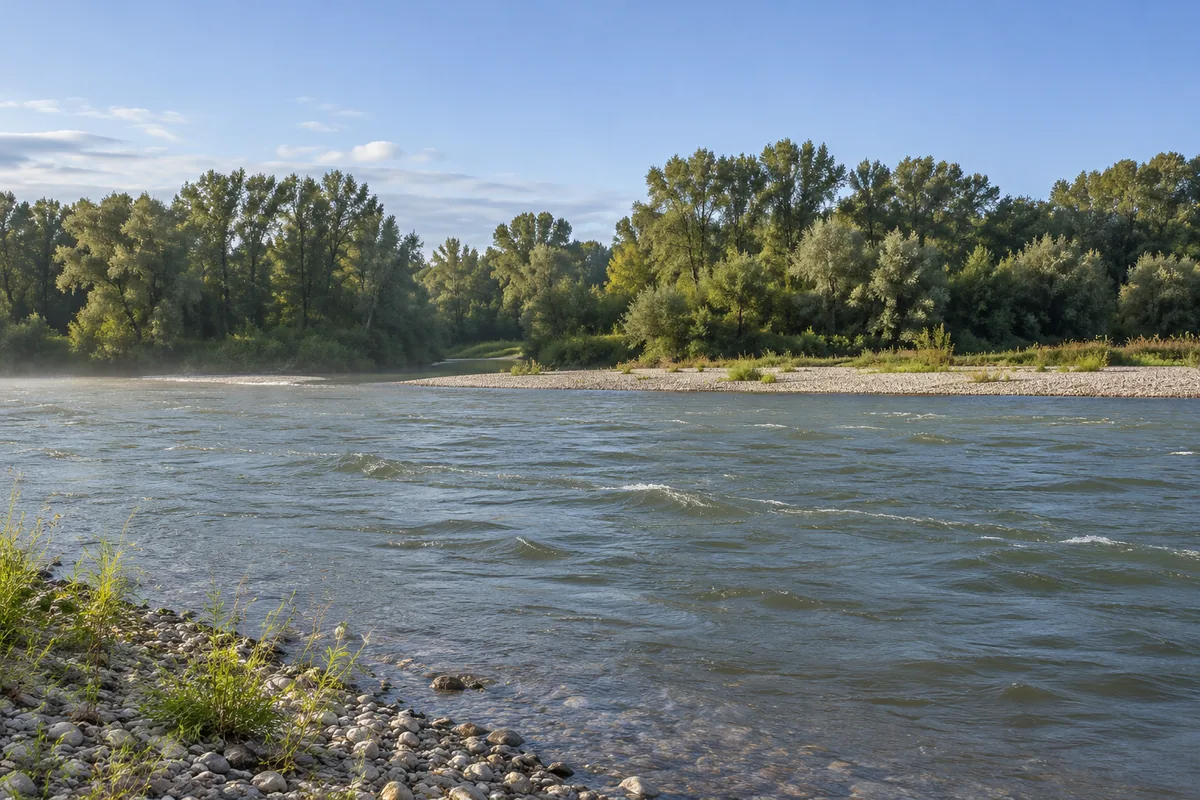
- Free-flowing stretches: The Wachau is undammed for 35 km, east of Vienna for 47 km. Of this, 36 km lie in the Donau-Auen National Park, where the water level fluctuates by up to 7 m.
- National park and waterway: East of Vienna the river belongs to the national park and is at the same time an international waterway (Verhaltensregeln des Nationalparks). The paths along the river, the towpaths (Treppelwege), are looked after by viadonau.
Fish and best time Huchen (Danube salmon), sterlet, wels catfish, zander, common nase and barbel
67 fish species live in the Donau-Auen National Park (Zahlen und Fakten). In the Aschach impoundment, among others, huchen, sterlet, wels catfish, zander, common nase, barbel and asp (Schied) have been recorded (Oö. Landesfischereiverband). Huchen and sterlet are regarded there as critically endangered according to the Red List of 1997.
- Common nase: In the Lower Austrian Danube it was a mass species until the middle of the 20th century, and today it is rare in many sections. It spawns from March to May on gravel banks with flowing water (Nationalpark Donau-Auen).
- Barbel: The barbel is a characteristic species of the free-flowing stretches.
- Zander and wels catfish: Neither is endangered in the Danube, and the zander is supported by stocking.
- Sterlet: In the Austrian Danube it now reproduces naturally only near Aschach.
The catch calendar shows which species bites when.
Papers and permit Guest card, licence and day licence in OÖ, NÖ and Vienna
In all three states you need two documents: a fishing card (Fischerkarte) or guest card of the state and the licence for the district. The licence is issued by the water manager (Bewirtschafter) or the holder of the fishing rights (Fischereiausübungsberechtigte) of your stretch.
- Upper Austria: The annual fishing card is issued by the Oö. Landesfischereiverband. An official fishing certificate (Fischerlegitimation) from another federal state is also valid, a foreign one only if you live abroad and with a certified translation. In addition you pay the Upper Austrian annual fishing card levy (§ 13 Oö. Fischereigesetz 2020). The guest fishing card is filled in by the water manager. It is valid for three weeks, from the age of 12, at most twice a year. Younger children fish accompanied by an authorised adult. Licences bought online you currently have to carry as a printout (Oö. Landesfischereiverband).
- Lower Austria: The fishing card is valid only with the card levy and the association fee paid. A foreign fishing certificate is enough only where there is reciprocity (§§ 9 und 14 NÖ Fischereigesetz 2001). The Fischergastkarte is valid for 30 days in the calendar year. It comes from the holder of the fishing rights, to whom you make your suitability credible, and is meant mainly for holidaymakers (NÖ Landesfischereiverband). Children under 14 need a licence and an adult with fishing documents at their side.
- Vienna: The Viennese fishing card is issued by the Wiener Fischereiausschuss. An equivalent exam from another federal state or country is recognised. The Fischergastkarte is issued by the holder of the fishing rights, is valid for 30 days and only for the registered fishing waters (§§ 28a und 29 Wiener Fischereigesetz). Children from 6 to 13 may fish under supervision, without a licence of their own.
For one day the licence on the Upper Austrian Danube is called a Tageslizenz, for example in the Obere Donau district (Oö. Landesfischereiverband). The Bundesforste also sell day licences near Orth in Lower Austria (Bundesforste). The Landesfischereiverband lists many issuing points in Lower Austria as points for day cards (Angelplätze).
Whether your German angling licence (Fischereischein) is enough in Lower Austria, clarify with the Landesfischereiverband a few weeks beforehand, as the check there sometimes takes weeks. In the Donau-Auen National Park the licence is only valid together with the fishing card or guest card of the respective state. Always buy the licence for exactly your stretch, more under Fishing permit and water map.
Special rules Donaufischereiordnung, fishing time in spring, nets
Each state regulates closed seasons and minimum sizes (Brittelmaße) itself, and the values for the Danube are in the box “At a glance”. In Upper Austria the Donaufischereiordnung deviates from the general Oö. Fischereiverordnung for pike, zander and perch. For Lower Austria the NÖ Fischereiverordnung applies, for Vienna the Wiener Schonzeitenverordnung.
- Fishing time in Upper Austria: From 1 April to 31 May you may fish on the Danube only from an hour before sunrise to an hour after sunset. You keep at least 20 m away from nets and other fishing gear set out by the managers.
- Fish passes and locks: In Upper Austria fishing in fish migration aids and locks is banned, as is fishing at their inlets and outlets (§ 29 Oö. Fischereigesetz 2020).
- Baits and tackle: Live vertebrates as bait are banned everywhere, in Lower Austria any live bait except unprotected invertebrates. Lower Austria bans the echo sounder, Vienna the wire keepnet. Rods that are set out are never left unattended.
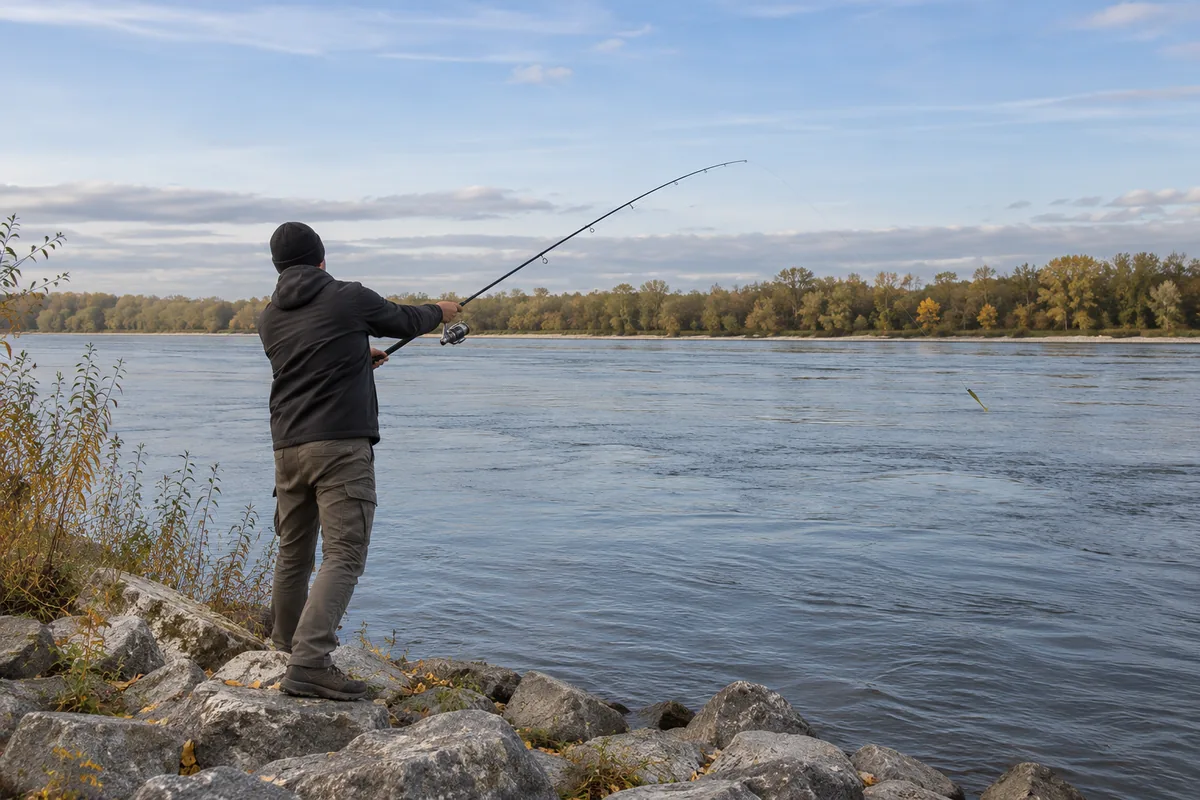
- Donau-Auen National Park: Fishing is only in designated areas, mainly on the main stream, and all other waters are protected areas. In the Lower Austrian part the following applies: fishing only from sunrise to sunset, spinning from 1 June to 31 December, no boilies, no echo sounder. Zander are protected from 1 January to 31 May, and you take at most eight a year. Pike you may take only between 55 and 80 cm, and every legal-size wels catfish and zander you must take (Managementplan 2019 bis 2028).
- Viennese part of the national park: Spinning only from 1 September, groundbaiting banned. In the Donaustrom-Lobau district fishing is banned completely from 1 to 31 May (Fischereilicher Managementplan Wien).
- Towpaths (Treppelwege): On foot you may use them with your permit carried visibly (viadonau). By car you need an authorisation from viadonau. In the Lower Austrian part of the national park driving on the towpaths is generally not permitted.
Status: October 2026. If the act, the management plan and the licence name different closed seasons, the stricter one applies. Individual districts have exceptions, and what counts are the regulations and your licence.
Safety
- High water: The water can rise quickly. Avoid places where high water can cut you off. Water levels and forecasts are at DoRIS.
- Ships: Moving ships create suction and strong waves (WSV). In a rowing boat or small craft you leave room for shipping and cannot expect it to give way to you. Above the highest navigable water level such boats may not go out at all (viadonau). More under Boat and life jacket.
- Bank in the national park: At high water or in strong wind trees can fall and branches come down. Trees on the bank that are at risk of collapsing stay where they are.
- Emergency number: 112, police 133, ambulance 144 (oesterreich.gv.at). More under Banks and waders.
Related
- Fishing on a river and Fishing in Austria
- Upstream: the Danube in Germany
- The states on the Danube: Upper Austria, Lower Austria and Vienna
- Species in the Danube: huchen, zander, wels catfish, common nase, barbel
- Closed season and minimum size explained and Returning fish
Sources
- Oö. Fischereigesetz 2020, Oö. Fischereiverordnung und Donaufischereiordnung (RIS, Fassung vom 04.10.2026)
- NÖ Fischereigesetz 2001 und NÖ Fischereiverordnung 2002 (RIS, Fassung vom 04.10.2026)
- Wiener Fischereigesetz, Verordnung über Schonzeiten und Mindestmaße (RIS, Fassung vom 04.10.2026) und Fischereilicher Managementplan 2022 bis 2028
- Nationalpark Donau-Auen: Managementplan 2019 bis 2028, Die Donau und Verhaltensregeln
- Oö. Landesfischereiverband: Was benötige ich zur Fischerei?, NÖ Landesfischereiverband: Fischergastkarte und Wiener Fischereiausschuss: Fischergastkarte
- viadonau: Nutzung Treppelwege, FAQ und Ruderboote auf der Donau
A guide without guarantee, status October 2026. What counts are the fisheries law of Upper Austria, Lower Austria and Vienna, the rules of the Donau-Auen National Park and the terms of your licence in their current version.