
Knowledge – Fish
Lake trout: Features, habitat, trolling
The lake trout is the large-growing lake form of the trout (Salmo trutta). It lives in the open water of deep, oxygen-rich lakes and runs up into the inflowing streams to spawn. It is mostly caught by trolling, in early spring also with a spinning rod and a worm on the drift.
In short: You catch lake trout best in April, mostly by day. Good spots in the lake: open water. Proven baits: mother-of-pearl spoons and crankbaits when trolling, dead baitfish on a rig, in spring spinners; in the current lobworm on the drift, with the fly streamers on a sinking line. In spring within reach of a spinning rod, in summer in the deep water layers. Many lakes have their own closed seasons, high minimum sizes and catch limits. Step by step: fishing for lake trout.
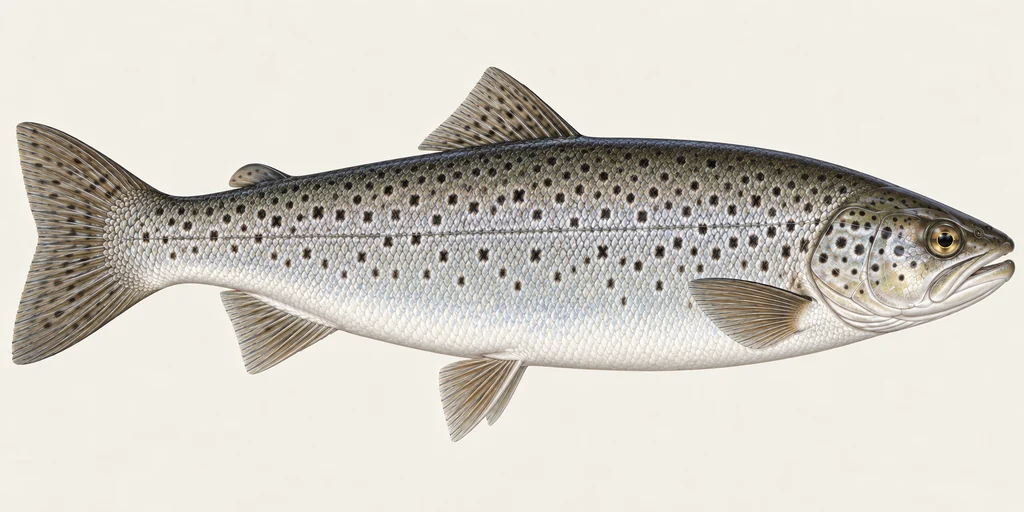
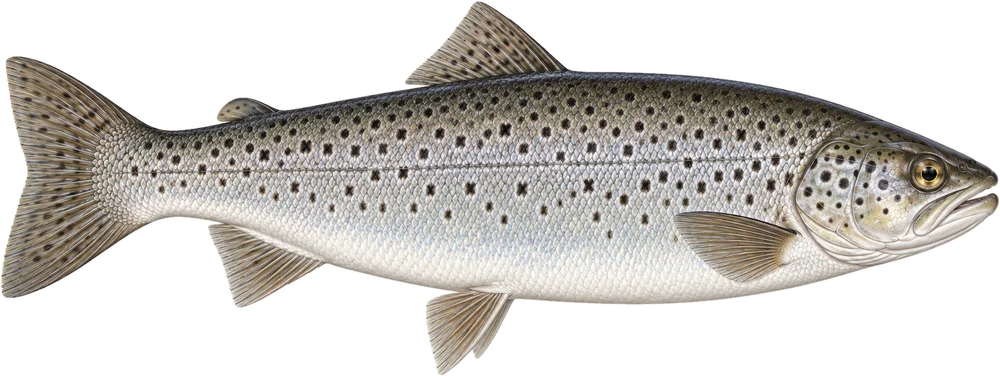
- Silvery scale cover with black spots or crosses
- The gape usually reaches behind the eye
- Relatively large adipose fin; paired fins and anal fin unspotted
Catch chances through the year
- Hardly any chance
- Possible
- Good
- Peak season
- Spawning (observe the closed season)
Editorial assessment for waters in Germany, not a measured value and no guarantee. Spawning time is not the same as the legal closed season.
Species profile and sources in the catch calendarAll species compared month by monthThe rules of your federal state
How to recognise it
The lake trout is elongated and club-shaped and carries a fairly large adipose fin. The scale cover is silver with black spots or crosses, the paired fins and the anal fin are unspotted, the underside whitish. The mouth is large and usually opens to beyond the eye; the teeth are strong. At spawning time the colouring darkens to grey-blue or grey-green, and the males develop a spawning hook on the lower jaw. The colouring varies greatly with water and origin; young fish carry dark vertical bars on the flanks.
Usual sizes are 40 to 80 centimetres; the Landesfischereiverband Bayern gives 100 centimetres as the maximum. In the lake some fish grow longer than a metre and heavier than ten kilograms, writes the Office for Forests and Nature of the Canton of Fribourg. FishBase lists up to 140 centimetres, 50 kilograms and 38 years for the species Salmo trutta as a whole. Regionally it is called Ferche, Laxl or, on Lake Constance, Lanke.
Lake trout and brown trout belong to the same species. The Red List describes brown trout, sea trout and lake trout not as species or subspecies but as life strategies of Salmo trutta that cannot be separated in terms of reproductive biology. Austrian sources, by contrast, list the lake trout as a subspecies and admit that brown and lake trout can often hardly be assigned by external features. As a rule of thumb the brown trout mostly bears red spots with pale rings, while the lake trout loses these red spots in the lake. The sea trout looks similar but spends part of its life in salt water.
In the salmon the mouth reaches only to below the rear edge of the eye, in the trout usually beyond it. FishBase counts 10 to 13 scales between the adipose fin and the lateral line in the salmon. The Alpine char has white-edged leading edges on the paired fins and the anal fin.
Side by side
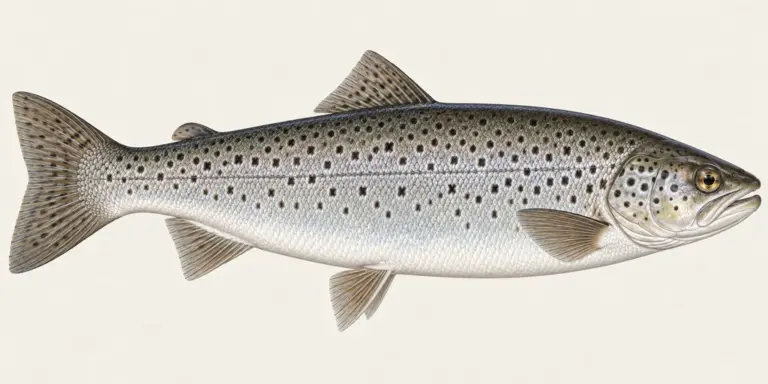
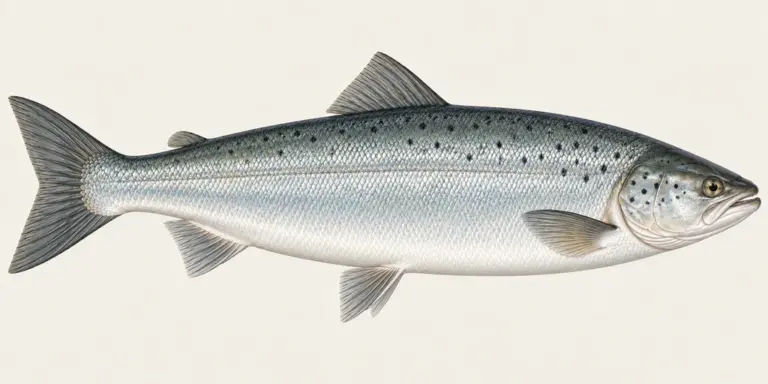
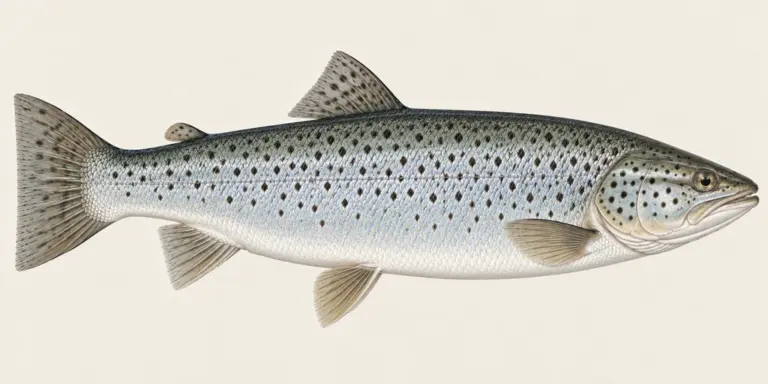
AI-generated illustrations.
Where it lives
The lake trout lives mainly in deep, cool, oxygen-rich Alpine and Alpine-foothill lakes. Through stocking it also occurs in reservoirs; on the Biggesee, for example, the population owes fish of up to 90 centimetres to stocking. More about the types of water is under fishing on lakes and fishing on reservoirs.
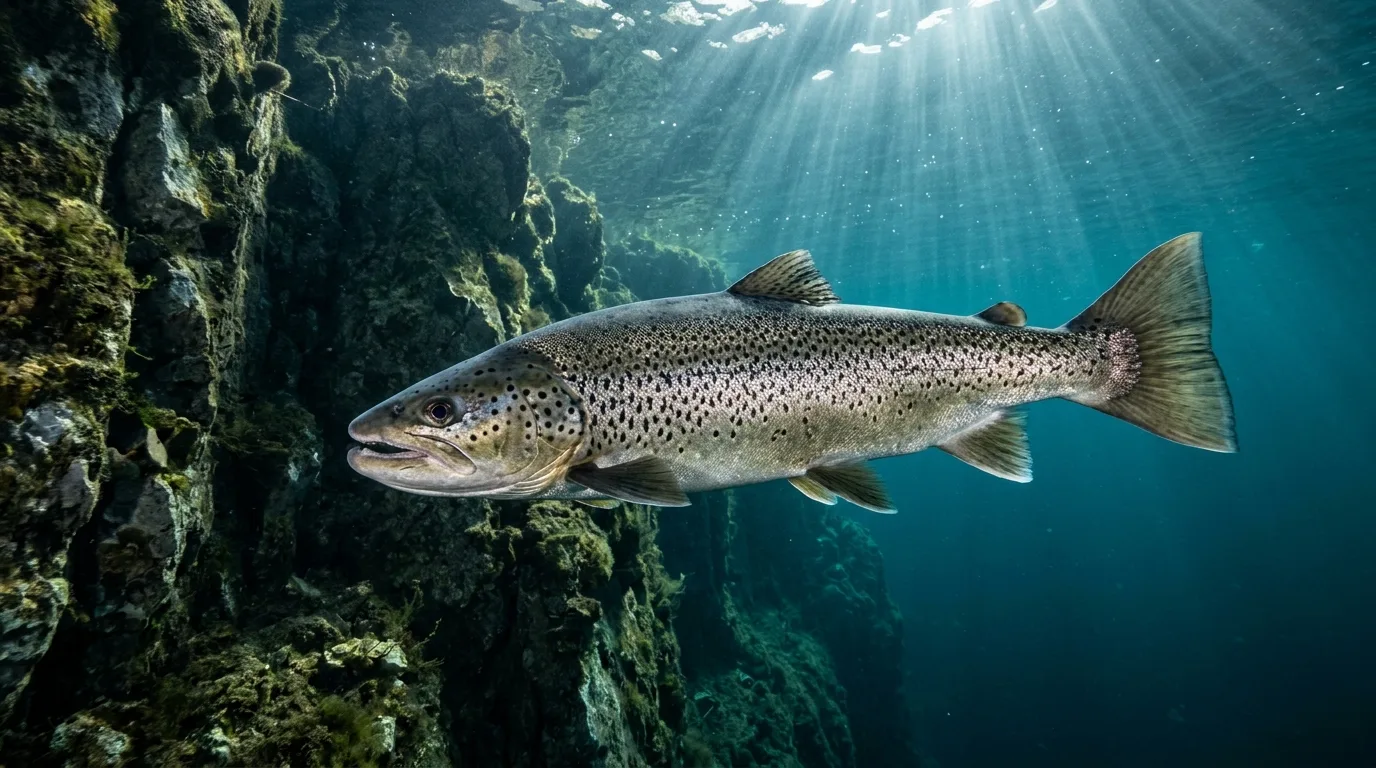
Young fish stay in the mouths of inflowing streams and along the shore and, according to FishBase, move into the lake in the first two years of life. Adults usually live in open water and hunt there as well as along the shore. In summer they stand in deep layers, and a pronounced thermocline then limits their hunting ground. As the upper lethal temperature the LAWA project gives 30 °C.
Where whitefish live, the lake trout follow the shoals. On the echo sounder the vendace appear as large clouds, and the predators stand at that depth too. As threats the Landesfischereiverband names transverse structures, loss of spawning grounds and gravel extraction in the inflowing streams.
Holding spots in the picture
Choose the season and time of day: the picture shows where the species stands then. Spots outlined in red apply only in the chosen season. Tap a fish or a spot in the list to bring it closer. The picture is schematic and AI-generated, every water is different.
Chance of a catch in springgood
Catch chances in summerpossible
Catch chance in autumnpossiblespawning, observe closed seasons
Catch chance in winterhardly any
- J
- F
- M
- A
- M
- J
- J
- A
- S
- O
- N
- D
Spawning season
No main time Trout are considered mainly daytime feeders, but lake trout usually run into the inflows in the dark to spawn.
Active time Trout are considered mainly daytime feeders, but lake trout usually run into the inflows in the dark to spawn.
No main time Trout are considered mainly daytime feeders, but lake trout usually run into the inflows in the dark to spawn.
No main time Trout are considered mainly daytime feeders, but lake trout usually run into the inflows in the dark to spawn.
In the lake
Water lilies and weed bed
Lake trout are found here in spring only.
Shelf edge
Lake trout are found here in spring only.
Open water
Lake trout are found here all year round.
Just below the surface
Lake trout are found here in winter only.
Adult lake trout live in the open water of deep, oxygen-rich lakes. Young fish stay at first at the mouths of the inflows and in the shore zone and later move into open water. The bigger the fish, the deeper they hold.
Spring: catch chances according to the catch calendar are good in March, peak season in April, good in May. In early spring rising water draws lake trout close to the bank. On Lake Constance they held at the start of April on an edge over gravel and weed beds at two to four metres‘ depth, and on reservoirs the stream inlets are a good place for bank anglers. On the Biggesee they can be caught with a spinning rod from March to early May. On the lakes of Upper Bavaria, too, people fish from the bank in spring and autumn.
Summer: catch chances according to the catch calendar are possible. In summer lake trout hold deep. A pronounced thermocline then limits their hunting ground.
Autumn: catch chances according to the catch calendar are possible in September and October, hardly any in November. This is when spawning takes place, so observe the closed seasons. From September to December ripe fish run up into the inflows, mostly in the dark and with higher flow after rain. In the lake they mostly bite when trolling in autumn.
Winter: catch chances according to the catch calendar are slim. In the cold season it is mainly smaller lake trout that stay near the surface. Spawning continues into December over gravel in the inflows, and the species is then protected in many places.
Depth: As they grow, lake trout stay at greater depths. Smaller suspended trout hold near the surface in the cold season.
Size comparison: AI-generated drawing, schematic.
How it hunts and spawns
Young lake trout eat small invertebrates and insects from the water and from the surface. Adults hunt mainly fish, besides that molluscs and crustaceans. They look for prey both in open water and along the shore.
To spawn, lake trout run up into the inflowing streams in autumn and winter, in the Alpine lakes usually from September to December. They spawn in fast-flowing water over gravel. The female digs a redd with powerful tail movements, and the eggs are covered with gravel. A female lays about 10.000 eggs, and the fish as a rule spawn more than once in their lives. The larvae stay in the gravel for two to three weeks.
According to FishBase, trout usually become sexually mature at three to four years of age.
When it bites
In early spring rising water lures lake trout close to the shore; according to Blinker the chances of catching a fish with light tackle are then at their best. On a reservoir the salmonids are caught with the spinning rod from March to early May. Even then the lake trout remains a fish of 1000 casts.
In summer the fish retreat into deep water layers and the chances of a catch are poor. In autumn they improve, but lake trout then mostly bite when trolling. Autumn is also the spawning time: in Bavaria the lake trout is protected by a closed season (Schonzeit) from 1 October to 15 March, with a minimum size (Mindestmaß) of 60 centimetres (AVBayFiG), in Baden-Württemberg from 1 October to 28 February (as of October 2026). On Lake Constance and many other lakes their own rules apply, which are stated in the fishing permit (Erlaubnisschein).
Today’s catch index needs JavaScript. Season and spawning time are in the catch calendar.
You will find the monthly overview of all species and the water temperature check in the catch calendar.
What to catch it with
Step by step: Fishing for lake trout: tips on bait, rig and tackle – season, swims, baits, tackle and rules on one page.
Spinning is the way in during spring: spinners and crankbaits (spinners, hardbaits). In the current at the lake outflow the drift with a lobworm brings bites, a mobile form of bottom fishing: a weight of 10 to 30 grams goes on the end of the mainline, above it a side arm about 70 centimetres long with a size 4 hook (side-arm rig, worms). The weight should bump slowly along the bottom, the worm ahead of it. The bites are sometimes hardly noticeable, often only the rod tip twitches a little harder. At stream inlets bank anglers also offer the worm under a float (float fishing). With the fly you fish streamers on a sinking line (streamers).
The classic method for larger fish in the lake is trolling. You work the bait from the boat, behind the boat, through open water. According to Blinker, mother-of-pearl spoons, crankbaits and dead whitefish on a rig are used (spoons, baitfish). What matters is the depth at which the lake trout are hunting the whitefish at the time. In summer it is easier to determine, because the thermocline limits the hunting ground. Whether baitfish and how many baits are allowed is regulated by the fishing permit (Erlaubnisschein). Many federal states (Bundesland) expressly forbid live baitfish.
Plan plenty of time: locals need on average around 100 kilometres of trolling distance on a reservoir for one lake trout of legal size. The mouth carries strong teeth, so use a landing net to land it. Land and release the fish as described under landing and unhooking a fish.
Find the food fish first: On the echo sounder whitefish shoals appear as large clouds. Work your baits at that depth.
Use the thermocline: In summer the thermocline limits the hunting ground of lake trout. The bait height is then easier to determine than during the rest of the year.
On rising water, go to the bank: After rain and a rising water level in spring, lake trout stand close to the shore. Light tackle from the bank is then a chance.
Suitable lures
Mother-of-pearl spoons and crankbaits when trolling, dead baitfish on a rig, in spring spinners; in the current lobworm on the drift, with the fly streamers on a sinking line.
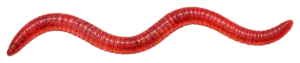
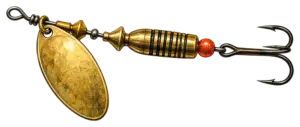
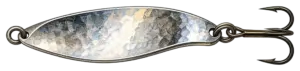
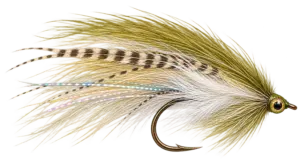
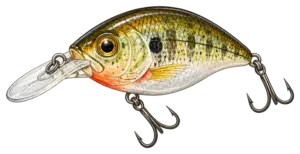
AI-generated illustrations. A click opens the lure’s page.
Rigs for these lures: float rig, running ledger rig.
Whether baitfish is allowed and how many trolling baits may be used is regulated by the fishing permit (Erlaubnisschein).
What lake trout tastes like and what to do with it
Trout flesh is firm, tasty and fine-grained. The colour ranges from white through pink to slightly red, depending on the food. The salmon trout is not a species of its own but a trout whose flesh is reddish because of its diet. Today this usually means farmed rainbow trout. Trout are prepared fresh, boiled, fried or smoked and as fillets (gutting a fish, filleting a fish, smoking a fish). Take only fish of legal size, where permitted.
What you need to observe
The trout Salmo trutta, to which the lake trout belongs, is listed as endangered on the 2023 Red List of Germany, with a strong long-term decline. The Red List calls for the diversity of forms to be preserved. Many managers regulate the catch of lake trout with their own closed seasons (Schonzeit), minimum sizes (Schonmaß) and daily catch limits. For a large reservoir Blinker names such rules for brown and lake trout.
Closed seasons (Schonzeit), minimum sizes (Mindestmaß) and harvest windows are set by the federal states (Bundesland), and on many waters additionally by the club or leaseholder. They differ depending on the water and the time of year. We give figures only with a date and a source; always binding are the fisheries regulation of your federal state and your fishing permit (Erlaubnisschein). You will find a list of links to the official sources in the catch calendar.
A fish of legal size that you want to keep you stun and kill immediately, in line with animal welfare (stunning and killing a fish). Protected fish, undersized fish or fish too large under a harvest window you unhook if possible in the water and with wet hands, and release gently (releasing a fish).
What closed season, minimum size and harvest slot mean and where to find them is explained on the page Closed season and minimum size explained.
What state law says about the closed season (Schonzeit) and minimum size (Mindestmaß) for this species is in the “At a glance” box on the state pages for Baden-Württemberg and Bavaria. For the other states our overview does not list this species; there the state fisheries regulation (Landesfischereiverordnung) is decisive.
Frequently asked questions (FAQ)
Is the lake trout a species of its own?
No. It is the large-growing lake form of the trout (Salmo trutta). Brown trout, lake trout and sea trout are different life strategies of the same species, which can breed with one another.
At what depth does the lake trout stand?
In summer in deep water layers, limited by the thermocline. Follow the food fish: where the clouds of whitefish stand on the echo sounder, the lake trout hunt too.
Is the salmon trout a lake trout?
No. Salmon trout is not the name of a species but describes trout with reddish flesh. The colour comes from carotenoids in the feed; today they are mostly farmed rainbow trout.
Sources
The rating of catch chances is an editorial assessment. The facts come from these sources, and the text is worded in our own words. The illustration is an original design by Angel Momente in the style of a natural history plate (AI-generated, see the AI notice).
- Landesfischereiverband Bayern: Fischlexikon (Laichzeit, Lebensraum, Nahrung, Aktivität)
- Kanton Freiburg, Amt für Wald und Natur: Forelle (Formen, Größe und Färbung der Seeforelle)
- Rote-Liste-Zentrum: Forelle, Salmo trutta einschließlich Seeforelle (Rote Liste der Süßwasserfische Deutschlands 2023: gefährdet)
- FishBase: Salmo trutta (Größe, Alter, Biologie, Laichen, Zähne)
- FishBase: Salmo salar (Höchstalter, Bestimmungsmerkmale)
- BMLUK Österreich: Forelle (traditionelle Lebensmittel; Seeforelle, Lachsforelle, Fleisch, Verwertung)
- LAWA-Projekt O 10.20 (Leibniz-IGB, 2021): Temperaturempfindlichkeiten der Fischgemeinschaften
- Blinker: Angeln im Biggesee (Seeforelle: Saison, Schleppangeln, Köder)
- Blinker: Auf zur Seeforelle, Forellenstart am Bodensee (Ufernähe im zeitigen Frühjahr)
- Blinker: Angeln am Sorpesee (Seeforelle an Bacheinläufen, oberflächennahes Schleppen)
- Bayern: AVBayFiG, Anlage 1 (Schonzeiten und Schonmaße, Fassung ab 1.6.2025)
- Wikipedia: Seeforelle (Merkmale, Laichwanderung, Höchstalter)
- FishBase: Salmo trutta (Lebenszyklus, Bestimmungsmerkmale, Nahrung)
- Kanton Zürich, Baudirektion: Seeforellen-Management, Konzept 2018–2026 (Lebenszyklus, Aufenthalt im See, Laichaufstieg)
- Bayerische Landesanstalt für Landwirtschaft, Institut für Fischerei: Seeforelle im Starnberger See (Vortrag 2018; Uferfischerei im Frühjahr und Herbst, Schleppen im Sommer)
Created with AI support from the sources listed. Figures only appear in the text if a source gives them. Last updated: 2 November 2026. Found a mistake? Write to us. Who is behind this site: About me.
More in the lexicon
- All fish species at a glance
- Catch calendar – month, water temperature and profile for 93 species
- Line calculator – breaking strain after the knot, drag guideline, backing
- Angling methods