
Knowledge · Tackle
Wading net: The small net for wading
A wading net is a small landing net with a short handle that you carry on your body while wading instead of laying it on the bank. It hangs on your belt or on your back, and you use it to land trout, grayling or sea trout right in the water.
Short handle instead of a telescopic pole
The difference from a bank landing net lies in the handle. On the bank, a slope, jetty or rock revetment often separates you from the fish, so the net needs reach. For bank and boat anglers, Blinker gives medium-length handles of 50 to 150 centimetres. If you are standing in the water, on the other hand, the fish is right in front of you. The tackle guide of the Fischereiverein Löningen, a study aid for the angling exam (Fischerprüfung), describes the wading net accordingly: a short handle, plus a loop with which you hang it round you.
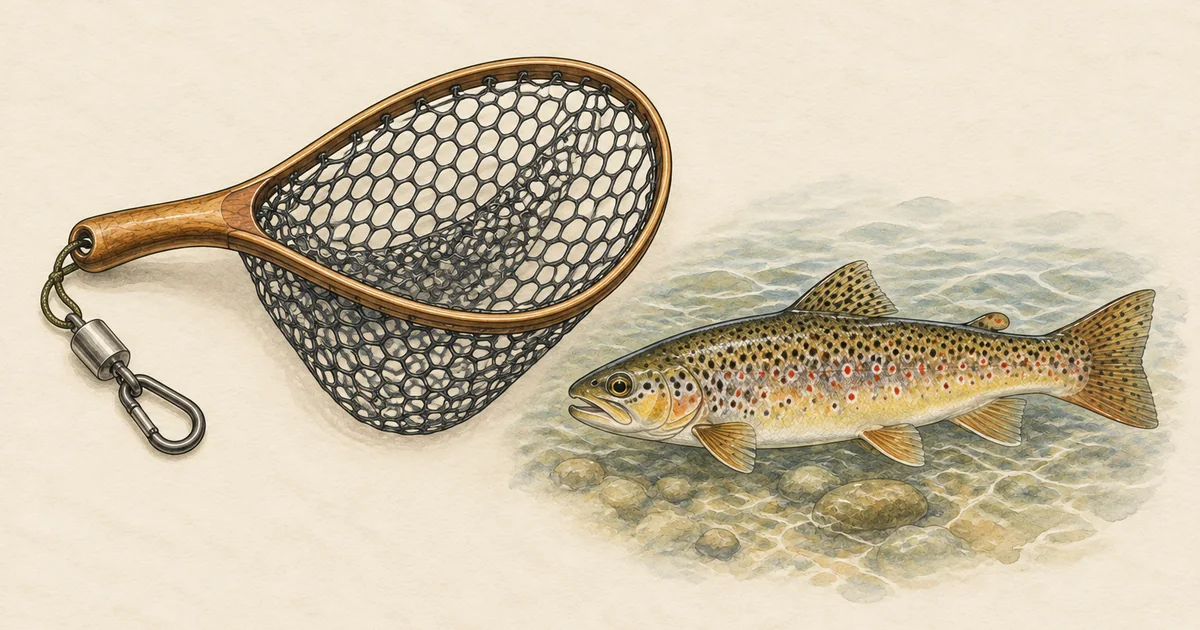
Rute & Rolle names a second difference. Wading nets often have no folding mechanism. That makes them slightly bulkier, but they weigh clearly less than a folding net and are ready at once without unfolding. How the big nets with a folding head and telescopic handle are built is described under Landing net.
| Feature | Wading net | Bank landing net |
|---|---|---|
| Handle | short handle | usually telescopic, often 50–150 cm |
| Head | small, often without a folding mechanism | often folding or detachable |
| Carrying | on the belt, jacket or back | put down at the swim |
| Typical use | Fly and lure fishing in the water | Bank, jetty, boat |
Net, frame and size
When wading, the fish is close to you, and spinning lures often carry two or three treble hooks. The question catalogue of the Bavarian angling exam considers landing nets with rubber mesh particularly kind to fish, because hooks hardly penetrate the material. In addition, trebles rarely catch properly in rubberised mesh, and fin rays and gill covers also get tangled in it less often. The same catalogue describes the net bag as deep and roomy, made of strong material without knots. Why the material matters for the fish’s mucous membrane is explained on the page Landing and unhooking fish.
The size depends on the target fish. For perch and trout when lure fishing, Blinker gives a net head of 40 to 50 centimetres in diameter as a guide, and for targeted pike fishing at least 70 centimetres across. For fly fishing for sea trout on the Baltic, a Blinker area report from Fehmarn counts an oversized wading net as part of the kit. If in doubt, go one size bigger: a small fish fits in a big net, a big one does not fit in a small net.
Carrying on the belt or on your back
In the water you need both hands for the rod and line, so the net hangs on your body. The specialist press describes three ways of attaching it:
- Magnet: For fly and lure anglers, according to Rute & Rolle, the net usually hangs on the back, held by a two-part magnet. One half sits on the D-ring of the wading jacket, a metal ring for hanging things on, or on the chest pocket, the other on the net. You reach behind you and pull the net forward, and the halves separate. After landing the fish you put them back together.
- Holder on the wading belt: The handle sits in a holder that is slid onto the wading belt. There are also wide belts with a built-in holder.
- Bungee cord: Sea trout anglers attach the net to the wading belt with an elastic cord, a stretchy band. On waders or the fishing bag too, a bungee cord or magnet is common.
With a magnet and belt holder, Rute & Rolle additionally recommends a safety lanyard between the net and the belt. Then you can simply let the net drop into the water during the fight and take in line with free hands. How to wade safely, with the wading belt firmly fastened and a wading staff, is described under Bank and waders.
Use on streams, rivers and the coast
Its classic field is fly fishing for brown trout and grayling. Because fly anglers are often on the move in the water, a short handle is enough there. Added to that are trout fishing, lure fishing on the coast and wading for pike or perch.
On the Baltic coast the wading net is part of the basic kit for sea trout. To get started, many lure anglers need only the wading net in addition to waders, since they already own a rod and reel. More on the fishing area under Fishing on the coast and in the surf.
Landing without lifting the fish out of the water
Standing in the water, you do not have to lift the fish to net it. The sequence:
- Play the fish briskly. A fish should not be played for longer than necessary. For that the drag has to suit the line: the line calculator gives the starting value, and Setting the reel drag explains the adjustment.
- Guide the fish to your feet. Only when it is there do you reach for the net. When the chance comes, you do not hesitate for long.
- Net in the water, fish over it. Hold the head below the surface and draw the fish over it with the rod.
- Unhook in the net. Leave the net with the fish in the water. According to Petri-Heil there is hardly a gentler way than freeing an undersized fish from the hook underwater, ideally by touching only the fly.
- Never lift by the line or lure. The pull on a firmly lodged lure loads the skeleton in a way it is not built for, writes Petri-Heil. The Bavarian question catalogue too names the landing net as the right way for larger fish, not lifting them out with the rod.
Time in the air counts too. Petri-Heil describes how, with time out of the water, the danger to the mucous membrane grows and an exhausted fish builds up an oxygen deficit. For salmonids such as trout and grayling, water temperature comes into it as well. According to the article, mortality of released fish rose in some species from 0 per cent at 8 °C to over 80 per cent at 20 °C.
Law: Whether you must or may release a fish is regulated by the fisheries law of your federal state (Bundesland) and your fishing permit (Erlaubnisschein). When releasing trophy fish, the Bavarian State Office for Health and Food Safety counts time in the air, alongside hooking and unhooking, among the causes of pain and suffering. The practical guide of the Leibniz Institute of Freshwater Ecology and Inland Fisheries gives holding a fish out of the water unnecessarily long for photos as an example of behaviour that has nothing to do with sporting, ethical angling. More under Law and permits and Releasing fish.
Holder, net and buoyancy
Net holders on vest and chest pack
The magnet needs a fixed point on your upper body. Rute & Rolle names the D-ring of the wading jacket and the chest pack for this. If your wading vest has such a ring on the back, attach the magnet half there. Without a magnet, a clip on the handle does the job, which according to the same source is found mainly on folding nets: it clips into the D-ring and holds the net in place. The only simpler option is a loop to sling over your shoulder.
If you wear an inflatable life jacket while wading, it matters where the lanyard and straps run. The Deutsche Gesetzliche Unfallversicherung (DGUV) states in its Information 212-004 that webbing straps can prevent the buoyancy chamber from inflating; its example comes from occupational safety, namely the safety harness. Applied to the wading net, this means: route the lanyard and carrying strap so that they do not lie across the buoyancy chamber.
Net types for wading
When wading, you usually unhook the fish in the net under water, so the fish lies with its skin and fins on the material. Blinker refers to studies on bluegills and barramundi in which researchers compared net types. Every net affected the slime layer, just to different degrees. Rubberised nets and soft, knotless mesh did the least damage to slime and scales. Small meshes also protect the fins, because they cannot slip through and get cut.
The teaching material of the Landesfischereiverband Baden-Württemberg for the angling exam (Fischerprüfung) names small, handy nets for fly fishing and wading, and generally recommends rubberised mesh, especially when undersized fish or fish in their closed season go back into the water. According to Blinker, monofilament nets also release hooks easily, because the points do not get deep into the mesh. According to the same magazine, large meshes move through the water faster but hold the fins back less well than small ones. More on net material and mesh size under Landing net.
Whether a rubberised net is mandatory on your water is set by state law, the water regulations and your fishing permit (Erlaubnisschein); what the federal states require is covered under Mandatory equipment. For care, Blinker advises rinsing a rubberised net with fresh water after every use and letting it dry completely, and that also applies after fishing on the coast.
Buoyancy
If you drop the net into the water on its lanyard during the fight, a sinking model hangs under water on the line, while a floating one stays on the surface within reach. Without a lanyard, a dropped net sinks or drifts away. Blinker often considers floating models sensible for fly fishing. If your net does not float by itself, you can retrofit it: Rute & Rolle shows a piece of foam pipe insulation over the handle.
When fishing from a belly boat, buoyancy helps too: Rute & Rolle describes a carp angler in a belly boat whose net carries floats and calls the landing with it trouble-free. The best way to check whether your net stays on the surface with a wet mesh is in shallow, calm water before you first use it.
To check before buying or before the trip:
| If … | then look out for |
|---|---|
| Lures with two or three trebles | rubberised mesh |
| Fish go back into the water | rubberised or soft and knotless, small meshes |
| Current or deep water | Lanyard and floating net |
| Net on your back | Magnet or clip on the D-ring |
| Inflatable life jacket | no lanyard across the buoyancy chamber |
| Net after use | rinse with fresh water, let it dry completely |
| Belly boat | Net with float |
Common mistakes
- Leaving the net on the bank. The folding net is lying somewhere in the long grass at the decisive moment. In the water, it belongs on your body.
- Wading without a safety lanyard. Without a connection to the belt, you cannot simply let go of the net during the fight when you need both hands.
- Choosing too small a head. A small trout net is too tight for a pike, and for sea trout on the coast an oversized wading net is part of the kit.
- Textile net with treble-hook lures. If a treble has dug into the fabric past the barb, freeing it costs time the fish does not have. Rubberised mesh saves that work.
- Lifting the fish out of the net for a photo. It is best to do without photos of fish that are going back altogether. If you do take one, lift the fish only briefly, level and just above the water.
Frequently asked questions
Is a wading net enough for pike too?
Wading for pike is one of the usual uses. For targeted pike fishing, however, a head at least 70 centimetres wide and a deep net are the guide. A small wading net for trout is too small for that.
Can I use the wading net from the bank or a boat too?
From a boat, usually yes: you sit close to the water there, and fairly short nets are enough. From a raised bank, jetty or rock revetment you lack the reach. Then you need a long handle.
Do I have to carry a landing net at all?
State law and the fishing permit regulate that. In its water rules (Gewässerordnung, 2024 edition), the Landesverband Sächsischer Angler requires, among other things, that you carry a landing net. The Landesanglerverband Sachsen-Anhalt requires landing aids with which the fish to be expected can be landed safely. For your water, what counts is what is in your papers, see Fishing permit and water map.
Does a wading net sink if it falls into the water?
That depends on the model. There are floating wading nets, and you can retrofit a sinking one with foam on the handle. You still need the lanyard to your belt, because it keeps the net with you.
Related
- Landing net: designs, nets and handle lengths of the big nets
- Landing and unhooking fish: net material, wet hands and unhooking mat
- Disgorger: removing the hook without holding the fish for long
- Releasing fish: when and how a fish goes back into the water
- Bank and waders: current, wading belt and wading staff
- Wading vest: pockets, rings and small items on your body when wading
- Fly rod: line class, length and action
- Line calculator: breaking strain after the knot and a starting value for the drag
Sources
- Blinker: Kescher fürs Angeln, der unterschätzte Helfer am Wasser (kurzer Griff, Stiele von 50 bis 150 cm, Klappkescher, Monofilnetze, große Maschen)
- Blinker: Kescher, am besten gummiert (Drillinge im Netz, schwimmende Modelle, kurzer Griff beim Fliegenfischen, Reinigen mit Süßwasser)
- Blinker: Welcher Kescher zum Spinnfischen? (Kopfgrößen, kurze Kescher im Boot)
- Blinker: Das erste Mal auf Meerforelle (Einstiegsgerät, Expanderschnur am Watgürtel) und Blinker: Das Silber der Meere, Meerforellenfischen auf Fehmarn (übergroßer Watkescher, Landung)
- Rute & Rolle: Welcher Kescher passt zu mir? (Befestigung, Bauform, Einsatzgebiete) und Rute & Rolle: Kescher, Einnetzen! (Magnet, Gürtelhalter, Klammer am Griff, Sicherungsschnur, Schwimmhilfe)
- Fischereiverein Löningen: Gerätekunde (PDF) (kurzer Griff, Schlaufe zum Umhängen)
- Bayerische Landesanstalt für Landwirtschaft: Fragenkatalog zur Fischerprüfung 2023/2024 (PDF) (Gumminetz, Netzsack, Landen mit dem Kescher)
- Landesverband Sächsischer Angler: Gewässerordnung 2024 (PDF) und LAV Sachsen-Anhalt: Gewässerordnung (PDF) (Kescher mitführen, Landehilfsmittel)
- Petri-Heil: Vom Haken zurück ins Wasser (Abhaken unter Wasser, Heben am Köder, Luftzeit, Wassertemperatur, Fotos)
- Bayerisches Landesamt für Gesundheit und Lebensmittelsicherheit: Tierschutzaspekte bei der Angelfischerei (Aufenthalt an der Luft) und Leibniz-Institut für Gewässerökologie und Binnenfischerei: Nachhaltiges Management von Angelgewässern (PDF) (Halten außerhalb des Wassers für Fotos)
- Blinker: Fische landen mit Kescher, Lip-Grip und Co. (Netztypen und Schleimschicht, Maschenweite und Flossen)
- Landesfischereiverband Baden-Württemberg: Gerätekunde, Arbeitsblätter zur Fischerprüfung (PDF) (kleine Kescher beim Watfischen, gummierte Maschen)
- Rute & Rolle: Mit dem Belly Boat auf Bartelbrummer (Kescher mit Auftriebskörpern)
- Deutsche Gesetzliche Unfallversicherung: DGUV Information 212-004, Rettungswesten und Schwimmhilfen (PDF) (Gurtbänder und Auftriebskörper)
Text AI-assisted, drawing AI-generated. Sources opened and checked in October and November 2026, no graphics taken from the sources.
All figures are guidelines only, without guarantee. Whether a wading net suits you depends on the water, the target fish and the way it is attached; what you have to release is regulated by state law and the fishing permit.