
Knowledge · Types of water
Fishing on the coast and in the surf
On the coast of the North Sea and Baltic you fish from the shore: with a far-cast bottom rig in the surf or wading with a spinning rod. Which papers you need is regulated differently by each coastal state. For cod and salmon in the Baltic, separate EU rules apply in 2026.
At a glance
- Spots
- Dark channels, sandbar, the first channel close to the shore, leopard ground in front of steep shores
- Fish
- Flounder, plaice, dab, sea trout, whiting, garfish; cod in the Baltic in 2026 to be put back only
- Casting distance
- For flatfish usually 40 to 100 metres, one rod also short into the trough in front of you
- Papers
- Differs by coastal state, choose below
- Take care
- Tides and tidal channels (Priele) on the North Sea, wind on the Baltic, rip current (Rippströmung) in gaps in the sandbar
What a beach looks like under water
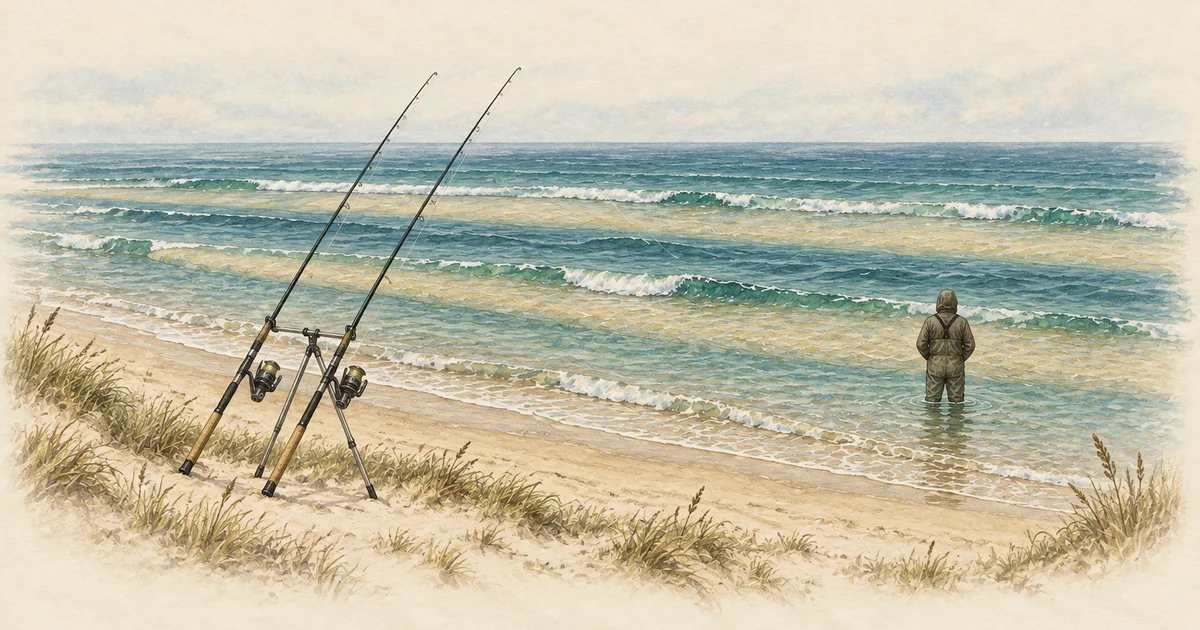
Off a sandy beach lie sandbars with deeper channels between them. Coastal protection in Mecklenburg-Western Pomerania calls the sandbars reefs and counts, as a rule, 2 to 3 off flat coasts and 1 to 2 off steep coasts (Generalplan Küsten- und Hochwasserschutz). This arrangement is not fixed: in the sea the seabed can change in a short time, and sandbars form or disappear (DLRG).
The map shows how to recognise a promising spot. Tap a number:
- Colour of the water: Dark water shows a channel with eelgrass and mussels, lighter water behind it sandy ground (Blinker).
- Sandy ground: For flatfish, sand that slopes away gently and reaches far out counts, with eelgrass and mussel beds nearby.
- Leopard ground: dark, overgrown rocks alternating with light sand, often in front of steep shores. A place for sea trout (Blinker).
- The first channel: Sea trout often hunt close inshore. Fish the channel at the shore before you wade far out (Blinker).
- Gap in the sandbar: Gaps in a sandbar are no place for wading. According to the DLRG, the dammed-up water breaks seawards through the surf zone there with great force (Rip current). This text does not replace instruction on site.
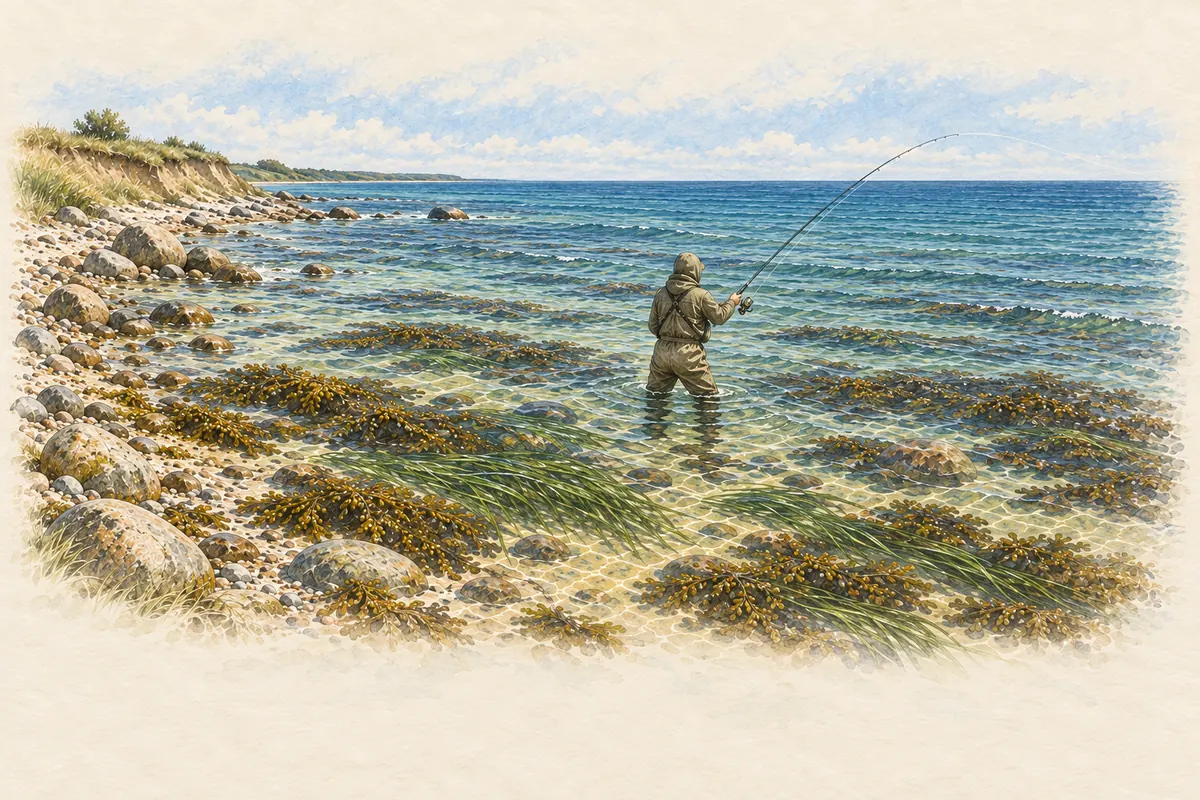
Baltic and North Sea: tides, mudflats and tidal channels
On the German North Sea coast the tidal range lies between roughly one metre and over four metres (BSH). In the Baltic the tides change the water level by only 10 to 30 centimetres. The wind has more effect there: a strong wind raises or lowers it by a few decimetres (Deutscher Wetterdienst).
North Sea
Ebb and flood raise and lower the water by roughly one to over four metres, depending on the place. Allow for the way back.
Baltic Sea
The tides move the water by only 10 to 30 centimetres. A strong wind raises or lowers it by a few decimetres.
Drawings: AI-generated, schematic.
In the Wadden Sea, wide areas are left dry at low water. The DLRG gives rules for this (DLRG Meldorf, DLRG St. Peter-Ording):
- Find out about the tides and allow enough time for the way back.
- Never go out on the tidal flats alone, and tell someone beforehand.
- Avoid the vicinity of tidal channels (Priele) on a rising tide. At flood they fill first and then have a strong current.
- You do not go onto the mudflats at dusk, in darkness, storm, fog or thunderstorm.
- Observe the no-entry rules in the protection zones of the Wadden Sea National Park.
Water pulls even without mudflats: the undertow in the surf can knock adults off their feet even in shallow water (DLRG). More on wading is under Shore and waders; you check the wind with Weather by the water.
Which fish you catch from the shore
A flatfish of the surf. Flounders like to bite at dusk from sunset, sometimes all night (Blinker).
A flatfish of the surf like the flounder, most promising at dusk.
The third flatfish of the surf, same spots and times as flounder and plaice.
The fish of the wading angler, over leopard ground and often in the first channel close inshore.
Baltic 2026: recreational fishing banned, put every cod back at once.
Is also caught in the surf.
Is also caught in the surf.
When it is on the coast is shown by the bar from the catch calendar.
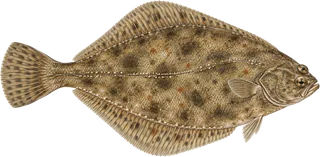
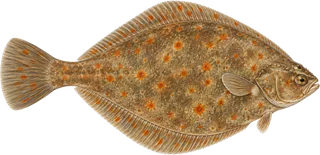
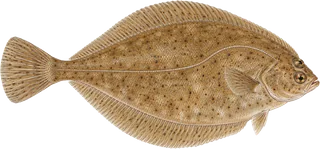
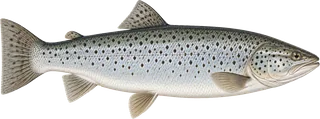
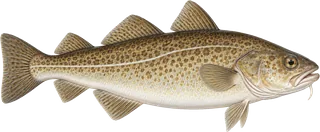
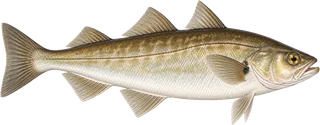

Fish pictures: AI-generated illustrations. A click opens the portrait.
The bars come from the Catch calendar and apply to the North Sea and Baltic together. For the Baltic the rules below apply in 2026.
Where to cast and when
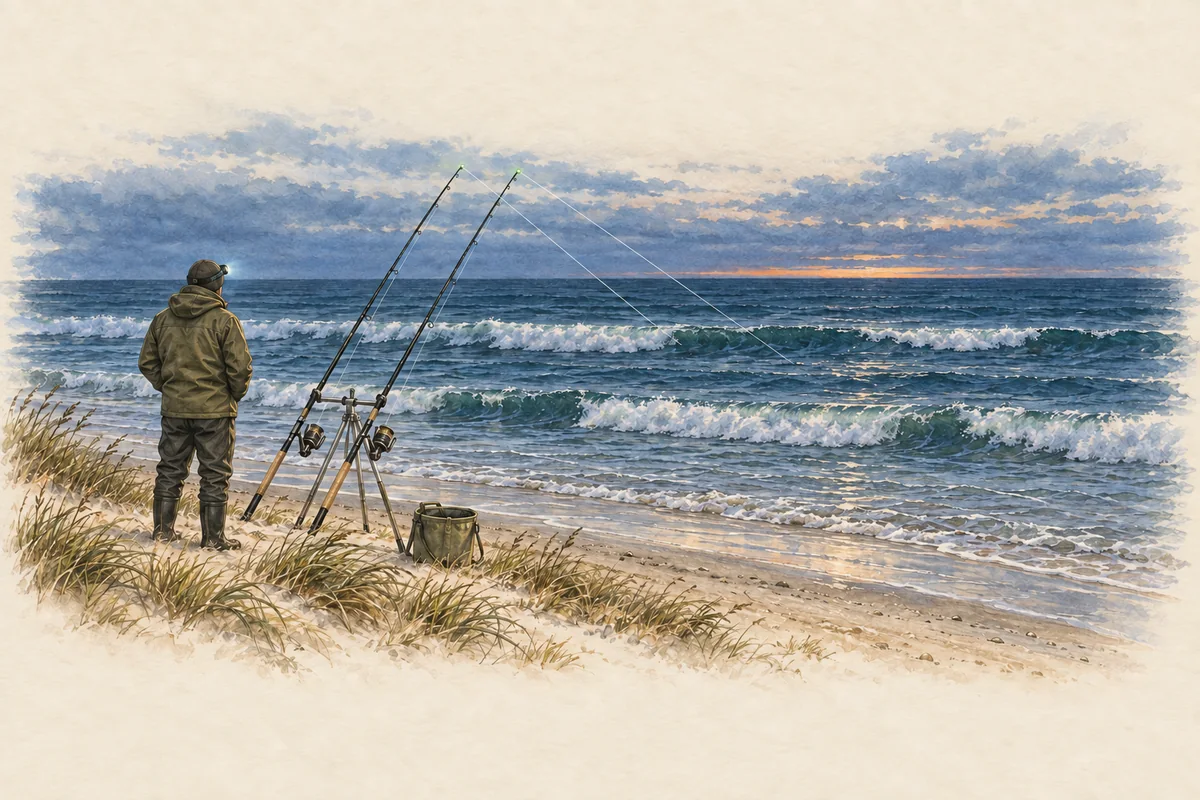
The casting distance depends on the beach. For flatfish Blinker gives 40 to 100 metres on most beaches; sometimes they sit even closer to the shore (Blinker). The sea angling officer of the Deutscher Angelfischerverband (DAFV) writes that he fished directly in the troughs between the beach and the first sandbar, that is in the shallow hollow right in front of you. Blinker, on the other hand, calls the sandbar itself the home of flatfish. The sources see this differently, so it is worth covering both areas. How to stagger your rods for this is explained on the page Surf fishing.
There is an expert statement on the time of day: according to the Thünen-Institut, large flounders lie buried in the sand by day and move into shallower water at night to feed (Fischbestände online). The angling press adds what anglers observe; it has not been measured. Choose your position on the beach:
Calm, clear sea
In calm seas and clear water, flatfish catches from the beach mostly succeed only in the evening and at night (Blinker).
Waves and cloudy water
In churned-up water and dull weather they often succeed all day (Blinker). An onshore wind is said to cause cloudiness and water movement and send the flatfish out to look for food (Blinker).
For the hours after sunset, read Night fishing.
Methods and rigs
In the surf
Tackle, lead and set-up for the beach are covered in Surf rig. You find natural baits in the Bait overview.
When wading
For wading, read Spin fishing and Fly fishing.
Beach, breakwater, boat
Sea fishing gives the overview of beach, breakwater, boat and charter boat.
Drawings: AI-generated, schematic.
Papers: three coastal states, three sets of rules
Papers, minimum sizes (Mindestmaße) and bans depend on the coastal state. Choose yours:
Lower Saxony
The fisheries act (Fischereigesetz) declares fishing for fish and crustaceans in coastal waters free (§ 16 Nds. FischG). Minimum sizes (Mindestmaße) and closed seasons (Schonzeiten) of the coastal fisheries regulation still apply (§ 6 NKüFischO).
- Sea trout: minimum size (Mindestmaß) 40 centimetres, closed season (Schonzeit) 1 October to 15 February (§ 6 NKüFischO)
- Eel: recreational fishing in coastal waters banned (Fischereiamt Niedersachsen)
Schleswig-Holstein
You need the fishing licence (Fischereischein) and pay the state’s fishing levy (Fischereiabgabe), even if you have already paid in another federal state (Bundesland). Without an exam there is the holiday fishing licence (Urlauberfischereischein) for 28 days, extendable once a year by another 28. You only need a fishing permit (Erlaubnisschein) on the coast in the Schlei, in the inner Neustädter Bucht, in the inner Lübecker Bucht including Travemündung and in the Untereider from the B5 bridge near Tönning (State of Schleswig-Holstein, FAQ, information sheet).
- Sea trout: minimum size (Mindestmaß) 40 centimetres. Fish in spawning dress are protected from 1 October to 31 December, silvery fish with loose scales are not (Anlage 1 KüFVO)
- Plaice: 27 centimetres in the North Sea, 25 in the Baltic
- Eel: recreational fishing banned in the North Sea and Baltic. Exceptions are the lower Elbe, the Untereider and the Schlei and Trave, each on the inland side (Schleswig-Holstein information sheet, State of Schleswig-Holstein on eel)
Mecklenburg-Western Pomerania
Here it is always three documents: fishing licence (Fischereischein), angling permit (Angelerlaubnis) and proof of the fishing levy (Fischereiabgabe). Without an exam there is the tourist fishing licence (Touristenfischereischein) for up to 28 days. You need the angling permit for the Bodden, lagoons (Haffe) and the Baltic as well (LALLF). At most three hand-held rods are allowed (§ 9 KüFVO M-V).
- Sea trout: minimum size (Mindestmaß) 48 centimetres, closed season (Schonzeit) 15 September to 14 December, at most three per fishing day
- Salmon: minimum size (Mindestmaß) 60 centimetres, closed season (Schonzeit) 15 September to 14 December
- Plaice, flounder and dab: 25 centimetres each
- Eel: banned for anglers in 2026 (LALLF, Mindestmaße und Schonzeiten)
As of: October 2026. An amended coastal fisheries regulation (Küstenfischereiverordnung) has applied in Mecklenburg-Western Pomerania since the end of September 2026; older overviews still give other sizes. More on the papers: Fishing licence and angling exam, Fishing permit and water map.
Cod and salmon: EU rules for the Baltic 2026
- Cod, Baltic: Recreational fishing for cod is banned in 2026. You put back every cod caught by accident without delay (Verordnung (EU) 2025/2454, Art. 10).
- Salmon, Baltic: You may keep one salmon with a clipped adipose fin per day. After that, salmon fishing is over for the day. All other salmon go back (Art. 11). The minimum size (Mindestmaß) and closed season (Schonzeit) of your coastal state also apply: 60 centimetres, in Mecklenburg-Western Pomerania protected from 15 September to 14 December, in Schleswig-Holstein fish in spawning dress from 1 October to 31 December (LALLF, Schleswig-Holstein information sheet).
The EU rules for cod and salmon apply for 2026 only. For 2027 the EU Fisheries Council will set them anew (State of Schleswig-Holstein). Check before the turn of the year what will apply then. Since 10 January 2026 Germany must also ensure that sea anglers are registered and report certain catches electronically: for now eel, cod and salmon in the Baltic, sea bass and eel in the North Sea. Whether the obligation already applies to you is stated on Portal Fischerei.
Common mistakes
- Looking at the beach only after dark. Blinker advises checking suitable flatfish beaches in daylight.
- Casting every rod far out although the fish may be feeding right in front of you: shortening one rod costs nothing.
- Wading far out although, according to Blinker, sea trout often strike in the first gully close to the shore.
- Walking out onto the mudflats on the North Sea without a tide table, or ignoring the wind on the Baltic Sea.
- Keeping a cod in the Baltic Sea or deliberately fishing for it: in 2026 this is prohibited.
- Using an older overview of sizes and papers: the rules of the coastal states and the EU change.
Before you set off
- Papers for your coastal state: in Schleswig-Holstein and Mecklenburg-Western Pomerania a fishing licence (Fischereischein) or holiday or tourist licence and fishing levy (Fischereiabgabe), in Mecklenburg-Western Pomerania also the angling permit (Angelerlaubnis)
- North Sea: tides checked and the way back planned. Baltic Sea: wind checked with Weather at the water
- Looked at the beach in daylight: gullies, sandbars, gaps
- One rod cast shorter, for the trough in front of you
- Tape measure with you, minimum sizes and closed seasons of your coastal state in your head
- Baltic Sea: release any cod straight away
- Never on the mudflats alone, and someone told where you are
- Avoid gaps in the sandbar when wading
Frequently asked questions
How far do I need to cast on the beach?
For flatfish, Blinker gives 40 to 100 metres on most beaches, and sometimes they feed right in front of you. So do not put everything out far, and check both zones.
When do flatfish bite best in the surf?
In calm, clear seas mostly in the evening and at night according to Blinker, in waves and murky weather often all day. This is an observation from the angling press, not a measurement.
Can I keep a cod in the Baltic Sea in 2026?
No. EU Regulation 2025/2454 prohibits recreational fishing for cod in the Baltic Sea for 2026. A fish caught by accident goes straight back into the water.
Do I need a fishing licence on the coast?
Each coastal state decides this. In Schleswig-Holstein you need the fishing licence (Fischereischein) plus the fishing levy (Fischereiabgabe), in Mecklenburg-Western Pomerania an additional fishing permit. Visitors get a licence there for up to 28 days.
Examples in the areas
These area pages describe waters of this type with their local rules:
Germany: Baltic coast of Schleswig-Holstein, Baltic coast of Mecklenburg-Western Pomerania, North Sea coast, Fehmarn, Schlei, Fishing in Lower Saxony, Fishing in Schleswig-Holstein
Denmark: West coast of Jutland, Funen, Langeland and the South Funen Archipelago, Bornholm, Zealand and Møn, North Jutland with Hirtshals and Skagen, East Jutland and Djursland, Lillebælt, Als and South Jutland, Lolland and Falster
Sweden: West coast of Sweden: Bohuslän and Halland, Scania and the Øresund, Gotland
Poland: Polish Baltic coast
The Netherlands: Zeeland and the delta waters, North Sea coast and Wadden Sea, North Holland coast
Italy: Northern Adriatic, Sardinia
Related
- Surf fishing: how it works on the beach, tripod and bite detection
- Surf rig and Natural bait rig for the sea: how the hooklength is built
- Surf rod: length and casting weight for the tackle
- Sea fishing: beach, pier, boat and charter boat at a glance
- Shore and waders, Tides: ebb and flood
- Closed season and minimum size explained, Releasing a fish
- Fishing in harbours and from piers and Bodden and fjord
Sources
- Verordnung (EU) 2025/2454 des Rates vom 1. Dezember 2025: Fangmöglichkeiten in der Ostsee 2026, Art. 10 und 11
- Niedersächsisches Fischereigesetz, § 16; Niedersächsische Küstenfischereiordnung, § 6; Staatliches Fischereiamt Bremerhaven
- Land Schleswig-Holstein: Fragen und Hinweise zur Angelfischerei (26.02.2026), Freizeitfischerei auf Dorsch 2026, Merkblatt zum Urlauberfischereischein (Stand März 2026), Küstenfischereiverordnung
- LALLF Mecklenburg-Vorpommern: Fischereischein und Angelerlaubnis, Fünfte Verordnung zur Änderung der Küstenfischereiverordnung (11. September 2026)
- Portal Fischerei: Registrierung und Fangmeldung beim Meeresangeln (Stand 5. Februar 2026)
- Bundesamt für Seeschifffahrt und Hydrographie: Gezeiten; Deutscher Wetterdienst: Gezeiten an Nord- und Ostsee (15.03.2026)
- DLRG: Sicherheit im Watt, Gefahren im Watt, Gefahren im Wasser, Gefahren in Küstengewässern
- Generalplan Küsten- und Hochwasserschutz Mecklenburg-Vorpommern (Riffe und Rinnen vor der Außenküste)
- Deutscher Angelfischerverband: Steinbutt, Flundern und Sonnenbrand (Wannen zwischen Strand und erster Sandbank)
- Thünen-Institut: Fischbestände online, Flunder (Aktivität nachts)
- Blinker: Brandungsangeln, Plattfische mit Wurm vom Ufer, Plattfischangeln, 10 Tipps, Angeln in Dänemark, Ostsee, die Silberküste, Steckbrief Meerforelle
- Saisonbänder der Fischkarten: Fangkalender von Angel Momente (redaktionelle Einschätzung mit den dort genannten Quellen)
Text AI-assisted, drawings AI-generated. Sources opened and checked in October 2026; no graphics taken from the sources.
Guide without guarantee. As of 26 October 2026, checked against state law and authority websites. What counts is the fisheries law of the coastal state concerned, the EU regulation on fishing opportunities and the rules on site.