
Knowledge – Fish
Flounder: Features, brackish water, season and baits
The flounder (Platichthys flesus) is a flatfish of European coasts and the only one that regularly occurs in fresh water. It likes brackish water and, especially as a young fish, ascends far up the rivers. Many anglers simply call it Butt.
In brief: You catch flounder best from July to October, mainly at night. Good spots on the coast: sandy bottom and surf; in rivers: rock armouring and the edge of the current. Proven baits: lugworm and ragworm on the bottom, also prawns, mussel meat or slim strips of fish; from a boat also a flounder spoon (Buttlöffel) with worm; in shallow water with a spinning rod also small soft plastic lures. The only native flatfish that ascends far up the rivers. In the Baltic off Schleswig-Holstein, the minimum size (Mindestmaß) and closed season (Schonzeit) are suspended until 31.12.2026; in Mecklenburg-Western Pomerania a minimum size of 25 cm applies (as of October 2026). Step by step: Fishing for flounder.
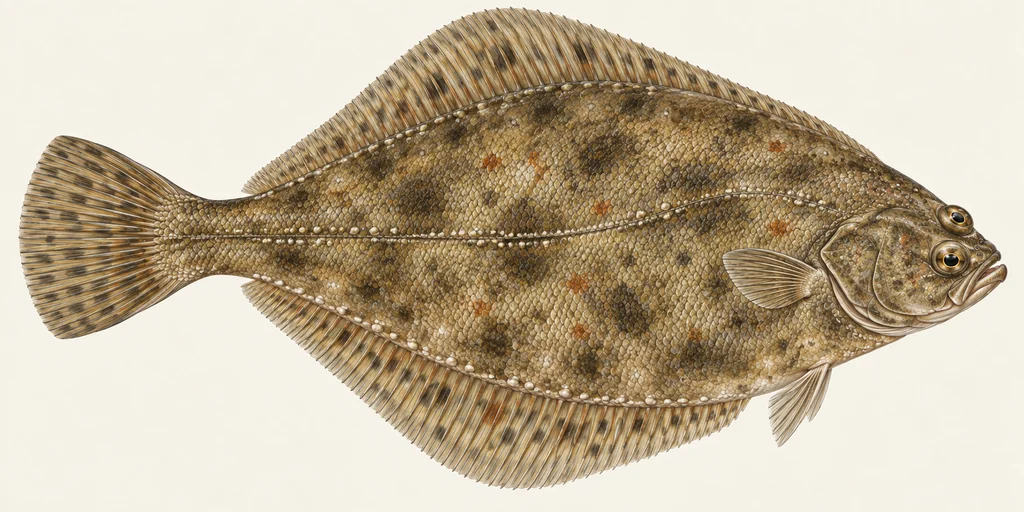
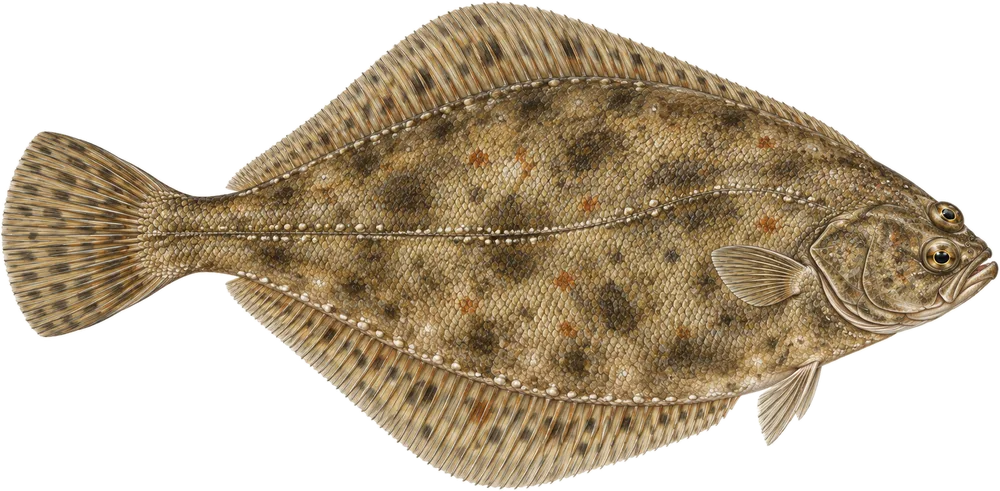
- Rough bony bumps along the lateral line and at the base of the dorsal and anal fins
- Almost straight lateral line, only slightly arched over the pectoral fin
- Brownish to olive-green eyed side with pale, irregular reddish spots
Catch chances through the year
- Hardly any chance
- Possible
- Good
- Peak season
- Spawning (observe the closed season)
Editorial assessment for waters in Germany, not a measured value and no guarantee. Spawning time is not the same as the legal closed season.
Species profile and sources in the catch calendarAll species compared month by monthThe rules of your federal state
How to recognise it
The flounder has an oval, strongly flattened body and a small mouth. Unlike the plaice, the eyed side is not fixed: about 70 per cent of the fish are right-eyed, and up to a third have both eyes on the left. The larvae first swim upright, and at a length of about ten millimetres one eye moves to the future upper side.
The eyed side is brownish to olive green with pale, irregular red spots, the blind side white. The colour adapts to the ground. The rough skin is typical: thorny bony bumps sit on the lateral line, on the gill cover and at the base of the dorsal and anal fins. The lateral line runs almost straight and arches only slightly above the pectoral fin.
Flounder are usually 20 to 30 centimetres long and weigh about 300 grams on average, exceptionally 50 centimetres at two to three kilograms. FishBase and the Norwegian Institute of Marine Research give 60 centimetres and 2.9 kilograms as maximum values. Females grow larger than males of the same age.
The skin sets it apart from plaice and dab. If you stroke over the lateral line and the base of the fins, the flounder feels like sandpaper. The plaice is smooth all over and has bright red spots and bumps on the head. You recognise the dab by the curve of the lateral line behind the head. If you catch a flatfish in a river, it is always a flounder, according to the anglers‘ association (Angelfischerverband).
The Baltic is also home to the Baltic flounder (Platichthys solemdali), described only in 2018. The two species can only be told apart with special knowledge, so the International Council for the Exploration of the Sea (ICES) initially combines them in its stock calculations. Where flounder and plaice spawn together, for example in the southern Belt Sea, hybrids with somewhat smoother skin and indistinct red spots occur.
Side by side
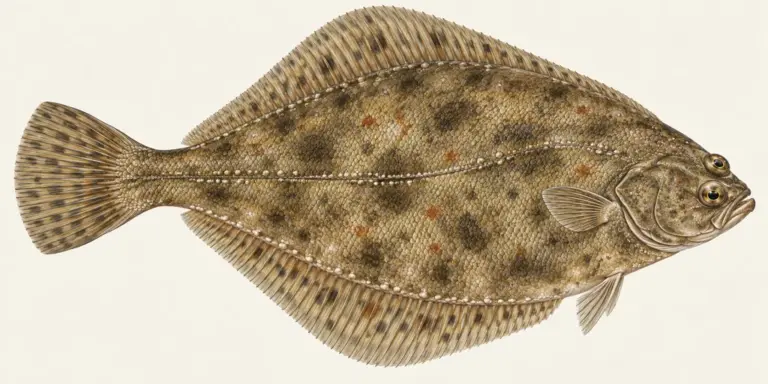
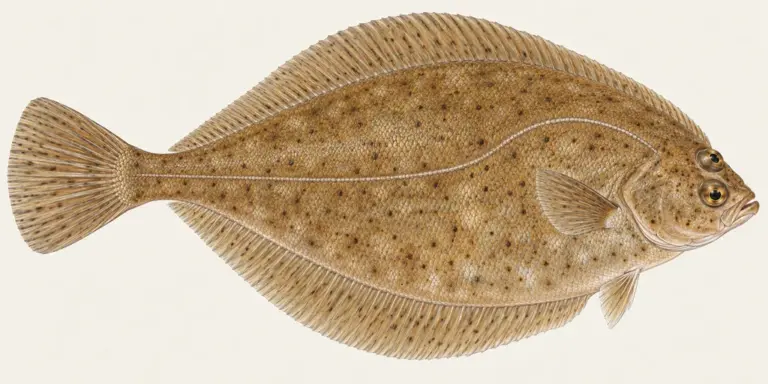
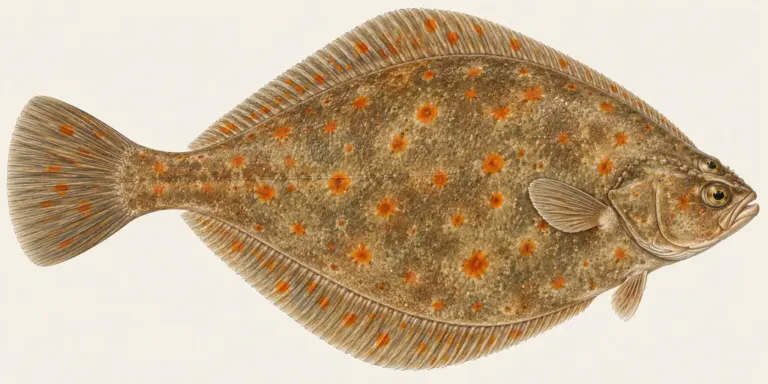
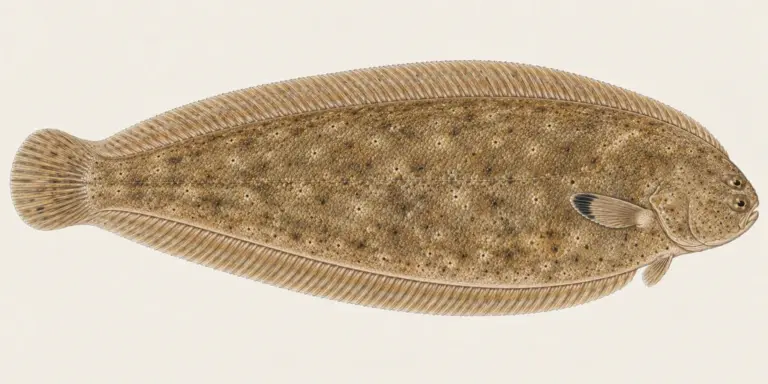
AI-generated illustrations.
Where it lives
The flounder lives on the coasts of the north-eastern Atlantic from the White Sea to North Africa. In the Baltic it occurs almost everywhere, missing only from the northern Bothnian Sea and the eastern Gulf of Finland. It lies on sandy, silty or mixed ground, from 1 to 100 metres deep according to FishBase.
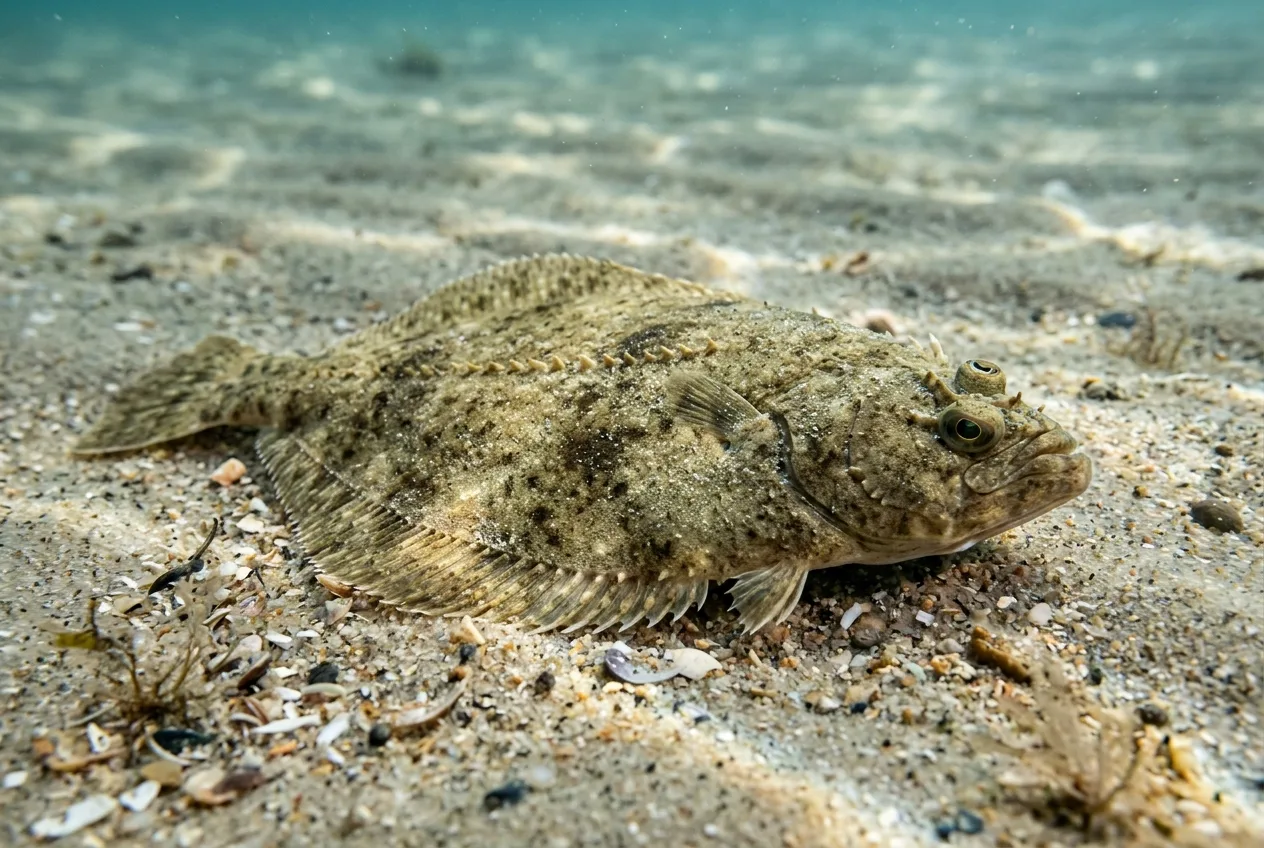
It is the brackish-water specialist among the flatfish. In summer you find it in river mouths, lagoons, fjords and firths, and it often penetrates far up the rivers, especially as a young fish. In the Rhine it has been observed regularly since the end of the 1980s, and it is also caught in the middle reaches of the Elbe. In many rivers its journey ends at the first weir or similar barrier, because fish passes are missing. Danish researchers rate it as more tolerant of high temperatures and fluctuating salinity than the plaice.
In winter the adult fish move into deeper, warmer and saltier water and spawn there in spring.
Holding spots in the picture
Choose the season and time of day: the picture shows where the species stands then. Spots outlined in red apply only in the chosen season. Tap a fish or a spot in the list to bring it closer. The picture is schematic and AI-generated, every water is different.
Catch chance in springpossibleSpawning season, observe closed seasons
Catch chance in summerPeak season
Catch chance in autumnPeak season
Catch chance in wintergood
- J
- F
- M
- A
- M
- J
- J
- A
- S
- O
- N
- D
Spawning season
Not a prime time The flounder is active at night; in slightly clouded water flatfish feed during the day too.
Not a prime time The flounder is active at night; in slightly clouded water flatfish feed during the day too.
Not a prime time The flounder is active at night; in slightly clouded water flatfish feed during the day too.
Active time The flounder is active at night; in slightly clouded water flatfish feed during the day too.
On the coast
Surf close to the shore
Flounder are present here only in spring, summer and autumn.
Sandy bottom
Flounder are present here only in spring, summer and autumn.
Deep, colder water
Flounder are present here only in spring and winter.
Flounder live on the bottom over sand, silt and gravel, preferring the brackish water of river mouths, firths and bays. By day mainly large fish bury themselves; at night they move into shallow water to feed. When the water is slightly clouded, flatfish feed in the surf by day too.
Spring: according to the catch calendar, chances of a catch are possible in March and April and good in May. Spawning falls in this period, so observe the closed seasons (Schonzeiten). To spawn, flounder move into deeper sea. In the North Sea they spawn from February to May at a depth of about 20 to 40 metres.
Summer: according to the catch calendar, chances are good in June and peak season in July and August. In summer flounder stand in river mouths, lagoons and firths. From there they often push far up the rivers, today usually only as far as the first weir or barrier.
Autumn: catch chance according to the catch calendar is peak season in September and October, good in November.
Winter: according to the catch calendar, chances are good in December and January and possible in February. In winter the adult fish move into deeper, saltier water. On the way many pass through the Kiel Canal (Nord-Ostsee-Kanal), where flounder are the most common catch in winter.
In the river
riprap, sheet piling, harbour
Flounder are present here all year.
Current seam
Flounder are present here all year.
In the Port of Hamburg, that is in the fresh water of the tidal Elbe, flounder are caught along the sheet piling of the harbour basins. There they stay in sandy channels, pits and hollows near the main stream and on the slopes of the fairway; with the rising water they move from there onto the sandbanks. They prefer hard sandy ground to soft mud.
Spring: according to the catch calendar, chances of a catch are possible in March and April and good in May. Spawning falls in this period, so observe the closed seasons (Schonzeiten).
Summer: catch chance according to the catch calendar is good in June and peak season in July and August.
Autumn: catch chance according to the catch calendar is peak season in September and October, good in November.
Winter: according to the catch calendar, chances are good in December and January and possible in February.
Depth: Flounder occur from the shoreline down to a depth of about 100 metres. In the Baltic they stand at almost any depth, near the beach just as in more than 20 metres.
Size comparison: AI-generated drawing, schematic.
How it feeds and spawns
By day the flounder lies buried in the bottom, with only the eyes showing. According to Danish observations it is most active at sunrise and sunset and at high water, and at night it stands higher in the water column. In the sea it eats bristle worms, crustaceans, thin-shelled mussels and small fish, in fresh water insect larvae. Older fish take more molluscs and fish, younger ones mainly crustaceans.
To spawn it moves into deeper sea water in winter. In the North Sea it spawns at around 20 to 40 metres, in northern waters from February to June according to Norwegian sources. The eggs drift freely in the water, and a female releases 400,000 to 2 million of them. The larvae drift to the coast, and the young fish spend the first two summers in the shallowest water.
Males mature at two to three years and 20 to 25 centimetres, females at three to four years and 25 to 30 centimetres.
When it bites
Blinker gives mid-June to the end of September as the best time; in surf fishing autumn up to the end of October is the strongest phase, and in November they still bite well. In winter the fish stand deeper, and then you catch them mainly from a boat. An exception is the Kiel Canal (Nord-Ostsee-Kanal): on their way from brackish water to the spawning grounds in salt water, many flounder pass through in autumn and winter, and there winter counts as the main season.
By day flounder are rather sluggish. At dusk they become active and move into the shallows, and the best catches come after dark. After a storm, churned-up worms, snails and prawns drift over the bottom, and then they bite particularly well on beaches. In slightly cloudy water they also hunt in the shallows by day. If you fish by day, it is best to go on dark days, in autumn or onto a mole.
Today’s catch index needs JavaScript. Season and spawning time are in the catch calendar.
You will find the monthly overview of all species and the water temperature check in the catch calendar.
From the blog: Fishing in November: which fish bite now and where I look for them
What to catch it with
Step by step: Fishing for flounder: tips on bait, rig and tackle – season, spots, bait, tackle and rules on one page.
Flounder come a long way to meet the angler. You catch them when surf fishing on the beach, from mole and harbour, in brackish bays and from a boat. With an onshore wind and in the dark they stand close to the shore, in the Baltic often already on the outer side of the first sandbank, sometimes only 40 metres out. Lighter tackle is enough there, and on the Baltic beach a carp rod is usually sufficient in summer.
Far out you fish a surf rig with two hooks. Bait clips stop the lugworm from tumbling or tearing off in the cast. In little swell you may choose snoods up to about 70 centimetres long; in strong wind you shorten them to 10 to 20 centimetres. One to three small beads or a small attractor spoon behind the hook make the flatfish curious. Long-shanked hooks of size 4 to 2 are used; larger ones up to 2/0 spare the fish. According to a study by the Thünen-Institut, flounder swallow the hook deeply more often than plaice and dab, and small hooks more often than large ones. So do not wait long on a bite: when the plucking turns into steady shaking, you wind in.
From a boat you drift over sandy areas with a running ledger rig. In five metres of Baltic water a pear lead of about 40 grams is usually enough, with a single hook on a hooklength 40 to 50 centimetres long. That way you feel cautious bites at once. The Buttlöffel also belongs here: a spinning rod with a spoon that attracts the curious fish.
The best baits are ragworm and lugworm. As a substitute you take prawns, mussel meat, slim strips of herring or mackerel, sand eels or thin strips of squid. Keep everything small, since the mouth is hardly bigger than that of a medium bream. Cut large worms in two. Moving baits catch more than ones lying still, so inch the bait slowly over the bottom. In shallow water you can also fish for flounder with a spinning rod and small soft plastic lures.
Adjust the snoods: In little swell the side arms of the rig may be up to about 70 centimetres long; in heavy swell you shorten them to 10 to 20 centimetres.
Go to the water after a storm: When the water is still churned up and worms and prawns have been washed free, the flounder come in close under the shore.
Protect your hands: The rough skin chafes. After several fish the hands look battered. Fishing gloves help.
Suitable lures
Lugworm and ragworm on the bottom, also prawns, mussel meat or thin strips of fish; from a boat also a flatfish spoon (Buttlöffel) with worm; in shallow water also small soft plastic lures on a spinning rod.
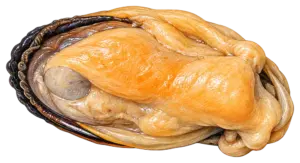
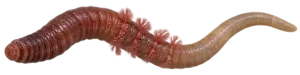
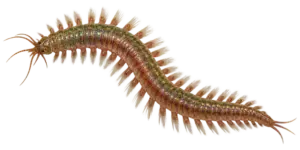
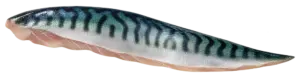
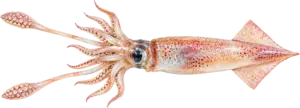
AI-generated illustrations. A click opens the lure’s page.
Rigs for these baits: surf rig, side-arm rig, natural-bait rig for the sea.
Choose small baits and move them slowly along the bottom.
What flounder tastes like and what to do with it
According to the Thünen-Institut, flesh and flavour are very similar to plaice, but flounder fetches a much lower price in the trade, and fillets of the two species are repeatedly mixed up there. The angling press recommends medium-sized flounders; with large females the flesh is often soft and bland to bitter.
Before that, the fish must be stunned and killed. How to fillet and smoke flatfish is explained in the encyclopaedia.
What you need to observe
Closed seasons, minimum sizes and harvest slots are set by the federal states (Bundesländer) and by the fisheries authorities of the neighbouring countries on the coast (Denmark, Norway, Poland). They vary by type of water, stretch of coast and time of year. We only give figures together with the date and source; the fisheries regulation of your federal state and your fishing permit (Erlaubnisschein) are always what is binding. You will find a list of links to the official sources in the catch calendar.
A fish of legal size that you want to keep you stun and kill at once, in line with animal welfare rules. Protected, undersized fish or fish too large under a harvest slot you unhook, if possible still in the water and with wet hands, and release gently. What exactly applies is regulated by state law and your fishing permit (Erlaubnisschein).
In the Baltic the catch rules for sea anglers change from year to year; in estuaries and rivers state law applies. The flounder was Fish of the Year 2017, chosen by the Angelfischerverband and the Bundesamt für Naturschutz to draw attention to weirs as barriers to migration. According to the Thünen-Institut it is considered not endangered in Europe and worldwide.
What closed season, minimum size and harvest slot mean and where to find them is explained on the page Closed season and minimum size explained.
What state law says about the closed season (Schonzeit) and minimum size (Mindestmaß) for this species is in the “At a glance” box on the state pages for Bremen, Mecklenburg-Western Pomerania and Schleswig-Holstein. For the other states our overview does not list this species; there the state fisheries regulation (Landesfischereiverordnung) is decisive.
Frequently asked questions (FAQ)
Can I catch flounder in rivers?
Yes, it is the only flatfish that can survive in fresh water. They are caught in the Rhine and the middle Elbe, for example, mostly up to the first weir. The rules of the federal state (Bundesland) apply there.
When do flounders bite best?
At dusk and at night, especially on the beach after a storm. During the day it works in murky water, on dark days and in autumn.
Which hook and which pieces of bait work best?
A long-shank hook in size 4 to 2 with small pieces of bait; large worms are cut up. Larger hooks up to 2/0 catch hardly fewer fish, according to a Thünen study, but are less often swallowed deeply.
Sources
The rating of catch chances is an editorial assessment. The facts come from these sources, and the text is worded in our own words. The illustration is an original design by Angel Momente in the style of a natural history plate (AI-generated, see the AI notice).
- FishBase: Platichthys flesus
- Thünen-Institut, Fischbestände online: Flunder
- Havforskningsinstituttet: Skrubbe (Flunder)
- DAFV: Fisch des Jahres 2017, Flounder
- DTU Aqua, Fiskepleje.dk: Skrubbe (Flunder)
- Blinker: Steckbrief Flunder
- Blinker: Plattfische unterscheiden, Flounder, Kliesche und Scholle
- Blinker: Plattfischangeln, 10 Tipps
- Blinker extra: Die Fische der Ostsee und wie man sie beangelt (Stand 2007)
- Thünen-Institut: Working Paper 262, Selektivität und Überlebensraten nach dem Zurücksetzen in der Angelfischerei auf Plattfische (Hakengröße, schneller Anhieb, Uferanteil der Fänge)
- Blinker: Brandungsangeln, alles über die Methode (Herbst als beste Brandungszeit)
- Blinker: Plattfischangeln im Nord-Ostsee-Kanal, mit der Kälte kommt der Butt (Flundern im Winter)
- Wikipedia: Flunder
- DAFV: Fisch des Jahres 2017, Die Flunder (Broschüre, PDF; Kapitel zum Flunderangeln im Hamburger Hafen)
Created with AI support from the sources listed. Figures only appear in the text if a source gives them. Last updated: 1 November 2026. Found a mistake? Write to us. Who is behind this site: About me.
More in the lexicon
- All fish species at a glance
- Catch calendar – month, water temperature and profile for 93 species
- Line calculator – breaking strain after the knot, drag guideline, backing
- Angling methods