
Waters · Denmark
Fishing on Lolland and Falster
Lolland and Falster are Denmark’s southern islands, separated by the Guldborgsund. All around lie sounds, fjords and noors with brackish water, home to perch and pike, plus an open Baltic coast with sea trout and garfish. Perch and pike are subject to their own strict rules here.
- Papers
- Fishing licence (fisketegn); in fresh water the owner’s permission
As of October 2026
At a glance
- Papers
- Fishing licence (fisketegn); in fresh water the owner’s permission
- Licence and permit
| Fish | Minimum size | Closed season | Catch limit | Note |
|---|---|---|---|---|
| Pike | 60 cm | 1.4.–15.5. | – | Guldborgsund, Storstrømmen, Grønsund and many streams: every pike goes back; elsewhere in fresh water 15.3.–30.4. |
| Perch | 24 cm | none | 3 per day | Maximum size 30 cm; in designated streams no perch 1.3.–30.4. |
| Sea trout | 40 cm | 16.11.–15.1. | – | coloured fish in spawning dress; in fresh water 16.11.–28.2. |
| Garfish | – | none | – | |
| Flounder | 23 cm | none | – | |
| Atlantic salmon | 60 cm | 16.11.–15.1. | 1 per day | only with clipped adipose fin, then finished for the day |
| Cod | – | Fishing ban 2026 | – | also from the shore |
| Eel | – | protected all year round | – | Fishing ban since 1.8.2026, salt and fresh water |
Danish regulations for salt water (Belts and Baltic Sea), Regulation No. 1673 on pike and perch and Regulation (EU) 2025/2454. As of: October 2026. The regulation and your fishing permit (Erlaubnisschein) are what count.
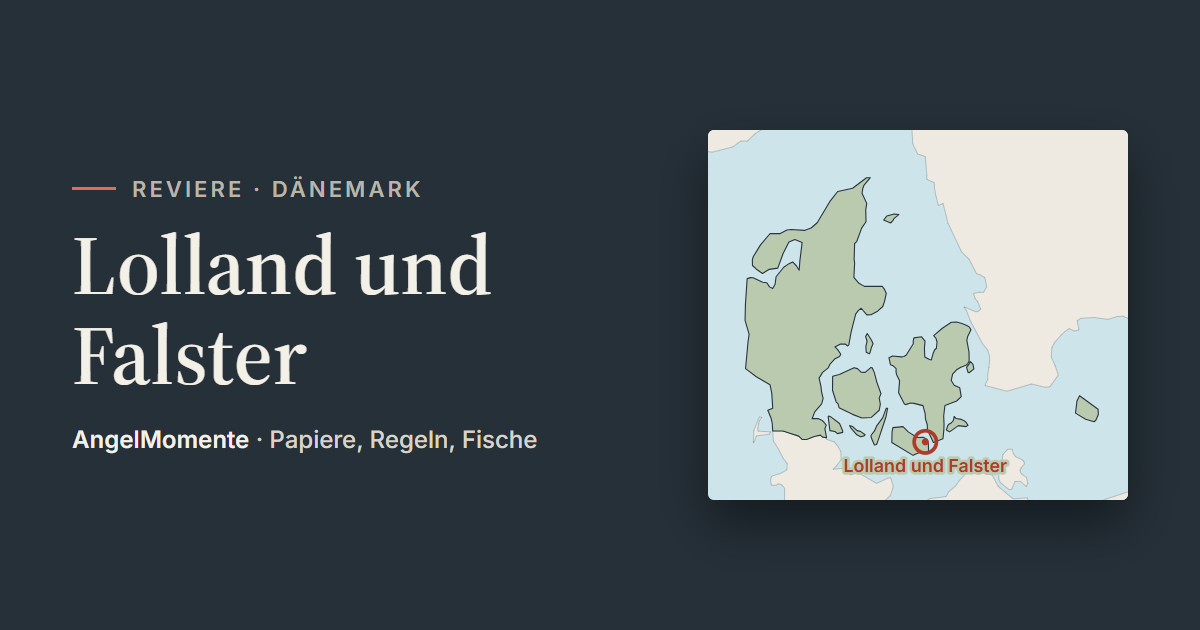
Location and waters Guldborgsund, Storstrømmen, Grønsund, Nakskov Fjord
North of the islands lie the Smålandsfarvandet with Nakskov Fjord and Sakskøbing Fjord, between Lolland and Falster the Guldborgsund, between Falster and Zealand the Storstrømmen, and between Falster and Møn the Grønsund (Regulation No. 1673, annexes 1 and 3). In fisheries law almost all waters around the islands belong to the Belts and the western Baltic Sea, and the boundary to the east follows the east coast of Falster to Gedser Odde (fisheries authority).
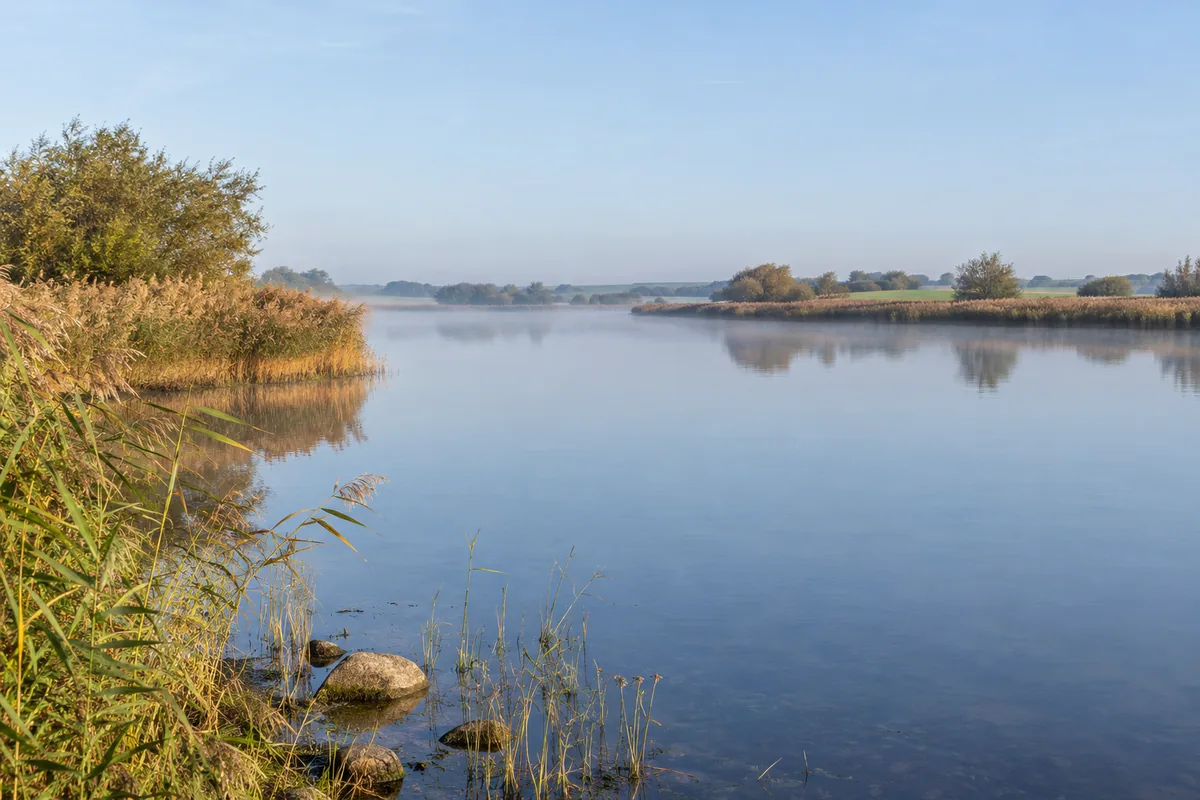
Danish brackish water contains 10 to 14 parts per thousand of salt (DTU Aqua). In the Guldborgsund, perch often live at more than 10 parts per thousand (DTU Aqua). From Fehmarn you take the Puttgarden–Rødbyhavn ferry to Lolland; a tunnel is under construction (Femern A/S).
Fish and best time Perch, brackish-water pike, sea trout, grey mullet
- Perch: It lives in the Guldborgsund and the Storstrømmen, among other places. To spawn it has to enter fresh water: perch from the Guldborgsund move into the Flintinge Å from September and spawn there in April (DTU Aqua).
- Pike: Brackish-water pike live on the coasts of Lolland-Falster. DTU Aqua tags them and asks anglers to report catches (DTU Aqua).
- Sea trout and grey mullet: The municipality of Guldborgsund names both for its coast (Guldborgsund Kommune). On the east coast of Falster you have chances of sea trout in spring and autumn (Naturstyrelsen).
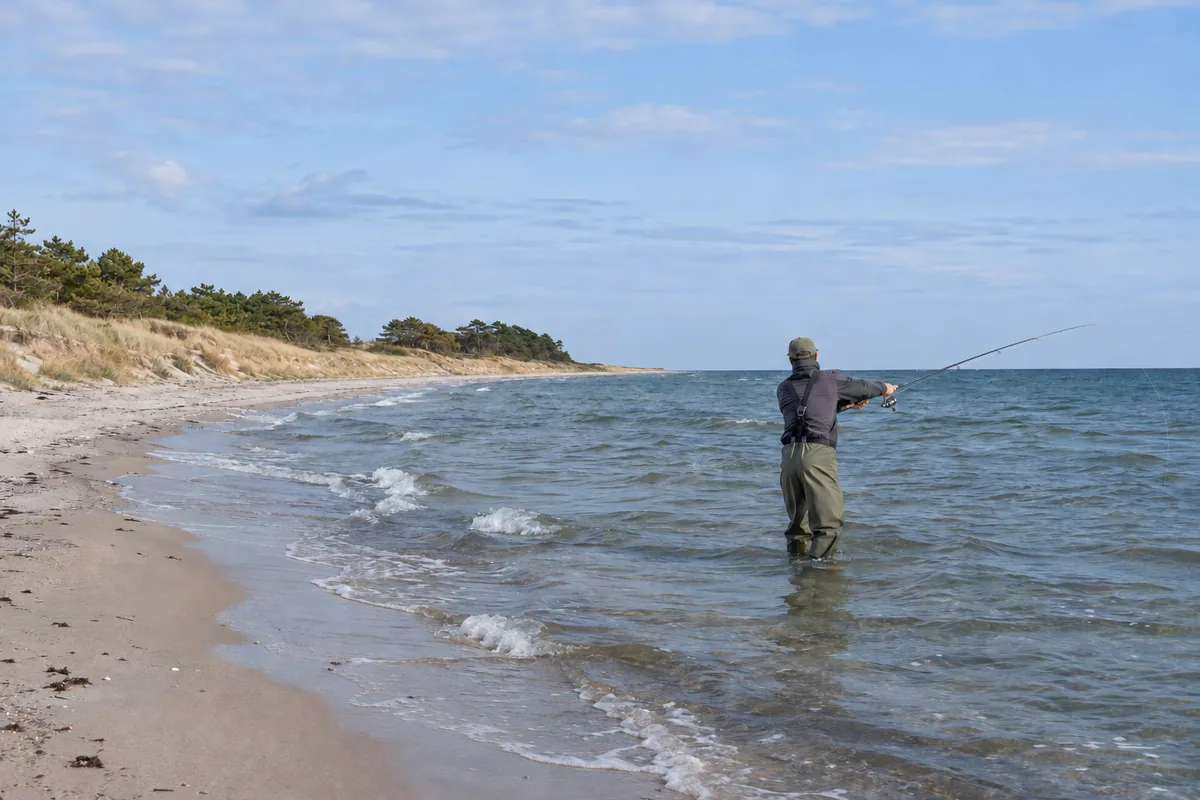
- Garfish: In May and June it comes right up to the beach on Falster’s east coast, best with an offshore wind (ibid.).
- Flounder: It lives almost everywhere in the inner Danish waters and becomes more common towards the Baltic (DTU Aqua).
For the other months the catch calendar helps.
Papers and permission Fishing licence (fisketegn), permission at the stream
- From the age of 18 you need the Danish fishing licence (fisketegn), up to Danish retirement age (Fisheries Act, § 54). fisketegn.dk gives 67 years. Anyone who does not need a licence registers there for 365 days before fishing in salt water (fisheries authority).
- On the coast the licence is enough. On streams and lakes you also need the owner’s permission; ask for it locally.
- At the water you give your licence number and show ID (Recreational Fishing Regulation, § 10). Purchase and prices are covered under Fishing in Denmark.
Special rules Pike go back and three regional regulations
Three regional regulations apply to the islands (overview of the fisheries authority). The main points:
- Pike: In the Guldborgsund with its bays, in the Storstrømmen east of the new bridge, in the Grønsund and in the sounds between Falster, Møn and southern Zealand you may not land any pike. Every pike goes straight back. The same applies in many streams on the islands (Regulation No. 1673, § 3). Nakskov Fjord and the Smålandsfarvandet west of the northern mouth of the Guldborgsund lie outside this area.
- Perch: From Nakskov Fjord via the Smålandsfarvandet, Sakskøbing Fjord and the Guldborgsund to the Grønsund and Hjelm Bugt a slot of 24 to 30 cm applies. You return smaller and larger fish at once and may keep no more than three a day. In designated streams no perch are allowed from 1 March to 30 April (§§ 5 to 7). The map in annex 5 of the regulation shows the exact boundaries.
- Cod: Fishing for cod is banned in 2026 in the Baltic Sea and the Belts, from a boat and from the shore. Every cod goes straight back (Regulation (EU) 2025/2454, Article 10; fisheries authority).
- Salmon: Per day you may keep one salmon with a clipped adipose fin, after which salmon fishing is over for that day (Article 11).
- Eel: Banned in salt and fresh water since 1 August 2026 (Regulation No. 670).
- Reporting catches: If you catch a protected species, you enter it in the RecFishing app on the same day, even if it goes back into the water (fisketegn.dk).
Protection zones: In front of stream and river mouths lie protection zones (fredningsbælter), usually 500 m around the mouth (fisheries authority, with map). The regulation for Lolland, Falster and Møn sets out where fishing there is banned all year and where from 16 September to 15 March. There are separate zones, for example, at the lock in the inner Nakskov Fjord and at the mouth of the Sakskøbing Å. In the adjoining stretch of the Å you may take only one trout and three perch per day (Regulation No. 1224).
Bøtø Nor: On the state land at Bøtø Nor on Falster, hunting and fishing are banned under the protection provisions (Naturstyrelsen).
As of: October 2026. The rules for pike and perch have applied since 1 January 2026; the cod ban and the salmon rule apply for 2026 only. For pike, location matters: in the Guldborgsund, Storstrømmen and Grønsund it always goes back, while in Nakskov Fjord and the Smålandsfarvandet 60 cm and the closed season (Schonzeit) from 1 April to 15 May apply.
How to return fish you may not keep properly is explained under Releasing fish.
Safety
Tides play hardly any role on these coasts; the water level is often determined by the wind (DTU Aqua). In a boat you carry a lifejacket or buoyancy aid for every person (Regulation No. 765), more under Boat and life jacket.
Related
- Fishing in bays and fjords and Fishing on the coast and in the surf
- Fishing in Denmark, next door Zealand and Møn and on the German side Fehmarn
- Perch, pike, sea trout and garfish in the fish encyclopaedia
- Closed season and minimum size explained
Sources
- Verordnung Nr. 1673 über Hecht und Barsch bei Südseeland, Møn, Lolland and Falster (gilt seit 1. Januar 2026) und Verordnung Nr. 1224 über Fischerei und Schutzzonen um Lolland, Falster und Møn
- Mindestmaße im Salzwasser, Schonzeiten im Salzwasser, Mindestmaße und Schonzeiten im Süßwasser, Aalverbot, Freizeitfischen, Fischereigesetz und Sicherheit auf Freizeitbooten
- Verordnung (EU) 2025/2454: Fangmöglichkeiten Ostsee 2026
- Fischereibehörde: Regeln für Südseeland, Lolland, Falster und Møn, Kein Dorsch, ein Lachs am Tag 2026, Schutzzonen und perch; fisketegn.dk (abgerufen 04.10.2026)
- DTU Aqua: perch, Brackwasserhechte und Flunder
- Naturstyrelsen: Falsters Ostküste und Guldborgsund Kommune: Angeln
Guide without guarantee, as of October 2026. The Danish regulations are what count, in particular the regulation on pike and perch and the regulation for Lolland, Falster and Møn, as well as the EU catch rules for the Baltic Sea in their current version.