
Waters · Denmark
Fishing on Zealand and Møn
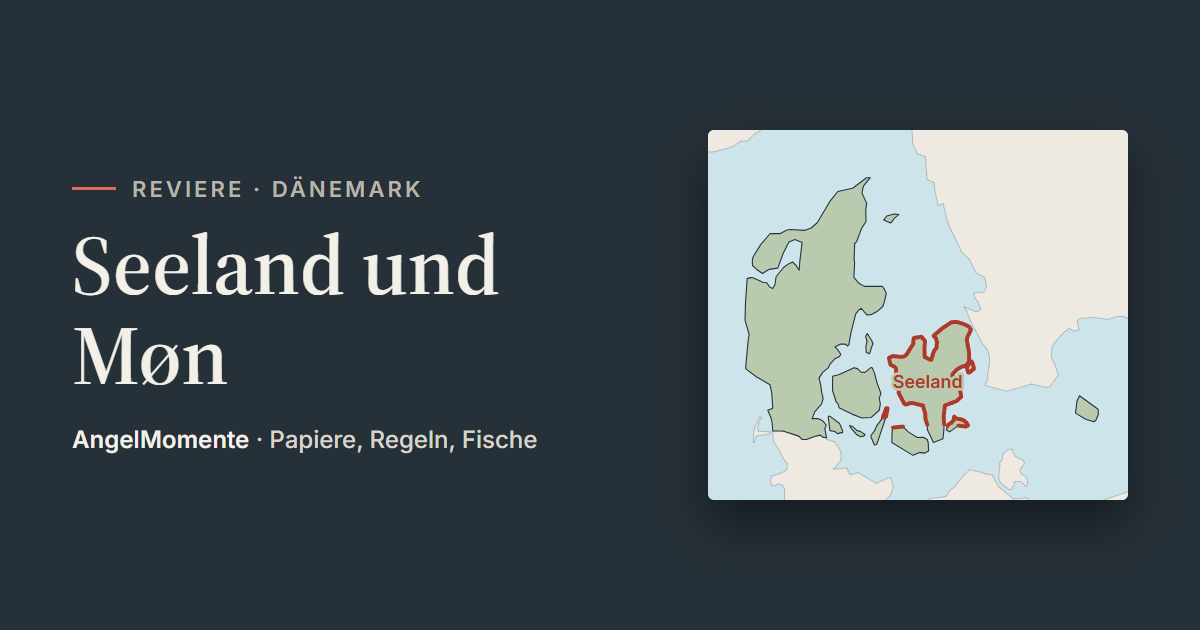
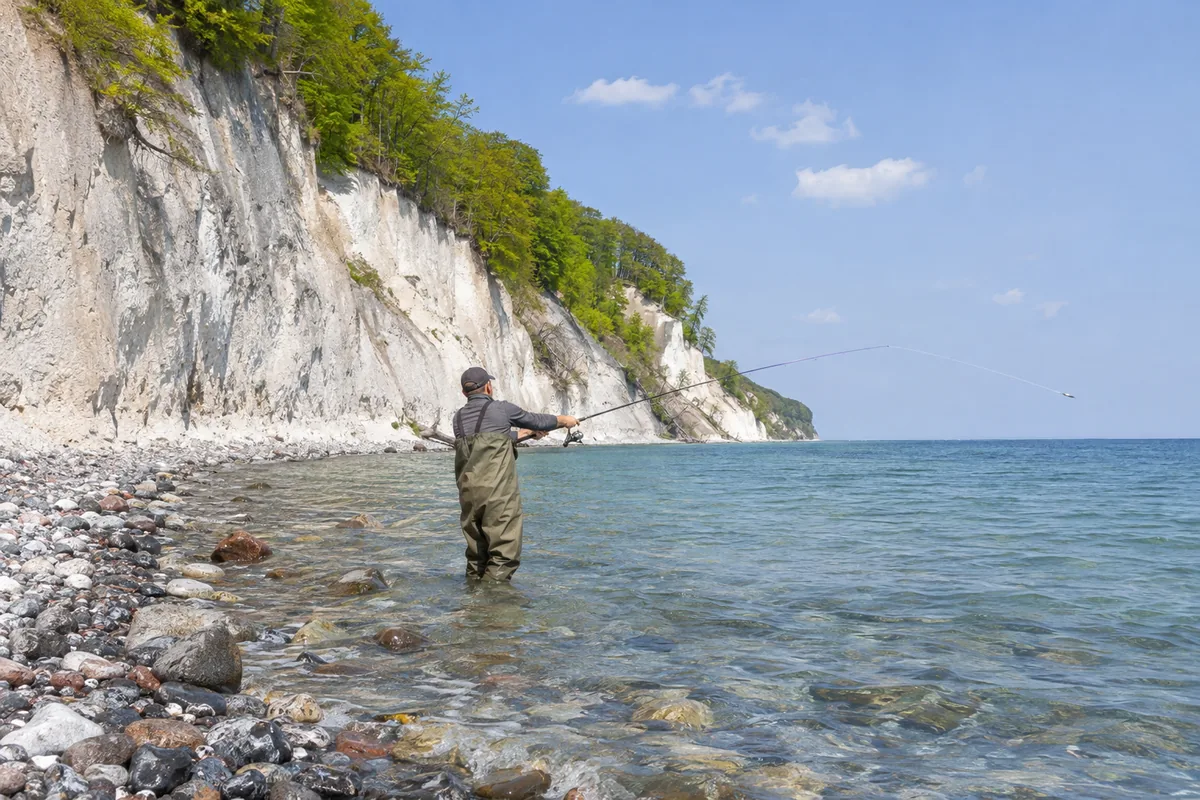
Zealand has three coasts with different rules: the Kattegat in the north, the Øresund in the east and the Belts and Baltic Sea in the west and south. Between southern Zealand and Møn lie shallow brackish bays with perch and pike, and at Møns Klint the chalk drops as much as 128 m to the beach.
- Papers
- Fishing licence (fisketegn), on streams and lakes the owner’s permission
As of October 2026
At a glance
- Papers
- Fishing licence (fisketegn), on streams and lakes the owner’s permission
| Fish | Minimum size | Closed season | Catch limit | Note |
|---|---|---|---|---|
| Sea trout | 40 cm | 16.11.–15.1. | – | in spawning colours; Præstø Fjord 1, parts of Isefjord and Roskilde Fjord 3 per day |
| Garfish | – | none | – | |
| Herring | 18 cm | none | – | size limit only in the Kattegat |
| Perch | 20 cm | none | – | Køge Bugt to Møn: only 24–30 cm, 3 per day |
| Pike | 60 cm | 1.4.–15.5. | – | between southern Zealand, Møn, Lolland and Falster every pike goes back |
| Cod | 35 cm | Fishing ban 2026 | – | not in the Kattegat, 30 cm there |
| Atlantic salmon | 60 cm | 16.11.–15.1. | 1 with clipped adipose fin per day | daily limit except in the Kattegat; closed season (Schonzeit) for fish in spawning colours |
| Plaice | 25 cm | none | – | Kattegat 27 cm |
| Eel | – | protected all year round | – | fishing ban since 1.8.2026; report your catch |
Danish regulations for salt water (Nos. 791 and 1473), Zealand regulation No. 1413, regulation No. 1673 for perch and pike and Regulation (EU) 2025/2454. As at: October 2026. What counts are the regulation and your fishing permit (Erlaubnisschein).
Location and waters Isefjord, Roskilde Fjord, Øresund and Møn
The north coast between the tip of Sjællands Odde and Gilbjerg Hoved lies on the Kattegat, with Isefjord and Roskilde Fjord (Verordnung Nr. 1571, Anlage 1). From the line Gilbjerg Hoved–Kullen the Øresund begins, and together with Køge Bugt it reaches as far as Stevns. The west and south coasts belong to the Belts, the waters south of Stevns around Møn to the Baltic Sea (fisheries authority (Fischereibehörde)).
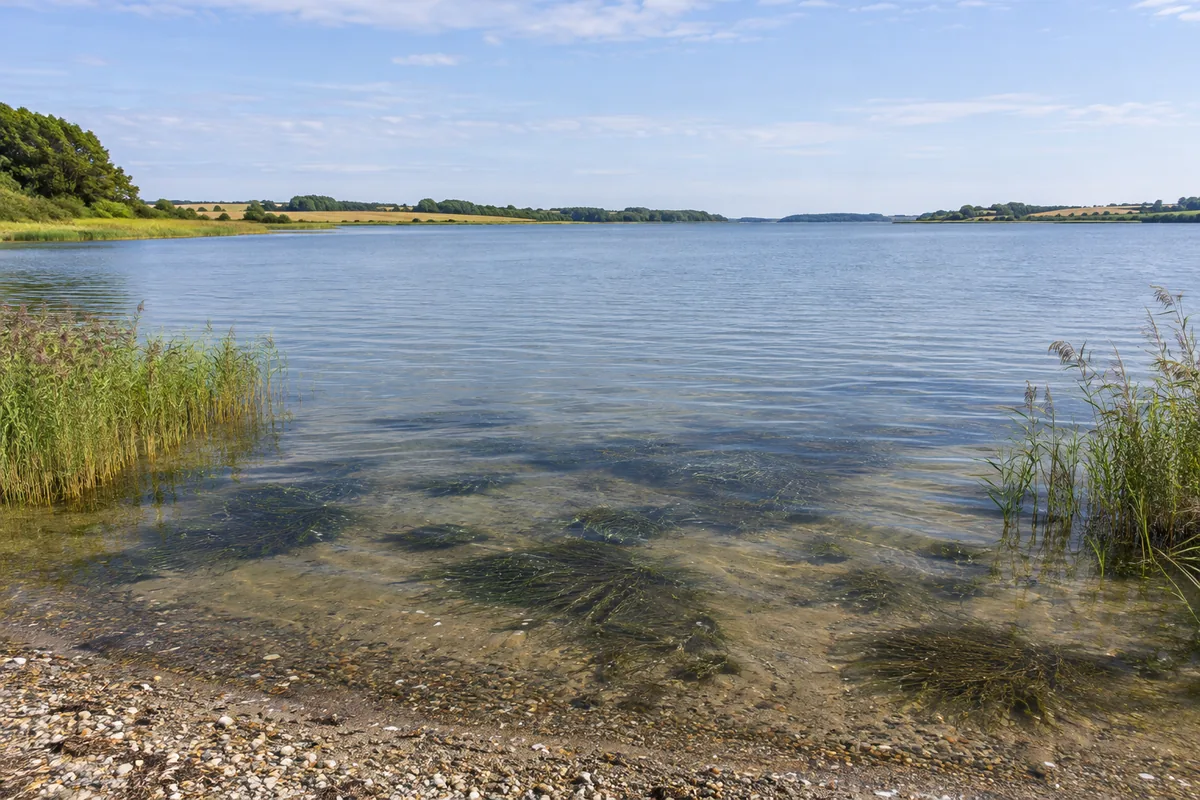
Between southern Zealand, Møn, Lolland and Falster lie shallow fjords, noors and sounds with brackish water of 10 to 14 parts per thousand salt (DTU Aqua). The islands on the other side of these waters have a profile of their own: Lolland and Falster.
Fish and best time Sea trout, garfish and herring
- Sea trout: The Isefjord is known for them, and streams such as the Tuse Å produce their own young (DTU Aqua). At Møns Klint they move in from the Baltic Sea into the shallow water between chalk and stone reefs. You fish there from the shore or troll from a boat (Naturstyrelsen).
- Garfish: They are found at Møns Klint and in the Øresund. They mostly arrive between mid-April and mid-June and stay over the summer (DTU Aqua).
- Herring: In autumn many herring run through the Øresund (DTU Aqua).
- Perch: They live in the brackish water around southern and eastern Zealand, for example in Præstø Fjord, in Stege Bugt and Stege Nor and in Køge Bugt. They move into the streams to spawn (DTU Aqua).
- Pike: Brackish-water pike live on the coasts of southern Zealand and Møn, and DTU Aqua tags and studies them (DTU Aqua).
The catch calendar shows when each species is worth fishing for.
Papers and permission Fishing licence (fisketegn), permission at the stream
On the coast you only need the Danish fishing licence (fisketegn) from the age of 18. Purchase, prices and exceptions are covered under Fishing in Denmark. On streams and lakes the fishing right belongs to the owner of the bank, and there you also need the owner’s permission (Fischereigesetz, § 28).
Special rules Cod ban 2026, in the Kattegat from 30 cm
Sizes and closed seasons are in the “At a glance” box.
- Cod: Fishing for cod is banned in 2026 on the west and south coasts, in the Øresund, in Køge Bugt and around Møn, from a boat as well as from the shore. Every cod goes straight back (Verordnung (EU) 2025/2454, Artikel 10; fisheries authority (Fischereibehörde)).
- Cod in the Kattegat: This ban does not apply there, but a minimum size (Mindestmaß) of 30 cm does. In a protected area in the south-eastern Kattegat, targeted cod fishing is banned from 1 January to 31 March, and a second area is closed all year to any fishing (Verordnung Nr. 979). The stock is regarded as collapsed (DTU Aqua), so it is best to return cod.
- Salmon: Outside the Kattegat you keep no more than one salmon per day with a clipped adipose fin. After that salmon fishing is over for that day, and what you keep must stay whole until you are ashore (Artikel 11).
- Eel: Banned since 1 August 2026, every eel goes straight back (Verordnung Nr. 670).
- Reporting catches: Eel and, in the Baltic Sea, also cod and salmon you enter in the RecFishing app on the same day, even if the fish goes back into the water (fisheries authority).
- Sea trout in winter: From 16 November to 15 January you may only keep fully silver fish with loose scales (fisheries authority).
Perch and pike in brackish water: From the Kalvebodløbet south of Copenhagen via Køge Bugt and Faxe Bugt to Møns Klint and in the waters between Zealand, Møn, Lolland and Falster you may only keep perch of 24 to 30 cm, three per day at most. In the streams of this area that the regulation lists, every perch stays in the water from 1 March to 30 April. Pike you must not land at all between southern Zealand, Møn, Lolland and Falster, for example in Præstø Fjord and in Stege Bugt and Stege Nor (Verordnung Nr. 1673).
Boat and trolling: Behind a motor boat you troll only from a distance of 100 m from the low-water line. In the Tempelkrogen in the Isefjord trolling is banned altogether (Verordnung über das Freizeitfischen, §§ 13 bis 15). In these areas at most two rods per person and four per boat are allowed when trolling, and you must not spread the line out to the side:
- Isefjord and Holbæk Fjord south of the line Kongsøre Næbbe–Kyndby Værket
- Roskilde Fjord south of the line Kulhuse–Sølager
- Øresund between Rungsted and Vedbæk up to three nautical miles off the coast
- Køge Bugt from Køge Sønakke to Brøndby up to 500 m off the coast
Outside these areas and beyond the 100 m, spreading the line is allowed, but only with a device that sits directly on the fishing line, and then with only one lure. South of the line Stevns–Falsterbo and east of 12° east, that is off Møn, planer boards are allowed only from three nautical miles off the coast.
Protection zones (fredningsbælter): In front of many stream mouths fishing within 500 m is banned, partly all year, partly from 16 September to 15 March. Which mouths are covered is set out in the Seeland-Verordnung Nr. 1413 and, for Møn, the Verordnung Nr. 1224, and there are zones of their own, for example in Roskilde Fjord and Stege Nor (map of the fisheries authority). For some fjords the Zealand regulation also limits how many sea trout you may take per day. The figures are in the box.
As at: October 2026. The EU rules for cod and salmon apply until 31 December 2026, the rules for perch and pike since 1 January 2026.
Protected fish and fish that do not meet the size rules go straight back: Releasing fish.
Safety
Every year chalk and mud break off at Møns Klint, most often in winter and spring. Climbing outside the stairs and paths is forbidden and life-threatening (Naturstyrelsen). Keep your distance from the foot of the cliff on the beach. In a boat you carry a lifejacket or buoyancy aid for every person (Verordnung Nr. 765).
Related
- Fishing the coast and surf and fishing in lagoons and fjords
- Lolland and Falster: the same rules for perch and pike in brackish water
- Fishing in Denmark, Funen and Langeland and across the water Scania and the Øresund
- Sea trout, garfish, perch and pike in the fish lexicon
- Closed seasons and minimum sizes explained, Bank and waders and Boat and lifejacket
Sources
- Verordnung Nr. 1673 über Hecht und Barsch bei Südseeland, Møn, Lolland und Falster (gilt seit 1. Januar 2026)
- Seeland-Verordnung Nr. 1413, Verordnung Nr. 1224 für Lolland, Falster und Møn, Verordnung Nr. 979 über Schutzgebiete im Kattegat und Verordnung Nr. 1571 mit den Grenzen der Meeresgebiete
- Mindestmaße im Salzwasser, Schonzeiten im Salzwasser, Aalverbot, Freizeitfischen, Fischereigesetz und Sicherheit auf Freizeitbooten
- Verordnung (EU) 2025/2454: Fangmöglichkeiten in der Ostsee 2026
- Fischereibehörde: Kein Dorsch, ein Lachs am Tag 2026, Fragen zum Dorschangeln, RecFishing, Schutzzonen, Sea trout und Arten ohne Mindestmaß; fisketegn.dk (abgerufen 04.10.2026)
- DTU Aqua: perch, Brackwasserhechte, Brackwasserhechte wandern, Meerforellen im Isefjord, Hornhecht, Hering, Dorsch und Küstenökologie
- Naturstyrelsen: Møns Klint, Praktisches und Møns Klint, Erlebnisse
Guide without guarantee, as at October 2026. What counts are the Danish regulations, in particular the Zealand regulation and the regulation on pike and perch, and the EU catch rules for the Baltic Sea as currently in force.