
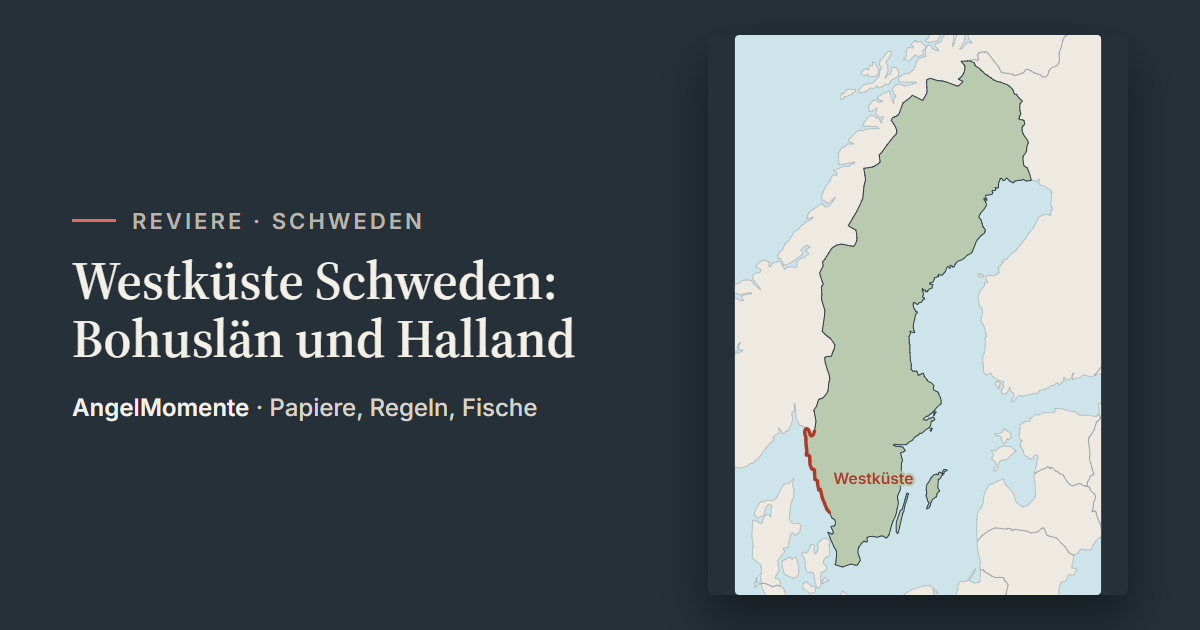
Fishing waters · Sweden
Fishing on Sweden’s west coast
The west coast of Sweden runs from Svinesund and the Idefjord on the Norwegian border through the Bohuslän archipelago to Halland. With a rod you fish at sea without a permit, but you must know the closed times and protected areas for salmon, sea trout and cod.
- Papers
- Sea: no permit; rivers and lakes: fiskekort from the rights holder
As of October 2026
At a glance
- Papers
- Sea: no permit; rivers and lakes: fiskekort from the rights holder
| Fish | Minimum size | Closed season | Catch limit | Note |
|---|---|---|---|---|
| Sea trout | 45 cm | 1.10.–31.3. | 2 a day including salmon | Svinesund and Idefjord 40 cm; beyond 4 nautical miles closed all year round |
| Atlantic salmon | 45 cm | 1.10.–31.3. | 2 a day including sea trout | Svinesund and Idefjord 50 cm; beyond 4 nautical miles closed all year round |
| Cod | 30 cm | 1.1.–31.3. | – | closed season inside the trawl limit; Gullmarsfjord and the fjords around Orust closed all year round; Brofjorden 3 a day including haddock and pollack |
| Pollack | – | 1.1.–31.3. | – | as for cod |
| Haddock | – | 1.1.–31.3. | – | as for cod |
| Mackerel | – | none | – | minimum size 20 cm only for nets and other gear |
| Lobster | 9 cm carapace length | 1.12.–26.9. | – | only with residence in Sweden and only with a lobster pot; season start 2027 on 27.9. at 07:00; egg-bearing animals protected all year round |
| Edible crab | – | none | – | traps only with residence in Sweden or a permit from the Länsstyrelse; not when diving |
| Eel | – | protected all year round | – | banned at sea since 2007 |
Values for hand-held tackle in the coastal waters of the Skagerrak and Kattegat under FIFS 2004:36 (version of 1 July 2026). In rivers and lakes the rules of the rights holder apply. As of October 2026. What counts are the regulation and your fishing permit (Erlaubnisschein).
Location and waters Bohuslän, Halland, Gullmarsfjord and Kosterhavet
In the north lies the Skagerrak, to the south the Kattegat adjoins. In the Skagerrak salinity is close to that of the ocean (SMHI: salinity). Tides play hardly any role: the tidal range in the Skagerrak is usually about 20 cm, up to 35 cm at spring tide, and in the Kattegat at most about 25 cm (SMHI: tides).
The largest fjord in Bohuslän is the Gullmarsfjord: 25 km long, up to about 125 m deep and separated from the Skagerrak by a sill at a depth of around 45 m (Länsstyrelsen Västra Götaland). In the far north lies the Kosterhavet, since 2009 Sweden’s first marine national park (Sveriges nationalparker). In Halland many coastal rivers hold salmon and sea trout.
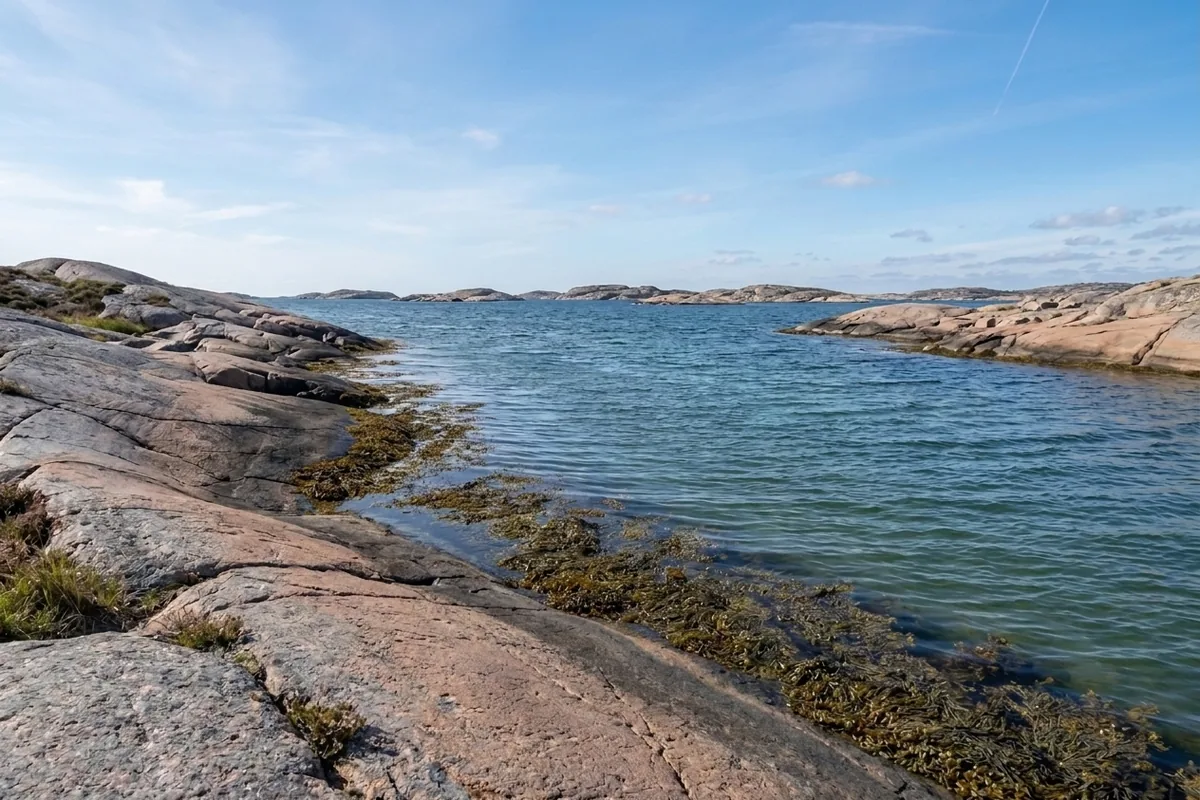
Fish and best time Sea trout, salmon, mackerel and cod
- Sea trout and salmon: Every year the county administrative board of Halland counts the fish in most of the province’s coastal rivers by electrofishing and fish counters (Länsstyrelsen Halland). According to the fisheries authority the salmon stocks of the west coast have become weaker (Havs- och vattenmyndigheten).
- Mackerel: It lives in the Skagerrak and Kattegat and overwinters in the deeper water of the Skagerrak. Its spawning migration towards the Skagerrak and Kattegat begins in April and May (Havs- och vattenmyndigheten: mackerel).
- Cod: Several coastal stocks in Västra Götaland are at a critically low level. Around Tjörn and Orust only a small remnant of spawning coastal cod is left. A project to rebuild it runs there until 2028 (Länsstyrelsen Västra Götaland).
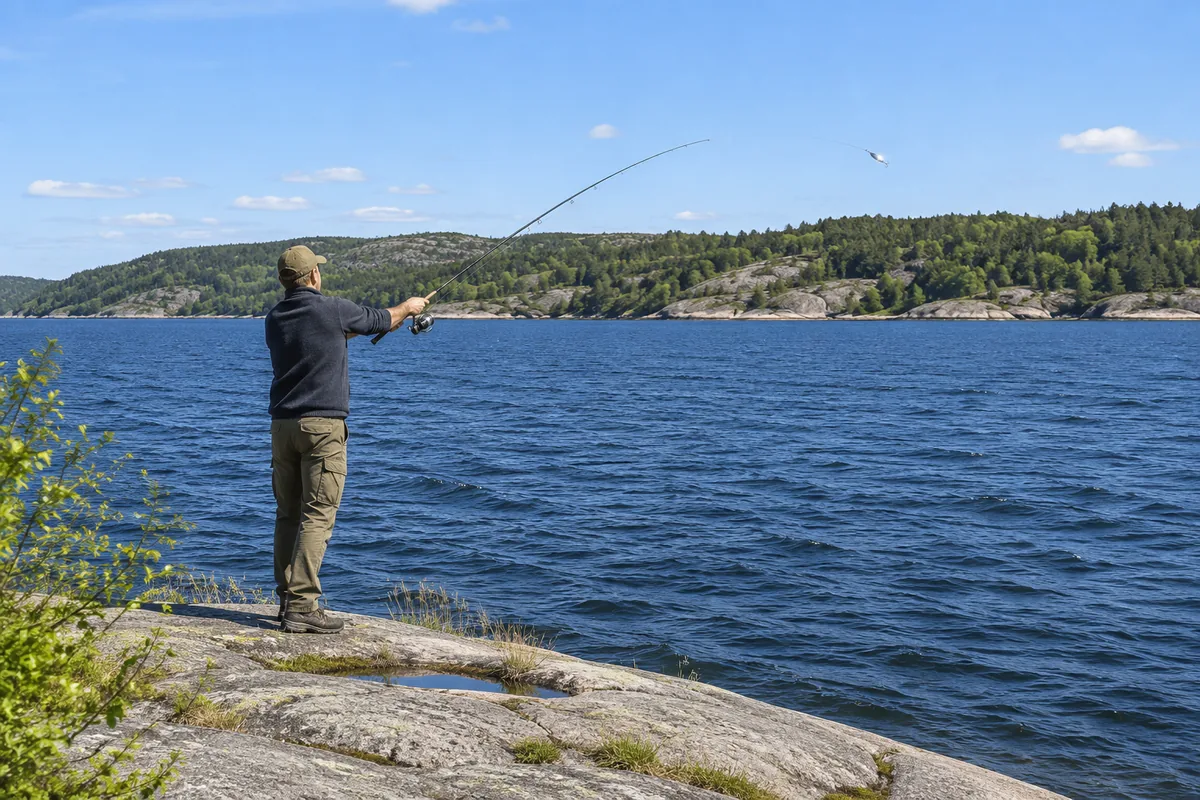
The catch calendar shows when each species is in season. Allow for the closed times in the box.
Papers and permit Free at sea, fishing card (fiskekort) on rivers
At sea you fish with hand-held tackle free of charge and without a permit, as a guest from abroad under the same rules as Swedes (Länsstyrelsen Halland). Other gear such as nets, fish traps or crab pots you may use without a permanent residence in Sweden only with a permit from the Länsstyrelse (Länsstyrelsen Halland: Regeln im Meer).
On rivers and lakes you need the fishing permit of the rights holder, the fishing card (fiskekort). If there is none, you ask the rights holder directly (Länsstyrelsen Västra Götaland). The boundaries of the fisheries management areas (fiskevårdsområden) and links to the permit sellers are on fiskekartan.se, the register of the Länsstyrelser. What counts as hand-held tackle is explained on the country page Angling holidays in Sweden.
Special rules Protected areas, Svinesund and Gullmarsfjord
Minimum sizes, closed seasons and daily limits are in the box. In addition there are protected areas (fredningsområden) and special rules for individual stretches from FIFS 2004:36, Annex 5:
- Svinesund and Idefjord: For salmon and sea trout no more than two rods per person with two lures each are allowed (Lachs-Seite der Behörde).
- Gullmarsfjord and the fjords around Orust: All fishing is banned there all year round. Hand-held tackle remains allowed for species other than cod, haddock and pollack.
- Brofjorden: In the inner part of the fjord you may keep three fish a day of cod, haddock and pollack combined (3 kap. 18 §).
- Laholm Bay and the southern Kattegat: In Laholm Bay all fishing is suspended from 1 January to 31 March. Off Halland and north-west Scania there are three protected areas. In the western one fishing is banned from 1 January to 31 March, and the rod for species other than cod remains allowed. In the north-eastern one the ban applies all year round, and you may fish there for species other than cod from April to December. In the south-eastern one all fishing is banned all year round.
- Protected areas at river mouths: Angling is suspended there from 1 October to 31 March. From April to September hand-held tackle is allowed if the method does not require a boat.
- Kosterhavet: In the Koster and Väderöfjord fjords there are marked zones where all fishing is banned (Havs- och vattenmyndigheten).
- Lobster and brown crab: Only Swedes and people with a permanent residence in Sweden may catch lobster, and only with a lobster pot. In 2026 the season for recreational fishers runs from 21 September, 7 a.m., to 30 November (the authority’s lobster page). Brown crab has neither a minimum size nor a closed season, but you may not catch it while diving (the authority’s crab page).
- Örekilsälven: Since June 2025 a year-round fishing ban has applied in the lower part of the Munkedalsälven. In the salmon section of the Örekilsälven you must disinfect or fully dry your gear before and after fishing. The reason is the salmon parasite Gyrodactylus salaris (FIFS 2004:37, ch. 3 §§ 8 and 9).
As of October 2026. The location and boundaries of the protected areas are shown on the map from Svenska fiskeregler. FIFS 2004:36 as currently in force is authoritative, last amended on 1 July 2026.
Related
- Fishing on the coast and in the surf, fishing in bays and fjords and a fishing holiday in Sweden
- Sea trout, salmon, mackerel, cod, pollack and grey gurnard in the fish encyclopedia
- Scania and the Øresund south of Kullen and southern Norway across the border
- Closed seasons and minimum sizes explained and Boats and life jackets
Sources
- FIFS 2004:36: Fischerei in Skagerrak, Kattegat und Ostsee (Fassung 01.07.2026) und FIFS 2004:37: Süßwasser (Fassung 12.06.2026)
- Havs- och vattenmyndigheten: Schonzeiten, Maße, Salmon, Dorsch, Hummer (25.09.2026), Taschenkrebs, Eel, Makrele und Schutzgebiete im Westmeer
- Länsstyrelsen Halland: Fischerei und Regeln im Meer
- Länsstyrelsen Västra Götaland: Fischerei, Projekt für den Dorsch und Gullmarn
- Svenska fiskeregler (Regeln mit Karte) und fiskekartan.se (Register der Länsstyrelser für Fischereipflegegebiete)
- SMHI: Salzgehalt und Gezeiten; Sveriges nationalparker: Kosterhavet
Guide without guarantee, as of October 2026. The Swedish fishing regulations FIFS 2004:36 and FIFS 2004:37 and the rules of the rights holders on rivers and lakes, as currently in force, are authoritative.