
Knowledge · Tackle
Surf rod: Long casts from the beach
The surf rod is the long, powerful casting rod for the sandy beach: it throws heavy leads out beyond the breaking waves and then holds the line high above the water on a tripod. This page is about length, casting weight, action, reel and shock leader, about safety when casting and about common mistakes.
Why the rod is so long
The first reason is casting distance: longer sea rods give more leverage according to Blinker and cast further. For cod from the beach, the British magazine Sea Angler even considers the trip to a good beach pointless if your own casting distance does not reach beyond the breakers. In the question catalogue for the angling exam (Fischerprüfung) in Saxony-Anhalt, the surf rod is the rod type for fishing from the coast.
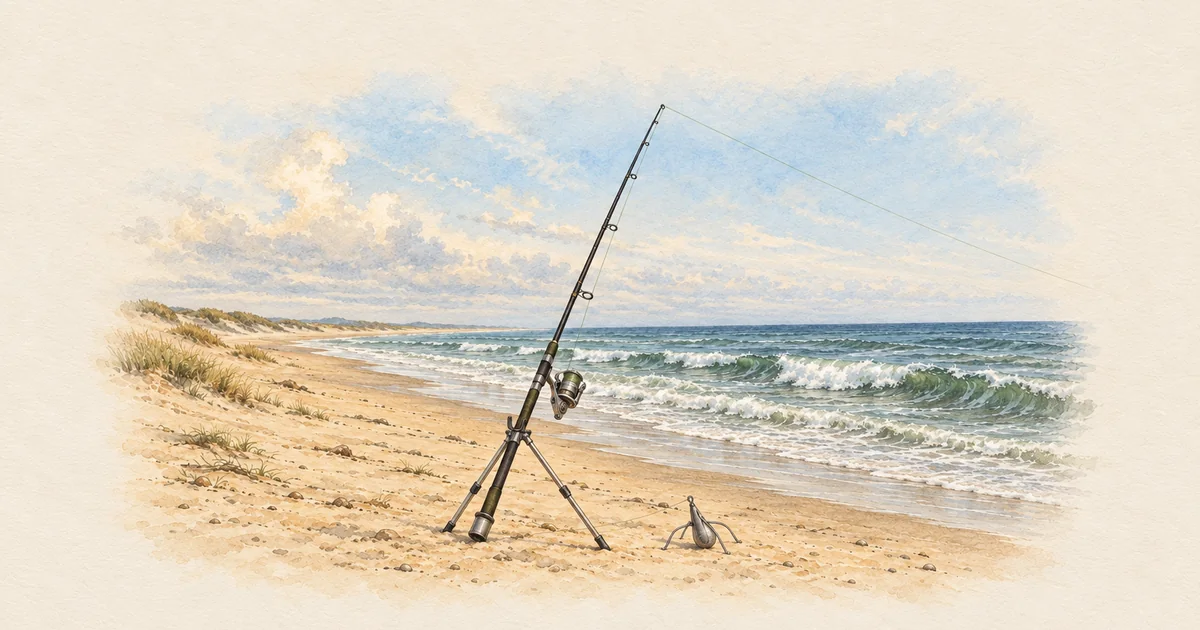
The second reason shows after the cast, when the rod stands steeply on the tripod. The high tip brings quite a lot: wind and swell act less on the line, it collects less drifting weed, and weed and wave action less often pull the lead loose or knock the rod over. How to recognise sandbank and gully is covered under Surf fishing, types of rod stands under Rod pod and tripod.
Length and casting weight: what the sources say
The sources give different ranges, all of them guide values.
| Source | Length | Casting weight |
|---|---|---|
| Blinker, two articles | 3,50-4,20 m and 3,60-4,20 m | in fact around 200 g |
| Rute & Rolle | 3,90–4,20 m | at most 200 g |
| Sea Angler (Great Britain) | 12-15 ft, around 3,66-4,57 m | 5-8 oz, around 142-226 g |
| Question catalogue Saxony-Anhalt | 3,0–5,0 m | no figure given |
| Tackle guide FV Löningen | no figure given | up to 300 g |
The page Sea rod works with 3,50-4,20 m and around 200 g. What matters is whether you can accelerate the rod. If you are not very tall, you do better with 3,50 m, and Rute & Rolle warns anglers of average build against long, heavy models that they cannot load. Manufacturers‘ casting weights are mostly set too high. As an upper limit, the printed figure nevertheless applies according to the tackle guide of the Löningen angling club. What casting weight and action mean is explained in the overview Fishing rods.
Markings in feet and ounces: British rods often carry ft and oz. 1 ft is 30,48 cm, 1 oz is around 28,3 g. A 13 ft rod therefore measures around 3,96 m, a 6 oz lead weighs around 170 g. Further values are converted by the unit converter.
Action, sections and tip
The tackle guide from Löningen assigns surf rods to the parabolic action: the rod bends under load from the tip to the handle. For practice, by contrast, a rather stiff stick is recommended. With a soft rod the fight is nicer, but when retrieving over obstacles too many fish are lost, and a stiff rod copes better with very heavy leads in a headwind or current.
A British trade magazine considers many of today’s surf rods so stiff and long that most anglers cannot get them to work properly. If the reel sits low at the end of the handle, the lower and middle sections bend more, and the rod becomes tamer. Anyone who holds the rod in the hand for a long time is more comfortable with the reel set high.
Surf rods come in two and three pieces. Two-piece ones have the better action, three-piece ones are easier to transport, for example in a small car or on a bicycle. At the tip you see the bite. Some sea rods carry a glass fibre tip that shows bites better. Fisch & Fang describes that tentative bites are not always visible on the chunky tip of a surf rod. For the night there are light sticks.
Reel, line and shock leader
On the Baltic Sea people fish with large fixed-spool reels. They should have a high gear ratio so that rig and fish come off the bottom quickly. The large spool has to wind neatly, because line comes off more easily in the cast from an evenly filled spool. For the choice between fixed-spool and multiplier reel see Frequently asked questions, for type and size under Fixed-spool reel.
A monofilament of around 0,30 mm or a thin braid serves as the main line. Very experienced surf anglers nowadays almost all fish braid, but most coastal anglers fish monofilament. What both line types can do is covered under Fishing line: monofilament, braid or fluorocarbon?
The shock leader
According to the exam catalogue, the shock leader is a stronger line at the front end of the main line. In the cast it absorbs the forces that would break a thin main line (Blinker). Sea Angler considers a main line with 15 lb breaking strength (around 6,8 kg) too weak to cast a lead of 5 oz or more safely. As a shock leader the magazine names 60 lb (around 27 kg) at 0,70 mm, about two rod lengths long. According to another source one rod length plus five to six turns on the reel is enough.
On material the sources disagree. For more distance Rute & Rolle takes a braided shock leader of 0,25 to 0,30 mm, because it slides through the guides more easily. By contrast a British trade magazine considers non-stretch material for shock leaders with heavy sea leads a poor choice, because it does not cushion casting errors. The connection is shown by the shock leader knot, breaking strength and diameter are compared by the line calculator.
Safety when casting
- Casting area clear: During casting practice on the beach, watch out for walkers, because a fast-flying lead of 180 g can be deadly. Cast only when nobody is behind you, next to you or in the casting direction.
- Shock leader: Without it, on the full follow-through the thin main line carries the whole load and can break, details above.
- Finger protection: During the cast the line presses hard on your index finger. That is why finger protection is part of the kit. With a braided shock leader, according to Rute & Rolle, it is a must. Types and makeshift solutions in the next section.
- Thunderstorms: Carbon-fibre rods conduct electricity very well, says the exam catalogue for Saxony-Anhalt, so take care in thunderstorms and near power lines. The VDE advises anglers to leave the water and the bank as soon as a thunderstorm starts to build. More under Thunderstorms and weather and Power lines and fishing rods.
Finger protection when casting
With a fixed-spool reel, your index finger hooks the line at the spool lip before the cast and releases it on the forward swing. At sea this finger takes more strain than when spinning or legering in fresh water, writes the British magazine Sea Angler: lines, rods, reels and leads are heavier, and the weather is often bad. The line is then hard to hold, and on a powerful long cast it can cut your finger until it bleeds. An article in Blinker on long-distance casting with the feeder adds that the shock leader cuts into the finger particularly quickly in cold and wet conditions.
Protection also depends on the reel. For surf casting the spool must be firmly locked, and according to Sea Angler that only works with a front drag. If the spool gives during the cast, the line runs over your finger like a knife. According to the magazine, rear-drag reels cannot be screwed down tightly enough; it names coarse fishing and spinning as their field. A tapered shock leader also helps: its smaller knot catches less often on loops of line on the spool or on your finger. When playing a fish in simple surf fishing, according to Sea Angler the drag is rarely needed; with a big fish, backwinding is often easier. How to set a drag in general is covered under Setting the reel drag.
Finger stall, glove and makeshift solutions
- Finger stall: a sleeve just for the index finger. According to Sea Angler it is standard among surf anglers using fixed-spool reels, especially when fishing with braid. When the finger stall is not on your finger, its wrist elastic can be put round the spool. That holds loose coils of the shock leader in place, and the finger stall does not get lost.
- Casting glove: covers the line finger and stays on your hand. Designs and their limits are shown in Fishing gloves.
- Tape or plaster: In the Blinker article the finger is wrapped in elastic tape. Rute & Rolle mentions a strong plaster only as an emergency solution for long casts with heavy spod rockets and recommends a proper casting glove.
- Mechanical line release: A small trigger on the rod handle holds the line instead of your finger and releases it during the cast. Alongside the finger stall, Sea Angler names it as a way to cast powerfully without endangering your finger. It sits above and slightly behind the spool lip. The magazine advises first attaching it only with insulating tape and whipping it on permanently only once the position is right.
- Thumb on the multiplier: Here your thumb holds the turning spool. To stop it slipping, Sea Angler names as probably the simplest solution a cut-off finger of a rubber glove, which gives grip and protects. Instead, many tape a piece of bicycle inner tube about 2,5 cm wide under the reel seat, which folds over the spool. More about the reel under Baitcaster and multiplier reel.
Before every cast
If your finger slips off the spool or the line goes too early, according to Sea Angler haste was usually involved. Five steps before you cast:
- On a fixed-spool reel, screw the front drag right down.
- Put on a finger stall or glove and keep your finger dry.
- Pick up the line with your fingertip only. That way you release it faster than under the whole first joint of the finger, the Blinker article explains.
- Check that the line runs freely through all the rings.
- Stand securely and make sure you can see the casting area is clear, see above.
Target fish and rules
The beachcaster is aimed mainly at flatfish such as flounder and plaice. On the Baltic shore you also catch cod, whiting and even sea trout. Closed seasons (Schonzeit) and minimum sizes (Mindestmaß) are set by your federal state (Bundesland); you will find them in the state fisheries regulation (Landesfischereiverordnung) and on the fishing permit (Erlaubnisschein). For a start, read Closed seasons and minimum sizes explained.
Cod in the Baltic: Article 10 of Regulation (EU) 2025/2454 bans recreational fishing for cod in the Baltic in 2026, specifically in subdivisions 22 to 32. Cod caught by accident must be returned to the sea immediately. An exception for bycatch applies only in subdivisions 27 to 32; which subdivision lies off your beach is something the fisheries authority (Fischereibehörde) of your state will tell you. The DAFV confirms the ban on keeping cod for anglers. The rules are decided afresh every year. How to release a fish gently: Releasing fish.
Common mistakes
- Small tip ring in weed: When there is weed in the water, small tip rings clog up because the shock leader knot picks up weed.
- Exceeding the casting weight: A weight above the figure printed on the rod overloads it; the tackle guide from Löningen rules this out.
- Main line too thick: Thick line offers wind and current more surface. For long casts over snag-free ground, 0.30 to 0.38 mm is considered most effective.
- Buying by packed length alone: A three-piece rod fits better in the car, a two-piece has the better action.
Frequently asked questions
Can a feeder rod be used in the surf?
An article in Fisch & Fang shows this with a heavy 4.50 m feeder rod that casts around 100 g and has extra-stiff tips. It shows fine bites more clearly, and casting takes less effort. For very heavy leads, a stiff pole is considered the better choice.
Fixed-spool reel or multiplier?
Both are fished from the beach. To start with, the fixed-spool reel is considered simpler: its spool does not turn during the cast, so a bird’s nest is less likely. That is what the exam catalogue for Saxony-Anhalt calls line that has run off uncontrolled and tangled up. A multiplier needs a rod with rings set up for it, see Baitcaster and multiplier reel.
How do I learn to cast a beachcaster?
First practise with just a casting weight and no rig, on the beach or on a harvested field. In the pendulum cast the weight swings under the tip. In the ground cast it lies behind you on the sand, and its drag as it is pulled loads the rod, which is how the greatest distances are achieved.
Which finger protection suits a surf rod?
On a fixed-spool reel a finger stall or a casting glove, elastic tape too, or a strong plaster if need be. If you do not want to hold the line with your finger at all, fit a mechanical line release to the handle. On a multiplier, a rubber cap protects your thumb.
Related
- Sea rod: beachcaster, pirk rod and boat rod compared
- Surf fishing: reading the beach, how a session runs, target fish by season
- Surf rig: hooklength with snoods and a grip lead
- Shock leader knot: joining thin main line to thick shock leader
- Rod pod and tripod: setting up and weighting a tripod
- Fishing gloves: casting glove and finger guard alongside other designs
- Line calculator: breaking strain and diameter of main line and shock leader
Sources
- Blinker: Brandungsangeln, alles, was man über diese Angelmethode wissen muss (Länge, Wurfgewicht, Aktion, Teilung, Rolle, Schnur, Sicherheit, Wurftraining, Zielfische)
- Blinker: Die richtige Meeresrute, darauf kommts an (Hebelwirkung, 3,60–4,20 m, Glasfaserspitze), Blinker: Was ist eigentlich eine Schlagschnur? (Zweck, Länge) und Blinker: Futterkorb auf Distanz, weit werfen und viel fangen (Fingerschutz bei Kälte und Nässe, Elastikband, Fingerkuppe)
- Rute & Rolle: Brandungsangeln, 10 Tipps für mehr Meter (Länge, Wurfgewicht, Schlagschnur, Fingerschutz) und Rute & Rolle: Karpfen füttern mit der Spod-Rute (Pflaster als Notlösung, Wurfhandschuh)
- Fisch & Fang: Zitterübung in der Brandung (Feederrute als Alternative, Bissanzeige)
- Sea Angler: Beginner’s Guide to Cod Fishing From the Shore and Beach (Länge, Wurfgewicht, Rollen, Schlagschnur, Dreibein), Basic Beachcasting Tactics (Dreibein, Spitzenring, Schnurstärke) und Beitrag zur Rollenposition beim Werfen (Rollenposition, Schlagschnur)
- Sea Angler: These gadgets will help you cast further (Druck auf den Wurffinger, Fingerling, mechanischer Schnurhalter, Daumenschutz an der Multirolle, Handgriffe vor dem Wurf) und Beitrag über Stationärrollen am Strand (Frontbremse, Bremse im Drill, Fingerling oder Schnurauslöser, verjüngte Schlagschnur)
- Ministerium für Wirtschaft, Tourismus, Landwirtschaft und Forsten Sachsen-Anhalt: Fragenkatalog zur Fischerprüfung (PDF, Stand 28.04.2022) (Länge, Rutenart, Schlagschnur, Perücke, Gewitter)
- Fischereiverein Löningen: Gerätekunde zur Fischerprüfung (PDF) (Aktion, Wurfgewicht)
- VDE: Blitzschutz beim Wassersport (Angler verlassen bei Gewitter Wasser und Ufer)
- Verordnung (EU) 2025/2454, Artikel 10 (Dorsch in der Ostsee 2026) und DAFV: Fangregeln für Angler in der Ostsee 2026 (Entnahmeverbot)
Text AI-assisted, drawing AI-generated. Sources opened and checked in October and November 2026, no graphics taken from the sources.
All figures are guide values without guarantee. Which beachcaster suits you depends on your height and strength, the beach and the weather; catch rules are set by the EU and the coastal states.