
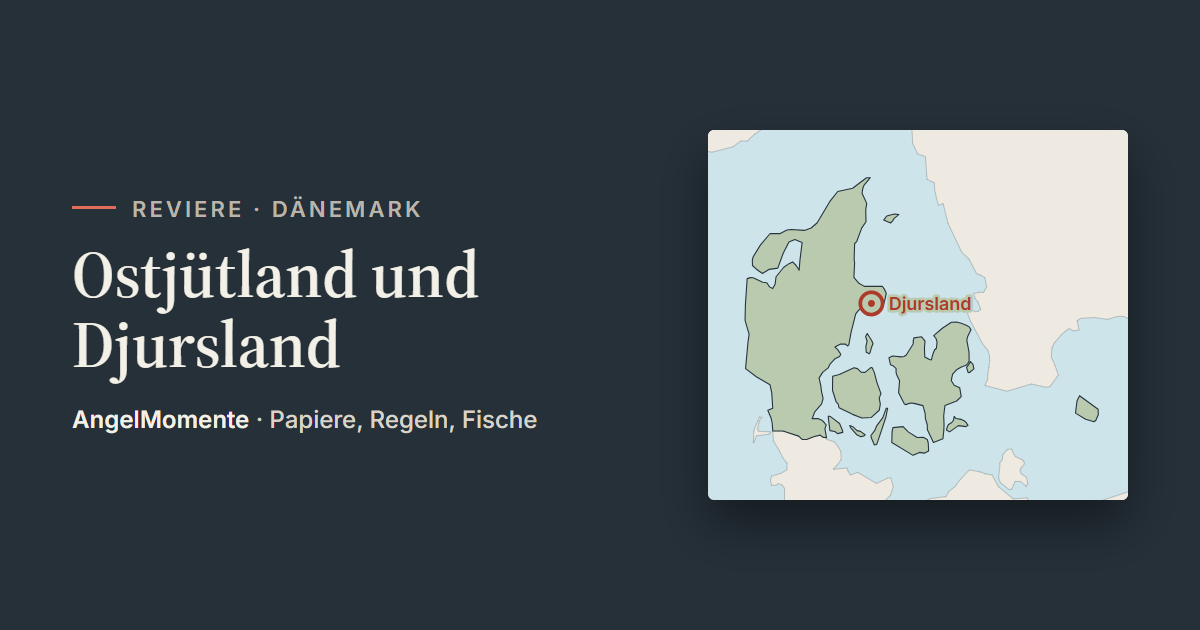
Waters · Denmark
Fishing in East Jutland and on Djursland
In East Jutland the Djursland peninsula juts into the Kattegat, to the south lies Aarhus Bay, and to the north the Randers Fjord and Mariager Fjord open out. A border runs right through this water: south of Ebeltoft the Baltic Sea begins, with the cod ban, and north of it the Kattegat. Along the whole coast the Danish fishing licence (fisketegn) is enough.
- Papers
- Danish fishing licence (fisketegn), from 18 to retirement age
As of October 2026
At a glance
- Papers
- Danish fishing licence (fisketegn), from 18 to retirement age
| Fish | Minimum size | Closed season | Catch limit | Note |
|---|---|---|---|---|
| Sea trout | 40 cm | 16.11.–15.1. | – | spawning dress; Randers Fjord: all trout 16.11.–1.3. |
| Cod | 30 cm | none | – | South of Hasenøre (Baltic): fishing ban 2026 |
| Garfish | – | none | – | |
| Herring | 18 cm | none | – | Baltic: no minimum size |
| Plaice | 27 cm | none | – | Baltic: 25 cm |
| Flounder | – | none | – | Baltic: 23 cm |
| Atlantic salmon | 60 cm | 16.11.–15.1. | Baltic: 1 a day | Baltic: only with clipped adipose fin; Randers Fjord 16.11.–1.3. |
| Zander | 50 cm | 1.5.–31.5. | – | Randers Fjord |
| Perch | 20 cm | none | – | Randers Fjord: 15.4.–31.5. |
| Eel | – | protected all year round | – | Fishing for eel banned since 1.8.2026 |
Danish regulations for salt water, values for the Kattegat; deviations in the Baltic Sea south of the Hasenøre line and in the Randers Fjord are given in the note. As of: October 2026. The regulation and your fishing permit (Erlaubnisschein) are what count.
Location and waters Aarhus Bay, Mols, Helgenæs and Ebeltoft Vig
The border is a line from Hasenøre on Jutland’s east coast (56° 09′ N, 10° 44′ E), a few kilometres south-east of Ebeltoft, across to Zealand. North of it lies the Kattegat, south of it subdivision 22 of the Baltic Sea, the Belts (Regulation No. 1571, annex 1). The map of the fisheries authority shows its course.
- South of the line (Baltic): Aarhus Bay, Kalø Vig, the coasts of Mols and Helgenæs and Ebeltoft Vig.
- North of the line (Kattegat): the east coast of Djursland with Grenaa and the mouths of the Randers Fjord and Mariager Fjord.
- Randers Fjord: The regulation means the water east of the bridge at Randers as far as the mouth between Sødring and Udbyhøj.
- Mariager Fjord: 42 km long, from Hobro to the Kattegat. It is deep on the inside and shallow on the outside, so it exchanges little water with the sea (Danish environmental agency).
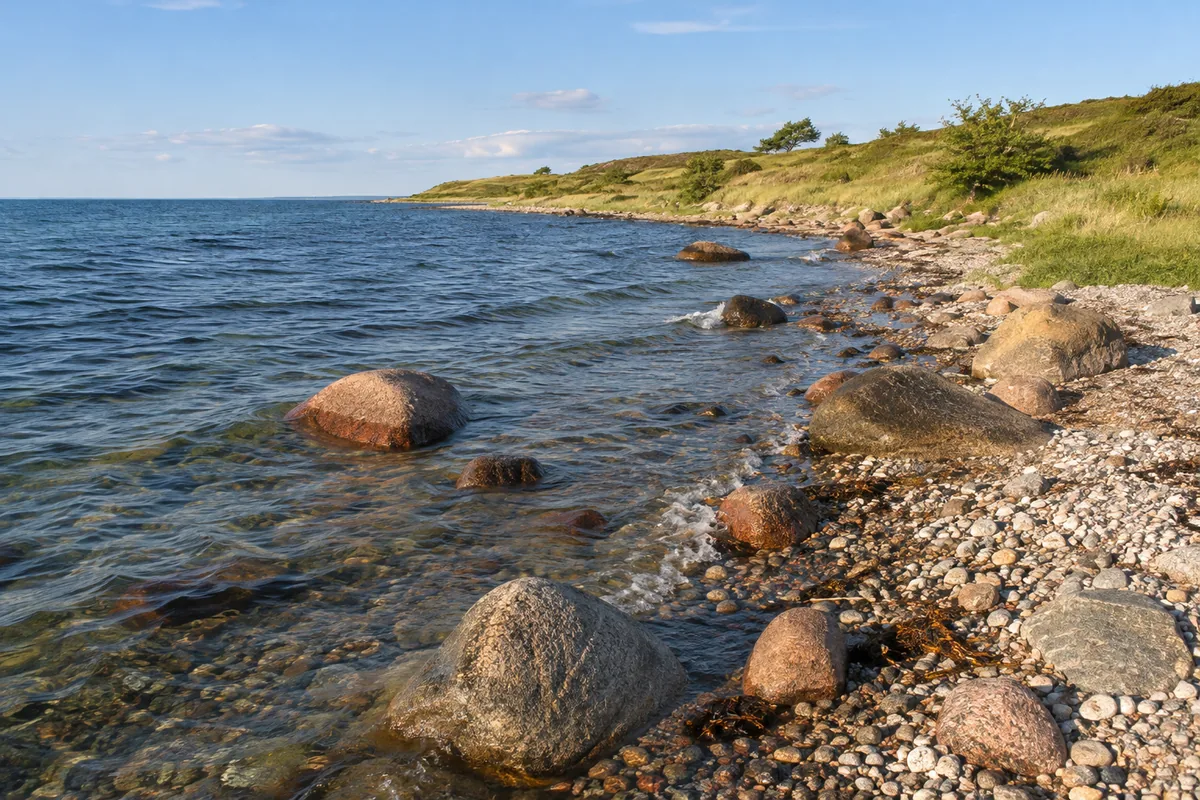
Fish and best time Sea trout and garfish
- Sea trout: The streams between Kalø Vig and the Randers Fjord produce their own offspring. In addition there is stocking at the mouths, intended to strengthen the stock at sea (DTU Aqua, Plan 2023). On the rocky coasts of Helgenæs many anglers look for deep water with current (Naturstyrelsen).
- Garfish: usually comes from mid-April to mid-June, lives in the Kattegat as in the Baltic Sea and in spring moves in close to beaches and harbours (fiskepleje.dk).
- Herring: Autumn spawners spawn partly in Danish fjords, partly they travel through the Belts to spawning grounds in the western Baltic Sea.
- Flatfish: The plaice is widespread in the Kattegat and the Baltic Sea. The flounder becomes more common from the Kattegat towards the Baltic Sea, and young flounder like to grow up in fjords.
- Cod: allowed only north of the line. The stock in the Kattegat is regarded as collapsed (DTU Aqua).
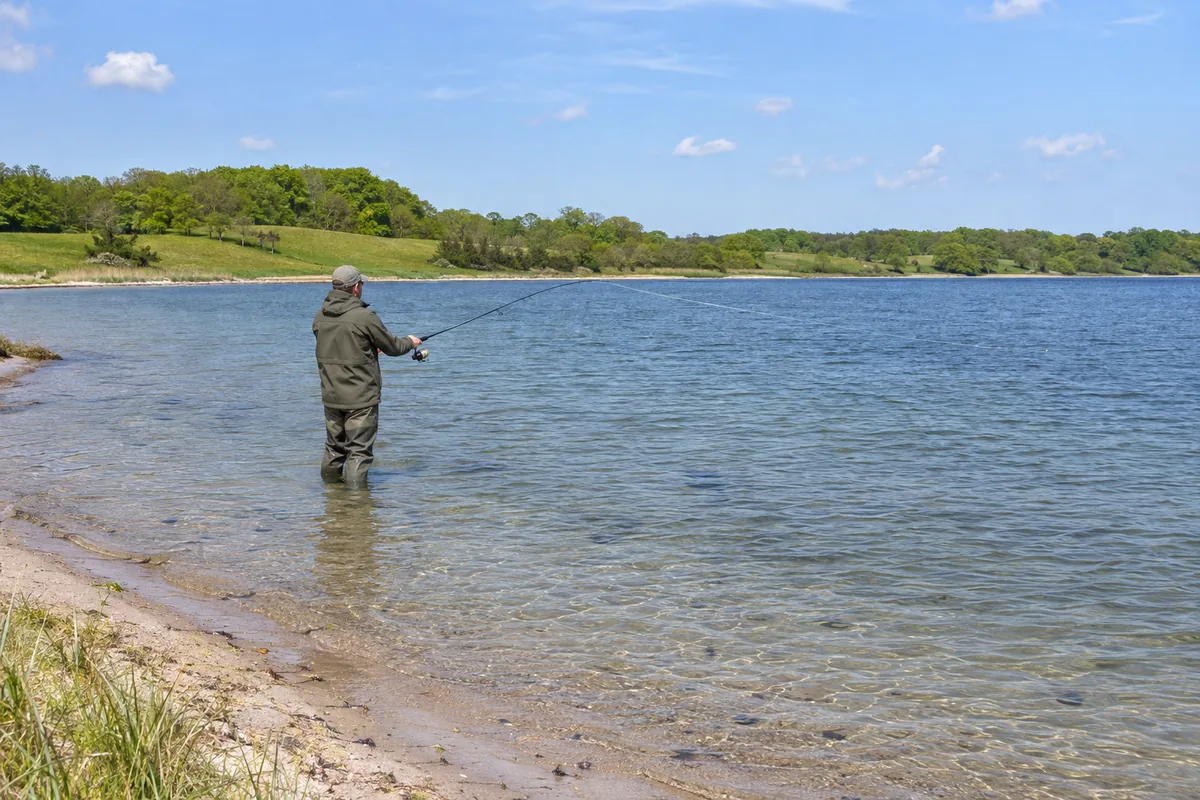
The catch calendar shows when each species bites best.
Papers and permission Fishing licence (fisketegn) on the coast and on the cutter
On the coast the state licence is enough; it is compulsory from the age of 18 to Danish retirement age (Fisheries Act, § 54). Younger and older anglers register on fisketegn.dk before fishing. In a check you give the number of your licence and show ID. On the angling cutter the same papers apply, and everyone on board needs their own licence.
On the Gudenå and the other tributaries, the fishing rights belong to the owner of the bank or to whoever has acquired them from the owner (§ 28). There you also need the owner’s permission. You will find more about the licence under Fishing in Denmark.
Special rules Cod: banned in the south, allowed in the Kattegat
- Cod south of the line: In 2026 you may not keep any cod in the Baltic Sea, whether you fish from the shore, from a pier, from a boat or on a charter boat. Every cod goes straight back. The fisheries authority (Fischereibehörde) names East Jutland explicitly (Ingen torsk i 2026).
- Cod north of the line: In the Kattegat the ban does not apply (Questions and answers); the minimum size (Mindestmaß) is 30 cm.
- Salmon south of the line: at most one salmon per day with a clipped adipose fin. You must land any fish you keep whole.
- Sea trout: Fish in spawning colours are protected from 16 November to 15 January; during that time you may only keep a fully silver fish.
- Randers Fjord: A separate Regulation No. 1409 protects salmon and trout from 16 November to 1 March, whether bright or coloured. Spent fish are protected all year round, and there are also closed seasons (Schonzeit) for perch and zander. In Randers harbour and in the marked channel only a rod is allowed. In Grund Fjord fishing is banned within 1 km of the mouth of the Alling Å, and at the Albæk from 16 September to 15 March.
- Mariager Fjord: Under Regulation No. 1381, year-round protection zones (fredningsbælter) of 500 m apply at five stream mouths, and from 16 September to 15 March at six more and at the cooling-water outlet of the salt works. Fishing is banned in Kielstrup Sø.
- Rest of the coast: If a river mouth is 2 m wide or wider, fishing within 500 m is banned all year round; at narrower ones it is banned from 16 September to 15 March (Regulation No. 769).
- Eel and reporting duty: Since 1 August 2026, fishing for eel has been banned (Regulation No. 670). You enter species that must be reported in the RecFishing app on the same day, including fish you release.
As of October 2026. For Central Jutland, the fisheries authority (Fischereibehörde) lists separate regulations for Randers Fjord and Mariager Fjord. Its leaflet on Kalø Vig and Ebeltoft Vig is currently being revised. The regulations apply; if in doubt, ask the fisheries authority.
Safety
On the coasts of Helgenæs that are open to the south and west, long waves from the wake of distant ships can break heavily on the shore for a few minutes without warning (Naturstyrelsen). Do not wade out too far there. In your own or a hired boat, a suitable life jacket or buoyancy aid must be on board for every person (Regulation No. 765). More under Bank and waders and Boat and life jacket.
Related
- Fishing on the coast and in the surf, Fishing from a charter boat and from a boat and Fishing in lagoons and fjords
- Fishing in Denmark, the Limfjord and Gudenå and the Silkeborg lakes
- Sea trout, garfish, herring, cod and zander in the fish lexicon
Sources
- Verordnung Nr. 1571 über die Regulierung der Fischerei (Seegebiete), Fischereibehörde: Ingen torsk, kun én laks om dagen i 2026 und Artseite Lachs
- Verordnung Nr. 1409 über Randers Fjord (11.12.2013), Nr. 1381 über Mariager Fjord (28.11.2023) und Nr. 769 über Schutzzonen
- Verordnung Nr. 791 über Mindestmaße im Salzwasser, Nr. 1473 über Schonzeiten im Salzwasser, Nr. 670 über das Aalverbot und Nr. 765 über Sicherheit auf Freizeitbooten
- Fischereigesetz, Verordnung Nr. 1429 über das Freizeitfischen, fisketegn.dk und RecFishing (abgerufen 04.10.2026)
- DTU Aqua: Plan für die Bäche zwischen Kalø Vig und Randers Fjord (2023) und Artseiten Hornhecht, Hering, Plaice, Flunder, Dorsch
- Naturstyrelsen: Helgenæs, Erlebnisse und Praktisches; Umweltbehörde: Mariager Fjord
A guide without guarantee, status October 2026. What counts are the Danish regulations for salt water, the EU rules for the Baltic Sea, the regulations for Randers Fjord and Mariager Fjord and, in the tributaries, the permission of the rights holder.