
Knowledge · Tackle
Belly boat: Float ring for fishing on the lake
A belly boat is an inflatable float ring with a seat, from which you fish with fins on your feet and your legs in the water. This page explains how it is built, which waters it suits, what belongs to safety and where to find the rules for your water.
Construction: float tubes, seat, tray, fins
According to Blinker, today’s models have little in common with the old, circular car inner tubes. With the U-shape, a side is missing at the front; you sit between two tubes with the backrest behind you.
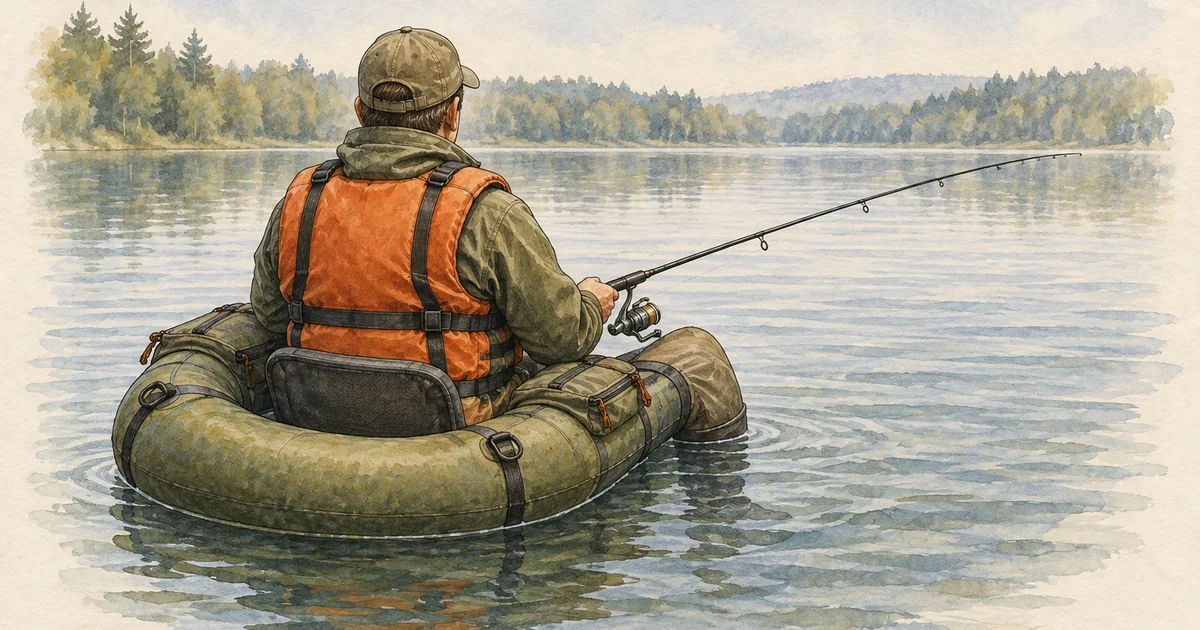
On some models you sit higher above the water. A high seat has advantages: only the lower legs are in the water, you get less cold in winter, and you can better see followers, that is, fish that follow the lure without taking it.
- Float tubes: the air-filled tubes. On today’s models a tough cover lies over them, which a hook penetrates only with difficulty.
- Seat and backrest: A waterproof container for food and papers can be strapped behind the backrest, and flat lure boxes fit into the side pockets.
- Tray: Some trays have a measuring scale printed on them, see tape measure and measuring mat. The table there also serves as a surface when unhooking.
- Fins: They are pulled on over the booties of the waders. Large fins push harder but need more strength; smaller ones make sense for beginners.
Paddling backwards and using the wind
With fins you move backwards in a belly boat. For lure anglers, one tactic applies: you fish the bank the wind is blowing onto and have the wind at your back. With calm strokes of the fins you keep your distance from the bank, the wind carries the lure further, and you cover shallow areas and drop-offs in a fan pattern.
The author of the Blinker article plans his trip only the day before and, from wind force 3 to 4 Beaufort, goes by the wind direction. To stop you drifting off, he names a small folding anchor of 1 to 1,5 kg on a line of about 20 m.
An offshore wind blows from the bank out onto the water. For air mattresses, rubber animals and other inflatable water toys, the DLRG writes that they easily drift away on open waters and that, with an offshore wind or current, it is almost impossible to get back under your own power. It advises regularly orienting yourself on fixed points on the bank. It makes no statement there on the belly boat itself.
Fig. 2 shows the situation: the wind pushes you away from the bank, and the way back is against it. The sources we checked give no fixed wind limit. You use the fixed point on the bank, which the DLRG mentions, to notice drift early, and the folding anchor from the Blinker article keeps you in place.
Legwork, design and fitness
How much of your legwork turns into forward thrust also depends on the shape. A look back at the history of the belly boat in Blinker explains what the later U and V shapes do better. In the old round ring, a good part of the effort is lost downwards and the thrust stays weak. With the V shape, the two outer air chambers act rather like a keel, and the boat can be steered nimbly.
With the fins you stay on the spot and can cast at the same time. A Blinker overview of fishing boats from 2025 highlights this and sees the belly boat at small, clearly defined spots such as a lily-pad field, but not on large waters with lots of wind. A sea angler describes in Blinker how he uses this fine control when cod fishing to keep the soft lure close to the bottom in one place. Once one fan of casts has been fished out, you move a few metres to the side and start the next.
Paddling backwards against wind or current takes stamina. The sea angler advises everyone who otherwise does little sport to train their legs first before heading further out. If you want to hold your position without paddling all the time, take an anchor, see Anchor and drift sock.
Waters it suits
The author of the Blinker article prefers to fish in shallow water with light gear for perch, pike and zander. He starts in the bank zones and goes into the next deeper layer of water only when nothing bites there. Where weed, drop-offs and perch humps lie there is shown under fishing on a lake. For spinning from the ring, he names a rod of 2,20 to 2,40 m with a casting weight of 12 to 20 g and a short handle, because a long one gets in the way when seated. This is a guide value from the specialist press.
When carp fishing, anglers in a belly boat mainly lay feed and rigs, and some paddle silently up to the fish and fish for them by sight. According to Blinker, lure fishing for wels catfish from the ring is better left to experienced anglers.
The sources draw the limits at current and shipping traffic. Heading out onto the Rhine is regarded as inadvisable. The Dutch anglers‘ association Sportvisunie reminds belly boat anglers of their vulnerable position relative to ships, current and tides. If you are heading onto very large lakes or the sea, the weather forecast or sea weather forecast belongs beforehand.
Equipment on board
There is little room on a belly boat, and anything lying loose ends up in the water sooner or later. The Blinker articles and a report in Rute & Rolle describe how anglers pack:
- Rod rest: A small holder on the boat takes the rod when you have landed a fish, take a break or have a second rod with you.
- Waterproof container: According to Blinker, it keeps food, fishing licence, a spare battery, towel and camera dry and sits behind the backrest with straps.
- Lures: Flat lure boxes fit in the side pockets. The author advises not packing too much, about ten lures in different colours and weights that you trust, plus spare heads, hooklengths, scissors and forceps.
- Fish finder: A small unit, fastened to the boat with two straps so that unit and transducer sit securely. How a fish finder works is explained under Fish finder. Where the unit or its live version is banned, water rules differ.
- Landing net: A report in Rute & Rolle shows a carp angler in a belly boat with a landing net with flotation, with which, in his words, the fish landed without any problem. Net shapes are explained under Landing net.
- Eye protection and anchor: Blinker advises polarised glasses against wind and waves and a folding anchor against drifting.
Life jacket, cold and emergency call
The brochure „Sicherheit auf dem Wasser” from the Federal Ministry of Transport says: non-swimmers and children put on the life jacket before getting aboard, and safety-conscious water sports enthusiasts wear it on the water, good swimmers included. On large waters the life jacket is regarded as absolutely necessary in a belly boat; a close-fitting automatic life jacket is recommended. More under life jacket and boat and life jacket.
On a belly boat your legs are in the water the whole time, with the fins fitted over the boot feet of the waders. The ministry’s brochure warns: even below 15 °C air temperature, the wind alone can chill you, and after a fall into the water there is a particular risk of hypothermia. Anyone who ends up in 10 °C water without protective clothing can afterwards actively take part in their own rescue for only about ten minutes at most. Without protective clothing, the brochure advises keeping your clothes on in the water, because they insulate. The DLRG points out that water temperature in lakes often drops suddenly and markedly with depth.
For anglers at sea, the DGzRS, the German Maritime Search and Rescue Service (Deutsche Gesellschaft zur Rettung Schiffbrüchiger), advises bright, luminous clothing instead of camouflage colours so that you can be seen during a search. According to a sea rescuer, out on the open sea phone reception breaks off after just a few kilometres. You take your phone packed waterproof. What applies when a thunderstorm approaches is explained under thunderstorms and weather.
In an emergency: emergency number 112. On the North Sea and Baltic Sea you can reach the DGzRS maritime rescue coordination centre in Bremen around the clock on 0421 53687-0. The advice is relayed from the ministry, the DGzRS and the DLRG and is no substitute for medical advice.
Getting in, playing and landing
According to Blinker, the belly boat can be transported in a car with little effort and used even where there is no slipway. One angler reports that he inflates it at home and is ready to go after a few minutes. The ministry requires non-swimmers and children to put on the life jacket before getting in. On the bank, mud and long water plants lurk: the DLRG warns, at still waters, of water plants that brush the body and can trigger panic, and of muddy lake beds that make moving about considerably harder.
You land pike to the side of the ring, because nothing protects you at the front, and a jumping fish could otherwise land in your lap with the lure and its hooks. When unhooking, the tray serves as a base. How to handle the fish gently afterwards is explained under Landing and unhooking fish.
If a hook does stick in the skin, you leave it in and paddle to the bank by the shortest route. The hook plugs the hole; if you pull it out, the air escapes much faster.
Rules: waterway, state waters, water rules
Whether you may go on the water with a belly boat and whether you may fish from it are two separate questions with several levels:
| Level | Where to look | What is regulated there |
|---|---|---|
| Federal waterway | GDWS small-craft table | classification of the belly boat as a flotation aid or floating object |
| State waters, lakes | the authority responsible for the water | their own navigation police regulations |
| Fishing itself | Water rules and fishing permit | whether boats or belly boats are permitted when fishing |
Federal waterways: In its small-craft table (version 8.0, as of 1 September 2024), the Generaldirektion Wasserstraßen und Schifffahrt (GDWS) describes the belly boat as an inflatable half-boat that the user straps around the waist. It classes the basic version, also with fins or paddles, as a “mere flotation aid”, not as a small craft. For a version with a propulsion device it gives the classification as a floating object: it may only be used without special permission where it clearly does not obstruct traffic. The table says nothing about angling; it regulates the demarcation of objects on federal waterways.
State waters and lakes: As a federal authority, the GDWS says it can only make statements about federal waterways. How far its rules apply to state waterways or lakes should be asked of the authority responsible for the water. State waters have their own navigation police regulations, which usually also refer to the federal rules.
Water rules and fishing permit: Here the manager decides, and the texts turn out very differently. Examples, retrieved in November 2026, mostly in the original wording:
- Landesanglerverband Brandenburg, water regulations for its association waters (Gewässerordnung), 2019 edition, no. 4.6.1: “Soweit nichts anderes bestimmt wurde, ist die Benutzung von Booten und Wasserfahrzeugen einschließlich sog. Bellyboote, zum Angeln gestattet.”
- Anglerverband Niedersachsen, Steinhuder Meer: “Ein Erlaubnisschein mit Bootslizenz ist für jede Person, die von einem schwimmenden Objekt/Fahrzeug (inkl. SUP, Bellyboot, Kajak) angelt, verpflichtend.”
- Anglerverband Niedersachsen, Mittellandkanal: “Das Angeln von jeglichen Wasserfahrzeugen/Schwimmkörpern (z.B. Boote, Belly-Boote etc.) ist verboten.”
- Nationalparkamt Müritz for most waters in the national park where only rowing boats are allowed: “Das Befahren mit anderen Wasserfahrzeugen ist hier verboten (u.a. Stand Up Paddling und Bellyboote).”
- Landesfischereiverband Westfalen und Lippe, frequently asked questions: “No boats, model boats (e.g. bait boats) or flotation aids (e.g. belly boats) may be used when fishing in the association’s waters.” For the Offlumer See the page names an exception: belly boats without a motor are permitted there.
- Bezirksfischereiverband für Ostfriesland, fisheries and water rules (resolution of 23.02.2023), No. 2.15: “Belly boats and other flotation aids are treated as rowing boats.” Fishing is only allowed from an anchored or firmly moored boat, and the anchor weight must be chosen so that drifting is impossible.
- The Netherlands, condition 12 of the VISpas in the Sportvisunie water list for 2026 to 2028, in translation: the belly boat is not permitted for fishing where it could obstruct large commercial shipping, at any rate not in the fairway of the main waterways such as the Waal.
If your permit says nothing about belly boats, ask the body that issues it, or the fisheries authority (Fischereibehörde), before you launch. The section Law and permits gives an overview of permits and papers.
Pump and fins
Pump and air pressure
According to Blinker, belly boats can be inflated right at the water and deflated again after fishing. So the pump travels with you, unless you inflate at home. How firm the tubes should be is given in the manufacturer’s instructions. Don’t set off with them too soft: in the Blinker author’s experience, a hook simply bounces off a firmly inflated tube. Larger inflatable boats are covered on the page Inflatable boat.
The air in the tube reacts to heat. LEIFIphysik describes Amontons‘ law: if the volume stays the same, the pressure of a gas rises in the same proportion as its absolute temperature in kelvin. According to Blinker, even the first belly boats made from lorry tyres had a habit of bursting in great heat. A worked example with assumed figures, not for any particular model:
- You inflate at an air temperature of 20 °C to 0,2 bar above ambient pressure. With an ambient air pressure of about 1 bar, that makes 1,2 bar absolute, at 293 kelvin.
- In the sun the air in the tube warms up to 40 °C, i.e. 313 kelvin: 1,2 bar × 313 / 293 gives about 1,28 bar. The overpressure rises from 0,2 to 0,28 bar, by about 40 per cent.
- On water at 10 °C it cools to 283 kelvin: 1,2 bar × 283 / 293 gives about 1,16 bar. Of the overpressure, 0,16 bar remains, a fifth less, and the tube gets softer.
The calculation applies to a fixed volume; if the tube gives a little, the change is smaller. At the bank this means: in full sun, don’t inflate beyond the manufacturer’s figure, and after launching into cold water check the firmness again before you push off.
Fins: open heel or shoe
Swim fins come with two kinds of foot pocket. Closed fins, also called pool fins or full-foot fins, are shaped like a shoe. You put them on barefoot or with neoprene socks, mostly for warm water. Open-heel fins from scuba diving have an open heel and go over booties or dive shoes; an adjustable rubber strap or a stainless-steel spring holds them on the foot. The authors of the 2019 Blinker article go for this open type: one recommends open-heel fins from a dive shop for large waters, while the sea angler pulls dive fins over neoprene shoes.
The right size
When it comes to size, the foot pocket matters first. It has to fit over what you wear on your foot in the belly boat, i.e. over the stocking foot of your waders or a neoprene shoe. So try the fin on with exactly that footwear and tighten the heel strap until it sits firmly. In cold water the sea angler wears his own neoprene dive boots, and the foot pocket has to fit over those too. As for the blade, it was already said above that large fins push more and cost more effort. The sea angler adds that large blades make you faster and more agile, and sees them more for fit anglers.
Secure anything you could lose
In the sea angler’s experience, loose gear has a habit of disappearing into the water. He hangs his landing net, priest and knife on thin cords attached to the boat with saltwater-resistant karabiners. How to stun a fish properly is explained under Stunning and killing fish. The heel strap holds the open-heel fin on your foot, so tighten it before you get in.
Common mistakes
- Leaving the vest in the car. The ministry counts the lifejacket on board as clothing.
- Putting the life jacket on only once on the water. For non-swimmers and children, the brochure requires: before getting in.
- Not allowing for the wind. Spinning anglers plan the trip around the wind direction, and with offshore wind the way back becomes hard.
- Fins that are too big to start with. They push hard but cost more effort.
- Pulling the hook out of its keeper. Leave it in place and paddle to the bank.
- Launching without reading the water regulations. The examples above show how different the rules are.
Frequently asked questions
Do I need waders in a belly boat?
The fins go over the boots of the waders. One angler reports in Rute & Rolle that in hot weather and warm water he leaves them in the car. In cool weather the ministry’s warning about hypothermia applies.
In what wind should I not go out any more?
The sources checked give no fixed limit. From force 3 to 4 on the Beaufort scale, lure anglers plan the trip according to the wind direction, and the DLRG warns about offshore wind when using inflatable craft. Warning levels and thunderstorms are explained in Thunderstorms and weather.
Does a belly boat count as a boat?
The rules answer this differently. The Landesanglerverband Brandenburg lists belly boats among boats and watercraft, the Anglerverband Niedersachsen speaks of floating objects. What matters is what the water regulations and fishing permit for your water say.
Do I have to anchor with a belly boat?
That depends on the rules. The Bezirksfischereiverband für Ostfriesland only allows fishing from an anchored or firmly moored boat and treats belly boats as rowing boats. Regardless of that, Blinker advises a small folding anchor against drifting.
How do I land a fish from a belly boat?
Pike to the side of the ring, because there is no gunwale at the front. One angler uses a landing net with flotation, and the tray serves as an unhooking base. Put the rod in the holder meanwhile.
Related
- Boat and lifejacket: checklist before casting off, clothing, capsizing
- Lifejacket: buoyancy classes, automatic jacket, maintenance
- Waders: material, fit and the risks of waders full of water
- Fish finder: cone, image types and rules on live sonar
- Landing net: mesh, size and handle
- Fishing on a lake: weed, drop-off and perch hump from the bank into the depths
- Spinning rod: length, casting weight and action
- Line calculator: breaking strain and backing for the reel
Sources
- Blinker: Belly-Boot: Das 1. Mal im schwimmbaren Untersatz, 2019 (Sitz, Ablage, Geräteflossen und Flossengröße, rückwärts paddeln, Bauformen, Kondition, Sichern der Ausrüstung, straff pumpen, Wind, Anker, Ausrüstung, Weste, Haken, Rute, Rhein)
- Blinker: Angeln vom Belly-Boat: Der Spezialauftrag, 2016 (frühere Bauform, Karpfen und Wels, Einsatz ohne Slipstelle) und Rute & Rolle: Mit dem Belly Boat auf Bartelbrummer, 2021 (Wathose bei warmem Wasser, Kescher, Aufblasen)
- BMDV, BSH, WSV: Sicherheit auf dem Wasser (PDF), Dezember 2023 (Weste, Auskühlen, Unterkühlung)
- DLRG: Sicherheitstipps (ablandiger Wind, Fixpunkte am Ufer) und DLRG: Gefahren in stehenden Gewässern (Wasserpflanzen, Schlamm, kalte Schichten)
- Die Seenotretter (DGzRS): Sicher am Haken, Angeln an der Küste und auf See (Kleidung, Handyempfang, Notrufnummer)
- Generaldirektion Wasserstraßen und Schifffahrt: Kleinfahrzeugtabelle KFT-G, Version 8.0, Stand 1. September 2024 (PDF, ELWIS) (Einordnung des Belly-Boats, Bundeswasserstraßen, Landesgewässer)
- Landesanglerverband Brandenburg: Gewässerordnung, Ausgabe 2019 (Nr. 4.6.1 Boote und Bellyboote)
- Anglerverband Niedersachsen: Steinhuder Meer (Bootslizenz) und Anglerverband Niedersachsen: Mittellandkanal (Verbot für Wasserfahrzeuge und Schwimmkörper)
- Nationalparkamt Müritz: Wasserwandern im Müritz-Nationalpark (Befahrensverbot)
- Landesfischereiverband Westfalen und Lippe: Häufige Fragen (Boote und Schwimmhilfen in Verbandsgewässern) und Bezirksfischereiverband für Ostfriesland: Fischerei- und Gewässerordnung (Nr. 2.15, Beschluss vom 23.02.2023)
- Sportvisunie: Gezamenlijke Lijst van Nederlandse VISwateren 2026 bis 2028 (PDF) (Bedingung 12, Schifffahrt und Strömung)
- Blinker: Welches Boot brauche ich zum Angeln?, 2025 (Aufpumpen am Wasser, kleine Plätze, Grenzen bei großen Gewässern und Wind)
- LEIFIphysik: Gesetz von Amontons (Druck und Temperatur bei gleichem Volumen)
- Wikipedia: Schwimmflosse (geschlossene Flossen und Geräteflossen, ergänzend)
Text AI-assisted, drawings AI-generated. Sources opened and checked in November 2026, no graphics taken from the sources.
All figures are rough guides without guarantee. Whether and where you may go on the water with a belly boat is governed by navigation rules, water rules and fishing permit, and this text replaces neither medical advice nor local knowledge.