
Knowledge – Fish
Fishing for Greenland halibut
You will hardly ever fish for Greenland halibut: the dark flatfish usually stays 500 to 1000 metres down and is not a target species. Here you can read how to recognise it, where it lives and what to do if one takes your bait anyway.
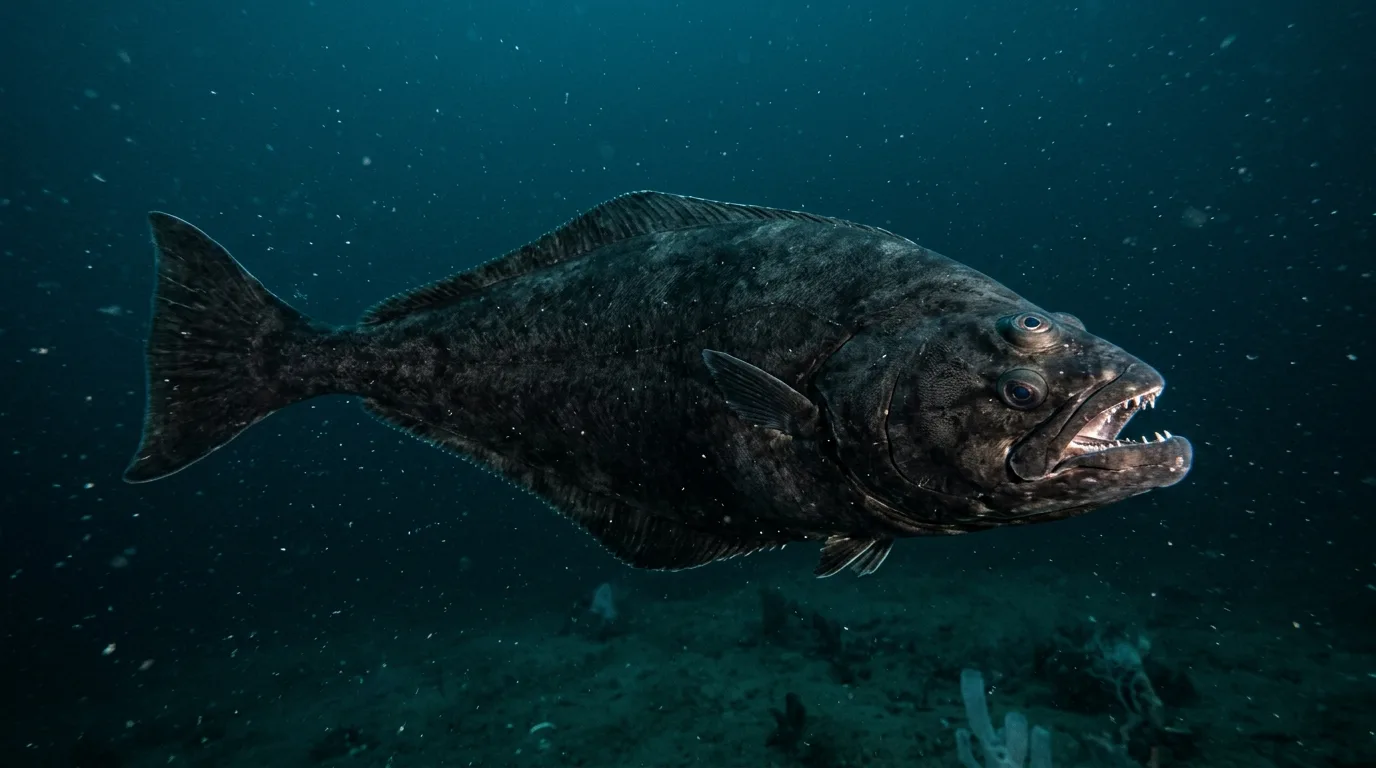
The Greenland halibut is not a target species. In Norway it is temporarily protected from sea anglers, and during that time it must not be fished for.
Quick to recognise
A slender, right-eyed flatfish with a large, toothed mouth, yellowish to greyish brown on top and brownish or bluish underneath too. Around 56 centimetres is usual; females reach up to 130 centimetres.
Why it is not a target fish
Worldwide the IUCN lists it as near threatened. For the Norwegian-Russian stock the Thünen-Institut sees overuse and a falling biomass. In Norway sea anglers are subject to a temporary protection, and there is no angling season for it.
Where it lives
On the coast
It lives in the cold depths around the Arctic, mostly between 500 and 1000 metres, for example on the continental slope off northern Norway. On the bottom it prefers soft mud, but it often hunts in open water too.
| All year round | deep water, edge, sandy bottom, open water |
|---|
Holding spots in the picture
Choose a season and time of day: the picture shows where the species sits then. Tap a fish or a spot in the list to bring it closer. The picture is schematic and AI-generated, every water is different.
On the coast
Sandy bottom
Greenland halibut is found here all year round.
Drop-off
Greenland halibut is found here all year round.
Deep, colder water
Greenland halibut is found here all year round.
Open water, mid-water
Greenland halibut is found here all year round.
The Greenland halibut lives in the cold depths of the North Atlantic, for example on the continental slope off northern Norway. On the bottom it likes soft, muddy ground, but it often hunts in open water too.
Winter: This is when spawning takes place, so observe the closed seasons (Schonzeiten). In winter it spawns at great depth just above the bottom.
Depth: It usually lives at 500 to 1000 metres and has been recorded between 20 and 2200 metres. Adult fish seek very cold water near the bottom.
Size comparison: AI-generated drawing, schematic.
Do not confuse
Despite the name it is not the same as the halibut; it forms a genus of its own. The surest way to identify it is the coloured blind side and the eye on the upper edge of the head. Plaice and flounder are white underneath, broader in build and do not have such a large, toothed mouth.
If it bites anyway
If one does take the hook, check whether a closed season is in force in Norway at the time and, if so, return it at once without a pause for photos. Handle it only with wet hands and remove the hook while it is still in the water.
Rules
For the Greenland halibut our overview of the states gives no figures for minimum size (Mindestmaß) or closed season (Schonzeit). That does not mean you may catch or keep it: protection is governed by state fisheries law and nature conservation law.
On the coast the rules of the coastal states apply, partly with their own catch restrictions: North Sea coast, Baltic coast of Schleswig-Holstein and Baltic coast of Mecklenburg-Western Pomerania.
The regulation and your fishing permit (Erlaubnisschein) are what count. Lake Constance, the Rhine and the coast, for example, have their own rules: Fishing waters in Germany.
Text AI-assisted, summarised from these pages: Greenland halibut (profile), Releasing a fish.