
Knowledge – Fish
Greenland halibut: Features, habitat, protection
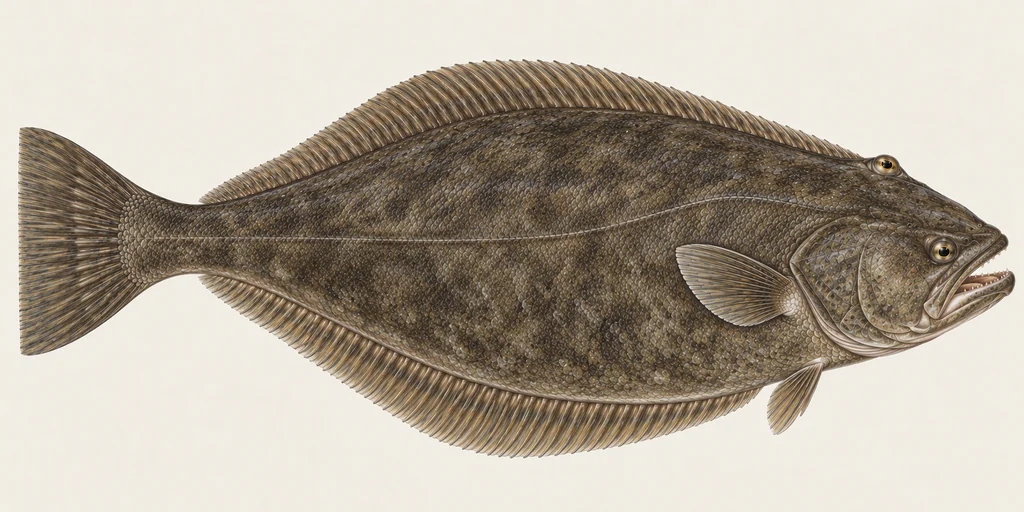
The Greenland halibut (Reinhardtius hippoglossoides), also called black halibut, is a flatfish of the cold deep sea. Unlike most flatfish it is dark on the underside too. It forms a genus of its own and is not a dark halibut.
In short: Not a target fish: it usually lives far below normal fishing depths and in Norway is protected for sea anglers for part of the year. A different species from the halibut, recognisable by its coloured underside. What to do with a bycatch: Greenland halibut as bycatch.
- The left eye sits on the upper edge of the head, not quite on the right side
- Large mouth with strong teeth
- Dorsal fin begins behind the upper eye, tail fin straight to slightly notched
Catch chances through the year
- Hardly any chance
- Possible
- Good
- Peak season
- Spawning (observe the closed season)
Editorial assessment for waters in Germany, not a measured value and no guarantee. Spawning time is not the same as the legal closed season.
Species profile and sources in the catch calendarAll species compared month by monthThe rules of your federal state
How to recognise it
The Greenland halibut is a right-eyed flatfish. During development the left eye migrates across the skull but only gets as far as the upper edge of the head.
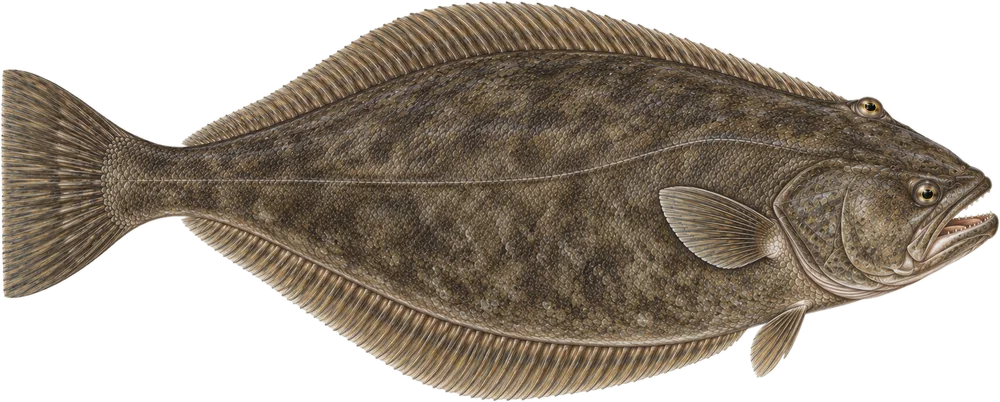
The upper side is yellowish to greyish brown. The underside, the blind side, is also brownish or bluish and not white as in plaice or flounder. The body is slimmer than in most flatfish, the mouth large and set with strong teeth. The dorsal fin begins behind the upper eye, the tail fin is cut straight to slightly notched, and the pectoral fins are small.
FishBase gives a common length of around 56 centimetres and a maximum of 110 centimetres for males and 130 centimetres for females. Store norske leksikon gives up to about one metre and 20 kilograms. The highest age given by FishBase is 36 years.
Despite its name, the Greenland halibut is not a dark halibut but belongs to a genus of its own. You can recognise it reliably by the coloured underside and the eye on the edge of the head.
It differs from plaice and flounder in its slimmer body, its large, toothed mouth and the absence of a pale blind side.
Side by side
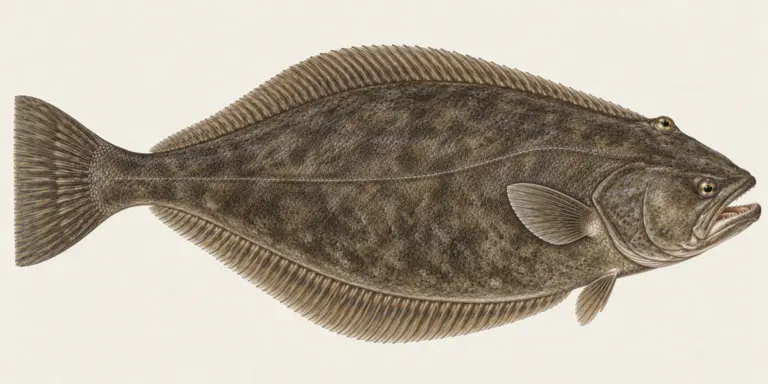
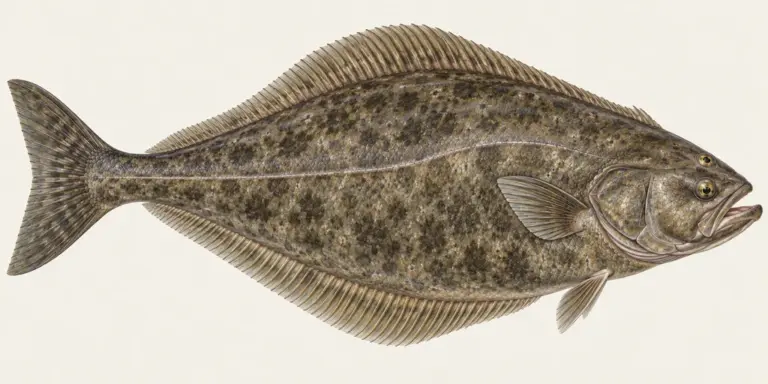
AI-generated illustrations.
Where it lives
The Greenland halibut lives around the Arctic in the North Atlantic and North Pacific. In the Atlantic it occurs from the coast of the USA via Canada and Greenland to the Barents Sea, and south to Ireland and southern Norway. In Norwegian waters an important stock lives from the continental slope off northern Norway as far as Franz Josef Land.
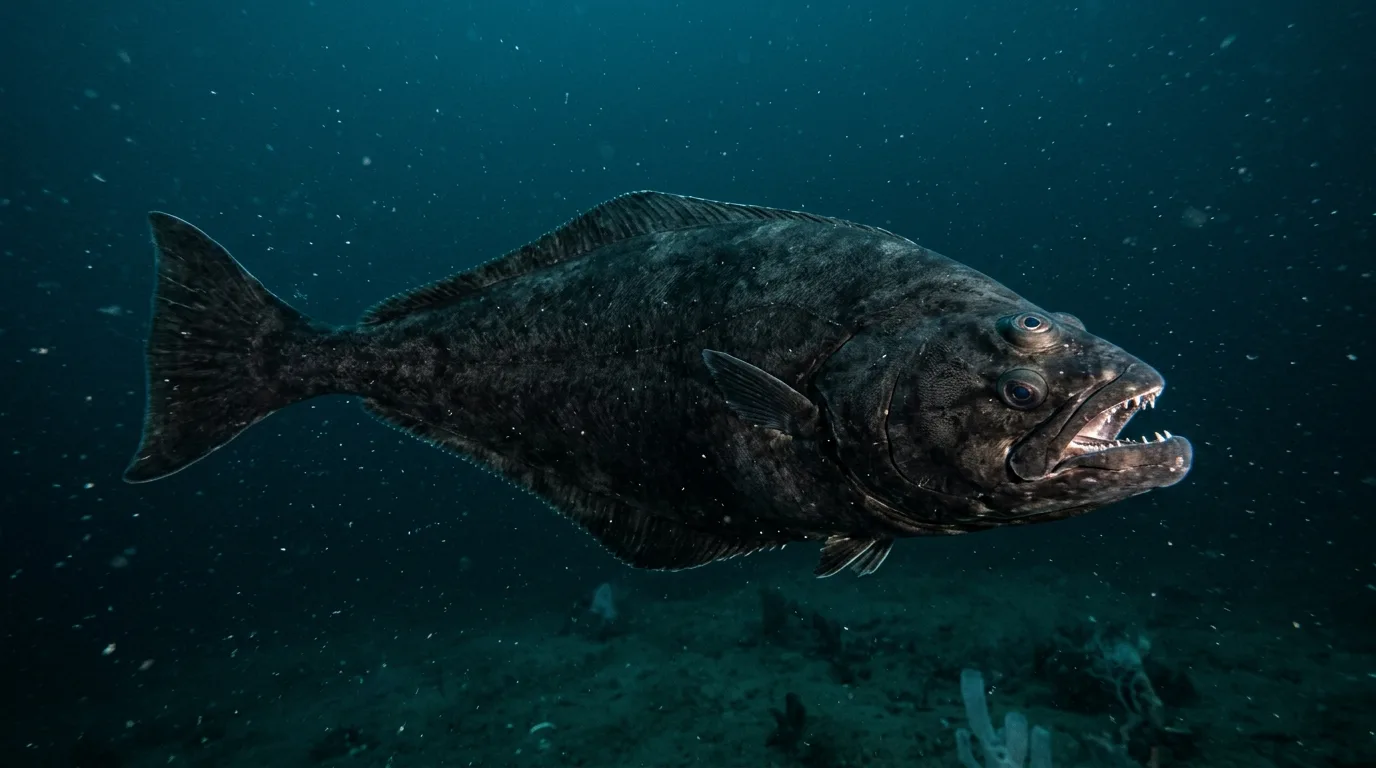
It occurs between 20 and 2200 metres, according to FishBase mostly at 500 to 1000 metres depth. Adult fish prefer bottom temperatures from just below zero to 6 degrees, and Store norske leksikon names water below 4 degrees as the centre of its range. On the bottom it likes soft, muddy ground.
Holding spots in the picture
Choose a season and time of day: the picture shows where the species sits then. Tap a fish or a spot in the list to bring it closer. The picture is schematic and AI-generated, every water is different.
On the coast
Sandy bottom
Greenland halibut is found here all year round.
Drop-off
Greenland halibut is found here all year round.
Deep, colder water
Greenland halibut is found here all year round.
Open water, mid-water
Greenland halibut is found here all year round.
The Greenland halibut lives in the cold depths of the North Atlantic, for example on the continental slope off northern Norway. On the bottom it likes soft, muddy ground, but it often hunts in open water too.
Winter: This is when spawning takes place, so observe the closed seasons (Schonzeiten). In winter it spawns at great depth just above the bottom.
Depth: It usually lives at 500 to 1000 metres and has been recorded between 20 and 2200 metres. Adult fish seek very cold water near the bottom.
Size comparison: AI-generated drawing, schematic.
How it hunts and spawns
Although it is a flatfish, it is often caught in open water. It hunts fish such as capelin, redfish and eelpouts, as well as deep-sea prawns, other crustaceans and squid. It can migrate long distances.
According to NOAA, Greenland halibut spawn in winter in deep water close to the bottom. A female releases 60 000 to 80 000 eggs. Females mature at about 60 centimetres and nine years of age. The Thünen-Institut suspects the main spawning area of the Norwegian-Russian stock in the sea between northern Norway and Bear Island.
The larvae drift in open water for about four months and grow up to 8 centimetres long. At about 7 centimetres they sink onto clay and silt bottoms at 300 to 450 metres depth and transform into flatfish.
Is there a season?
For anglers there is no season; the calendar shows zero throughout. The species usually lives far below the depths at which people normally fish along the coast, and in Norway it is protected for sea anglers for part of the year.
The Greenland halibut is fished commercially with trawls, longlines and gillnets.
You will find the monthly overview of all species and the water temperature check in the catch calendar.
What to do with a bycatch
As bycatch: Fishing for Greenland halibut? – why the species is not a target fish and what to do with a bycatch.
The Greenland halibut is not fished for deliberately. Since it usually lives at 500 to 1000 metres depth, a bite is conceivable mainly when fishing very deep.
If one does end up on the hook, first check whether the closed season (Schonzeit) is in force in Norway. During that time the species must not be fished for, so release the fish immediately and without a long photo break. Handle it with wet hands and remove the hook in the water if possible.
Check the underside: A coloured rather than white blind side is the quickest way to recognise the Greenland halibut.
Read the rules before the trip: Before you leave, read the current list of protected species at the Fiskeridirektoratet and check when the Greenland halibut is protected.
Suitable lures
We deliberately show no baits for this species.
Usually lives at 500 to 1000 m depth and is temporarily protected for sea anglers in Norway; IUCN: near threatened. Release a bycatch in the closed season (Schonzeit) immediately and gently.
What you need to observe
In Norway the fisheries directorate lists the Greenland halibut among the species protected for sea anglers for part of the year. Protected species may then not be fished for. You will find the current version at the Fiskeridirektoratet.
Closed seasons, minimum sizes and harvest slots are set by the federal states (Bundesländer) and by the fisheries authorities of the neighbouring countries on the coast (Denmark, Norway, Poland). They vary by type of water, stretch of coast and time of year. We only give figures together with the date and source; the fisheries regulation of your federal state and your fishing permit (Erlaubnisschein) are always what is binding. You will find a list of links to the official sources in the catch calendar.
The IUCN classes the Greenland halibut as near threatened worldwide (Near Threatened). For the Norwegian-Russian stock the Thünen-Institut finds that the exploitation rate is too high and the biomass is declining.
What closed season, minimum size and harvest slot mean and where to find them is explained on the page Closed season and minimum size explained.
Frequently asked questions (FAQ)
Is the Greenland halibut a halibut?
No. It belongs to a genus of its own (Reinhardtius), the halibut to the genus Hippoglossus. You can recognise it by the coloured underside.
Can I fish for Greenland halibut in Norway?
It usually lives at 500 to 1000 metres depth and in Norway is protected for sea anglers for part of the year. It is not fished for deliberately.
Where does the Greenland halibut live?
In the cold deep sea of the North Atlantic and North Pacific, mostly at 500 to 1000 metres depth. In Norway an important stock lives off northern Norway and in the Barents Sea.
Sources
The rating of catch chances is an editorial assessment. The facts come from these sources, and the text is worded in our own words. The illustration is an original design by Angel Momente in the style of a natural history plate (AI-generated, see the AI notice).
- FishBase: Reinhardtius hippoglossoides, Greenland halibut (Größe, Tiefe, Nahrung, Larven)
- Store norske leksikon (L. A. Vøllestad, Universität Oslo): blåkveite
- NOAA Fisheries: Greenland Turbot (Aussehen, Fortpflanzung, Lebensraum)
- Thünen-Institut, Fischbestände online: Heilbutt, schwarzer (Merkmale, Verbreitung)
- Thünen-Institut, Fischbestände online: Schwarzer Heilbutt Nordost-Arktis (Bestand, Laichgebiet, Tiefe)
- Fiskeridirektoratet: Meeresangeln in Norwegen, Regeln (zeitweise geschützte Arten)
Created with AI support from the sources listed. Figures only appear in the text if a source gives them. Last updated: 27 October 2026. Found a mistake? Write to us. Who is behind this site: About me.
More in the lexicon
- All fish species at a glance
- Catch calendar – month, water temperature and profile for 93 species
- Line calculator – breaking strain after the knot, drag guideline, backing
- Angling methods