
Knowledge · Tackle
Fly reel: Line capacity, drag and backing
The fly reel holds backing, fly line and leader and brakes a fish that takes line. It rests during the cast; the fly angler strips the line off by hand. This covers how the spool is filled, which drag is enough for what and what salt water does to the reel.
Line store behind the casting hand
The teaching material for the angling exam (Fischerprüfung) describes the fly reel as a very light reel without gearing: one turn of the handle turns the spool once. You do not cast from the reel. With one hand the fly angler pulls line off the spool, with the other he guides the rod.
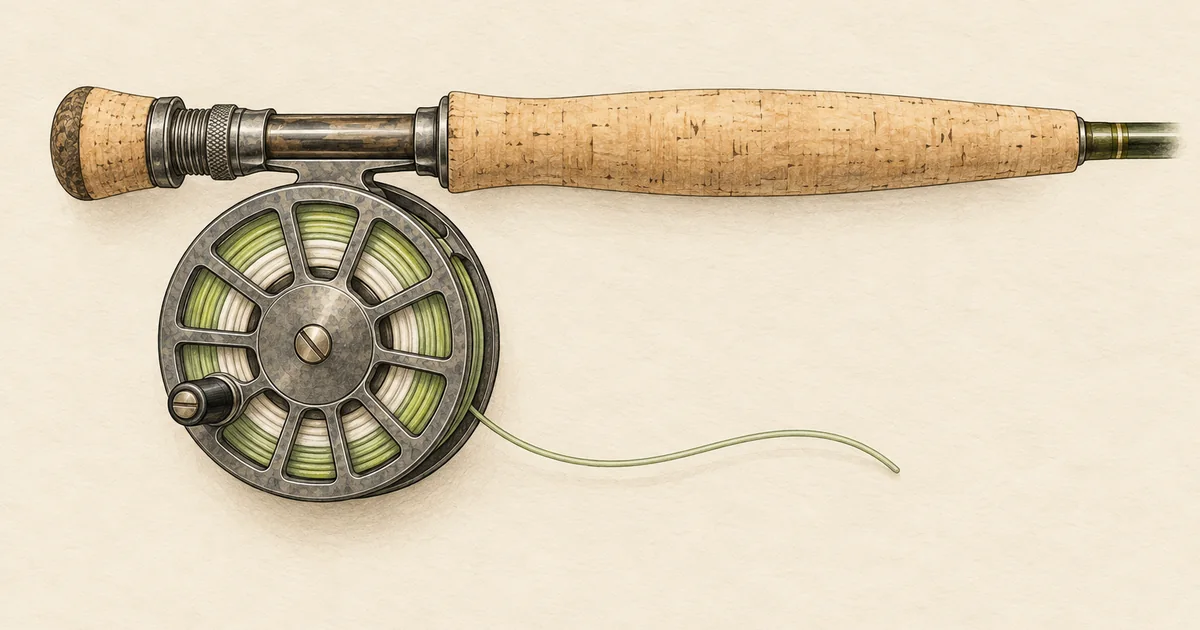
According to Blinker the reel is above all a store for the line. It becomes more important the bigger the fish: according to Rute & Rolle a sea trout on the coast takes a good few dozen metres of line in one run, and then the drag has to work cleanly. Where the reel sits on the rod is shown on the page about the fly rod.
Backing, fly line and leader on the spool
The backing goes on the spool first, a thin extra line. It builds up the fly line and serves as a reserve when a bigger fish runs far. Guide values:
- The material for the angling exam (Fischerprüfung) names an extra line of 0,25 to 0,40 mm diameter and 50 to 100 m length.
- For a class 6 outfit Blinker reckons on about 50 m of backing with a breaking strain of 20 lb, which is around 9 kg. 30 lb is given for large salmon, 50 lb for heavy saltwater fishing.
- For sea trout on the coast Rute & Rolle spools around 100 m of backing.
- For getting started, monofilament of 0,40 mm is also enough.
Next comes the fly line, and right at the end the leader, which tapers towards the fly. Beginners are recommended tapered monofilament leaders the length of the rod, at 9 ft that is about 2,74 m. If the thin tip is damaged, you knot on a new piece.
The connections
Each layer has a different diameter, so every transition needs its own knot. The table follows two trade articles.
| Transition | Knots | Note |
|---|---|---|
| Spool to backing | Uni knot | first layer on the spool core |
| Backing to fly line | Albright knot | joins unlike materials and thicknesses |
| Fly line to leader | Loop-to-loop | simple; laid correctly at least 90 % of breaking strain |
| Fly line to leader | Needle knot | passes more smoothly through the rings, up to class 7 |
| Leader to tippet | Surgeon’s knot | repairing or renewing the tip |
There is no separate guide here for the needle knot. A wrapped connection between fly line and leader is shown by the nail knot.
Line class of rod, reel and line
The reel, like the rod and line, carries a line class, usually with a hash (#) in front. A reel marked #5/6 or #6 suits a class 6 rod. What the classes mean is explained on the pages for fly rod and fly line.
Click-and-pawl and disc drag
The drag has two jobs: it stops the spool from overrunning when you pull line off, and it puts resistance on a fleeing fish until it tires. It is set by a dial on the outside of the reel, the drag knob. Where it sits depends on the design.
Click-and-pawl or ratchet: A pawl engages a toothed wheel and clicks as long as the spool turns. Originally it was only meant to prevent overrun, with braking done by the palm of the hand on the rim of the running spool. Later pawls could be adjusted slightly. For smaller fish that is enough; for large ones the adjustment range and force are lacking.
Disc drag: Drag discs pass pressure to the spool. Modern versions made of composite materials can be adjusted over a wider range, brake more evenly and withstand friction heat. It is recommended for beginners, and even inexpensive reels have it.
For smaller trout and grayling the click-and-pawl is enough. With large, hard-fighting fish such as salmon, the force and adjustment range of the drag matter, and that is exactly where the click-and-pawl reaches its limit. You will find a starting value with a spring balance under Setting the reel drag, written for the fixed-spool reel.
Large arbor: the big spool core
Arbor is the English word for the spool core. On a large-arbor reel it is big, so the line lies in wide coils. Without a gear ratio, every turn of the handle takes in one coil of line, so a big core takes in more per turn. Such spools also hold noticeably more fly line and backing. The big core is also meant to:
- reduce the memory of the fly line, meaning its tendency to come off the spool in curls,
- keep the drag more even over a run,
- take in slack line quickly when a hooked fish suddenly swims towards you.
Fly reels with a gear ratio, known as multipliers, struck many anglers as too heavy, complicated and prone to faults, and they never caught on. Reels with a large core have largely replaced them.
Worked example: With a winding diameter of 5 cm, one turn of the handle takes in about 16 cm of line (5 cm times 3,14), and at 8 cm about 25 cm. Both diameters are assumed. When a fish takes line, the diameter shrinks and the drag acts more strongly on the line. More on setting it under Setting the reel drag.
Switching the handle to the left or right
If you hold the rod with your right hand, you wind with your left, so according to Blinker your dominant hand stays on the rod. Most modern fly reels can be set up for either side. Whether you can do it yourself or need a tackle shop is explained in the instructions.
Saltwater: corrosion and care
Saltwater fly reels are mostly large-arbor reels with plenty of room for backing, because sea fish make long runs. Against corrosion they often have a frame and spool made of high-strength aluminium, galvanically coated or stainless steel parts and sealed bearings. For fishing reels in general, these care tips apply:
- Rinse after every saltwater session, not just after the holiday. Wiping with a wet cloth is not enough, otherwise salt stays trapped behind the covers.
- Close the drag first, then give the reel a short, gentle rinse with cold water.
- Never submerge the reel. No reel is completely watertight, and water would get inside.
- After every day’s fishing, loosen the drag and store the reel like that.
Frequent rinsing washes out the lubrication over time, so regular servicing is part of the deal. More on the coast under Sea fishing.
Common mistakes
- Winding on fly line without backing. Then there is no padding and no reserve when a big fish runs.
- Choosing a reel of the wrong class. The class on the reel should match the rod; a 6-weight rod goes with a reel rated #5/6 or #6.
- Grabbing the spinning handle. On a direct-drive reel the handle is fixed to the spool and turns with it during a run. The spool is braked at the rim, not at the handle.
- Going after big fish with a simple click-and-pawl reel. For sea trout or salmon it lacks braking power; a disc drag can be set over a wider range and more finely.
- Only wiping the reel after the sea, or dunking it in a bucket. In the first case salt stays inside, in the second water gets in.
Frequently asked questions
Do I need a reel with a disc drag as a beginner?
A click drag is enough for trout and grayling. Beginners are still advised to get a disc drag, and even inexpensive reels have one. If you later go for sea trout or salmon, you are already equipped.
How much backing belongs on a fly reel?
That depends on the target fish and the spool. The exam material gives 50 to 100 m, about 50 m for class 6, and around 100 m for sea trout on the coast.
Why does the handle turn when a fish takes line?
Classic fly reels have a direct drive: handle and spool are rigidly coupled, so on a fast run the handle can strike your fingers. Take your hand off the handle knob then. On reels with anti-reverse, which includes many saltwater fly reels, the handle stays still while the spool pays out line.
Related
- Fly rod: choosing line class, length and action
- Fly line: structure and types of casting line
- Fly fishing: principle, cast and target fish
- Fishing reels: the types of reel at a glance
- Setting the reel drag: finding a starting value with a spring balance
- Albright knot: tying backing to the fly line
- Line calculator: breaking strength of the leader tip after the knot
- Unit converter: converting lb and ft to kg and m
Sources
- Fischereiverein Löningen: Zusammenfassung Gerätekunde (PDF) (Rolle ohne Übersetzung, Nachschnur 0,25 bis 0,40 mm und 50 bis 100 m) und Fischereiverein Löningen: Gerätekunde zur Fischerprüfung (PDF) (Backing für große Fische)
- Blinker: Fliegenfischen, die besten Geräte-Tipps für Anfänger (Schnurspeicher, Backing mit 20 lb, Vorfach)
- Blinker: Fliegenfischen für Einsteiger, clever investieren (Rollenklasse, Kurbelseite, Scheibenbremse, 50 m Backing, Knoten)
- Blinker: Das kleine 1×1 der Fliegenrollen (Direct Drive, Anti Reverse, Large Arbor, Multiplier)
- Blinker: Fliegenschnur, was bedeuten diese Begriffe? (Backing mit 20, 30 und 50 lb) und Blinker: Knoten fürs Fliegenfischen (Knoten zwischen den Lagen)
- Blinker: 9 effektive Profitipps zur Rollenpflege (Pflege nach Salzwasser)
- Rute & Rolle: Kaltstart auf Meerforelle (100 m Backing, Bremse)
- Wikipedia: Fishing reel (Bedienung, Bremsarten, Large Arbor, Salzwasserrollen, Antrieb)
Text AI-assisted, drawing AI-generated. Sources opened and checked in October 2026; no graphics taken from the sources.
All figures are guidelines without guarantee. How to set the handle side and the drag, and which parts may be greased, is explained in your reel’s instructions.