
Knowledge · Knots
How to tie an Albright knot
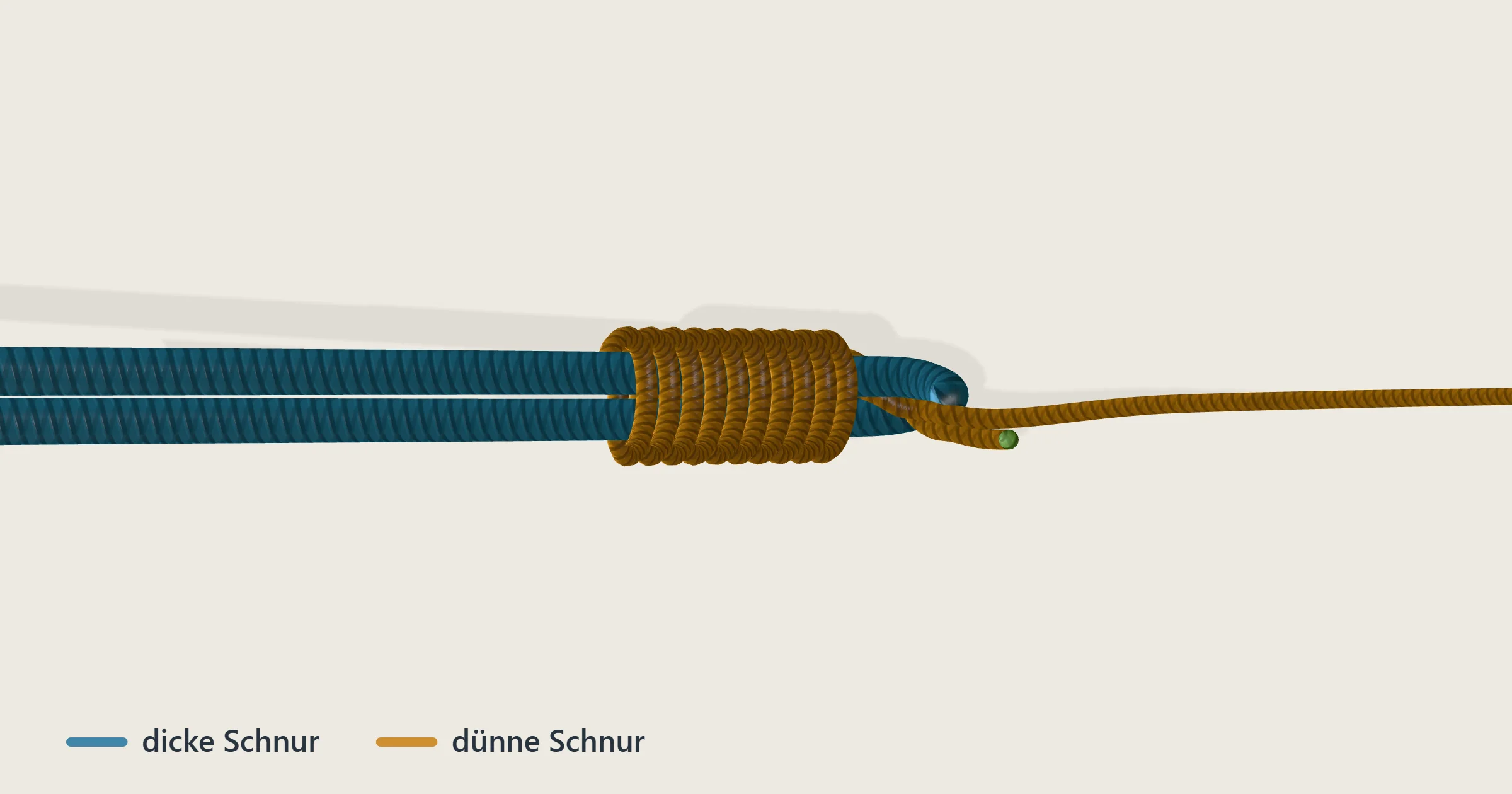
The Albright knot joins two lines of different diameter or material. The thinner line is wrapped around a loop of the thicker one and runs back through that loop.
What is the Albright knot good for?
Typical cases are braid to monofilament, a leader to the main line or fly line to backing. Animated Knots and Blinker point out that the finished knot is slim and slides well through the rod rings.
The loop always goes in the thicker line. If you join monofilament to a wire leader, Blinker puts the loop in the stiffer wire leader.
Tying the Albright knot: step by step
- Loop in the thick line. Fold the end of the thicker line into a loop.
- Pass the thin line through. Pass the thinner line through the loop. NetKnots gives about 10 inches, i.e. around 25 cm.
- Wrap. Hold all three strands between thumb and forefinger. Wrap the thin line back over itself and over both strands of the loop, turn next to turn towards the end of the loop. Animated Knots and NetKnots give ten turns, Blinker ten to twelve.
- Back through the loop. Pass the end of the thin line back through the loop so that it comes out on the same side it went in.
- Tighten. Moisten the knot. Hold both ends of the thick line, push the turns towards the end of the loop and pull the thin line tight. Cut the ends close to the knot.
Common mistakes
- Wrong side on exit: The end must leave the loop on the side where it went in.
- Turns untidy: Hold them under your fingers while wrapping so that they lie neatly side by side.
- Ends too long: Protruding ends catch in the rings.
Pull test and knot strength
First check that the turns lie neatly side by side and both lines are undamaged. Then pull steadily on both main lines. Do not wrap thin line around your bare fingers to do this. If an end slips or the knot distorts, tie it again. A pull test does not measure breaking strength; it only shows gross tying errors.
Material, diameter and tying technique affect every connection. The line calculator gives you a rough guide using cautious knot factors of our own.
Related knots
The FG knot is even slimmer, but harder to tie. For lines of similar strength the blood knot is suitable.
Used in these rigs: Carolina rig and jig head rig.
Note: None of the sources consulted gives a strength in per cent for the Albright knot. Rely on the pull test.
Sources
- Animated Knots – Albright Knot
- NetKnots – Albright Special
- Blinker – Albright-Knoten
- Blinker – Knoten fürs Fliegenfischen
Sources opened and checked on 2 October 2026. Texts in our own words, sketch drawn independently; no graphics taken from the sources. You will find all knots in the overview of fishing knots.
All figures are guide values without guarantee. Follow the line manufacturer’s instructions.