
Knowledge · Knots
How to tie a blood knot
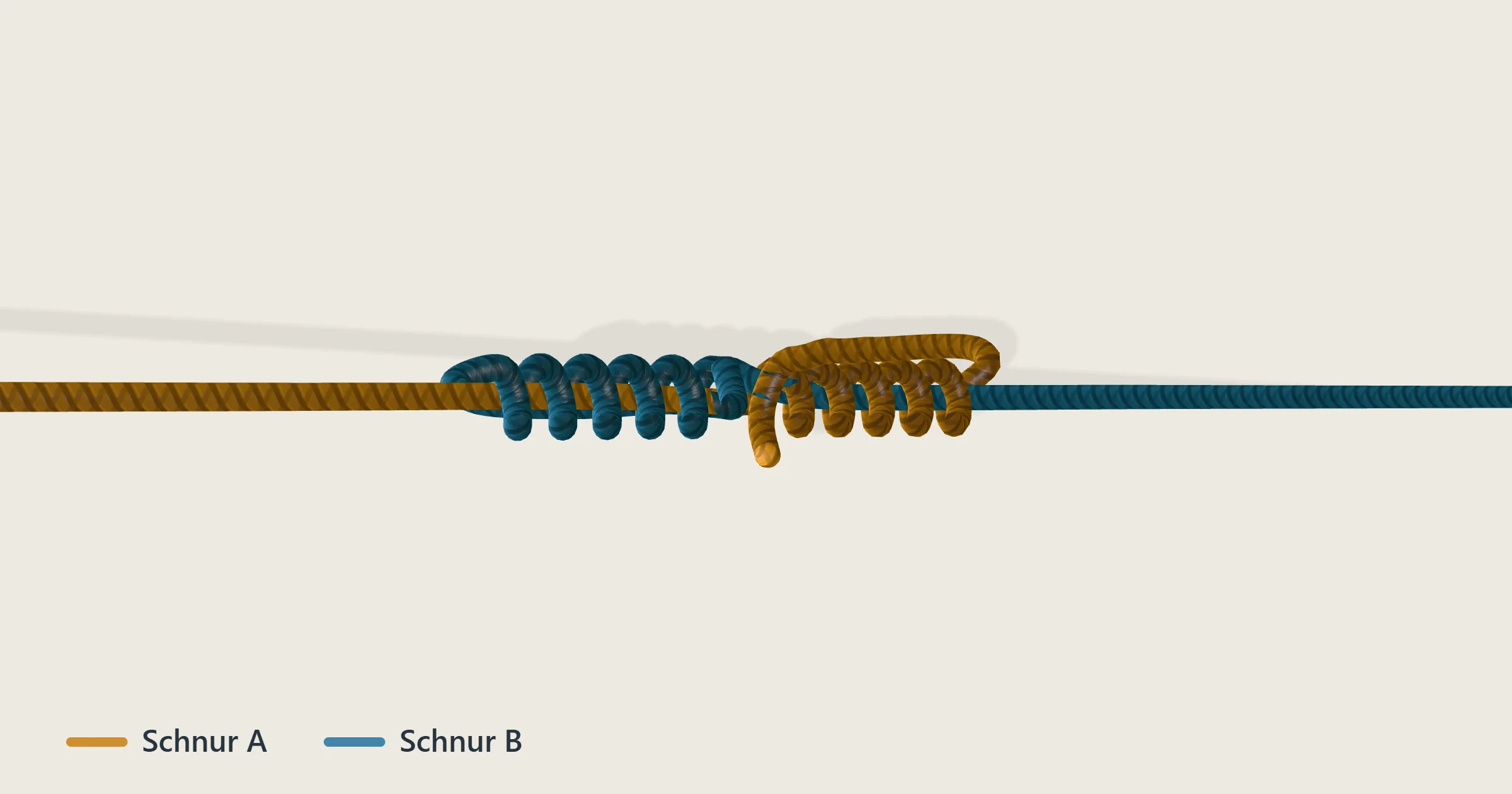
The blood knot joins two lines of similar diameter. Each end is wrapped around the other line and tucked back through the gap in the middle. Fly anglers use it to build tapered leaders.
What is the blood knot good for?
The blood knot works best when both lines are about the same thickness and is used mainly for monofilament. Blinker also names the main line directly to the leader without a swivel as a use; the knot slides well through the rings.
According to Blinker, the blood knot holds about 75 per cent of the line strength. For clearly different diameters, Wikipedia points to the Albright knot.
Tying the blood knot: step by step
- Overlap the lines. Lay the two lines side by side, overlapping; the short ends point in opposite directions. Wikipedia gives an overlap of 6 to 8 cm.
- Wrap the first end. Wrap one end around the other line. The sources give five to seven turns per side.
- Back through the middle. Bring this end back and tuck it between the two lines, where the turns begin.
- Wrap the second end. Wrap the other end around the first line the same number of times and tuck it through the same gap in the opposite direction.
- Tighten. Moisten the knot and pull slowly on both main lines until the turns close up. Cut the ends close to the knot.
Common mistakes
- Both ends in the same direction: They must pass through the middle in opposite directions, one from above, one from below.
- Tightened too fast: Pull slowly so that the turns can settle.
- Tightened dry: Without moistening, friction heat builds up that can weaken the line.
- Very different diameters: The blood knot is not the first choice for that.
Pull test and knot strength
First check that the turns lie neatly side by side and both lines are undamaged. Then pull steadily on both main lines. Do not wrap thin line around your bare fingers to do this. If an end slips or the knot distorts, tie it again. A pull test does not measure breaking strength; it only shows gross tying errors.
Material, diameter and tying technique affect every connection. The line calculator gives you a rough guide using cautious knot factors of our own.
Related knots
The surgeon’s knot is easier to tie. The double uni knot also joins two lines. A loop of similar construction is the dropper loop.
Used in fly fishing.
Note: Animated Knots points out that the turns rearrange as you tighten. The finished knot therefore looks different from the loosely laid one in the sketch.
Sources
- Animated Knots – Blood Knot
- NetKnots – Blood Knot
- Blinker – Der Blutknoten
- Wikipedia – Blutknoten
- Wikipedia (englisch) – Blood knot
Sources opened and checked on 2 October 2026. Texts in our own words, sketch drawn independently; no graphics taken from the sources. You will find all knots in the overview of fishing knots.
All figures are guide values without guarantee. Follow the line manufacturer’s instructions.