
Knowledge – Fish
Fishing for dace
Fishing for dace means: outwitting a shy shoal in clear, flowing water with fine tackle and a small bait. Here is the way there in nine steps, each with a link to the detailed page.
 Choose another fish117 fish with guides
 EelOff-peak season
 EelpoutPossible
 IdePossible
 ArapaimaGood
 GraylingPeak season
 Atlantic salmonSpawning time, please spare
 Brown troutSpawning time, please spare
 Brook troutSpawning time, please spare
 BarbelOff-peak season
 BarramundiSpawning season
 Greater amberjackGood
 Topmouth gudgeonOnly as bycatch
 Blue marlinSpawning season
 BonefishSpawning season
 BonitoGood
 BreamOff-peak season
 Dusky grouperOnly as bycatch
 CobiaPossible
 Spiny dogfishOnly as bycatch
 CodPeak season
 ChubPeak season
 MinnowOnly as bycatch
 European sturgeonOnly as bycatch
 FlounderPeak season
 PerchPeak season
 Largemouth bassGood
 Ballan wrasseOnly as bycatch
 Yellowfin tunaSpawning season
 Giant trevallyGood
 Prussian carpPossible
 BrillPossible
 Gilthead breamSpawning time, please spare
 Golden doradoSpawning season
 Golden mahseerOnly as bycatch
 Dolphinfish (mahi-mahi)Good
 Grass carpPossible
 Great barracudaGood
 GudgeonPossible
 White breamPossible
- DaceOff-peak season
 PikePeak season
 HalibutOff-peak season
 HerringPossible
 GarfishOut of season
 Huchen (Danube salmon)Possible
 Crucian carpOnly as bycatch
 CarpOff-peak season
 RuffeOff-peak season
 VendaceOnly as bycatch
 DabPeak season
 GurnardPossible
 Coley (saithe)Peak season
 Chinook salmonHardly any chance
 King mackerelSpawning season
 LingPeak season
 TuskOff-peak season
 MackerelPossible
 Bighead carpOut of season
 WhitefishPossible
 Conger eelOff-peak season
 Sea troutSpawning time, please spare
 Grey mulletPossible
 Murray codSpawning season
 MuskellungeGood
 Common nasePossible
 Nile perchPossible
 PayaraPossible
 Peacock bassPeak season
 PermitGood
 WeeverOnly as bycatch
 PollackOff-peak season
 BurbotOff-peak season
 AspPossible
 Red snapperSpawning season
 Rainbow troutPeak season
 RoosterfishGood
 RoachPeak season
 RedfishOut of season
 Bluefin tunaOnly as bycatch
 RuddPossible
 Russian sturgeonOnly as bycatch
 HaddockOff-peak season
 SnakeheadPossible
 TenchOff-peak season
 SpirlinOnly as bycatch
 PlaiceOff-peak season
 Greenland halibutOnly as bycatch
 Round gobyOnly as bycatch
 SwordfishGood
 Lake troutSpawning time, please spare
 HakeSpawning time, please spare
 Alpine charSpawning time, please spare
 MonkfishPossible
 SoleOff-peak season
 SailfishGood
 Silver carpOut of season
 SnookPeak season
 PumpkinseedOnly as bycatch
 SpratOnly as bycatch
 Atlantic wolffishSpawning time, please spare
 TurbotPeak season
 SterletOnly as bycatch
 SmeltOnly as bycatch
 Horse mackerelPossible
 TaimenGood
 TarponGood
 TigerfishSpawning season
 BleakPossible
 WahooGood
 Wels catfishOff-peak season
 WhitingPeak season
 Sea bassOff-peak season
 ZanderPeak season
 White-eye breamOnly as bycatch
 Blue breamOnly as bycatch
 Brown bullheadPossible
 VimbaOnly as bycatch
Season in October according to the catch calendar, an estimate and not a guarantee of a catch. The fish pictures are reduced natural-history plates and AI-generated.
Best time
From May to October, mainly in the morning and in the evening.
In January: PossibleIn February: PossibleIn March: Possible, spawning seasonIn April: Possible, spawning seasonIn May: Good, spawning seasonIn June: GoodIn July: GoodIn August: GoodIn September: GoodIn October: GoodIn November: PossibleIn December: Possible
Good spot
- River: main current and rifflemain currentmain currentquiet bay
Top baits
Starter tackle
- Rod: match rod 3,60–4,50 m with a soft action
- Line: monofilament 0,16–0,20 mm
- Hook: 16–22, light, long-shank, fine-wire with a round bend
- Rod: light fly rod
- Line: floating fly line with a fine leader
- Hook: nymph 12–14, dry flies small
In short
In short: the best time to catch dace is from May to October, mainly in the morning and in the evening. Good spots on the river: main current. Proven baits: maggots or a small piece of worm on a fine, drifting float; also small dry flies and nymphs. Bavaria protects the dace from 1 March to 30 April, Mecklenburg-Western Pomerania from 1 March to 31 May, and Hamburg forbids targeted fishing (as of October 2026). What applies at your water is governed by state law and your fishing permit (Erlaubnisschein).
Quick to recognise
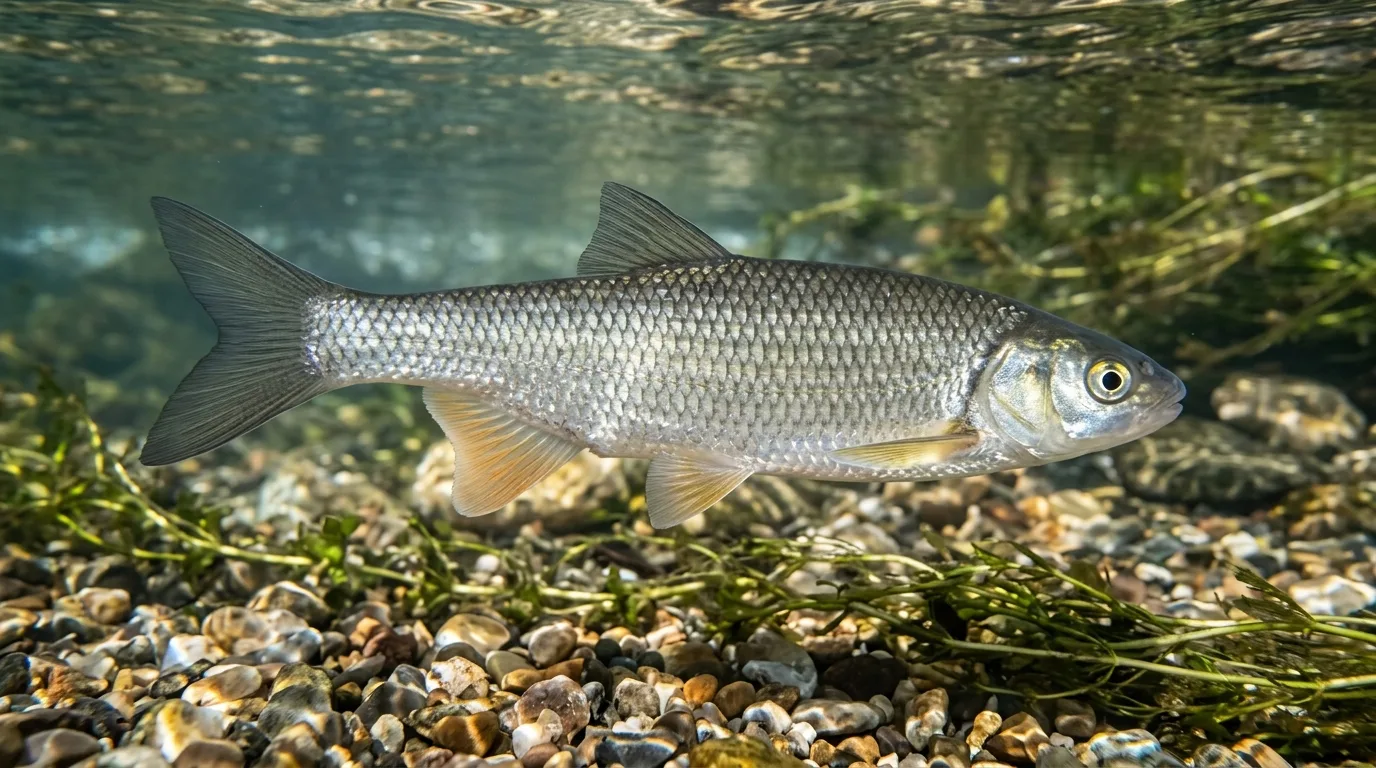
A small, slim shoaling fish of clear, cool rivers, fast and shy. You tell it from a young chub by its concave anal fin and its small, slightly underslung mouth. It usually measures 20 to 30 centimetres.
When
From May to October the chances are good, in winter hardly any. In heat and low water the dace suffers, and then you are better off choosing another target. It spawns from March to May. Then a closed season applies in Bavaria from 1 March to 30 April, in Mecklenburg-Western Pomerania until 31 May, and in Hamburg you may not fish for it deliberately (as of October 2026).
- JanPossible
- FebPossible
- MarPossible, spawning season
- AprPossible, spawning season
- MayGood, spawning
- JunGood
- JulGood
- AugGood
- SepGood
- OctGood
- NovPossible
- DecPossible
Peak seasonGoodPossibleHardly any chanceSpawning season
Spring tactics
Early in the year the shoals move upstream to shallow, stony spawning grounds. Leave these stretches alone during the spawning season. Some states protect the dace during spawning; whether this applies to you is shown below in the rules section.
Summer tactics
The fish stand scattered in the current and feed well. In the morning and evening they rise to insects, and then the fly is worthwhile. In heat and low water you are better off fishing elsewhere.
Autumn tactics
Until October the chances remain good. A swim baited with maggots now holds the shoal longer, because fewer insects fall on the water.
Winter tactics
Dace also feed in cold water, but then they stand tightly packed in calm bays, oxbow lakes or small tributaries. Anyone who knows these spots can catch the odd fish on mild days, but often it stays quiet.
Is it biting today?
In January: PossibleIn February: PossibleIn March: Spawning time, please spareIn April: Spawning time, please spareIn May: Spawning time, please spareIn June: Off-peak seasonIn July: Off-peak seasonIn August: Off-peak seasonIn September: Off-peak seasonIn October: Off-peak seasonIn November: PossibleIn December: Possible
Today’s catch index needs JavaScript. Season and spawning time are in the catch calendar.
From the blog: Roach or rudd, bream or silver bream: how to tell these silver fish apart reliably
Where it is now
In the river
Dace stand in shoals in clear rivers over gravel or stone, often near the surface, sometimes in fast current, sometimes in calmer stretches. In winter they gather tightly packed in the lower reaches and oxbow lakes.
How to go about it: Dace live in big, powerful rivers as well as in small, overgrown streams and in canals connected to a river. From spring to autumn they stand in the free current, preferably in somewhat deeper channels. Keep moving until you find the shoal; a few maggots thrown in will draw it out of cover and shade.
| Spring | main current, riffle |
|---|---|
| Summer | Main current |
| Autumn | Main current |
| Winter | calm bay |
Biting time: mainly in the morning and in the evening. What that looks like at the water is shown by the picture of the holding spots just below.
Holding spots in the picture
Choose the season and time of day: the picture shows where the species stands then. Spots outlined in red apply only in the chosen season. Tap a fish or a spot in the list to bring it closer. The picture is schematic and AI-generated, every water is different.
Catch chance in springpossibleSpawning season, observe closed seasons
Catch chance in summergood
Catch chance in autumngood
Catch chance in winterpossible
- J
- F
- M
- A
- M
- J
- J
- A
- S
- O
- N
- D
Spawning season
Active time The dace usually feeds most strongly in the twilight hours.
No main time The dace usually feeds most strongly in the twilight hours.
Active time The dace usually feeds most strongly in the twilight hours.
No main time The dace usually feeds most strongly in the twilight hours.
In the river
Gravelly shallow (riffle)
Dace are found here only in spring.
Calm bay with aquatic plants
Dace are found here only in winter.
Free current in mid-river
Dace are found here only in spring, summer and autumn.
The dace is a sociable shoaling fish of clear running waters with a hard bottom and often swims near the surface. Depending on the source it stands in fast-flowing stretches or rather in calm zones and slow-flowing sections. It looks for food in all layers of the water.
Spring: catch chances according to the fishing calendar possible in March and April, good in May. This is spawning time, so observe the closed seasons (Schonzeit). In March and April the dace spawns on very shallow, fast gravel stretches less than 50 centimetres deep, often in small tributaries.
Summer: catch chance according to the catch calendar good.
Autumn: catch chance according to the catch calendar good in September and October, possible in November.
Winter: catch chances according to the fishing calendar possible. In winter the adult fish gather in dense shoals in the lower river stretches or in oxbow lakes. They often move into small tributaries too and overwinter there. They feed throughout the winter.
Size comparison: AI-generated drawing, schematic.
How
With a light float that drifts with the current, or with a pole, you offer small baits. Since the dace likes to take insects from the surface, the fly rod is worthwhile on summer evenings.
Easiest way
Take a match rod of 3,60 to 4,50 m with a small fixed-spool reel and 0,16 monofilament, plus a light stick float and a fine-wire hook in size 16 to 20. Find a stretch of the river with an even current over gravel, throw in a few maggots regularly and let a single maggot drift down this trail with the float.
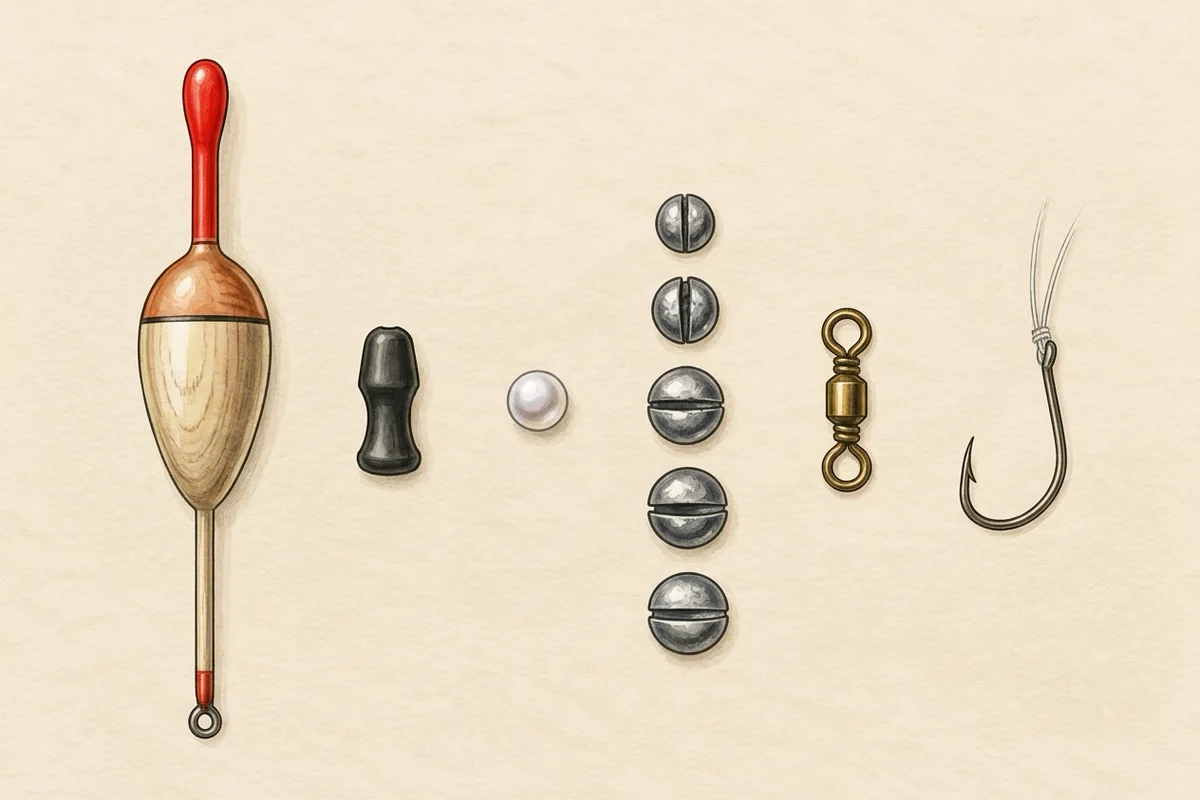
Drifting stick float
The standard for dace in rivers with slow to medium current, when the shoal feeds scattered in the current.
- Read the current
Look for evenly flowing stretches and slightly deeper channels between the shallows. In shaded areas you can often see the shoals from the bank.
- Fixed stick float
Fix the stick float at the top and bottom with silicone rings. Set the shot as a chain, the heaviest directly below the float and getting lighter towards the hook.
- A few maggots
Throw in just a handful of maggots above your spot at short intervals. That lures the shoal out of cover without filling it up.
- Just upstream
Put the float in the water a little above the baited spot so that the bait has time to reach the depth of the fish.
- Stop and go
Let the float drift and hold it back briefly every now and then. The current lifts the bait, and as it drifts on again it sinks, and that is often exactly when the bites come.
- React at once
Dace take and spit out the bait very quickly. Keep the line free of slack between the rod tip and the float and strike at the first twitch.
- Cushion softly
A soft rod absorbs the fish’s turning in the current. That way the small hook pulls out less often.
- Net quickly
Guide the fish downstream beside you into the landing net and do not let it thrash about in the shoal for long, or the others will move off.
Small fly on the surface
For summer evenings, when dace take insects from the surface, and for clear streams with visible shoals.
- Look for rings
Look for small rings in calmer runs and under trees. If the fish are not rising, they are often holding near the bottom and can be reached with a nymph.
- Choose a pattern
On the surface almost any small, well-floating dry fly will catch. Under water a plain nymph in size 12 to 14 does the job.
- Ahead of the shoal
Place the fly a little above the rings and let it drift down to the fish without drag.
- Without hesitation
Unlike with trout, you do not wait. The dace lets go of the fly in an instant, so the strike has to follow at once.
- Short and gentle
Bring the fish in quickly and unhook it in the water or in the landing net.
What with
A single maggot or a piece of worm on a small hook, and in summer insects as well. For the fly rod, small dry flies and nymphs suit its small mouth. Strike quickly, because it lets go of the bait fast.
- Maggots & larvaeall year round, as a single maggot or caster
Maggots catch most dace and also serve as feed for the swim.
- Insectsin high summer on streams with meadows along the bank
Grasshoppers then often end up in the water and are taken quickly, even when they sink.
- Dry flyon summer evenings when rings are visible
Dace rise to insects that land on the water and take small dry flies without being fussy about the pattern.
Tackle
Fine tackle is called for: a float rod or pole, and a fly rod for flies. A thin hooklength brings more bites, and a small landing net is enough for landing.
Drifting stick float
- Rod
- Match rod 3,60–4,50 m with a soft action
- Reel
- small fixed-spool reel, alternatively a centrepin reel
- Line
- Monofilament 0,16–0,20 mm
- Leader
- thinner than the mainline, as fine as the river allows
- Hooks
- 16–22, light, long-shanked, fine-wire with a round bend
- Weight, float, lead
- Stick float with a carrying capacity of 1–6 g, as light as the current allows; shot strung out in a chain
More on tackle
- Float rod: match, Bolognese and pole
- Pole: no reel, fine and direct
- Fly rod: choose line class, length and action
- Line calculator
- Fishing line: monofilament, braid or fluorocarbon?
- Spooling a reel properly – without line twist
- Wading net: the small landing net for wading
- Disgorger: unhooking quickly and gently
Common mistakes
- Simply letting the float drift: A bait that travels along evenly often catches less. Hold the float back briefly every now and then so that the bait rises and sinks again.
- Bow of line on the water: With a slack bow the strike comes too late. Keep the link between the rod tip and the float as straight as possible.
- A rig that is too coarse: Even lightly fished dace are wary in clear water. Fish as fine as you can without break-offs, and use a light, fine-wire hook.
- A rod that is too stiff: Dace turn in the current and easily pull free on rigid tackle. A soft tip absorbs that.
- Staying too long in one spot: If the bites stop after a few fish, the shoal has often been scared off. Move on a little and look for the next run.
Rules
Each federal state (Bundesland) sets its own closed season (Schonzeit) and minimum size (Mindestmaß). Choose your state; the values come from our state pages.
Baden-Württemberg
Our overview for Baden-Württemberg does not list the dace. What applies there is covered on the page Fishing in Baden-Württemberg, with places in the state.
Bavaria
- Minimum size
- –
- Closed season
- 1.3.–30.4.
As of October 2026. All rules, exceptions and sources: Fishing in Bavaria.
Berlin
Our overview for Berlin does not list the dace. What applies there is covered on the page Fishing in Berlin, with places in the state.
Brandenburg
- Minimum size
- 15 cm
- Closed season
- none
As of October 2026. All rules, exceptions and sources: Fishing in Brandenburg.
Bremen
Our overview for Bremen does not list the dace. What applies there is covered on the page Fishing in Bremen, with places in the state.
Hamburg
- Minimum size
- –
- Closed season
- protected all year round
- Note
- must not be targeted
As of October 2026. All rules, exceptions and sources: Fishing in Hamburg.
Hesse
Our overview for Hesse does not list the dace. What applies there is covered on the page Fishing in Hesse, with places in the state.
Mecklenburg-Western Pomerania
- Minimum size
- –
- Closed season
- 1.3.–31.5.
As of October 2026. All rules, exceptions and sources: Fishing in Mecklenburg-Western Pomerania.
Lower Saxony
Our overview for Lower Saxony does not list the dace. What applies there is covered on the page Fishing in Lower Saxony, with places in the state.
North Rhine-Westphalia
Our overview for North Rhine-Westphalia does not list the dace. What applies there is covered on the page Fishing in North Rhine-Westphalia, with places in the state.
Rhineland-Palatinate
Our overview for Rhineland-Palatinate does not list the dace. What applies there is covered on the page Fishing in Rhineland-Palatinate, with places in the state.
Saarland
Our overview for Saarland does not list the dace. What applies there is covered on the page Fishing in Saarland, with places in the state.
Saxony
Our overview for Saxony does not list the dace. What applies there is covered on the page Fishing in Saxony, with places in the state.
Saxony-Anhalt
Our overview for Saxony-Anhalt does not list the dace. What applies there is covered on the page Fishing in Saxony-Anhalt, with places in the state.
Schleswig-Holstein
Our overview for Schleswig-Holstein does not list the dace. What applies there is covered on the page Fishing in Schleswig-Holstein, with places in the state.
Thuringia
Our overview for Thuringia does not list the dace. What applies there is covered on the page Fishing in Thuringia, with places in the state.
The regulation and your fishing permit (Erlaubnisschein) are what count. Lake Constance, the Rhine and the coast, for example, have their own rules: Fishing waters in Germany.
After the catch
Playing and landing
Strike at once and let a soft rod cushion the runs in the current, because on thin hooklengths every hard pull ends in a break. You net the small fish quickly, unhook it with wet hands or a disgorger and, if you may not keep it, return it straight away in the water.
You can usually remove the hook from this small fish easily with a disgorger. If you are returning it, handle it only with wet hands and release it in the water. A fish you may keep you stun and kill at once.
Frequently asked questions
What hook size for dace?
Usually 16 to 22, even smaller for very wary fish. What matters is a light, fine-wire hook that the fish barely feels when it sucks it in.
What is the best bait for dace?
Maggots and casters are the surest baits. In very fast current a little hemp can help, and in summer grasshoppers and small flies catch too.
Can you catch dace on the fly?
Yes, dace take small dry flies on the surface and nymphs below it. An immediate strike is what counts, because they spit the fly out quickly.
Where do dace hold in a river?
Often in slightly deeper runs, by obstacles and in the shade under trees. On shallow, clear stretches you can quickly see whether fish are there.
How do you tell a dace from a chub?
The dace has a smaller, slightly downward-pointing mouth and edges of the dorsal and anal fins that curve inwards. In the chub these fin edges are rounded outwards.
Similar species
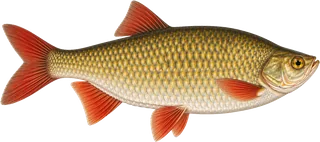
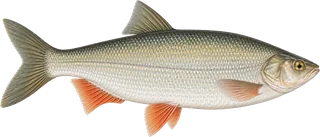
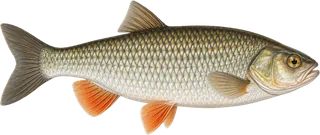
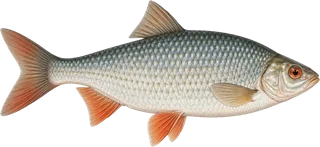
Anyone who catches dace can also fish for these species with similar tackle:
Sources
As of: October 2026. The practical knowledge comes from 9 sources, summarised in our own words.
View all 9 sources
- Posenangeln: Nimm’s Stöckchen · BLINKER (Thomas Pruß)
- Stippangeln: Die Sache mit den Angelhaken · BLINKER (Thomas Pruß)
- Dace · Canal & River Trust (Fisheries & Angling Team)
- The princely dace · Canal & River Trust (Dr. Mark Everard)
- How to catch big dace from tiny streams · ANGLING TIMES (Freddie Sandford mit Dan Bouskila)
- Fishbook: Dace · Angling Trust (Dachverband der Angler in England)
- Im Bach sind die Fische auf Heuschrecken heiß · BLINKER (Frank Schlichting)
- Rotfeder mit der Fliege: Sommer-Highlight · BLINKER (Florian Pippardt)
- Pirsch auf Döbel & Co. · FISCH & FANG (Andal Grunert)
Text produced with AI support, based on the sources named and on these pages: Dace (profile), Float fishing, Pole fishing, Fly fishing, Worms.