
Knowledge – Fish
Snakehead (Northern Snakehead): Features, season, rules in the USA and EU
The northern snakehead (Channa argus), known in the USA as the Northern Snakehead, is an air-breathing predator from East Asia. It was first discovered in the Chesapeake Bay watershed in 2002 and is now firmly established in the Potomac and several tributaries. The state of Maryland has since renamed it Chesapeake Channa.
In short: According to the catch calendar, the best time is April to September. Good spots on a lake: weed bed, reed edge and surface; on a river: calm bay. Proven lures: weedless soft plastic frogs for the surface, paddle-tail shads on a weighted weed hook and live baitfish under a float. An air-breathing predator from East Asia, introduced into the USA. It is on the EU Union list of invasive alien species: live animals must not be imported, kept or released. Step by step: Fishing for snakehead.
- Long dorsal fin without spines that runs along almost the whole back
- Flat, scaly head with a large mouth and projecting lower jaw
- Irregular dark blotches on a light to dark brown flank
Catch chances through the year
- Hardly any chance
- Possible
- Good
- Peak season
- Spawning (observe the closed season)
Editorial assessment for the home water (eastern USA (Potomac and tributaries of Chesapeake Bay)), not a measured value and not a guarantee. The rules of the country you travel to are binding.
How to recognise it
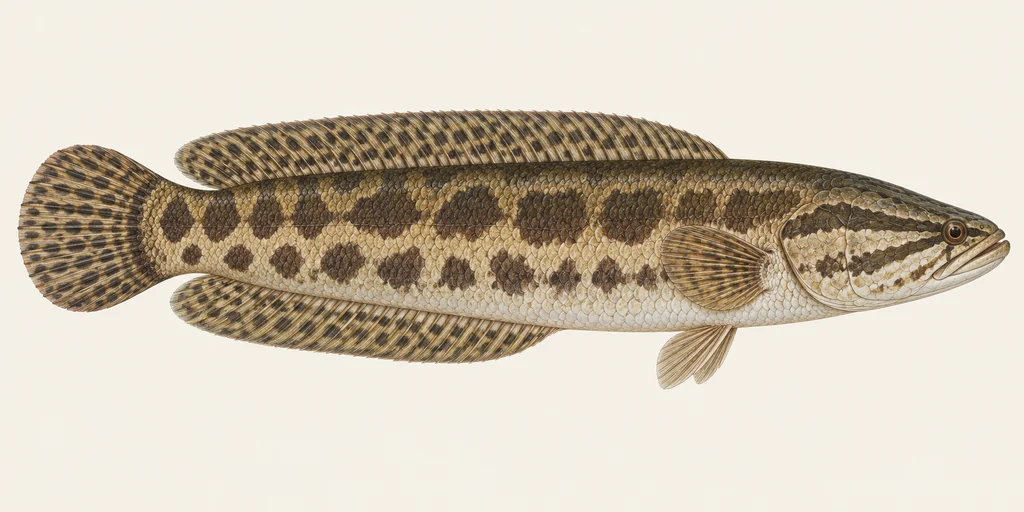
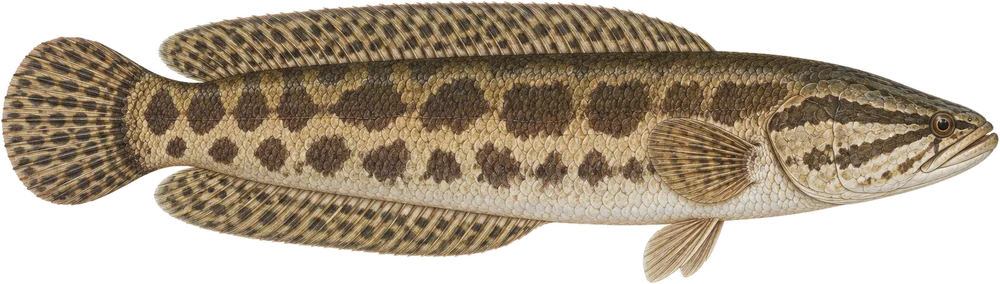
The body is long and almost cylindrical. The family owes its name mainly to the flat head with large scales, which resembles a snake. The base colour is light to dark brown, with large, irregular dark blotches on the flanks. The mouth is large and full of sharp teeth, and with the mouth closed the lower jaw clearly projects.
The dorsal and anal fins are very long, and all fins have only soft rays: FishBase counts 49 to 54 in the dorsal fin and 32 to 38 in the anal fin. The pelvic fins sit just behind the pectoral fins, almost beneath them. In Virginia, according to the DWR fisheries authority, the fish reach about 90 centimetres in length and around 9 kilograms in weight, and live eight years on average, rarely up to 15. FishBase gives maximum values of 100 centimetres total length and 9,5 kilograms. The species becomes sexually mature at about two years and around 30 centimetres.
Snakeheads (family Channidae) are freshwater fish with two genera: Channa in Asia as far as Indonesia and Parachanna in tropical Africa. All species also breathe air, through paired cavities above the gills (suprabranchial chambers) whose walls are lined with well-supplied papillae. The northern snakehead depends on this air breathing and so copes even in water low in oxygen.
Snakeheads for angling trips compared
| Species | Native range | Size according to FishBase | Distinguishing feature |
|---|---|---|---|
| Northern snakehead (Channa argus) | from the Amur to southern China; introduced into the USA | up to 100 cm total length, 9,5 kg | brown flanks with irregular dark blotches |
| Giant snakehead, toman (Channa micropeltes) | Mekong, Chao Phraya, Malay Peninsula, Sumatra, Borneo | up to 130 cm standard length, 20 kg | adults with a broad dark lateral band, juveniles with two black stripes and an orange field between them |
| Striped snakehead (Channa striata) | Pakistan to Thailand and southern China | up to 100 cm standard length, 3 kg | back and flanks marbled black and ochre, belly white |
In the USA it is often confused with the native bowfin (Amia calva), which Virginia calls Ruddy Bowfin. According to USGS, in the snakehead the pelvic fins sit directly behind the pectoral fins, in the bowfin much further back. The snakehead’s anal fin is about as long as the dorsal fin, whereas in the bowfin it stays short. The bowfin also has a bony plate between the lower jaw bones (gular plate), no scales on top of the head and often a dark spot near the base of the tail.
According to USGS the species also resembles the burbot (Lota lota), which is native to North America.
Side by side
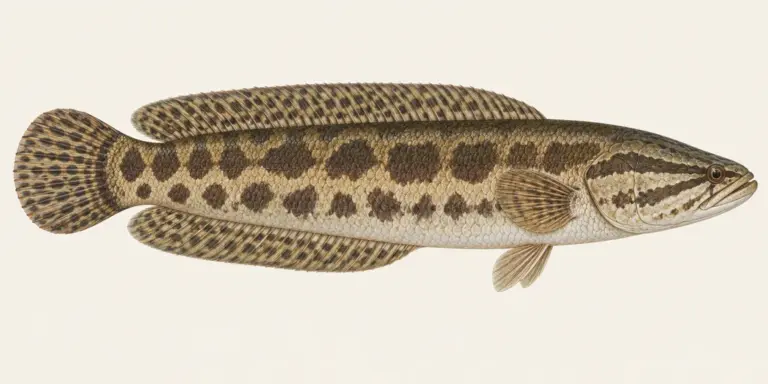
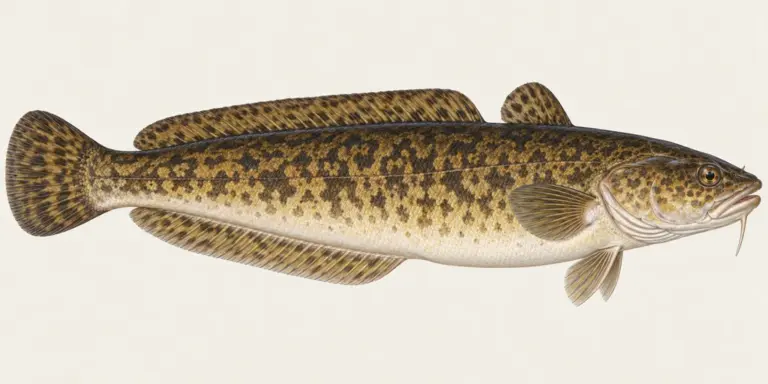
AI-generated illustrations.
Where it lives
According to FishBase its native range extends from the Amur to the Xi Jiang and the island of Hainan; USGS names China, Russia and Korea. In the USA the species is established in Maryland, Virginia, Delaware, Pennsylvania, New York, New Jersey and Arkansas, among others, most strongly in the Potomac and its tributaries. Virginia also reports it from the Rappahannock.
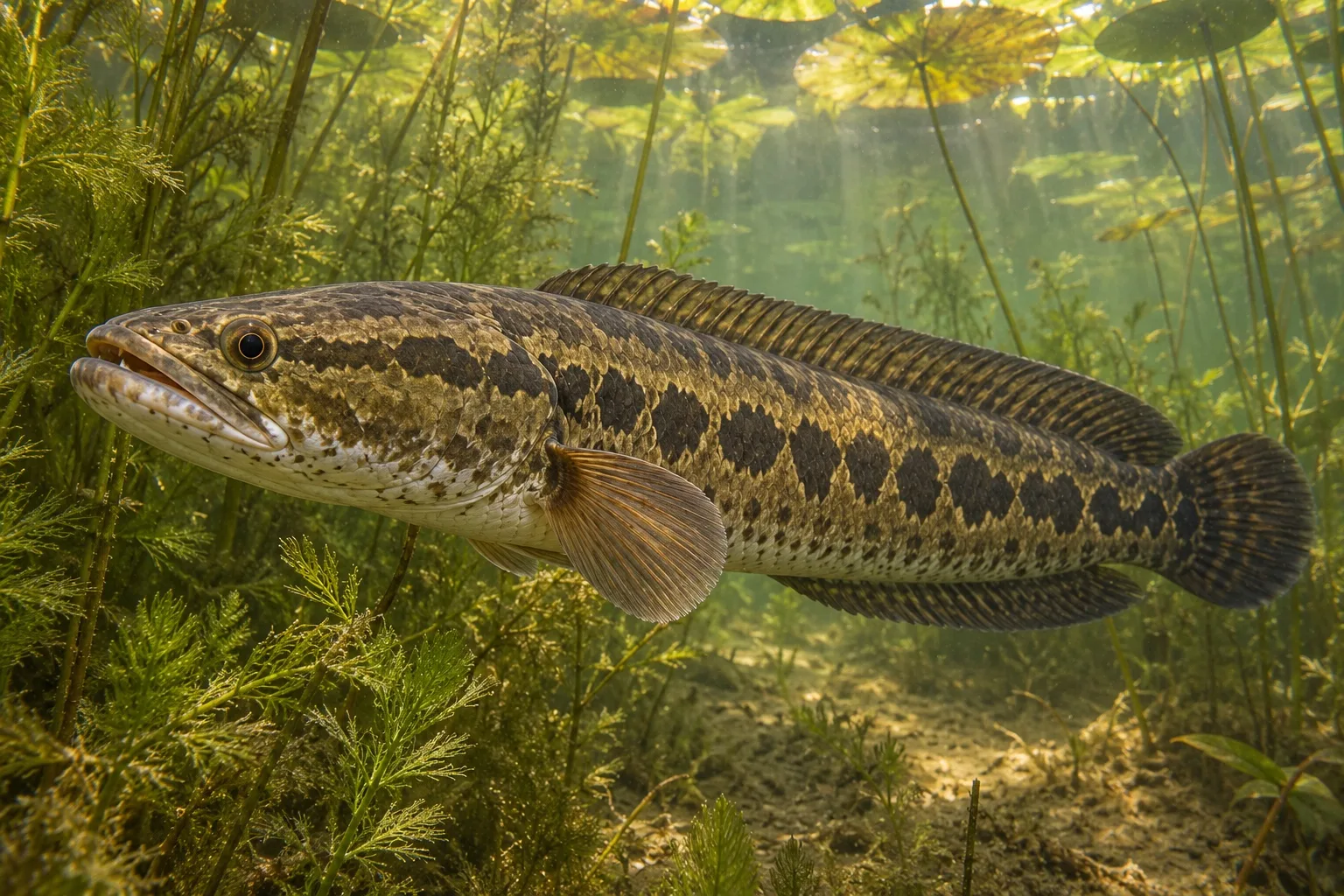
It likes shallow, still or slow-flowing water down to about two metres deep, with a muddy bottom and dense plant growth: ponds, swamps, canals and tidal side channels. According to USGS it tolerates 0 to over 30 degrees, survives for a long time under ice and in an experiment withstood salinities of 15 to 18 per mille.
According to FishBase the giant snakehead lives in lowland rivers and swamps, mostly in deep, calm water, and spawns in densely overgrown streams. The striped snakehead inhabits ponds, swamps and canals and survives the dry season buried in mud, as long as skin and breathing organ stay moist.
Holding spots in the picture
Choose the time of day: the picture shows where the species holds. We do not show German seasons for travel fish; the bars give the chance of a catch for each month. Tap a fish or a spot in the list to bring it closer. The picture is schematic and AI-generated, and every water is different.
Chance of a catch per month according to the catch calendar
- J
- F
- M
- A
- M
- J
- J
- A
- S
- O
- N
- D
Spawning season
Active time According to FishBase it hunts mainly in the morning and in the evening.
Not the main time According to FishBase it hunts mainly in the morning and in the evening.
Active time According to FishBase it hunts mainly in the morning and in the evening.
Not the main time According to FishBase it hunts mainly in the morning and in the evening.
In the lake
reed edge
Northern snakehead is present here all year round.
Water lilies and weed bed
Northern snakehead is present here all year round.
Just below the surface
Northern snakehead is present here all year round.
The snakehead lurks in shallow, still waters with a muddy bottom and dense plants, for example in ponds and swamps. It waits in the weed or on the bottom until prey comes close. At water lilies, reed and weed mats it often gives itself away with a swirl at the surface.
In the river
Calm bay with aquatic plants
Northern snakehead is present here all year round.
In the Potomac and its tributaries it stays in sluggish, weedy areas, in canals and tidal side arms. In spring, as soon as the shallows warm up, it moves upstream as far as weirs and similar obstacles. The fish spend the spawning period and brood care, late April to August, in weedy shallows.
Depth: It prefers shallow water down to about two metres; in winter, according to the USGS, it moves to deeper areas.
Size comparison: AI-generated drawing, schematic.
How it hunts and guards its brood
The northern snakehead is an ambush hunter that waits in weed or on the bottom until prey comes within reach. According to FishBase it hunts mainly in the morning and evening. According to USGS adults eat more than 97 percent fish, plus crayfish, frogs and occasionally small birds or mammals. In Virginia it was mainly killifish and sunfish. In the lower Potomac its diet overlaps strongly with that of the largemouth bass.
In the USA spawning runs from the end of April into August, peaking in June. The female builds a floating nest from bitten-off water plants, on which 1300 to 1500 orange-yellow eggs drift, up to five clutches a year. Both parents guard eggs and brood for weeks after hatching. Brood care is typical of the whole family: of the giant snakehead USGS even reports attacks on people who came too close to a shoal of fry.
Out of the water the species survives up to four days according to USGS, but only juveniles can move overland at most. According to Virginia’s authority it does not attack people or pets.
When and where the season is
On the Potomac the season begins when the shallow water warms up in spring. Virginia’s authority then observes upstream migrations as far as weirs and other obstacles. From the end of April to August the fish hold in weedy shallows for spawning and brood care. At a tournament in Maryland in June 2012, more than 200 snakeheads were caught in 18 hours.
In winter the fish move to deeper water according to USGS, so the season in the catch calendar lies between spring and early autumn.
What you catch it with
Step by step: Fishing for snakehead: tips on lures, rigs and tackle – season, holding spots, lures, tackle and rules on one page.
In the Chesapeake area snakehead are mostly fished with artificial lures in shallow, densely weeded water. The regional angling magazine FishTalk recommends weedless surface lures, above all soft plastic frogs over lily pads, grass and weed mats. You cast parallel to the bank, first right up against water lilies, reeds and marsh edges, then bit by bit further out.
The bite often comes as a swirl at the surface. If you strike at once, you often pull the lure back empty. FishTalk advises lowering the rod tip, taking up loose line, counting to three and only then striking firmly upwards. Hooked fish often jump, so keep the line tight.
Heavily fished snakeheads become wary. Then smaller frogs worked slowly with pauses bring more bites, as do paddle-tail shads on a weighted weed hook with a spinner blade. Murky water is better than clear. Live baitfish under a float serve as natural bait.
In Virginia bowfishing for snakehead is also allowed in public inland waters with a regular fishing licence; fish that are shot must be kept. In Southeast Asia snakeheads are mainly food fish and, according to USGS, are usually caught with hand lines, traps and nets.
Bowfin or snakehead: Look at the pelvic and anal fins. If the pelvic fins sit right behind the pectoral fins and the anal fin is long, it is a snakehead.
Keeping your catch: A snakehead you keep must not be held alive in a keepnet or cool box in Maryland and Virginia. Virginia names three ways to kill it: cutting off the head, tearing the gill arches from the body or removing the innards. Then put it on ice quickly.
Parasites in Southeast Asia: According to USGS the striped snakehead in Thailand is an intermediate host of the nematode Gnathostoma spinigerum, which causes gnathostomiasis in humans. In an older study from Thailand all fish over 41 centimetres were infected. This is no substitute for medical advice.
Suitable lures
Weedless soft plastic frogs for the surface, paddle-tail shads on a weighted weed hook and live baitfish under a float.
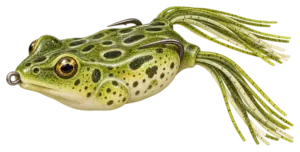
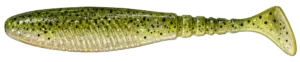
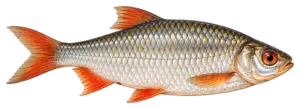
AI-generated illustrations. A click opens the lure’s page.
Rigs for these lures: Float rig.
Fish over and beside dense weed; in Maryland and Virginia, kill fish you keep at once.
Rules in the USA and in the EU
In the USA all snakeheads of the genera Channa and Parachanna have been listed since 2002 as injurious wildlife under the Lacey Act. Under the federal regulation 50 CFR 16.13, importing, transporting and acquiring live fish and viable eggs without a permit is prohibited.
In Maryland the state regulation on snakeheads (Code of Maryland Regulations, Snakehead Prohibitions) prohibits bringing live animals or their eggs into the state, transporting, selling or breeding them. You may possess a northern snakehead only if it was killed immediately after being caught.
In Virginia it is prohibited to import, possess, transport, buy, sell or give away live northern snakeheads. Releasing at the place of capture is allowed. Anyone who keeps a fish must kill it and report it to the Department of Wildlife Resources as soon as possible. There is no statewide daily catch limit. Licences and further rules are set by each state, and the local authority is decisive.
Important for the journey home: the Argus snakehead has been on the EU Union list of invasive alien species since August 2022 (Implementing Regulation (EU) 2022/1203). Under Article 7 of Regulation (EU) No 1143/2014, live animals and viable eggs must not be intentionally brought into the EU, kept, bred, transported, traded, exchanged or released. So live souvenirs are out. In Germany the species does not occur in the wild, according to the Bundesamt für Naturschutz. Of the snakeheads, only this one is on the Union list. In Thailand and Malaysia the law of the authorities there applies.
Frequently asked questions (FAQ)
May I take a snakehead from the USA to Germany?
Not alive. The Argus snakehead is on the EU Union list of invasive species; live animals and viable eggs may neither be imported nor kept.
How big does the northern snakehead grow?
In Virginia about 90 centimetres and around 9 kilograms. FishBase gives maximum values of 100 centimetres and 9,5 kilograms.
Can a snakehead travel overland?
Adult fish cannot. The species breathes air and survives up to four days out of the water, but according to USGS only juveniles can move overland at most.
Sources
The rating of catch chances is an editorial assessment. The facts come from these sources, and the text is worded in our own words. The illustration is an original design by Angel Momente in the style of a natural history plate (AI-generated, see the AI notice).
- FishBase: Channa argus, Northern snakehead
- FishBase: Channa micropeltes, Giant snakehead
- FishBase: Channa striata, Striped snakehead
- U.S. Geological Survey, Nonindigenous Aquatic Species: Channa argus Fact Sheet
- U.S. Geological Survey: Courtenay und Williams, Snakeheads (Pisces, Channidae), A Biological Synopsis and Risk Assessment, Circular 1251 (2004)
- U.S. Government Publishing Office: 50 CFR 16.13 (Ausgabe 2024), Importation of live or dead fish
- State of Maryland, Code of Maryland Regulations: COMAR 08.02.19.06 Snakehead Prohibitions
- Virginia General Assembly: Code of Virginia § 29.1-574 Prohibitions
- Virginia General Assembly: Virginia Administrative Code 4VAC15-350-70 (Bogenfischen)
- Virginia Department of Wildlife Resources: Northern Snakehead (Artenprofil)
- Virginia Department of Wildlife Resources: Northern Snakehead (Angeln)
- Chesapeake Bay Program: Field Guide, Chesapeake Channa (Channa argus)
- Amt für Veröffentlichungen der EU: Verordnung (EU) Nr. 1143/2014 über invasive gebietsfremde Arten (Amtsblatt L 317, deutsche Fassung)
- Amt für Veröffentlichungen der EU: Durchführungsverordnung (EU) 2022/1203 zur Änderung der Unionsliste (Amtsblatt L 186, deutsche Fassung)
- Bundesamt für Naturschutz: Art. 4 Unionsliste
- Aquatic Nuisance Species Task Force: National Control and Management Plan for Members of the Snakehead Family (Channidae), 2014
- FishTalk Magazine: How to Catch Snakeheads on Topwater Lures
- FishTalk Magazine: How to Find and Catch Snakeheads from Shore
- Virginia General Assembly: Virginia Administrative Code 4VAC15-320-25 (Fang- und Längenbegrenzungen)
Created with AI support from the sources listed. Figures only appear in the text if a source gives them. Last updated: 27 October 2026. Found a mistake? Write to us. Who is behind this site: About me.
More in the lexicon
- All fish species at a glance
- Catch calendar – month, water temperature and profile for 93 species
- Line calculator – breaking strain after the knot, drag guideline, backing
- Angling methods