
Knowledge – Fish
Dolphinfish (mahi-mahi): Features, season and baits
The dolphinfish (Coryphaena hippurus), called dolphin in the USA and sold under its Pacific name mahi-mahi, is a brightly coloured open-sea fish of warm oceans. It grows very fast, lives only a few years and likes to stay under flotsam and sargassum fields. It is not related to the dolphin, the marine mammal.
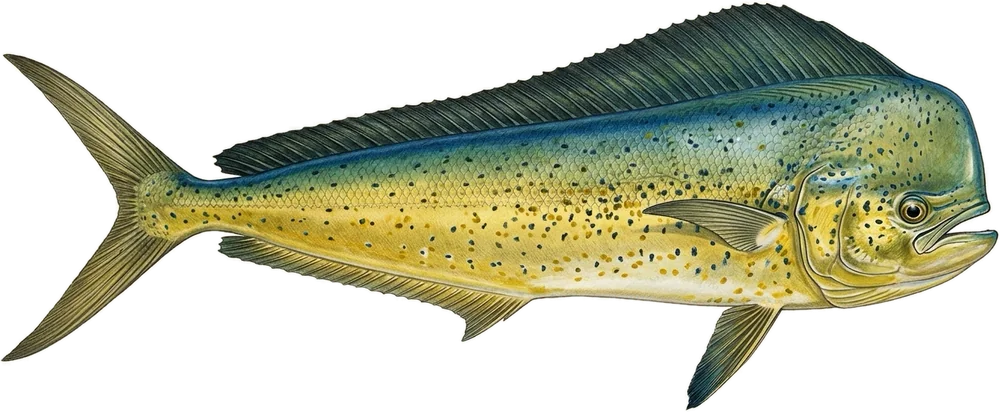
In short: According to the catch calendar, the best time is August. Good spots off the coast: just below the surface and open water. Proven baits: trolled lures and natural baits. The bright colours fade shortly after capture. Despite the English name dolphin, the dolphinfish is not related to the dolphin, the marine mammal. Step by step: fishing for dolphinfish.
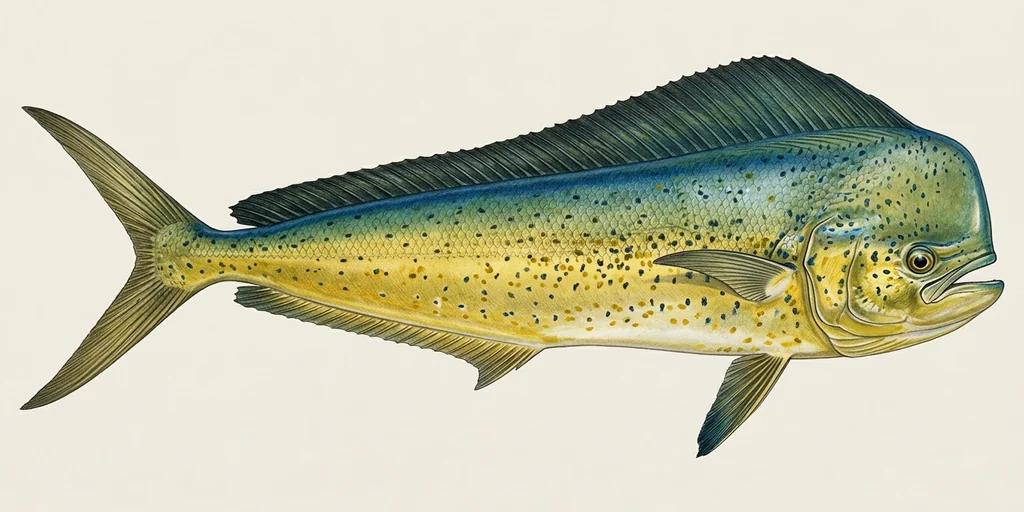
- Steep, almost vertical forehead with a bony hump in adult males
- A single long, dark dorsal fin from the head almost to the tail fin
- Blue-green back, golden flanks with irregular dark or golden spots
Catch chances through the year
- Hardly any chance
- Possible
- Good
- Peak season
- Spawning (observe the closed season)
Editorial assessment for the home water (North Carolina (Gulf Stream)), not a measured value and not a guarantee. The rules of the country you travel to are what count.
How to recognise it
The dolphinfish has an elongated, laterally flattened body that tapers strongly from head to tail. A single dorsal fin runs from just behind the head almost to the deeply forked tail fin. The anal fin starts roughly in the middle of the body and curves inwards along its edge.
Adult males carry a strong bony hump at the front of the head, and their forehead drops almost vertically. In females the head slopes more gently. In life the back is bright blue-green, the flanks silver with a golden sheen and irregular dark or golden spots. These colours fade almost immediately after capture.
According to FishBase the dolphinfish reaches up to 210 centimetres and 40 kilograms, with around 100 centimetres being typical. It grows very fast, matures at just four to five months and, according to FishBase, lives for four years at most.
It is mostly confused with the smaller pompano dolphinfish (Coryphaena equiselis). According to FishBase and the Florida Museum, the common dolphinfish is more slender: its body depth is less than a quarter of the standard length, in the pompano dolphinfish more. The pectoral fins are longer than half the head. The English name dolphin shares only the sound with the dolphin.
Side by side
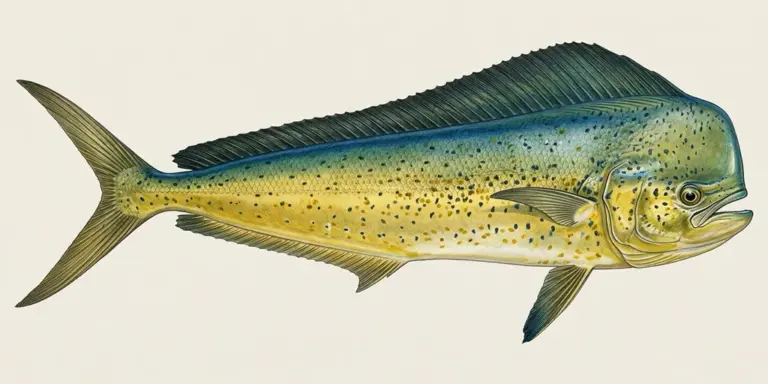
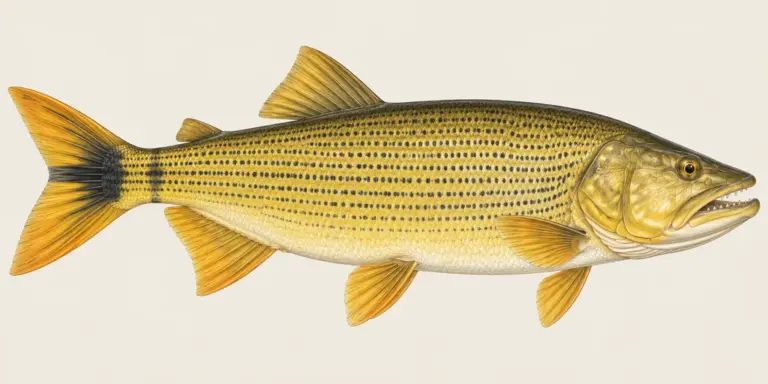
AI-generated illustrations.
Where it lives
The dolphinfish lives worldwide in tropical and subtropical seas, including the Mediterranean. According to the Florida Museum it is common in the Gulf of Mexico, the Florida Current and the Caribbean. It mostly stays on the high seas, but occasionally also near the coast, at depths of 0 to 85 metres.
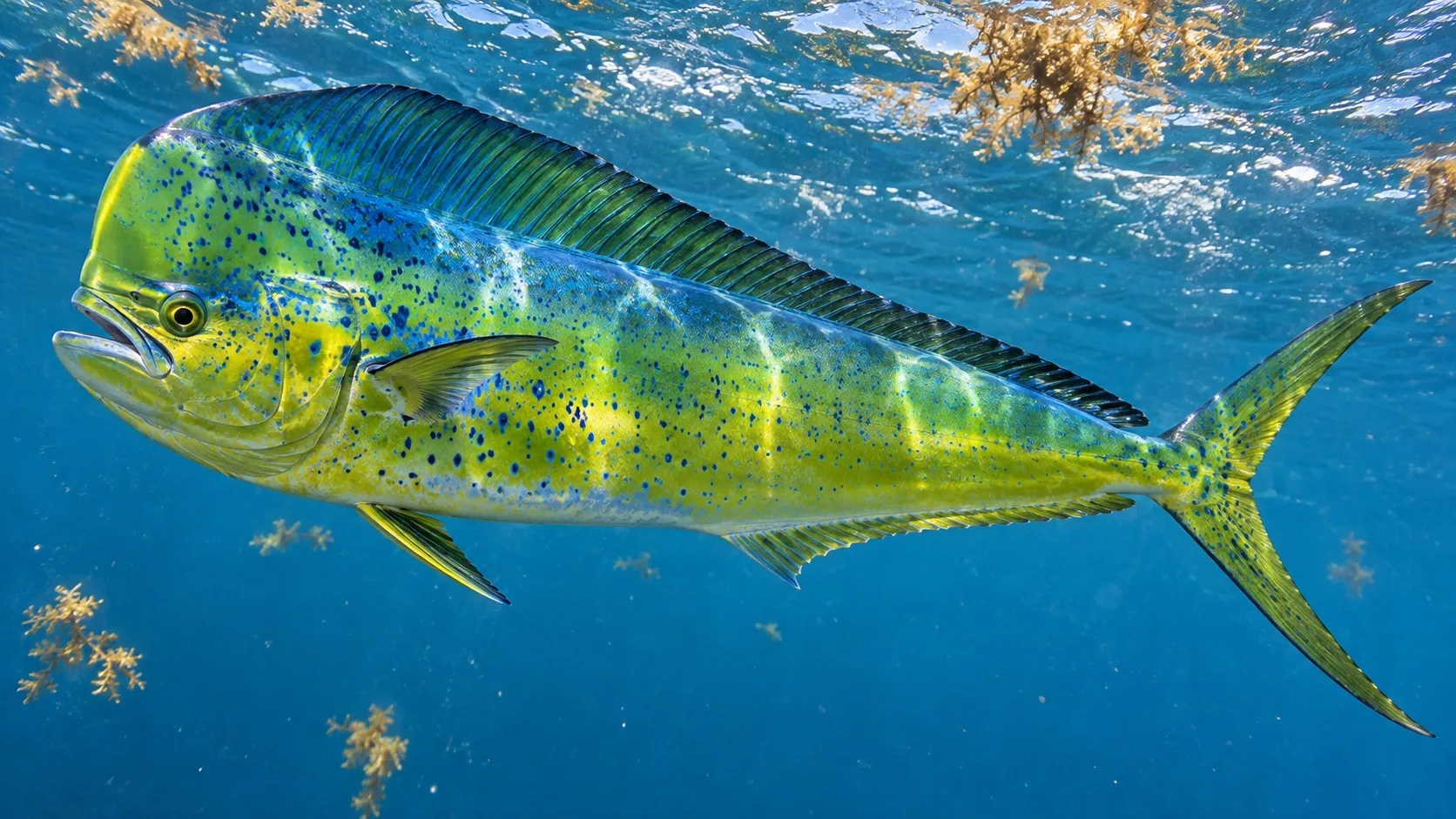
Drifting objects attract it, above all fields of the brown alga sargassum, which offer shelter and food. According to the fisheries authority (Fischereibehörde) of North Carolina, in summer, when the water over the shelf warms up, it comes closer to the coast and is then occasionally found as little as ten miles off the beach.
Holding spots in the picture
Choose the time of day: the picture shows where the species holds. We do not show German seasons for travel fish; the bars give the chance of a catch for each month. Tap a fish or a spot in the list to bring it closer. The picture is schematic and AI-generated, and every water is different.
Chance of a catch per month according to the catch calendar
- J
- F
- M
- A
- M
- J
- J
- A
- S
- O
- N
- D
Spawning season
No main time Dolphinfish hunt mainly by day and by sight.
Active time Dolphinfish hunt mainly by day and by sight.
No main time Dolphinfish hunt mainly by day and by sight.
No main time Dolphinfish hunt mainly by day and by sight.
On the coast
Open water, mid-water
Dolphinfish (mahi-mahi) are found here all year round.
Just below the surface
Dolphinfish (mahi-mahi) are found here all year round.
The dolphinfish usually lives on the open sea but occasionally comes closer to the coast. It stays under drifting weed fields, driftwood and other floating objects, where it finds cover and food.
Depth: They live from the surface down to about 85 metres.
Size comparison: AI-generated drawing, schematic.
How it hunts and spawns
Young dolphinfish travel in schools of a few to over 50 fish, large ones live alone or in pairs. They hunt mainly by day and by sight, according to the Florida Museum often in pairs or small groups. Their diet includes flying fish, young tuna, mackerel and jacks, small fish from the sargassum, crustaceans and squid. According to the fisheries authority (Fischereibehörde) of North Carolina, plastic film, small light bulbs and bits of line that had got tangled in the sargassum have also been found in their stomachs.
The spawning season depends on latitude. In the tropics the dolphinfish spawns all year round. Fish from the Florida Current spawned from November to July, according to the South Atlantic Fishery Management Council, and in the Gulf Stream off North Carolina in June and July. The eggs drift freely in the water.
When and where the season is
The season information applies to the Gulf Stream off North Carolina. In summer the shelf water warms up, the fish move closer to the coast and spawn in June and July. The calendar therefore rates May to October as good and August, after spawning, as the main season.
Further south in the Florida Current, young dolphinfish occur all year round according to the Florida Museum, most often in summer. In winter the calendar rates the chances off North Carolina as merely possible.
What to catch it with
Step by step: Fishing for dolphinfish: tips on bait, rig and tackle – season, spots, baits, tackle and rules on one page.
According to the fisheries authority (Fischereibehörde) of North Carolina, the dolphinfish is caught mainly by trolling with artificial and natural baits. Good spots are drifting sargassum fields, driftwood and other floating objects.
The so-called bailing method is also popular: a hooked fish is kept in the water, draws the rest of the school to the boat and sends it into a feeding frenzy. This way more fish from the school can be caught at the boat.
Search the sargassum: Drifting mats of algae and other floating objects are the most important clue. Troll along their edges.
Leave the first fish in the water: When bailing, the first hooked fish stays in the water until the rest gather at the boat. This often lets you fish a whole school.
Suitable lures
Trolled lures and natural baits.
AI-generated illustrations. A click opens the lure’s page.
Look around sargassum and flotsam; leave a hooked fish in the water to keep the school together
Rules and licences
The rules of the country in whose waters you fish and the authority there are what count. In federal waters off the south-eastern US coast, the South Atlantic Fishery Management Council regulates the catch. A daily bag limit per person and an upper limit per boat apply there. A minimum size (Mindestmaß) applies only off Florida, Georgia and South Carolina. The fish must be landed with head and fins attached.
In the coastal waters of North Carolina you additionally need the Coastal Recreational Fishing License. Separate rules apply to fish brought from the Bahamas to the USA by sea. The IUCN lists the dolphinfish as not threatened.
Frequently asked questions (FAQ)
Is mahi-mahi a dolphin?
No. The dolphinfish is a fish. The English name dolphin has nothing to do with the marine mammal.
When is the best time off North Carolina?
In summer, when the shelf water warms up and the fish come closer to the coast. The chances are best in August, after spawning.
Why does the fish lose its colour?
The bright shades of blue, green and gold fade almost immediately after death. Dead fish look grey with a green sheen.
Sources
The rating of catch chances is an editorial assessment. The facts come from these sources, and the text is worded in our own words. The illustration is an original design by Angel Momente in the style of a natural history plate (AI-generated, see the AI notice).
- FishBase: Coryphaena hippurus, Common dolphinfish
- North Carolina Division of Marine Fisheries: Dolphinfish
- Florida Museum of Natural History: Dolphinfish
- South Atlantic Fishery Management Council: Dolphin
- NOAA Fisheries: Pacific Mahimahi
Created with AI support from the sources listed. Figures only appear in the text if a source gives them. Last updated: 27 October 2026. Found a mistake? Write to us. Who is behind this site: About me.
More in the lexicon
- All fish species at a glance
- Catch calendar – month, water temperature and profile for 93 species
- Line calculator – breaking strain after the knot, drag guideline, backing
- Angling methods