
Knowledge – Fish
Tigerfish: Features, season, baits and way of life
The tigerfish (Hydrocynus vittatus) is an African predatory characin with long fangs that project over the lips. It lives in warm rivers and lakes from the Nile and Niger to the Zambezi and Limpopo. From a length of about 10 cm it eats almost nothing but fish and hunts in packs of fish of the same size.
In short: According to the catch calendar, the best time is March to April. Good spots on a river: current seam and main current; on a lake: open water. Proven baits: slim diving crankbaits with a single hook that imitate a small fish. On the Incomati it is hardly active in winter below 24 °C, but tigerfish were also caught from June to October on the Kavango and in the Okavango Delta. In South Africa it is on the list of protected species (NEMBA). Step by step: Tigerfish fishing.
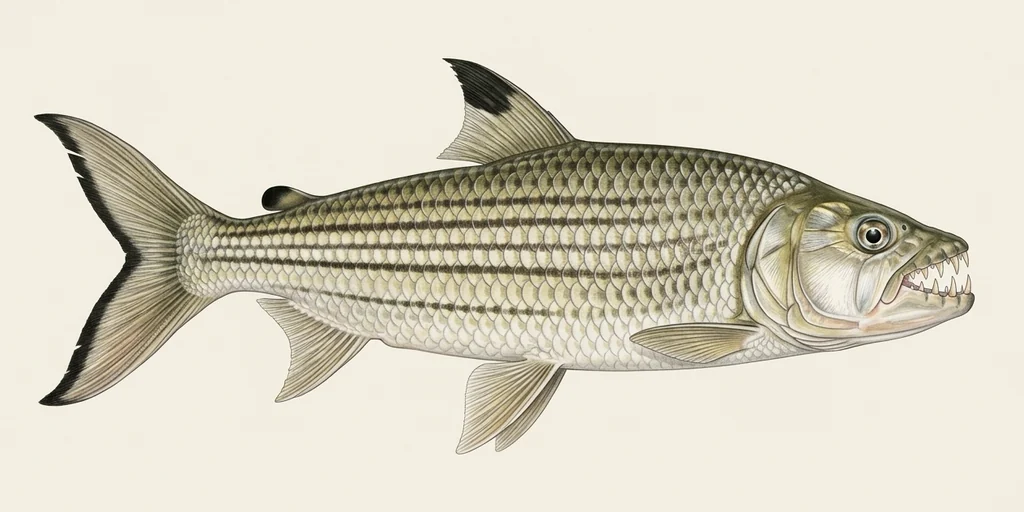
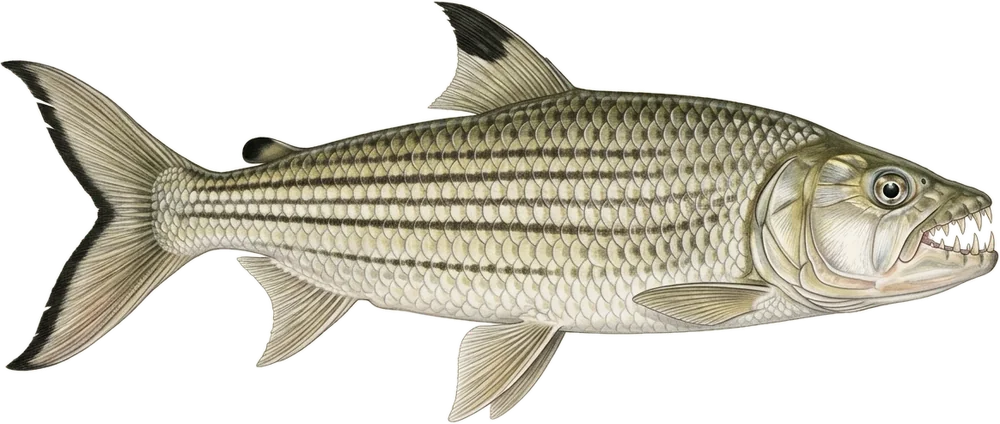
- Long, fang-like teeth that project over the jaws when the mouth is closed
- Dark lengthwise stripes above the lateral line
- Black tips on the dorsal and adipose fins, black edge of the forked tail fin
Catch chances through the year
- Hardly any chance
- Possible
- Good
- Peak season
- Spawning (observe the closed season)
Editorial assessment for the home water (southern Africa (Zambezi, Lake Kariba, Incomati)), not a measured value and not a guarantee. The rules of the country you travel to are binding.
How to recognise it
What strikes you first about the tigerfish is the teeth: they are long and fang-like and project over the jaws even when the mouth is closed. The body is elongated, and dark lengthwise stripes above the lateral line gave the fish its name.
The dorsal and adipose fins have black tips, and the edge of the forked tail fin is black. The dark colouring can extend onto the middle rays of the tail fin and form a sickle-shaped spot there. Along the lateral line you count 43 to 53 scales.
FishBase gives up to 105 cm fork length and 28 kg, and 74 cm for females. The highest documented age is 8 years, and it becomes sexually mature at about 40 cm.
Side by side: tigerfish or Nile perch?
| Feature | Tigerfish | Nile perch |
|---|---|---|
| Teeth | long fangs that project over the jaws even when the mouth is closed | many small brush-like teeth, no fangs |
| Dorsal fin | without spines, tip black, with an adipose fin behind it | divided by a deep notch, with 7 to 8 spines at the front |
| Tail fin | forked, edge black | rounded |
| Size according to FishBase | up to 105 cm and 28 kg | up to 200 cm and 200 kg |
The goliath tigerfish (Hydrocynus goliath) lives in the Congo basin. According to FishBase it grows up to 133 cm long and up to 50 kg in weight and is restricted to the Congo basin and Lake Tanganyika.
The genus itself has not been fully described yet either: a genetic study found five previously unknown lineages in it, so the taxonomy is still in flux.
It shares some waters with the Nile perch. The Nile perch, however, has a divided dorsal fin with spines, a rounded tail fin and no fangs.
Where it holds
The tigerfish is widespread across large parts of Africa: in West Africa from Senegal and the Niger to Chad, in the whole Congo basin, in the Nile and, in the south, in the Zambezi, Okavango and Limpopo down to the Pongolo. It is well known from Lake Kariba.
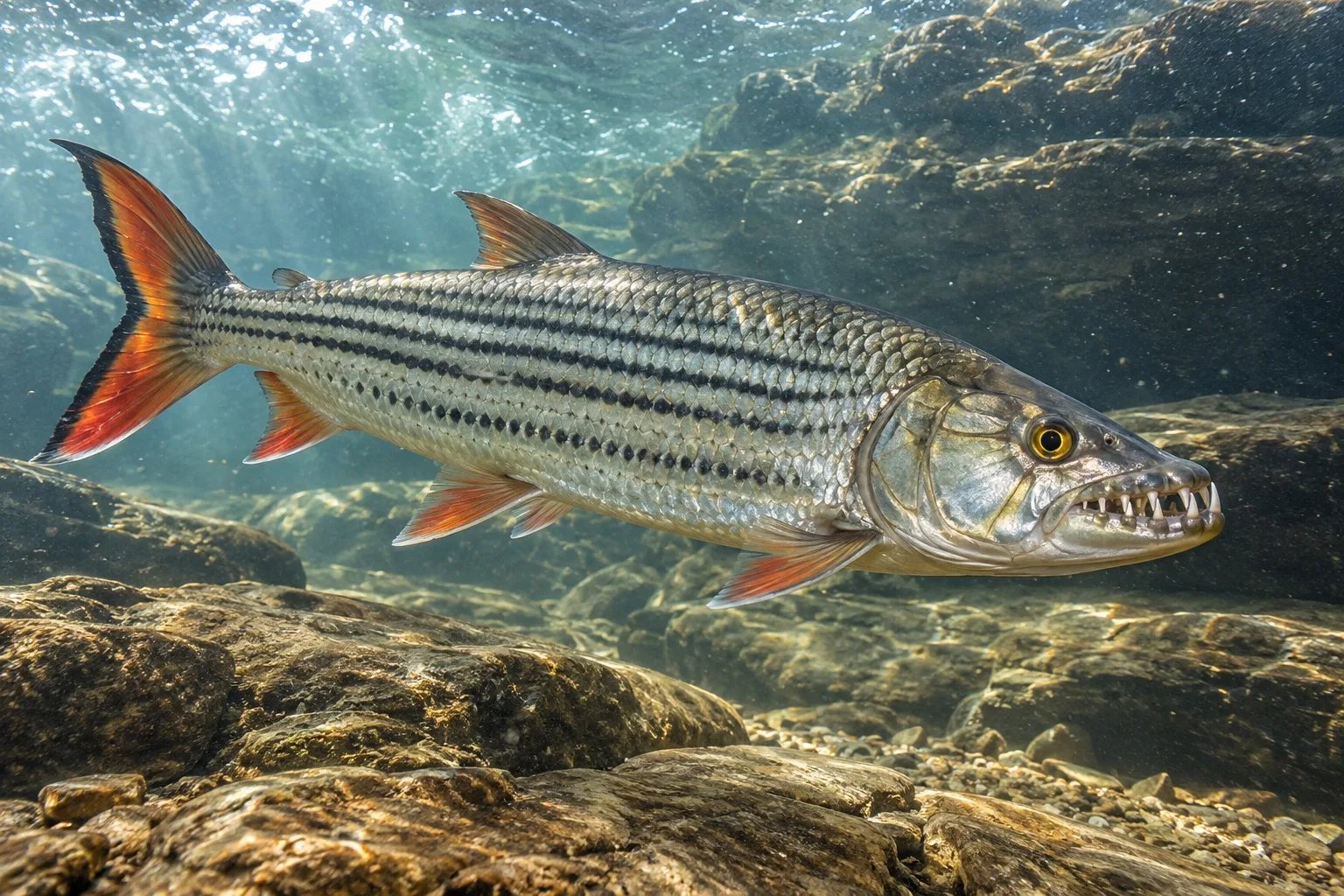
It prefers warm, oxygen-rich water in larger rivers and lakes. In South Africa it depends on temperature: below 24 °C it hardly moved in a study on the Incomati. 18 °C is close to the limit it survives.
In Kruger National Park the tigerfish is regarded as an apex predator on a par with the crocodile. Low water levels caused by water extraction and dams make it vulnerable there, and in one study tagged fish fell prey to African fish eagles.
Holding spots in the picture
Choose the time of day: the picture shows where the species holds. We do not show German seasons for travel fish; the bars give the chance of a catch for each month. Tap a fish or a spot in the list to bring it closer. The picture is schematic and AI-generated, and every water is different.
Chance of a catch per month according to the catch calendar
- J
- F
- M
- A
- M
- J
- J
- A
- S
- O
- N
- D
Spawning season
In the river
Current seam
Tigerfish are found here all year.
Free current in mid-river
Tigerfish are found here all year.
The tigerfish needs warm, well-oxygenated water and lives mainly in larger rivers. Except for the largest ones, tigerfish roam in groups of fish of the same size, hunting small characins and barbs. On the Incomati, tagged fish mostly stayed in a territory of just under 5 hectares.
In the lake
Open water
Tigerfish are found here all year.
It also occurs in large lakes such as Lake Kariba. There the groups hunt fish of the genus Limnothrissa, among others.
Size comparison: AI-generated drawing, schematic.
How it hunts and migrates
From a length of about 9 to 10 cm the tigerfish eats only fish. It takes what is most common, but prefers small characins, barbs and fish of the genus Limnothrissa, which occur in Lake Kariba. Except for the largest individuals, tigerfish hunt in roaming packs of fish of the same size.
On the Incomati researchers fitted 41 tigerfish with transmitters. The fish mostly stayed in a territory averaging just under 5 hectares and rarely covered more than 730 m. They found no large spawning migrations of the kind described earlier. Spawning there takes place from October to February, when the rivers carry high water.
When and where the season is
In southern Africa the tigerfish is a summer fish. On the Incomati it was active from November to April, and much less so from May to October when the water was cooler. Spawning falls between October and February.
The warm months after spawning, roughly March and April, are therefore a good time. In winter it bites less often. Further north, for example in the Nile or Niger basin, other seasons and water levels apply.
What you catch it with
Step by step: Tigerfish fishing: tips on bait, rig and tackle – season, spots, baits, tackle and rules on one page.
For a study in Kruger National Park researchers caught tigerfish by rod and line with artificial lures, among other methods, as well as by electrofishing and seine net. As it hunts small characins and barbs, slim lures that imitate a small fish are a good fit. On the Kavango in Namibia researchers caught 49 tigerfish from a boat with diving crankbaits.
Land it with the landing net, unhook it with long pliers and do not put your hand in its mouth.
Wait for warm water: On the Incomati the tigerfish hardly moved below 24 °C, so the southern summer is the best time to travel there. It does not shut down completely in winter, though: on the Kavango researchers caught 49 tigerfish from June to October.
Release gently: Tigerfish stay in their territory. On the Incomati most marked fish returned to the place where they were caught, but some never did. The researchers therefore regard catching and releasing as a possible major disturbance.
Suitable lures
Slim diving crankbaits with a single hook that imitate a small fish.
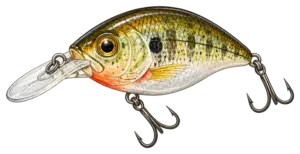
AI-generated illustrations. A click opens the lure’s page.
Fangs: land with a landing net, unhook with long pliers. Protected species in South Africa (NEMBA).
Which rules apply
According to the IUCN Red List the tigerfish is not globally threatened, and the assessment dates from 2025. Regionally it is under pressure from dams, weirs and water extraction, particularly in South Africa. There it is on the list of protected species under the biodiversity act (National Environmental Management: Biodiversity Act, NEMBA) (as of October 2026).
Fishing licences and catch rules are issued by the authorities of the country concerned, and in protected areas such as national parks the park administration’s own regulations apply. Information from the competent local authority is the one that counts.
Frequently asked questions (FAQ)
When is the best time for tigerfish?
In southern Africa the southern summer. On the Incomati the fish were active from November to April and hardly at all in the cool winter. Spawning takes place from October to February.
How big does a tigerfish get?
FishBase gives up to 105 cm fork length and 28 kg. The related goliath tigerfish from the Congo reaches up to 133 cm and 50 kg.
Does the tigerfish migrate to spawn?
Not on the Incomati. Tagging 41 fish with transmitters showed small territories and no large spawning migrations.
Sources
The rating of catch chances is an editorial assessment. The facts come from these sources, and the text is worded in our own words. The illustration is an original design by Angel Momente in the style of a natural history plate (AI-generated, see the AI notice).
- FishBase: Hydrocynus vittatus
- FishBase: Hydrocynus goliath
- Roux et al. (2018), Koedoe (SANParks): Movement patterns and home range size of tigerfish in the Incomati River system
- Sonamzi et al. (2020), Koedoe (SANParks): Assessing the effect of tagging and the vulnerability to predation in tigerfish
- Goodier et al. (2011), PLOS ONE: Cryptic Diversity of African Tigerfish (Genus Hydrocynus)
- FishBase: Lates niloticus
- Jacobs (2017), University of KwaZulu-Natal: The conservation ecology of the African tigerfish in the Kavango River, Namibia (Dissertation)
- Gerber (2011), University of Johannesburg: Physiological response of tigerfish and smallmouth yellowfish to catch-and-release angling (Masterarbeit)
Created with AI support from the sources listed. Figures only appear in the text if a source gives them. Last updated: 27 October 2026. Found a mistake? Write to us. Who is behind this site: About me.
More in the lexicon
- All fish species at a glance
- Catch calendar – month, water temperature and profile for 93 species
- Line calculator – breaking strain after the knot, drag guideline, backing
- Angling methods