
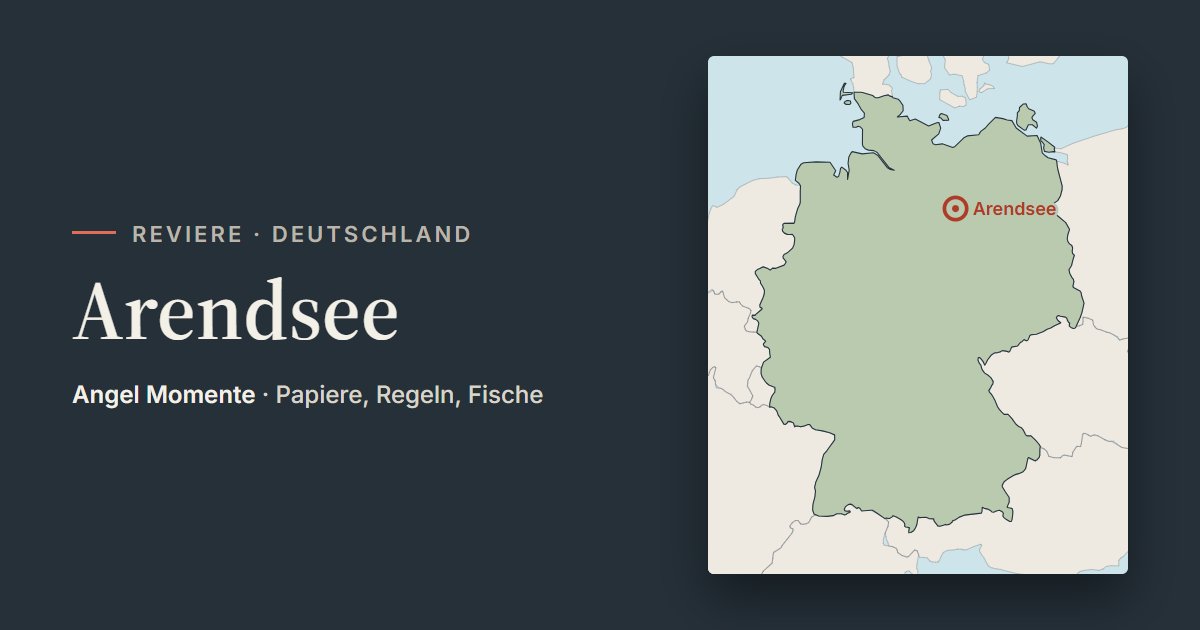
Waters · Germany
Fishing at the Arendsee
The Arendsee in the Altmark is the largest natural lake in Saxony-Anhalt and a typical whitefish lake, around 50 m deep. The fish stock is managed by a commercial fisherman from Zießau, so ask there about the fishing permit (Angelkarte). The protected area sets tight rules for boats and anglers.
- Papers
- Fishing licence and fishing permit from the person entitled to fish
As of October 2026
At a glance
- Papers
- Fishing licence and fishing permit from the person entitled to fish
| Fish | Minimum size | Closed season | Note |
|---|---|---|---|
| Vendace | 12 cm | none | Stock maintained only by stocking |
| Perch | – | none | |
| Roach | – | none | |
| Ruffe | – | none | |
| Pike | 50 cm | 15.2.–30.4. | |
| Bream | – | none | |
| rudd | – | none | |
| Eel | 50 cm | none | rare |
| Tench | 25 cm | none | rare |
| Large whitefish (Große Maräne) | 30 cm | none | very rare |
Fischereiordnung Sachsen-Anhalt (§§ 3, 4); the fishing permit (Angelkarte) may be stricter. As of October 2026. The regulation and your fishing permit are what count.
Location and waters Arendsee in the Altmark, deep collapse lake
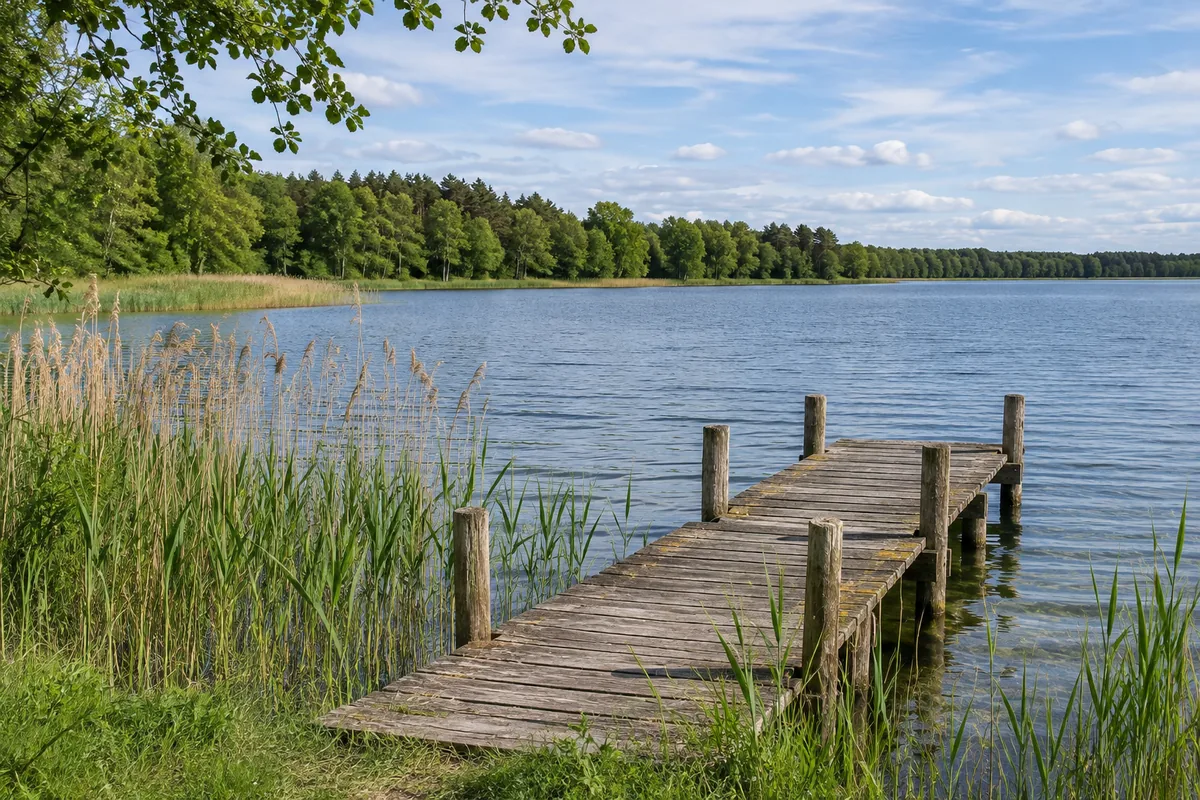
You will find it roughly midway between Seehausen and Salzwedel. It formed as a sinkhole over a salt dome, covers 514 ha and, depending on the measurement, is around 50 m deep (Natura-2000-Steckbrief). The banks drop steeply, and on the northern and south-western banks there are reed belts up to 60 m wide.
The water takes more than 50 years to renew itself, and nutrient levels have been too high for decades (IGB). Phosphorus precipitation was meant to change that, but the Altmarkkreis refused approval in July 2026. Whether and how things continue is open. More on the lake type under Water types.
Fish and best time Vendace, perch, roach and pike
The species list in the state’s fish species atlas (Fischartenatlas) is based on a 2004 survey. According to it, common species are vendace, roach (there Plötze), perch and ruffe. Silver bream, bream, rudd and pike are widespread. Rarely seen are crucian carp, tench, gudgeon and eel, and the common whitefish is even very rare. Carp used to be promoted through stocking (Landesamt für Umweltschutz), but it is missing from the 2004 list.
Vendace need cold, oxygen-rich water and do not spawn until late autumn. In the Arendsee their stock is currently maintained only by stocking. Towards the end of summer the oxygen below about 37 m is almost completely used up, which narrows their habitat. In the fish kill of August 2024, according to the district, only young whitefish died.
For pike the season begins after the closed season on 1 May. The catch calendar shows the species‘ rough year.
Papers and permit Fishing licence and fishing permit at the Arendsee
In Saxony-Anhalt you need two documents (Landesverwaltungsamt):
- Fishing licence (Fischereischein, colloquially Angelschein): It is issued by the lower fisheries authority at your main residence, for one to five years or for life. The exam is preceded by a 30-hour course. More under Fishing licence and angling exam.
- Children: From the age of 8 there is the coarse-fish licence (Friedfischfischereischein), and until their twelfth birthday only this one (§ 29 Fischereigesetz).
- You buy the fishing permit (Angelkarte) from the person entitled to fish the water, across the state usually the local club or commercial fisherman. At the Arendsee, management has been with Fischerei Kagel in Zießau for decades. Ask there about types of permit, price and conditions, and also whether you may fish from a boat and at night.
Carry both documents with you when fishing. Fishing permit and water map explains what is on the permit.
Special rules Motors, reeds, groundbaiting and hegene rig
The lake is subject to the regulation on the landscape protection area, the Natura 2000 state regulation (§ 11) and the Fischereiordnung:
- Motors: Combustion engines are banned, as are electric motors of 5 kW or more. The regulation lists exceptions, for example for commercial fishing.
- Reeds: Do not drive or walk into them. From 1 March to 30 September, stay at least 50 m from the reed-lined bank when on the water. Between the Zießau boat landing and the lido it is 100 m.
- Boat: Do not cross floating leaves, silting-up zones or shallow-water areas. New jetties need a permit.
- Groundbaiting and noise: Pre-baiting is prohibited, and loudspeakers stay off.
- Camp: Tents, caravans and open fires only at approved sites.
- Hegene rig: Allowed in the whitefish water for coarse fishing, then with only one hand-held rod. Only worms, maggots or nymphs go on the hook points.
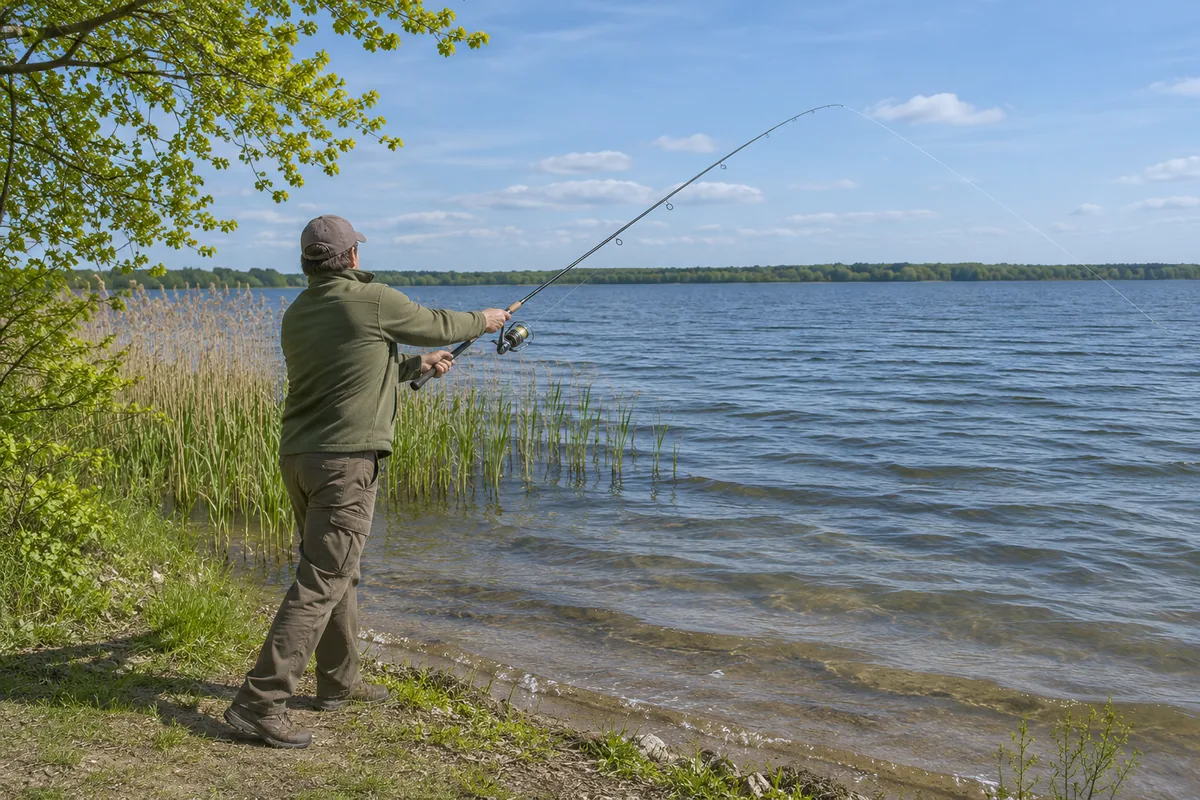
- Rods and bait: No more than two casting rods and one pole, and with a spinning or fly rod only that one. Live baitfish are banned.
- Nets: Keep 50 m from the fisherman’s gear unless he agrees.
- Keepnet: You must not keep whitefish, pike or perch in a keepnet.
As of October 2026. The minimum sizes and closed seasons in the overview follow the state’s Fischereiordnung. The conditions of your fishing permit (Angelkarte) may be stricter and then take precedence. The lake restoration is on hold for now, and new requirements are possible.
Safety Steep banks and algae to watch for
The bank drops steeply into big water. On a boat the life jacket is part of the kit (Boat and life jacket), and at the edge Bank and waders will help. Algal blooms and bathing bans occur on the Arendsee. Follow the notices and reports from the district. If a thunderstorm is approaching, see Thunderstorms and weather.
Related
- Fishing in Saxony-Anhalt and the Elbe
- Fishing on lakes and Water temperature and oxygen
- Closed season and minimum size explained and Returning fish
Sources
- Landesverwaltungsamt Sachsen-Anhalt: Fischereischein und Fischerprüfung, Fischereibehörden
- Fischereiordnung Sachsen-Anhalt (§§ 1 bis 5, 10) und Fischereigesetz Sachsen-Anhalt (§§ 26, 28 bis 31, Änderung vom 21. März 2026)
- Ministerium für Landwirtschaft und Umwelt Sachsen-Anhalt: Fischartenatlas Teil II, Die Fischgewässer (2014), S. 363 bis 364
- Landesamt für Umweltschutz: LSG Arendsee und Verordnung vom 9. Oktober 2014
- Land Sachsen-Anhalt: Steckbrief FFH-Gebiet Arendsee und Natura-2000-Landesverordnung
- Altmarkkreis Salzwedel: Fischsterben im Arendsee (28. August 2024), Restaurierung Arendsee (20. Juli 2026)
- Leibniz-Institut für Gewässerökologie und Binnenfischerei: Arendsee, Restaurierung vorerst gestoppt
Guide without guarantee, as of October 2026. The Fischereigesetz and the Fischereiordnung Sachsen-Anhalt, the protected area regulations and the conditions of your fishing permit are what count.