
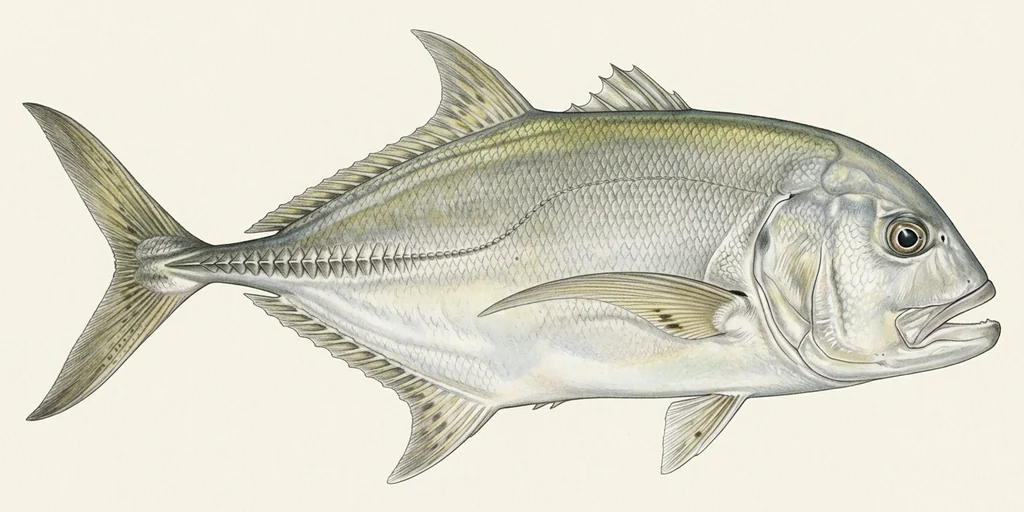
Knowledge – Fish
Giant Trevally (GT): Features, habitat and methods
The giant trevally (Caranx ignobilis), GT for short, is the largest jack of the genus Caranx. It hunts at reefs, reef channels and flats in the tropical Indo-Pacific from the Red Sea to Hawaii and is regarded there as one of the most sought-after fish for angling trips.
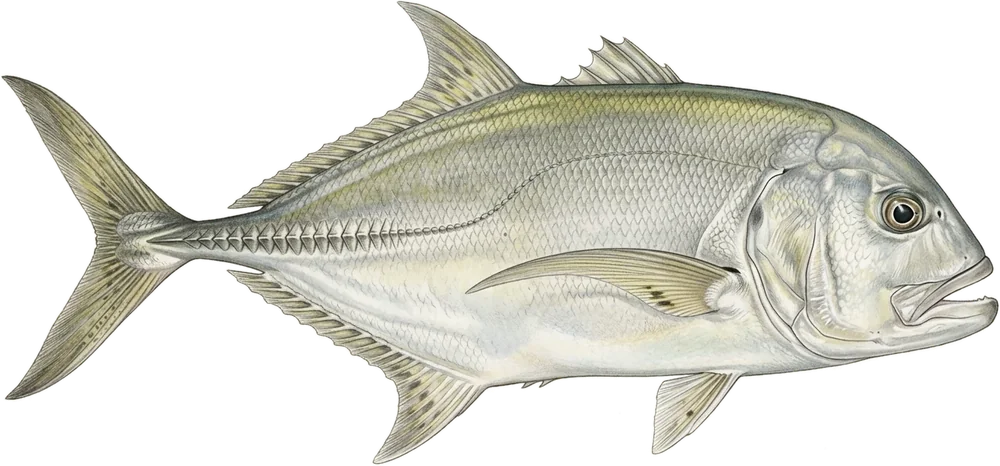
In short: According to the catch calendar the best time is the whole year. Good spots along the coast: wrecks, reefs, drop-offs and the channel in front of the sandbank. Proven baits: surface lures on a spinning rod. The largest species of the genus Caranx, recognisable by its steep head profile and strong bony scutes. In Hawaii a minimum size and a daily limit apply to ulua. Step by step: How to fish for giant trevally.
- Steeply sloping head profile
- Strong bony plates (scutes) on the rear, straight part of the lateral line
- No dark spot on the rear edge of the gill cover
Catch chances through the year
- Hardly any chance
- Possible
- Good
- Peak season
- Spawning (observe the closed season)
Editorial assessment for the home range (Hawaii and the tropical Indo-Pacific), not a measurement and no guarantee. The rules of the country you visit are what count.
How to recognise it
The GT is a very large, deep-bodied trevally. Its colour ranges from silvery through dark golden to almost black, sometimes with dark bars on the back. Typical features are the steeply sloping head profile and the strong bony plates, known as scutes, on the rear, straight part of the lateral line. It has no dark spot on the rear edge of the gill cover.
The fins are usually uniformly grey to black. Fish from turbid coastal water often have yellow fins, with the anal fin the most strongly coloured. The belly is usually scaleless at the front, often with a small patch of scales in front of the pelvic fins.
FishBase gives a common length of 100 centimetres, with a maximum of 170 centimetres and 80 kilograms. Fishes of Australia gives 180 centimetres and 86,6 kilograms. In Hawaii, fish of over 86 kilograms have been reported.
The GT is most easily confused with the bluefin trevally (Caranx melampygus). This species has bright blue second dorsal, anal and tail fins and numerous blue and black spots on its flanks. In Hawaii, hybrids of the two species have also been found.
Like the permit and the amberjack, the GT belongs to the jack family.
Side by side
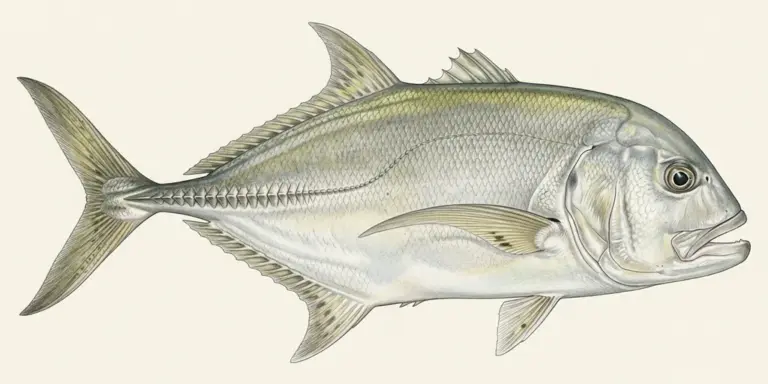
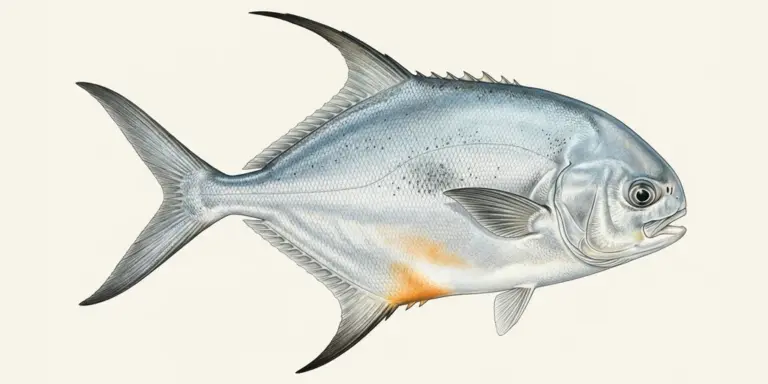
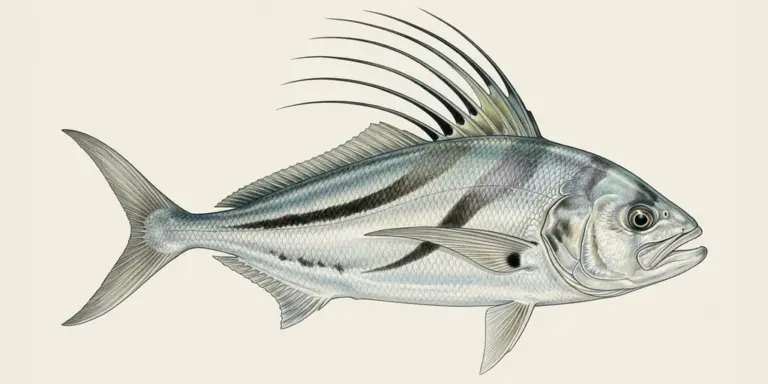
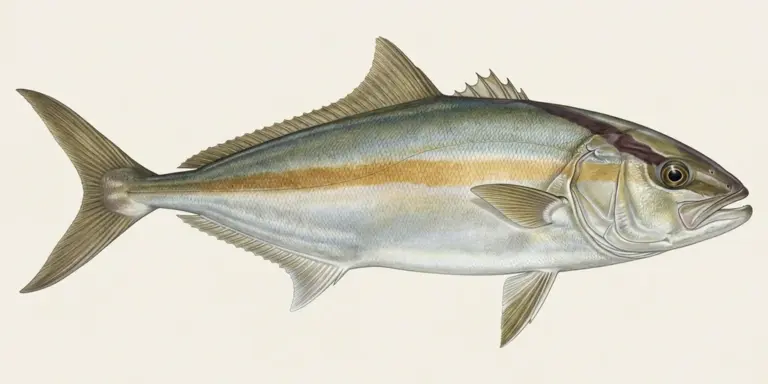
AI-generated illustrations.
Where it holds
The GT lives in the Indo-Pacific from the Red Sea and the East African coast to Hawaii and the Marquesas, north to southern Japan and south to northern Australia. The population in Hawaii is genetically distinct.
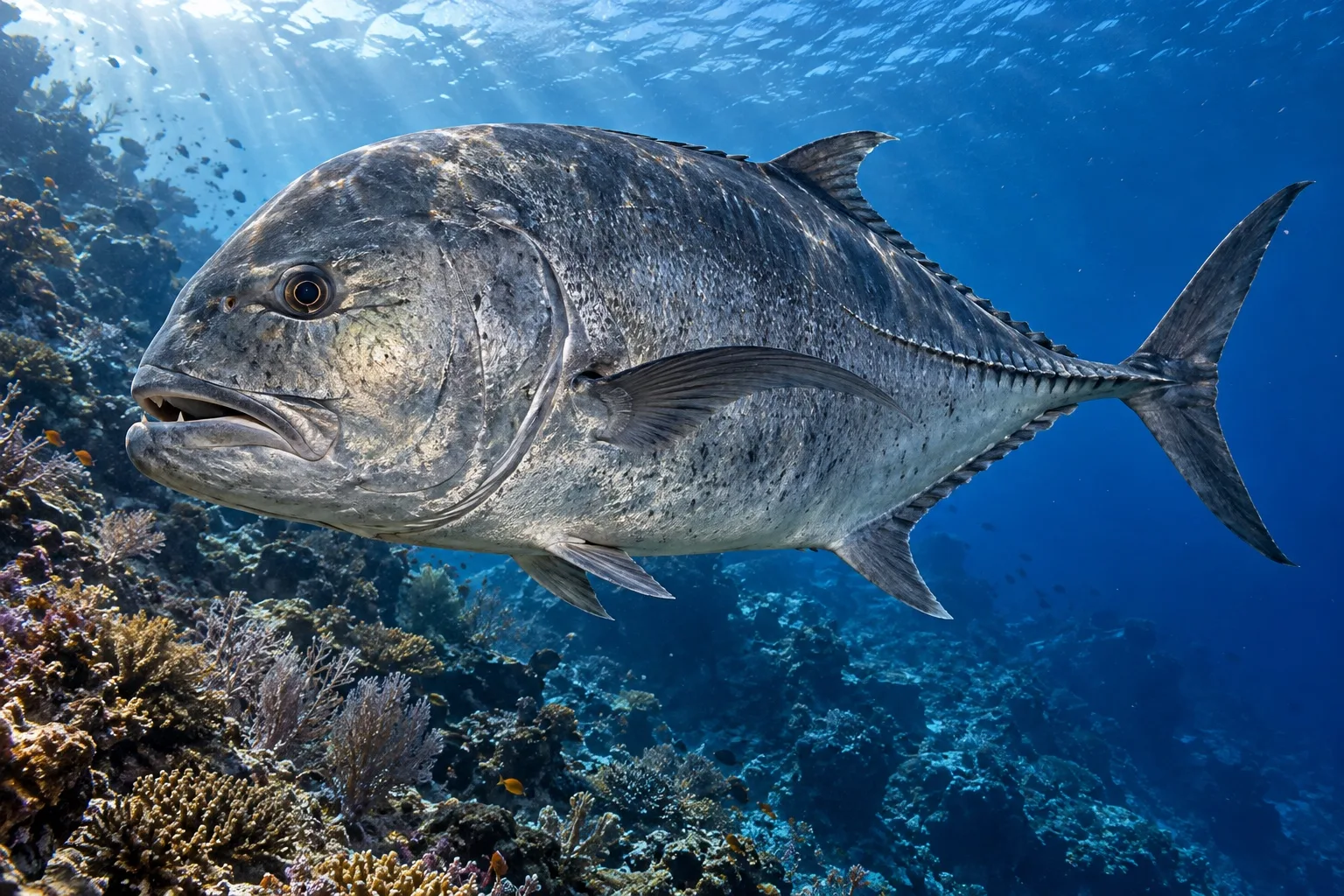
Adult fish roam freely over rock, reef channels, inner and outer reefs and shallow sandy flats near the coast. They like to patrol along reef edges. Juveniles form small shoals over sandy areas close to shore and also occur in river mouths. The species tolerates fresh water remarkably well.
Holding spots in the picture
Choose the time of day: the picture shows where the species holds. We do not show German seasons for travel fish; the bars give the chance of a catch for each month. Tap a fish or a spot in the list to bring it closer. The picture is schematic and AI-generated, and every water is different.
Chance of a catch per month according to the catch calendar
- J
- F
- M
- A
- M
- J
- J
- A
- S
- O
- N
- D
Spawning season
Active time According to FishBase it hunts mainly at night. From southern Africa it is described as a daytime hunter that feeds especially at dusk.
No main time According to FishBase it hunts mainly at night. From southern Africa it is described as a daytime hunter that feeds especially at dusk.
Active time According to FishBase it hunts mainly at night. From southern Africa it is described as a daytime hunter that feeds especially at dusk.
Active time According to FishBase it hunts mainly at night. From southern Africa it is described as a daytime hunter that feeds especially at dusk.
On the coast
gully in front of the sandbank
Giant trevally (GT) is found here all year round.
Sandy bottom
Giant trevally (GT) is found here all year round.
Stony mixed ground
Giant trevally (GT) is found here all year round.
Drop-off
Giant trevally (GT) is found here all year round.
Wreck, reef
Giant trevally (GT) is found here all year round.
The GT patrols reef edges, moves through reef channels and over shallow sand close to the shore. It is also found over rocky bottom on inner and outer reefs. Juveniles stay in small shoals over sandy bottom and come as far as river mouths.
Size comparison: AI-generated drawing, schematic.
How it hunts and spawns
The GT is an apex predator. In a study in the Northwestern Hawaiian Islands, more than 90 per cent of its diet was fish, with crustaceans and cephalopods making up the rest. According to FishBase, it hunts crustaceans such as crabs and spiny lobsters, and fish, mostly at night. For southern Africa, by contrast, it is described as active by day, with a peak at dawn and dusk.
To spawn, GT form aggregations in summer on shallow outer reefs and offshore banks. In Hawaii, researchers found ripe fish from April to November, with a peak roughly from May to August. Females there mature at a standard length of about 60 centimetres, which corresponds to around three and a half years.
When and where the season is
As a tropical fish, the GT is present in its home waters all year and is caught all year. In Hawaii the main spawning period lies roughly between May and August, when the fish gather on outer reefs and banks.
Well-known flats destinations for the GT are the Seychelles, Kiritimati in the island state of Kiribati and French Polynesia. The best time to travel differs from region to region and should be asked about locally.
What it is caught on
Step by step: Fishing for giant trevally: tips on bait, rig and tackle – season, spots, bait, tackle and rules on one page.
The GT is fished by recreational anglers throughout its range, on the flats mostly as catch and release. A study on Kiritimati examined 73 GT caught on spinning rods with surface lures (topwater).
The result concerns above all the choice of hook. Lures with a single J hook or a single treble hook mostly sat in the mouth. Lures with two hooks more often hooked the fish in the body, and two trebles in particular caused more injuries and made unhooking harder. Anglers report that the GT heads straight for the reef after the bite, so the tackle has to be very strong.
One hook instead of two trebles: If you want to release the fish, fit surface lures with just one hook. In the study on Kiritimati this reduced body hooking, injuries and time out of the water.
Keep the fight and the air time short: With longer fights and longer time out of the water, the fish more often lost their balance and escape reflex. Keep the GT in the water when unhooking.
Suitable lures
Surface lures on a spinning rod.
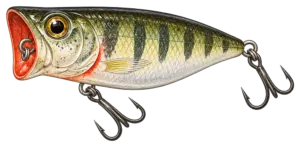
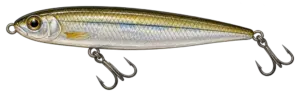
AI-generated illustrations. A click opens the lure’s page.
Use lures with a single hook for release
What you need to know in the country you visit
In Hawaii the GT counts among the ulua and pāpio. A minimum size (Mindestmaß) and a daily limit apply to this group, and the rules are published by the fisheries authority (Fischereibehörde) Hawaii Division of Aquatic Resources. Anyone who does not live in Hawaii has needed a marine fishing licence since 2024 (Nonresident Recreational Marine Fishing License).
In the Seychelles, Kiribati, Australia and other countries, separate licences, protected areas and rules apply. Many flats destinations are run as pure catch and release fisheries. The competent local authority is always the one that counts. The IUCN lists the GT as Least Concern.
Frequently asked questions (FAQ)
How big does a giant trevally get?
Around 100 centimetres is usual. FishBase gives a maximum of 170 centimetres and 80 kilograms, Fishes of Australia 180 centimetres and 86,6 kilograms.
How do I tell a GT from a bluefin trevally?
The bluefin trevally has bright blue second dorsal, anal and tail fins and many blue and black spots on its flanks. The GT has a steep head and no such markings.
Which hooks are kinder to the GT?
In a study on Kiritimati, lures with a single hook mostly sat in the mouth. Two trebles more often led to body hooking and injuries.
Sources
The rating of catch chances is an editorial assessment. The facts come from these sources, and the text is worded in our own words. The illustration is an original design by Angel Momente in the style of a natural history plate (AI-generated, see the AI notice).
- FishBase: Caranx ignobilis, Giant trevally
- Museums Victoria / Fishes of Australia: Giant Trevally, Caranx ignobilis
- Museums Victoria / Fishes of Australia: Bluefin Trevally, Caranx melampygus
- NOAA Fishery Bulletin: Sudekum et al. (1991), Life History and Ecology of Large Jacks in Undisturbed, Shallow, Oceanic Communities
- Hawaii Division of Aquatic Resources: Marine Fishes and Vertebrates (Fischereiregeln)
- Hawaii Division of Aquatic Resources: Nonresident Recreational Marine Fishing License – FAQ
- GigaByte / Europe PMC (Volltext): The genome of a giant (trevally): Caranx ignobilis (2022)
- Environmental Biology of Fishes / Europe PMC (Volltext): Cascading effects of climate change on recreational marine flats fishes and fisheries (2023)
- Danylchuk et al. (2026): Hooking injury, physiological stress, and post-release activity patterns of giant trevally, Environmental Biology of Fishes (Carleton University)
Created with AI support from the sources listed. Figures only appear in the text if a source gives them. Last updated: 27 October 2026. Found a mistake? Write to us. Who is behind this site: About me.
More in the lexicon
- All fish species at a glance
- Catch calendar – month, water temperature and profile for 93 species
- Line calculator – breaking strain after the knot, drag guideline, backing
- Angling methods