
Knowledge – Fish
Blue marlin: Features, habitat, season and methods
The blue marlin (Makaira nigricans) is a solitary fish of the warm, open Atlantic and the largest marlin that anglers target there. It hunts by day just below the surface and is caught by trolling from a boat.
In brief: According to the catch calendar the best time is from May to October. Good spots on the coast: open water just below the surface. Proven baits: trolled lures for the open sea and trolled natural baitfish. The Atlantic stock is classed as overfished by ICCAT, and the IUCN lists the species as vulnerable. In sport fishing the blue marlin is now mostly released alive. Step by step: Blue marlin fishing.
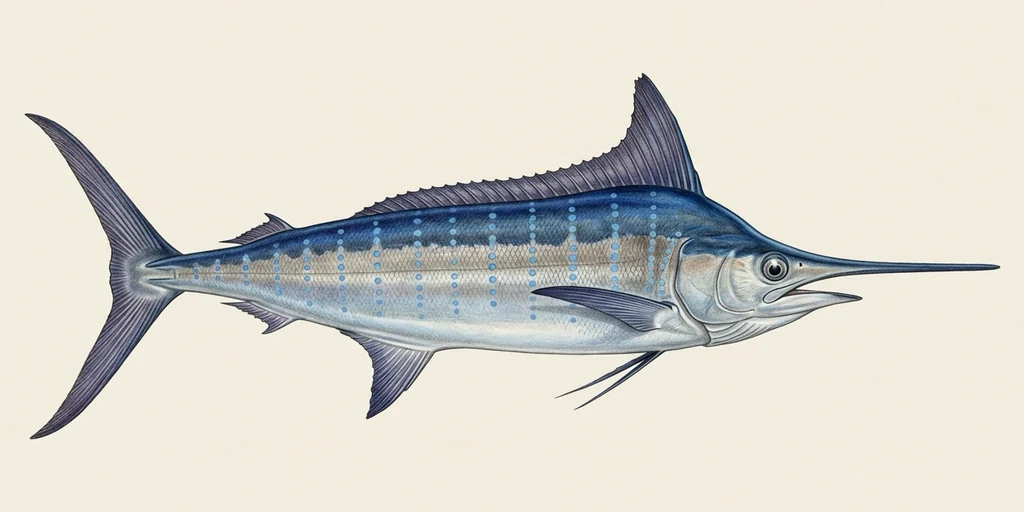
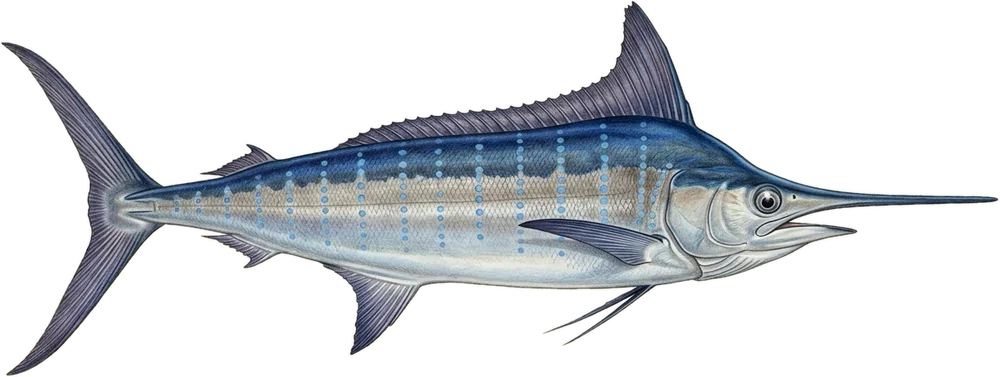
- Long spear with a round cross-section (extended upper jaw)
- First dorsal fin lower at the front than the body is deep, long and low towards the rear
- About 15 vertical rows of pale blue spots on the flanks
Catch chances through the year
- Hardly any chance
- Possible
- Good
- Peak season
- Spawning (observe the closed season)
Editorial assessment for the home area (western Atlantic: US east coast, Bahamas and Caribbean), not a measured value and not a guarantee. The rules of the country you are visiting are binding.
How to recognise it
The blue marlin has an elongated body that is barely flattened from the sides. The upper jaw is extended into a powerful bill that is round in cross-section. Behind the head the nape rises steeply to the first dorsal fin. The front part of that fin is lower than the body is deep, and towards the rear the fin runs out long and low. The pelvic fins are shorter than the pectoral fins, and on the tail stock there are two keels on each side.
The back is dark blue to blue-black, the flanks and belly silvery white. Across them run about 15 vertical rows of pale blue spots. The net-like lateral line is distinct in young fish and hardly visible in large ones.
According to FishBase the blue marlin grows up to 500 centimetres in length and 636 kilograms in weight, with around 290 centimetres being usual. The big fish are females; according to the manual of the International Commission for the Conservation of Atlantic Tunas (ICCAT), males do not grow heavier than 150 kilograms. FishBase gives a maximum age of about 20 years.
The North Carolina fisheries authority (Fischereibehörde) names the white marlin and the sailfish as the most common mix-ups. In the white marlin the dorsal and anal fins are rounded at the tips, in the blue marlin they are pointed. The sailfish is the only one of its relatives to keep its tall, sail-like dorsal fin for life. The swordfish has a long, flat sword instead of the round bill and no pelvic fins.
Side by side
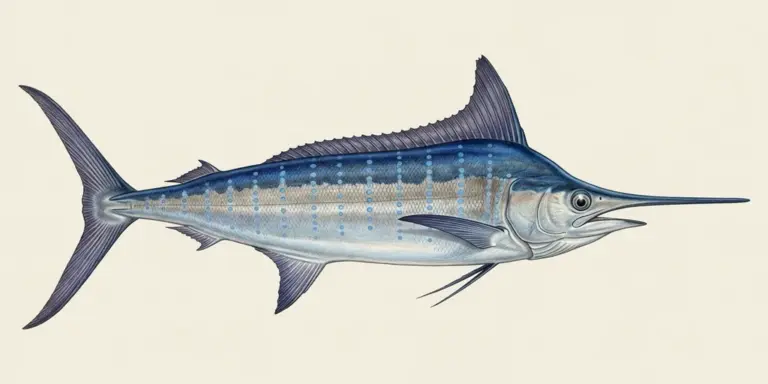
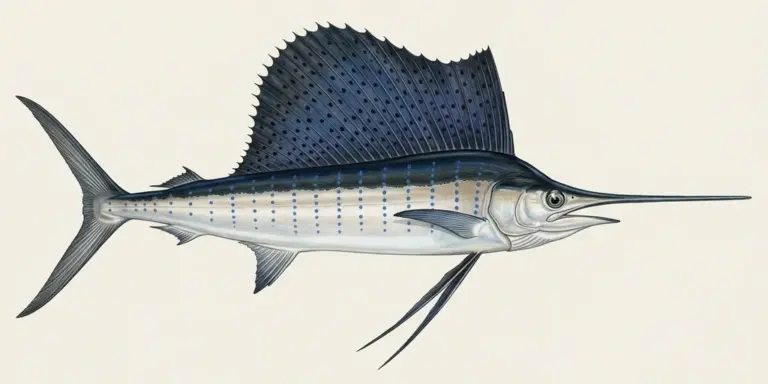
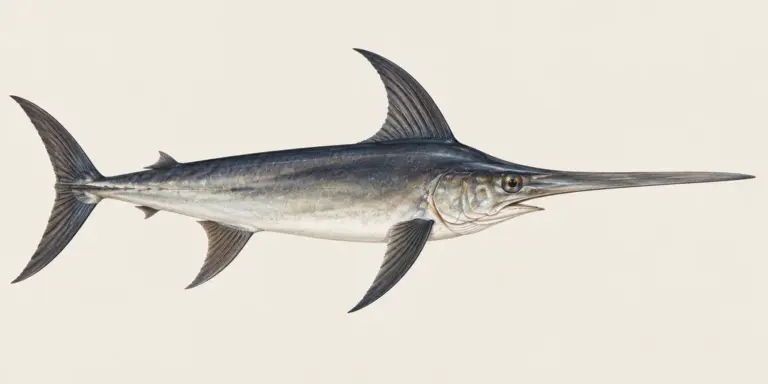
AI-generated illustrations.
Where it holds
The blue marlin lives in the open ocean, usually in clear, deep blue water far from the coast. According to the ICCAT manual, important populations are found off the south-eastern coast of the USA, in the Gulf of Mexico, in the northern and eastern Caribbean and off Brazil. In the eastern Atlantic, Madeira and Cape Verde are the main areas for sport fishing.
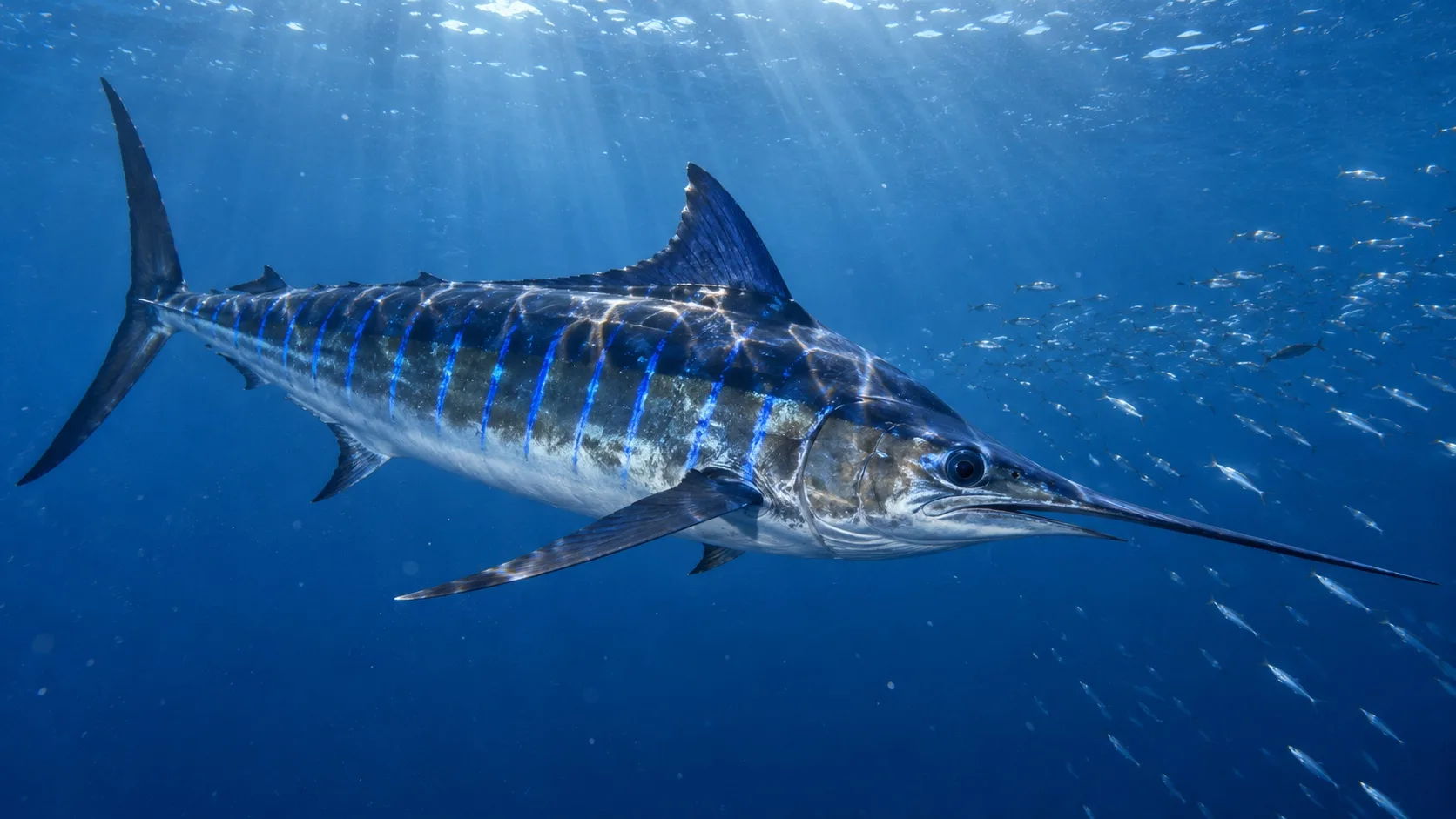
It seeks warm surface water of 22 to 31 °C. Fish with satellite tags stayed mostly in the upper 25 metres but often dived briefly, usually to 100 to 200 metres, and some deeper than 800 metres. A heat-producing organ below the brain keeps the brain and eyes warm.
Holding spots in the picture
Choose the time of day: the picture shows where the species holds. We do not show German seasons for travel fish; the bars give the chance of a catch for each month. Tap a fish or a spot in the list to bring it closer. The picture is schematic and AI-generated, and every water is different.
Chance of a catch per month according to the catch calendar
- J
- F
- M
- A
- M
- J
- J
- A
- S
- O
- N
- D
Spawning season
Not prime time Blue marlin feed by day; as far as is known, not at night.
Active time Blue marlin feed by day; as far as is known, not at night.
Not prime time Blue marlin feed by day; as far as is known, not at night.
Not prime time Blue marlin feed by day; as far as is known, not at night.
On the coast
Open water, mid-water
Blue marlin are present here all year round.
Just below the surface
Blue marlin are present here all year round.
The blue marlin lives far out in clear, deep blue ocean. It travels alone and looks for warm surface water. There it hunts flying fish, small tuna, dolphinfish and squid.
Depth: It mostly stays in the upper 25 metres but often dives briefly to 100 to 200 metres, and individual fish deeper than 800 metres.
Size comparison: AI-generated drawing, schematic.
How it hunts and spawns
Blue marlin do not form shoals but travel through the sea singly. They hunt flying fish, small tunas, dolphinfish and squid, according to the ICCAT manual also at greater depth than other marlin and sailfish. FishBase describes foraging as a daytime activity; at night blue marlin, according to the Florida Museum, do not feed as far as is known.
In the North Atlantic the blue marlin spawns, according to ICCAT, from May to October, probably most strongly in June and July. Spawning females and larvae have been found in the Straits of Florida, off Puerto Rico, in the Bahamas, Jamaica and Bermuda, among other places. The eggs drift freely in the water.
Most tagged marlin were recaptured near where they were released. A few, however, travel very far: a fish tagged off Delaware was caught again after 1108 days off Mauritius, 14 893 kilometres away.
When and where the season is
The season dates here apply to the western Atlantic from the US east coast across the Bahamas into the Caribbean. According to the ICCAT manual, blue marlin move in summer from their feeding grounds off the north-eastern coast of the USA, in the Gulf of Mexico and in the southern Caribbean to the spawning grounds in the northern Caribbean and around the Bahamas. After spawning they travel back.
That gives the assessment in the calendar: from May to October, when the water is warmest and the fish gather, the chances are best. Outside those months the calendar rates them as possible only.
How it is caught
Step by step: Blue marlin fishing: tips on bait, rigs and tackle – season, marks, bait, tackle and rules on one page.
The blue marlin is caught by trolling, that is with baits pulled behind a moving boat. According to the North Carolina fisheries authority (Fischereibehörde), boats pull up to eight lines at 4 to 8 knots. Two lines run close behind the stern on the surface, the others are led away from the boat on side outriggers. A hookless attractor lure (teaser) in the wake brings the marlin to the surface.
Both artificial and natural baits are trolled. Anyone fishing with natural bait in US waters in a registered tournament must use circle hooks without an offset, which usually catch in the corner of the mouth. NOAA Fisheries advises strong tackle so that the fight stays short.
Unhook in the water: A marlin that is not kept stays in the water under US rules, also for the photo. Circle hooks and a release tool make unhooking alongside the boat easier.
Check the fin tips: The species must be certain before any fish is kept. Pointed dorsal and anal fins point to a blue marlin, rounded tips to a white marlin.
Suitable lures
Trolled lures for the open sea and trolled natural baitfish.
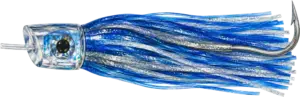
AI-generated illustrations. A click opens the lure’s page.
In US tournaments with natural bait, circle hooks only; fish that are not kept are unhooked in the water
Rules, permits and release
Which rules apply depends on the country in whose waters you fish. The responsible authority on the spot is always the one that counts.
In the USA, federal rules for highly migratory species (Highly Migratory Species, HMS) apply in the Atlantic, summarised in the NOAA Fisheries guide. Private boats need an HMS permit for this, charter boats their own charter permit; guests aboard such a boat fish under that permit. Every marlin landed must be reported, within 24 hours according to the guide. A minimum size (Mindestmaß) and an annual limit for all US landings combined also apply. In the coastal waters of the states, their angling licence is added, in North Carolina for example the Coastal Recreational Fishing License.
NOAA Fisheries expressly recommends releasing billfish alive. A fish that is not kept must be released immediately and without lifting it out of the water. According to the ICCAT manual, sport fishing for marlin in the Atlantic has largely developed into catch and release. ICCAT classes the Atlantic stock as overfished following its 2024 assessment, and the International Union for Conservation of Nature (IUCN) lists the species as vulnerable. On health: the US authorities FDA and EPA count marlin among the fish with the highest mercury levels, which pregnant women, nursing mothers and small children should avoid. This does not replace medical advice.
Frequently asked questions (FAQ)
How big does a blue marlin get?
According to FishBase up to 500 centimetres and 636 kilograms, with around 290 centimetres being usual. The big fish are females; males stay under about 150 kilograms.
When is the best time in the western Atlantic?
From May to October. The water is warm then, and the fish gather in the northern Caribbean and around the Bahamas to spawn.
May you keep a blue marlin?
That depends on the country. In US waters a permit, a minimum size (Mindestmaß) and a duty to report govern keeping a fish, but the authority recommends release.
Sources
The rating of catch chances is an editorial assessment. The facts come from these sources, and the text is worded in our own words. The illustration is an original design by Angel Momente in the style of a natural history plate (AI-generated, see the AI notice).
- FishBase: Makaira nigricans, Blue marlin
- ICCAT: Manual: Blue Marlin
- ICCAT: Executive Summary Blue Marlin (Bestandsbewertung 2024)
- North Carolina Division of Marine Fisheries: Blue Marlin
- North Carolina Division of Marine Fisheries: Sailfish
- FishBase: Xiphias gladius, Swordfish
- NOAA Fisheries: HMS Recreational Compliance Guide
- Florida Museum of Natural History: Blue Marlin
- U.S. Food and Drug Administration: Advice about Eating Fish (Marlin unter „Choices to Avoid“, Stand 5. März 2024)
Created with AI support from the sources listed. Figures only appear in the text if a source gives them. Last updated: 27 October 2026. Found a mistake? Write to us. Who is behind this site: About me.
More in the lexicon
- All fish species at a glance
- Catch calendar – month, water temperature and profile for 93 species
- Line calculator – breaking strain after the knot, drag guideline, backing
- Angling methods