
Knowledge – Fish
Swordfish: Features, habitat, season and methods
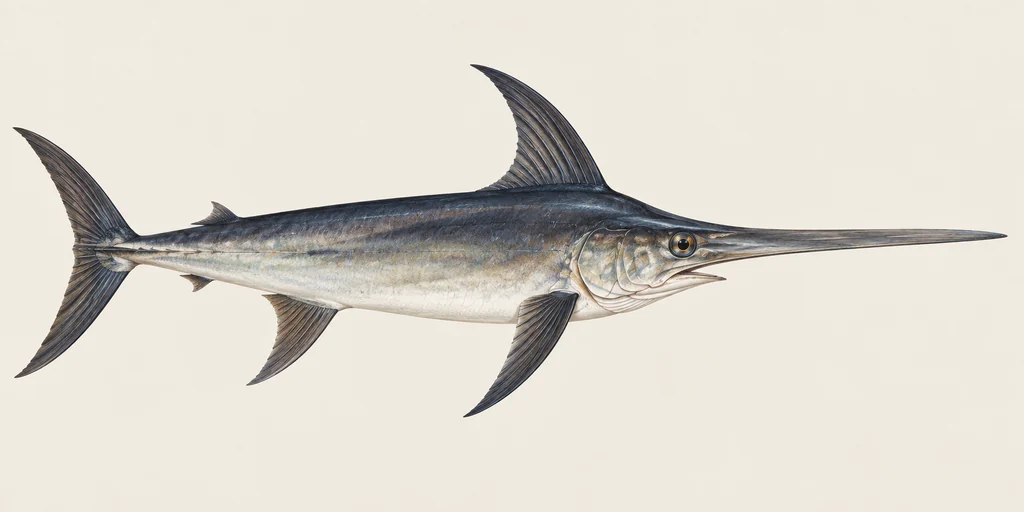
The swordfish (Xiphias gladius) is the only member of its family and carries a long, flat sword instead of a round spear. It lives in all warm and temperate oceans and dives by day to depths that hardly any other billfish reaches. Off southern Florida it is fished at night at the surface and by day with heavy deep-drop rigs at several hundred metres.
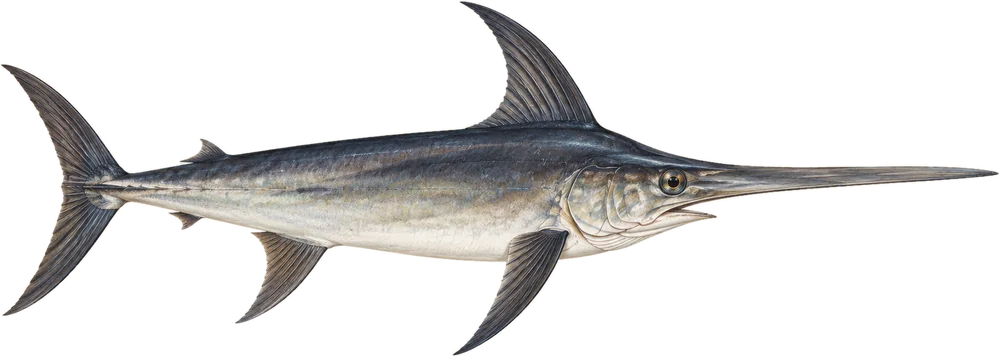
In short: According to the catch calendar, the best time is all year round. Good spots off the coast: deep water, open water and just below the surface. Proven baits: large squid or baitfish, drifted shallow at night or lowered to great depth with a heavy weight by day. The swordfish has a flat sword and no pelvic fins, which sets it apart from marlins and the sailfish. Large predatory fish like it contain particularly high levels of methylmercury, according to the BfR. Step by step: fishing for swordfish.
- Long, flat sword with an oval cross-section
- Tall, rigid, sickle-shaped first dorsal fin, a very small second one far back
- Large eye and a strong keel on each side of the tail stalk, no pelvic fins
Catch chances through the year
- Hardly any chance
- Possible
- Good
- Peak season
- Spawning (observe the closed season)
Editorial assessment for the home water (southern Florida and the Straits of Florida), not a measured value and not a guarantee. The rules of the country you travel to are what count.
How to recognise it
The swordfish has a powerful, almost round body and a very long sword. It is flat and oval in cross-section, not round like the spear of the marlins. The first dorsal fin is tall, rigid and sickle-shaped, the second very small and set far back. Pelvic fins are completely absent, the tail fin is crescent-shaped, and on each side of the tail stalk sits a strong keel.
Adult swordfish have neither scales nor teeth, and the lateral line disappears from a length of about one metre. The back is blackish brown and gets lighter towards the belly. The eyes are large.
According to FishBase the swordfish reaches up to 455 centimetres and 650 kilograms. In the US fishery most fish weigh between 50 and 200 pounds, or roughly 25 to 90 kilograms, according to NOAA Fisheries. Females grow faster, and almost all animals over 140 kilograms are females. NOAA gives a lifespan of about nine years.
It can be confused with the blue marlin or the sailfish only at first glance. Marlins and the sailfish have a round spear, pelvic fins and, as adults, scales. The sailfish also carries a tall, sail-like dorsal fin.
Side by side
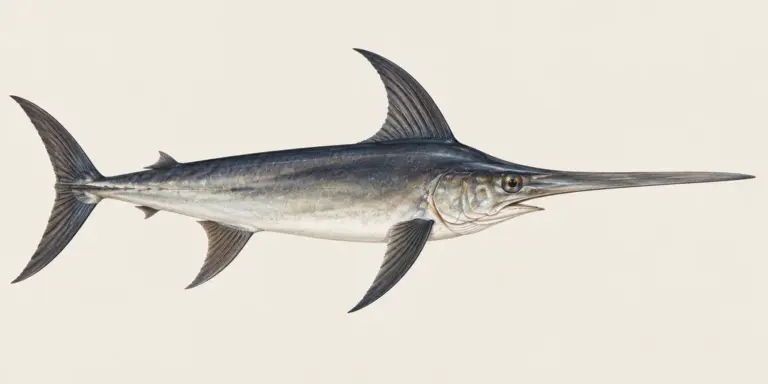
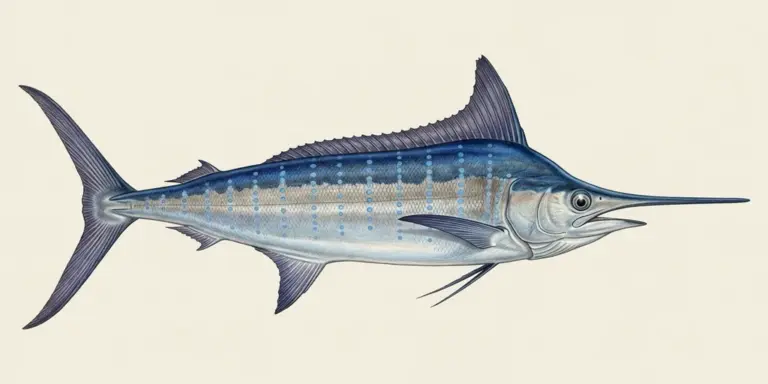
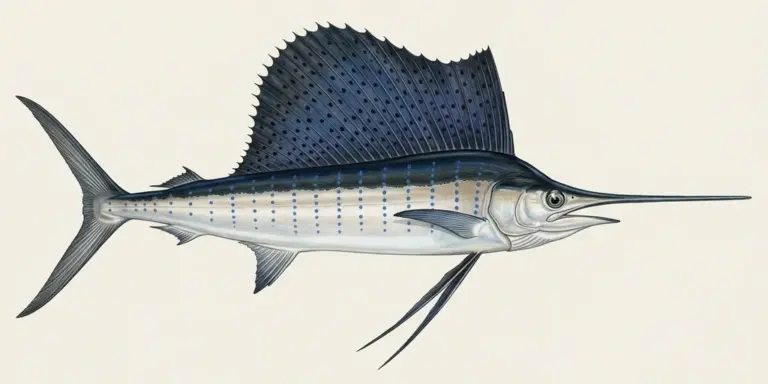
AI-generated illustrations.
Where it holds
Swordfish live worldwide in tropical, temperate and at times cold seas, including the Mediterranean. In the western Atlantic they travel with the Gulf Stream as far as the Grand Banks off Newfoundland. According to NOAA, the Gulf of Mexico and the Straits of Florida are important nursery areas for young fish.
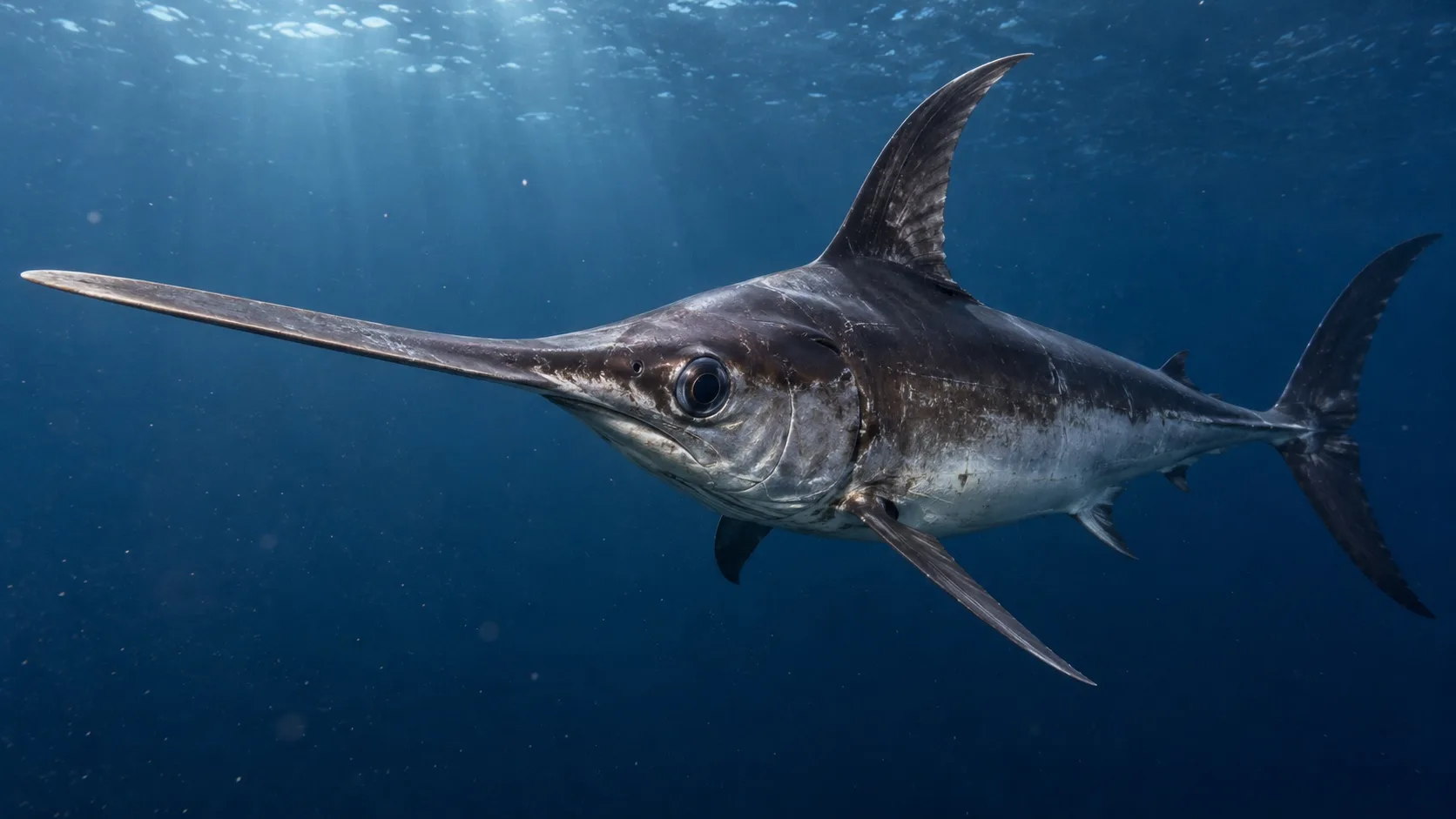
No other billfish tolerates such a wide temperature range: according to the Florida Museum it lives in water of 5 to 27 °C and prefers 18 to 22 °C. By day it usually stays deep below the thermocline, according to a study from California at 300 to 600 metres, and at night in the upper, mixed water. The Florida Museum gives 200 to 600 metres as its main depth range. A heat organ at an eye muscle keeps the brain warm.
Holding spots in the picture
Choose the time of day: the picture shows where the species holds. We do not show German seasons for travel fish; the bars give the chance of a catch for each month. Tap a fish or a spot in the list to bring it closer. The picture is schematic and AI-generated, and every water is different.
Chance of a catch per month according to the catch calendar
- J
- F
- M
- A
- M
- J
- J
- A
- S
- O
- N
- D
Spawning season
No main time At night it hunts in the upper water, by day it sits deep and is then fished with deep rigs.
Active time At night it hunts in the upper water, by day it sits deep and is then fished with deep rigs.
No main time At night it hunts in the upper water, by day it sits deep and is then fished with deep rigs.
Active time At night it hunts in the upper water, by day it sits deep and is then fished with deep rigs.
On the coast
Deep, colder water
Swordfish sits here all year.
Open water, mid-water
Swordfish sits here all year.
Just below the surface
Swordfish sits here all year.
The swordfish lives in the open ocean and travels daily between the water layers. By day it sits far down in the cold deep water, at night it rises to hunt. It eats fish from all depths and squid.
Depth: By day it usually sits 300 to 600 metres deep, far below the thermocline. At night it comes into the upper, mixed layer.
Size comparison: AI-generated drawing, schematic.
How it hunts and spawns
Swordfish eat fish from all layers of the water, as well as squid and other cephalopods. They slash at their prey sideways with the sword, wounding or stunning it. Squid from swordfish stomachs often bear cuts.
In summer swordfish move into cooler waters to feed, in autumn back into warm water. In the western North Atlantic they spawn, according to NOAA, from December to March south of the Sargasso Sea and in the northern Caribbean, and from April to August off the south-eastern US coast. Off Florida, in the Caribbean and in the Gulf of Mexico the species spawns all year round, according to the Florida Museum. Depending on size, a female carries 1 to 29 million eggs, which drift freely in the water.
When and where the season is
The season information applies to southern Florida and the Straits of Florida. Spawning and nursery areas lie close together there, and this has long been the centre of recreational swordfishing in the USA. Because the species spawns off Florida all year round and both young and adult fish occur there, the calendar rates every month as good. A pronounced main season like that of the marlin or sailfish does not show up in the sources.
When choosing the time of day, the method matters more than the month. In the past people fished off southern Florida almost only at night; since around 2010 daytime deep fishing has predominated.
How it is caught
Step by step: Fishing for swordfish: tips on bait, rig and tackle – season, spots, baits, tackle and rules on one page.
The traditional method is night drift fishing: from the drifting boat, baited lines are offered at shallow depth, where swordfish hunt at night. In the early 2000s anglers in southern Florida adopted daytime deep fishing (deep drop), in which the bait is lowered several hundred metres. According to a study in the journal of the Californian fisheries authority, this has been the most common method in southern Florida and on the Gulf coast since 2010.
In deep fishing the main line carries a heavy weight of 2 to 4 kilograms, followed by a long trace with a large circle or J hook. The bait is usually a large squid tied firmly to the hook shank, with a light stick near the hook. Often several lines are fished at different depths, and floats on the drifted lines signal a bite. Because of the depth, electric reels are mostly used.
Choose the time of day by method: At night you fish shallow in the upper water. By day the swordfish usually stays deep below the thermocline, and a bait offered shallow rarely reaches it.
Release in the water: A swordfish that is not kept is released in US waters immediately and without lifting it out of the water.
Suitable lures
Large squid or baitfish, drifted shallow at night or lowered to great depth with a heavy weight by day.
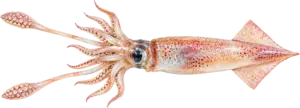
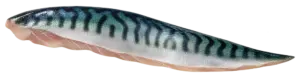
AI-generated illustrations. A click opens the lure’s page.
Light stick near the hook; in US waters only handline or rod and reel
Rules, reporting duty and health
The rules of the country in whose waters you fish and the authority there are always what count. In the USA the federal rules for highly migratory species (HMS) apply in the Atlantic, summarised in the NOAA Fisheries guide. Private boats need an HMS permit, charter boats their own. Only handline and rod and reel are allowed. A minimum size (Mindestmaß) and catch limits per person and boat apply, and some areas are closed at times. South of 5 degrees north, recreational anglers may not catch or land swordfish.
Every landed swordfish must be reported within 24 hours according to the guide. It may be gutted and beheaded, but not cut up at sea. A fish that is not kept is released without lifting it out of the water. According to NOAA the North Atlantic stock is not overfished after the 2022 assessment, and the IUCN lists the species worldwide as Near Threatened.
Health: the Federal Institute for Risk Assessment (BfR) names the swordfish, alongside shark and tuna, as an example of large, older predatory fish with the highest levels of methylmercury. According to the BfR, pregnant and breastfeeding women should avoid fish species with high levels. This does not replace medical advice.
Frequently asked questions (FAQ)
When does the swordfish bite?
At night it hunts near the surface, by day at depths of 300 to 600 metres. Off southern Florida it is caught in both cases, today mostly by day with deep rigs.
How do I tell it from a marlin?
By the flat sword, the missing pelvic fins and the scaleless skin of adult fish. Marlins have a round spear and pelvic fins.
Can you eat swordfish without worry?
The BfR advises pregnant and breastfeeding women to avoid fish species with high methylmercury levels, such as swordfish. This does not replace medical advice.
Sources
The rating of catch chances is an editorial assessment. The facts come from these sources, and the text is worded in our own words. The illustration is an original design by Angel Momente in the style of a natural history plate (AI-generated, see the AI notice).
- FishBase: Xiphias gladius, Swordfish
- NOAA Fisheries: North Atlantic Swordfish
- Florida Museum of Natural History: Swordfish
- California Fish and Wildlife Journal: Aalbers et al. 2022, Recreational deep-drop fishery for swordfish
- University of North Florida: Kerstetter et al. 2017, South Florida nighttime recreational swordfish fishery (Abstract)
- NOAA Fisheries: HMS Recreational Compliance Guide
- Bundesinstitut für Risikobewertung: Schwangere und Stillende sollten Fischarten mit hohen Gehalten an Methylquecksilber meiden
- FishBase: Istiophorus platypterus, Indo-Pacific sailfish
Created with AI support from the sources listed. Figures only appear in the text if a source gives them. Last updated: 27 October 2026. Found a mistake? Write to us. Who is behind this site: About me.
More in the lexicon
- All fish species at a glance
- Catch calendar – month, water temperature and profile for 93 species
- Line calculator – breaking strain after the knot, drag guideline, backing
- Angling methods