
Knowledge – Fish
Sailfish: Features, habitat, season and methods
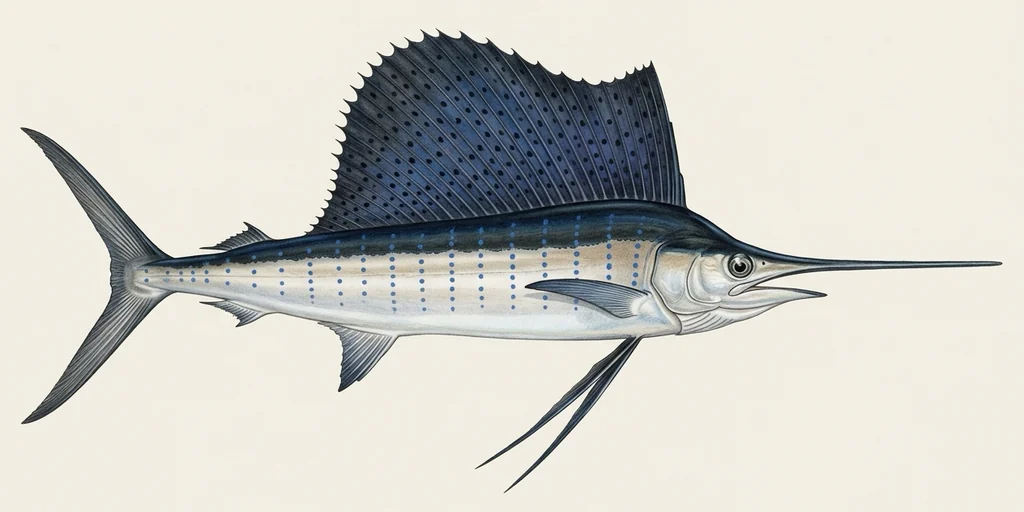
The sailfish (Istiophorus platypterus) carries a tall, sail-like dorsal fin that sets it apart from all marlins. Unlike most of its relatives it often comes close to coasts, islands and reefs. Off north-western Australia it gathers in large numbers every year in the winter and spring of the Southern Hemisphere.
In short: According to the catch calendar, the best time is July to September. Good spots off the coast: open water, just below the surface and wreck, reef. Proven baits: trolled lures and natural baitfish such as mullet or garfish. The IUCN lists the sailfish as threatened. Off north-western Australia almost all sailfish caught are released, many of them tagged. Step by step: fishing for sailfish.
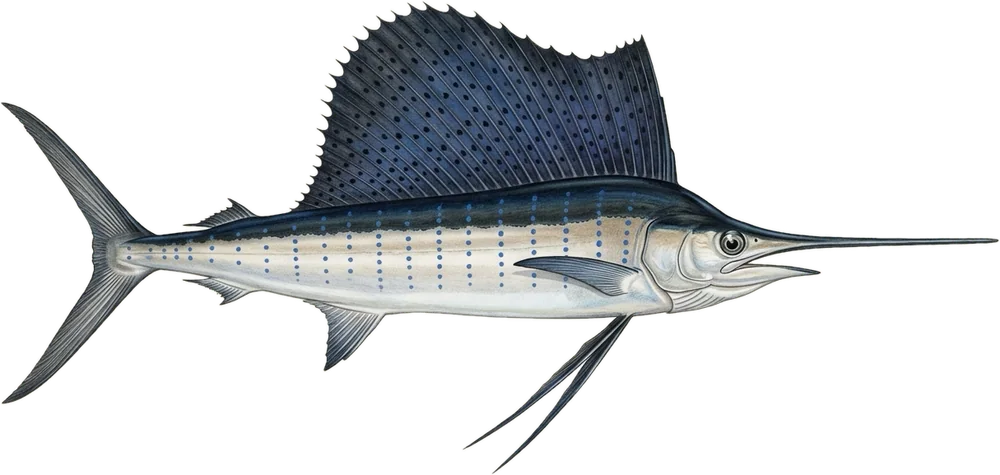
- Very tall, sail-like first dorsal fin, blue-black with many dark spots
- Long, slender bill with a round cross-section
- Very long, narrow pelvic fins and about 20 vertical rows of blue spots along the flanks
Catch chances through the year
- Hardly any chance
- Possible
- Good
- Peak season
- Spawning (observe the closed season)
Editorial assessment for the home area (north-western Australia (Broome, Dampier, Exmouth)), not a measured value and not a guarantee. The rules of the country you are visiting are binding.
How to recognise it
The sailfish is slim, elongated and laterally flattened. Its upper jaw extends into a very long, thin spear with a round cross-section. The first dorsal fin is unmistakable: very large, as tall as a sail, and it can be folded into a groove along the back. The pelvic fins are strikingly long and narrow.
The back is dark blue, the flanks brownish to bluish, the belly silver. About 20 vertical rows of light blue dots run across the sides. The skin of the sail is blue-black with many dark spots.
According to FishBase the sailfish reaches up to 348 centimetres fork length and well over 100 kilograms, and the highest known age is 13 years. Off Broome, according to an analysis of tagging data, almost nine out of ten released fish weighed between 11 and 25 kilograms.
Young marlins also carry a tall dorsal fin. According to the fisheries authority (Fischereibehörde) of North Carolina, however, only the sailfish keeps this sail for life, so it is mainly small marlins that can be confused with it. In the blue marlin the front part of the first dorsal fin is lower than the body is deep. The swordfish has a flat sword and no pelvic fins.
Side by side
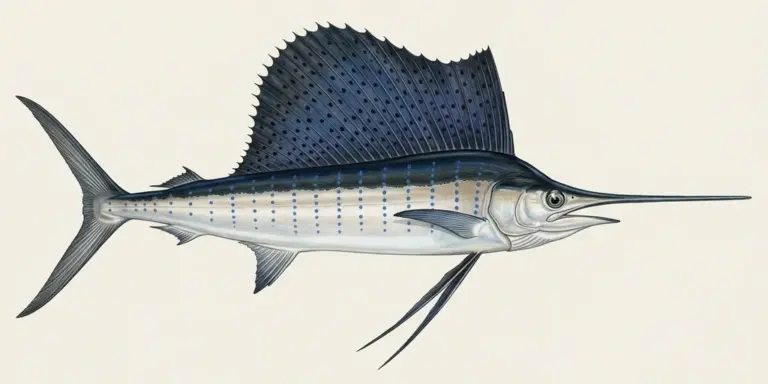
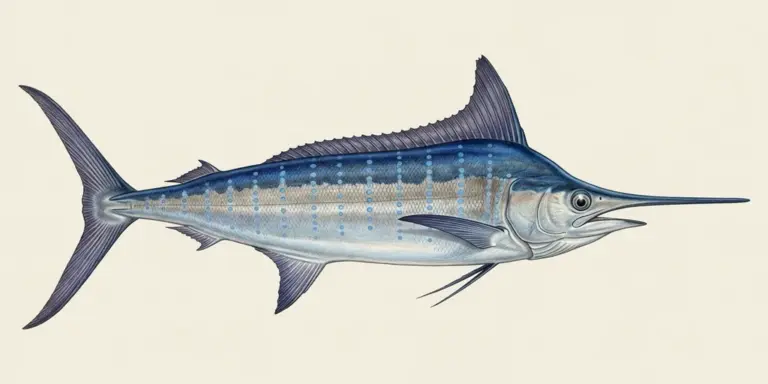
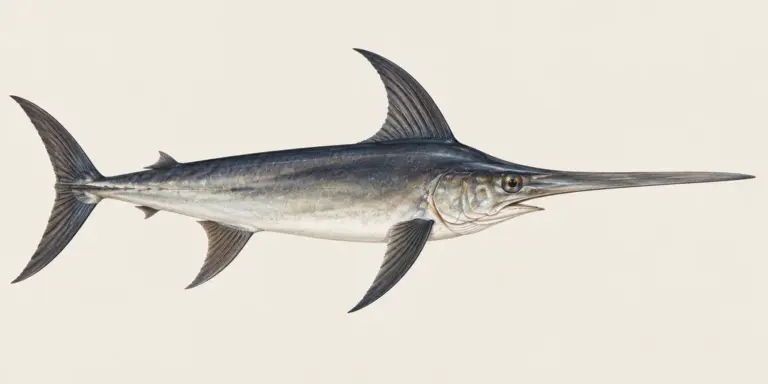
AI-generated illustrations.
Where it holds
The sailfish lives in the warm surface water of tropical and temperate seas, mostly above the thermocline, the boundary between warm surface water and cooler deep water. FishBase lists Istiophorus platypterus for the Indian Ocean and the Pacific. It reached the Mediterranean from the Red Sea via the Suez Canal.
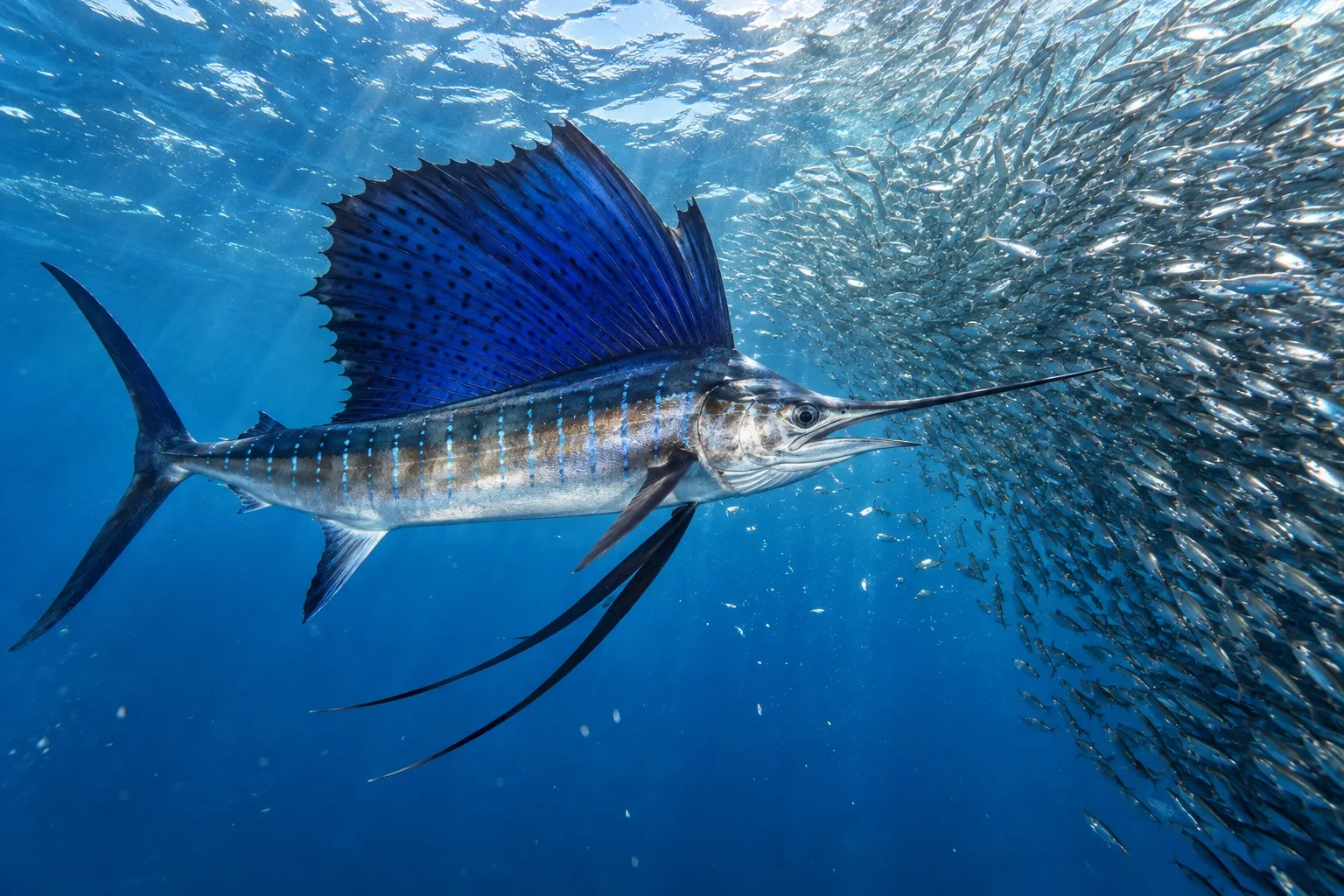
Unlike most marlins it often gathers in fairly shallow, nutrient-rich coastal water less than 150 metres deep and likes to stay close to coasts, islands and reefs. According to a study in the Journal of the Royal Society of Western Australia, known gathering areas lie on the Pacific coast of Central America, off Malaysia, in the Great Barrier Reef and off north-western Australia around Dampier and Broome.
Holding spots in the picture
Choose the time of day: the picture shows where the species holds. We do not show German seasons for travel fish; the bars give the chance of a catch for each month. Tap a fish or a spot in the list to bring it closer. The picture is schematic and AI-generated, and every water is different.
Chance of a catch per month according to the catch calendar
- J
- F
- M
- A
- M
- J
- J
- A
- S
- O
- N
- D
Spawning season
Not prime time Along the US Atlantic coast it hunts mainly in daylight.
Active time Along the US Atlantic coast it hunts mainly in daylight.
Not prime time Along the US Atlantic coast it hunts mainly in daylight.
Not prime time Along the US Atlantic coast it hunts mainly in daylight.
On the coast
Wreck, reef
Sailfish are present here all year round.
Open water, mid-water
Sailfish are present here all year round.
Just below the surface
Sailfish are present here all year round.
The sailfish hunts in warm surface water and herds shoals of sardines, anchovies and mackerel there. Unlike most marlins, it comes close to coasts, islands and reefs.
Depth: It stays in the warm water above the thermocline and often gathers over coastal water less than 150 metres deep.
Size comparison: AI-generated drawing, schematic.
How it hunts and spawns
Sailfish eat mainly fish, plus crustaceans and cephalopods, preferring schooling fish such as sardines, anchovies and mackerel. According to observations reported by the Australian Museum, they first follow a school with their fins half folded. When attacking they fold the fins in completely, spread them during a sharp turn, strike into the school with the spear and eat the stunned fish, usually head first. On the US Atlantic coast the fisheries authority (Fischereibehörde) of North Carolina describes groups that circle a school and corral it with their sails. Hunting there takes place mainly in daylight.
In the tropical Pacific the sailfish spawns almost all year round according to FishBase, most strongly in the respective summer. Males and females swim in pairs, or two to three males follow one female.
Sailfish probably form groups of animals of equal size. Off Broome and Dampier the average weight of the tagged fish increased over the course of the season. The authors of the study interpret this to mean that many fish stay in the area for several months.
When and where the season is
The season dates apply to north-western Australia. The main places for sailfish fishing are Broome, Dampier and Exmouth, plus the remote Rowley Shoals off Broome. According to the study, larger fish are caught at the Rowley Shoals and in Exmouth Gulf than off Broome and Dampier.
Off Broome, sailfish can be caught in most months. The charter data from 1996 to 2004 show a clear season from June to October, peaking from July to September, which is winter and spring in the southern hemisphere. In autumn, from March to May, only a few sailfish take the hook. Off south-eastern Florida it is different: there most sailfish are caught in winter and early spring, according to a study by US fisheries research on live-bait fishing.
How it is caught
Step by step: Sailfish fishing: tips on bait, rigs and tackle – season, marks, bait, tackle and rules on one page.
Sailfish are caught from a boat, usually by trolling with artificial or natural baits. In the Australian study a fish counts as sighted when it follows a bait or lure behind the boat. On the US Atlantic coast, according to the North Carolina fisheries authority (Fischereibehörde), lures and baitfish such as mullet, Spanish mackerel, bonito and halfbeak are trolled.
Because sailfish feed mainly on schooling fish and stay close to the coast, it pays to look where the forage fish are. Off Broome, according to charter logbooks, catches are concentrated in an area of only 30 to 40 square nautical miles.
Prepare for release: Off north-western Australia almost all sailfish are released. NOAA Fisheries advises, for all billfish, to leave the fish in the water, use circle hooks and keep the fight short with strong tackle.
Use tagging: Many fish are tagged before release. The weight, place and date noted down help researchers to track the season and the stock.
Suitable lures
Trolled lures and natural baitfish such as mullet or halfbeak.
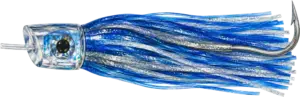
AI-generated illustrations. A click opens the lure’s page.
Off north-western Australia almost all sailfish are released; circle hooks make unhooking easier
Licence, rules and release
In Western Australia you need the Recreational Fishing from Boat Licence (RFBL) for any fishing from a powered boat. Licences from other Australian states are not valid there. If you fish on a licensed charter boat or with a licensed tour operator, you do not need your own RFBL. Marlin, sailfish and spearfish each have a daily bag limit, and undersized or protected fish must go straight back into the water, as unharmed as possible.
The current rules are in the Recreational Fishing Guide of the Western Australian fisheries ministry. The authorities on the spot are binding, that is the Department of Primary Industries and Regional Development (DPIRD). Marine protected areas usually have additional rules.
Release is the norm in the region: according to the study, off Broome, Dampier and Exmouth practically all sailfish are tagged and released or simply released. The International Union for Conservation of Nature (IUCN) lists the species as vulnerable.
Frequently asked questions (FAQ)
When is the best time for sailfish off Broome?
From June to October, peaking from July to September. Single fish turn up almost all year.
How do I tell a sailfish from a young marlin?
By the sail. Young marlin also have a tall dorsal fin, but only in the sailfish is it so large, blue-black with dark spots, and it stays for life.
Do I need a licence in Western Australia?
For fishing from your own or a hired powered boat, yes: the Recreational Fishing from Boat Licence. On a licensed charter boat you do not need your own licence.
Sources
The rating of catch chances is an editorial assessment. The facts come from these sources, and the text is worded in our own words. The illustration is an original design by Angel Momente in the style of a natural history plate (AI-generated, see the AI notice).
- FishBase: Istiophorus platypterus, Indo-Pacific sailfish
- Journal of the Royal Society of Western Australia: Pepperell, Kopf & Malseed 2011, Sailfish off northwestern Australia
- Australian Museum: Indo-Pacific Sailfish, Istiophorus platypterus
- Department of Primary Industries and Regional Development (WA): Recreational fishing guide 2026
- North Carolina Division of Marine Fisheries: Sailfish
- NOAA Fisheries: HMS Recreational Compliance Guide
- ICCAT: Manual: Blue Marlin
- Prince, Snodgrass, Orbesen u. a. 2007: Circle hooks, J hooks and drop-back time, a hook performance study of the south Florida recreational live-bait fishery for sailfish (Fisheries Management and Ecology 14)
Created with AI support from the sources listed. Figures only appear in the text if a source gives them. Last updated: 27 October 2026. Found a mistake? Write to us. Who is behind this site: About me.
More in the lexicon
- All fish species at a glance
- Catch calendar – month, water temperature and profile for 93 species
- Line calculator – breaking strain after the knot, drag guideline, backing
- Angling methods