
Knowledge – Fish
Redfish / Golden redfish: Features, depth, protection and fishing
The redfish or golden redfish (Sebastes norvegicus) is a golden-red deep-water fish of the North Atlantic. It grows very slowly, matures only after about a decade and can live to over 60. In Norway it is on the Red List, and fish brought up from the depths do not survive release.
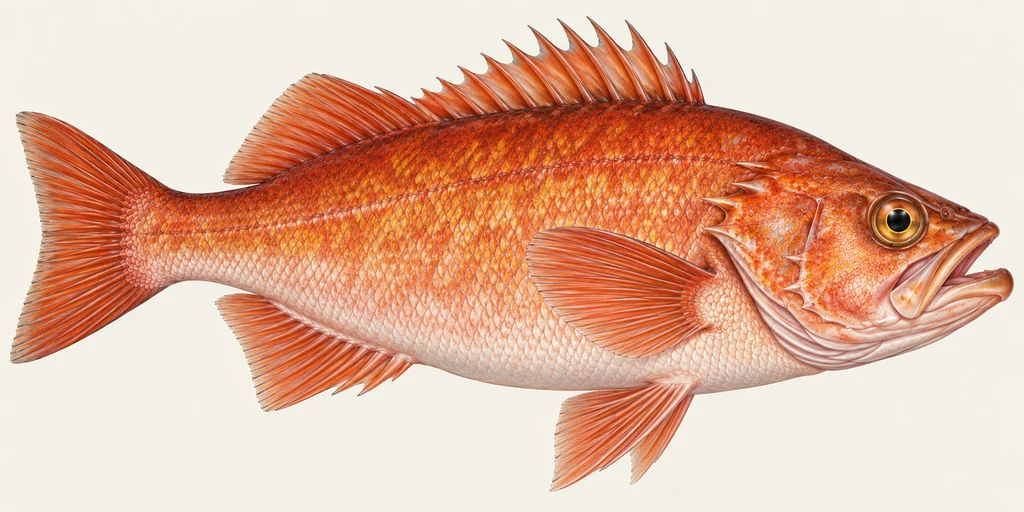
In short: You catch redfish best from June to August, especially in the evening and at night. Good spots on the coast: deep water. Proven baits: small fish strips on a paternoster at great depth. Deep-sea fish, grows very slowly. In Norway north of Stad (62° N) allowed only from 1 June to 31 August with the Jukse (as of October 2026) and listed on the Red List as endangered. Step by step: Fishing for redfish.
- Vivid golden-red to orange-red colouring with darker marbling on the back, belly pink
- Spiny front dorsal fin with very hard rays
- Strong spines on the gill cover and preopercle
Catch chances through the year
- Hardly any chance
- Possible
- Good
- Peak season
- Spawning (observe the closed season)
Editorial assessment for waters in Germany, not a measured value and no guarantee. Spawning time is not the same as the legal closed season.
Species profile and sources in the catch calendarAll species compared month by monthThe rules of your federal state
How to recognise it
The redfish is bright golden-red to orange-red, with some darker marbling on the back and light pink on the belly. The mouth cavity is light red too. In the water itself it looks dark grey, because red light does not reach the depths. Only at the surface does it show its colour.
The scales are large, hard and carry pointed spines on the rear edge, which is why the fish feels very rough. Strong spines sit on the gill covers, and there are very hard rays in the first dorsal fin. That makes it almost indigestible for predators, and for you it is a fish you only handle with a glove.
Usually about 45 centimetres according to FishBase. Up to one metre and 15 kilograms is possible, but according to the Norwegian encyclopedia Store norske leksikon, only a few fish grow longer than 60 centimetres. The maximum age is over 60 years.
In Norwegian waters, alongside the redfish, live the deepwater redfish (Sebastes mentella) and the small lesser redfish (Sebastes viviparus). The deepwater redfish stands deeper, according to FishBase mostly at 350 to 500 metres, and according to the marine research institute rarely grows longer than 47 centimetres. The two species look so alike that experts often have to check many body features or examine the genetic material.
A further form is the giant redfish, which reach 60 centimetres on average and grow up to 100 centimetres long. Their relationship to the two species is not settled. In the trade, every species of the genus Sebastes is sold as redfish. In the trade, golden redfish means Sebastes norvegicus.
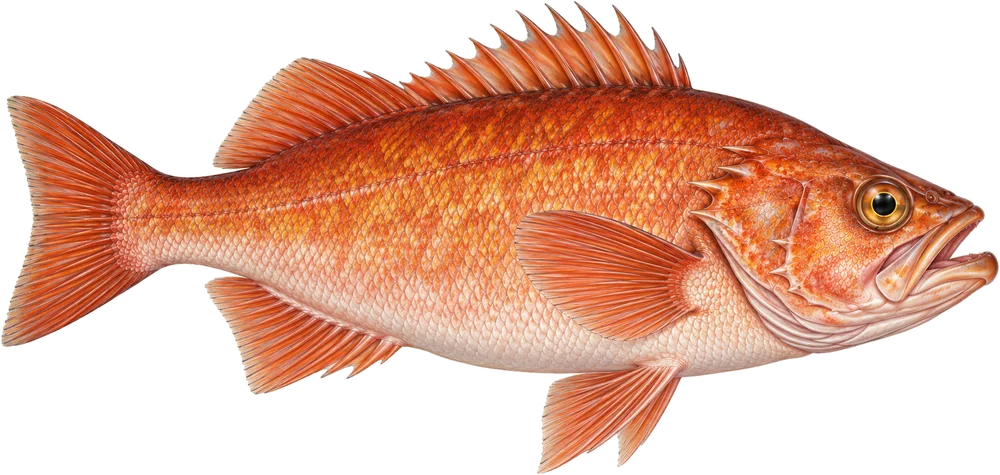
Side by side
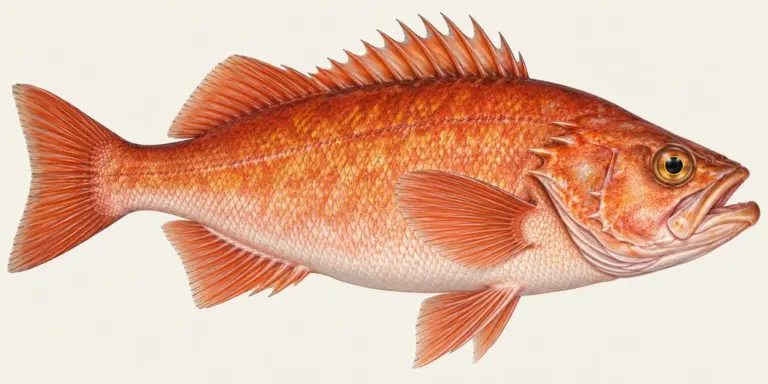

AI-generated illustrations.
Where it holds
The redfish lives on the continental slope, along the coast and in places also in fjords, at depths of 100 to 500 metres. According to FishBase it occurs down to 1000 metres and prefers 3 to 7 degrees. It is distributed from the North Sea to Spitsbergen. North of Bear Island it is, according to the marine research institute, only rarely present in catchable quantities.
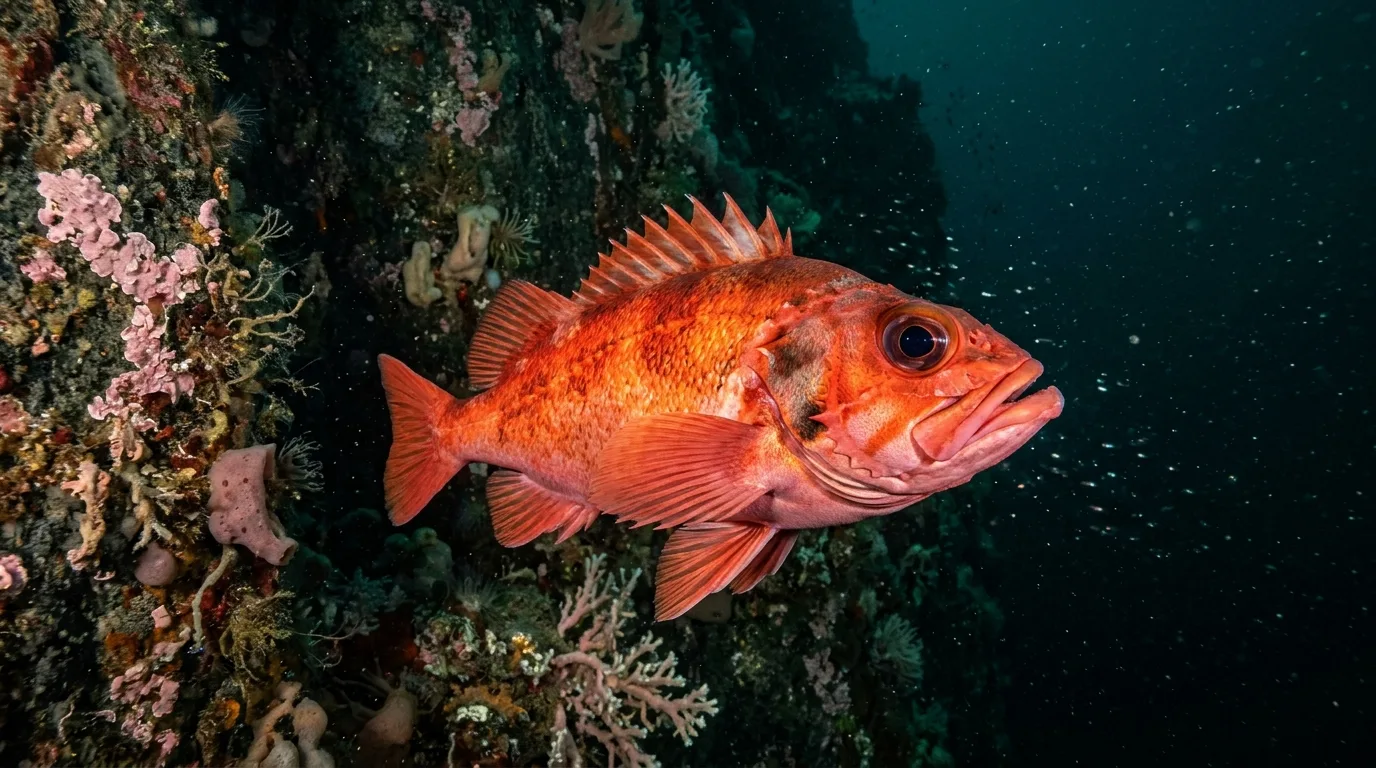
Young redfish stay closer to the coast in fjords and bays. The fish are sociable all their lives. The most important areas for giving birth lie on the shelf edge from the Shetland Islands northwards, especially off Vesterålen, Haltenbanken and Storegga.
Holding spots in the picture
Choose a season and time of day: the picture shows where the species sits then. Tap a fish or a spot in the list to bring it closer. The picture is schematic and AI-generated, every water is different.
Catch chances in springhardly anyspawning season, observe the closed seasons (Schonzeit)
Catch chances in summerpossible
Catch chance in autumnhardly any
Catch chance in winterhardly any
- J
- F
- M
- A
- M
- J
- J
- A
- S
- O
- N
- D
Spawning season
No main time By day the shoals stay near the seabed, at night they leave it; for redfish of the genus Sebastes in the north-west Atlantic it is described that they rise into open water to feed around sunset and return to the bottom at dawn.
No main time By day the shoals stay near the seabed, at night they leave it; for redfish of the genus Sebastes in the north-west Atlantic it is described that they rise into open water to feed around sunset and return to the bottom at dawn.
Active time By day the shoals stay near the seabed, at night they leave it; for redfish of the genus Sebastes in the north-west Atlantic it is described that they rise into open water to feed around sunset and return to the bottom at dawn.
Active time By day the shoals stay near the seabed, at night they leave it; for redfish of the genus Sebastes in the north-west Atlantic it is described that they rise into open water to feed around sunset and return to the bottom at dawn.
On the coast
Deep, colder water
Redfish are present here all year round.
The redfish stands in shoals near the bottom in deep water: on the shelf, along the coast and in places in the fjords. By day the shoals stay near the seabed. Juveniles live close to the coast in fjords and bays.
Spring: catch chance according to the catch calendar slim. The spawning season falls in this period, so observe closed seasons (Schonzeit). From April to June the females release their larvae. In spring they eat capelin, herring and krill.
Summer: catch chance according to the catch calendar possible. In summer the redfish feeds mainly on krill.
Autumn: catch chance according to the catch calendar slim. Mating takes place in autumn. Herring are now the main food.
Winter: catch chance according to the catch calendar slim. Herring are also the main food in winter.
Depth: The redfish lives near the bottom at 100 to 500 metres depth, occasionally down to 1000 metres. In fjords it is caught on terraces between 100 and 170 metres.
Size comparison: AI-generated drawing, schematic.
How it lives and reproduces
In its first years of life the redfish eats almost only animal plankton. Later it switches to krill, capelin, herring and cod-like fish. FishBase describes the annual cycle like this: in summer krill predominates, in autumn and winter herring, in spring there is capelin, herring, krill and comb jellies. As a young fish it is itself an important prey for cod-like fish and halibut.
It gives birth to live young. Females and males do not mature at the same time, so after mating in autumn the females store the sperm until the eggs are ripe. According to the Norwegian Institute of Marine Research, the 4 to 6 millimetre young appear in April and May. In spring almost only females gather in the birthing areas. According to FishBase, a female releases 50.000 to 350.000 larvae, comparatively few.
Growth is very slow. At two years a redfish measures 10 to 12 centimetres and then adds about 2 centimetres a year. Half of the fish are sexually mature at 11 to 12 years and 30 to 35 centimetres. That is why it takes many decades for a collapsed stock to recover.
When it bites
There is no bite time in the usual sense: the redfish stays in the deep all year round. Blinker gives May to September as the best time to travel to northern Norway. North of Stad (62° N), however, fishing is only permitted from 1 June to 31 August and only with the jukse, according to the Fiskeridirektoratet, so the catch calendar shows only these months.
More important than the month is the legal position: Norway lists the redfish among the species that are protected only at certain times. Check it before the trip.
Today’s catch index needs JavaScript. Season and spawning time are in the catch calendar.
You will find the monthly overview of all species and the water temperature check in the catch calendar.
What you catch it with
Step by step: Fishing for redfish: tips on bait, rig and tackle – season, spots, bait, tackle and rules on one page.
Redfish are caught with heavy natural-bait tackle from a boat in 100 to over 300 metres, often where ling and tusk also live. On the redfish paternoster (a rig with several side arms one above the other), whole baitfish or fish strips are offered. The natural bait rig shows the principle.
The tackle has to be up to the depth. Blinker names a boat rod of 30 to 50 lb, a sturdy multiplier reel with at least 500 metres of braid, hooks from 3/0 to 5/0 for redfish and weights of 500 to 1000 grams for this kind of fishing. More on the sea rod and on sea fishing.
On the way up, the strong swim bladder expands and pushes the soft organs out of place. According to Blinker, every fish cranked up to the surface from 50 to 200 metres is finished. A redfish from 100 to 300 metres therefore does not survive being released. Every redfish that is hooked is a fish taken. So do not target it deliberately if it is protected.
Few fish, use all of them: Because released deep-sea fish do not survive, every catch counts. Stop as soon as you have enough for the kitchen.
Handle with a glove: The spines on the gill cover and the rays of the dorsal fin are hard and sharp. Whether they carry venom is disputed, but a sting can hurt much like one from a weever. Grip the fish only with sturdy fishing gloves and hold it away from you.
Read the rules before the trip: The redfish is protected only at certain times in Norway, and the rules change. Ask beforehand whether fishing for it is allowed in your area.
Suitable lures
Small fish strips on a paternoster at great depth.
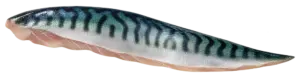
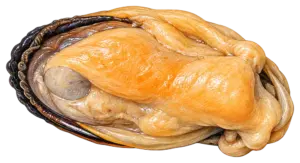
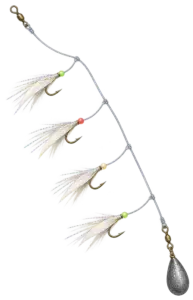
AI-generated illustrations. A click opens the lure’s page.
Rigs for these baits: natural bait rig for the sea.
Protected at certain times in Norway and classed as endangered. Fish brought up from the deep do not survive being released.
Redfish in the kitchen and why you take them in moderation
The redfish is a popular food fish. In the shops it is sold fresh, whole or as fillets, deep-frozen and hot-smoked. FishBase gives frying, grilling and baking as the usual ways to cook it. Because the scales are hard and the spines sharp, a filleting glove helps. The steps are shown in scaling and skinning fish and filleting fish.
Think beforehand about how many fish you need. A redfish that takes a decade to mature and does not survive being brought up is not a fish for stocking the freezer. Take only what you will use.
What you need to observe
Closed seasons, minimum sizes and harvest slots are set by the federal states (Bundesländer) and by the fisheries authorities of the neighbouring countries on the coast (Denmark, Norway, Poland). They vary by type of water, stretch of coast and time of year. We only give figures together with the date and source; the fisheries regulation of your federal state and your fishing permit (Erlaubnisschein) are always what is binding. You will find a list of links to the official sources in the catch calendar.
A fish of legal size that you want to keep you stun and kill at once, in line with animal welfare rules. Protected, undersized fish or fish too large under a harvest slot you unhook, if possible still in the water and with wet hands, and release gently. What exactly applies is regulated by state law and your fishing permit (Erlaubnisschein).
North of Stad (62° N), catching redfish in Norway is prohibited (as of October 2026). The only exception is fishing with the jukse from 1 June to 31 August, under the catch regulation for boats under 15 metres. A jukse is a vertically fished line with hooks, worked by hand or with a machine. The authority does not say explicitly whether a rod with a heavy natural-bait paternoster counts, so if in doubt, ask the Fiskeridirektoratet before the trip. The minimum size (Mindestmaß) is 30 cm outside and 32 cm inside 12 nautical miles. The Norwegian Institute of Marine Research recommended no catch quota for 2025 and 2026.
The Norwegian Red List of 2021 classes the redfish as endangered because of the decline in stock size. According to the assessment, the spawning stock has shrunk by about 60 per cent since the end of the 1980s, and the year classes of young fish have been weak since the 1990s. The International Union for Conservation of Nature (IUCN), by contrast, lists the golden redfish as of least concern worldwide and the deepwater redfish as endangered in Europe (Thünen-Institut).
What closed season, minimum size and harvest slot mean and where to find them is explained on the page Closed season and minimum size explained.
Frequently asked questions (FAQ)
What is the difference between redfish, Goldbarsch and deepwater redfish?
Goldbarsch is the trade name of Sebastes norvegicus; in the shops, redfish stands for all species of the genus. The deepwater redfish (Sebastes mentella) lives deeper and is smaller. The two are hard to tell apart by looks.
Why can I not release a redfish?
When hauled up from great depth, the swim bladder expands and pushes the soft organs out of place. The fish is so badly damaged that it dies even after being released.
How old does a redfish get?
More than 60 years. It only becomes sexually mature at 10 to 12 years, so a thinned-out stock needs decades to recover.
Sources
The rating of catch chances is an editorial assessment. The facts come from these sources, and the text is worded in our own words. The illustration is an original design by Angel Momente in the style of a natural history plate (AI-generated, see the AI notice).
- Wikipedia: Rotbarsch
- FishBase: Sebastes norvegicus
- Havforskningsinstituttet: Vanleg uer (Rotbarsch)
- Thünen-Institut, Fischbestände online: Rotbarsch (Biologie, Schwimmblase, IUCN-Status)
- Artsdatabanken: Norsk rødliste for arter 2021, Sebastes norvegicus (sterkt truet)
- Fiskeridirektoratet: Sea angling in Norway, regulations (geschonte Arten, Ausfuhrquote)
- Blinker: Barotrauma bei Fischen
- Blinker: Angeln in Norwegen (Zielfische, Tiefen, Reisezeit)
- Store norske leksikon: Uer (Vanlig uer, Rotbarsch)
- FishBase: Sebastes mentella
- Havforskningsinstituttet: Snabeluer (Tiefenrotbarsch)
- Fiskeridirektoratet: Meeresangeln in Norwegen, Regeln für ausländische Besucher
- Fiskeridirektoratet: Freda og delvis freda artar (Uer nördlich von Stad nur im Sommerfenster, Kveite)
- Fiskeridirektoratet: Minstemål i fritidsfiske (kein Mindestmaß für Sei und Lyr, Lange nicht aufgeführt)
- Norsk Helseinformatikk (NHI): Stikk av fjesing (auch Rotbarsch als möglicher Auslöser, umstritten)
- Blinker: Norwegen, Angeln im Fjord (Saison, Naturköderangeln)
- Grinyó et al. 2023, Frontiers in Marine Science: Occurrence and behavioral rhythms of the endangered Acadian redfish (Sebastes fasciatus) in the Sambro Bank (Scotian Shelf)
Created with AI support from the sources listed. Figures only appear in the text if a source gives them. Last updated: 27 October 2026. Found a mistake? Write to us. Who is behind this site: About me.
More in the lexicon
- All fish species at a glance
- Catch calendar – month, water temperature and profile for 93 species
- Line calculator – breaking strain after the knot, drag guideline, backing
- Angling methods