
Knowledge – Fish
Gilthead sea bream (dorade): Features, habitat, baits
The gilthead sea bream (Sparus aurata), usually sold as dorade, is a sea bream of the Mediterranean and the eastern Atlantic. Its centre lies in the Mediterranean and from the Bay of Biscay southwards; it turns up in the North Sea only rarely. With strong grinding teeth it cracks mussels and crustaceans.
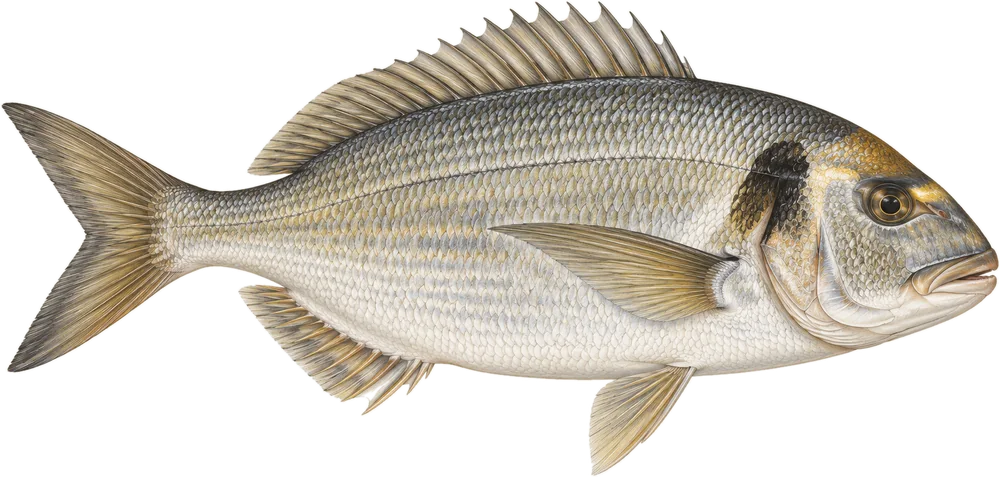
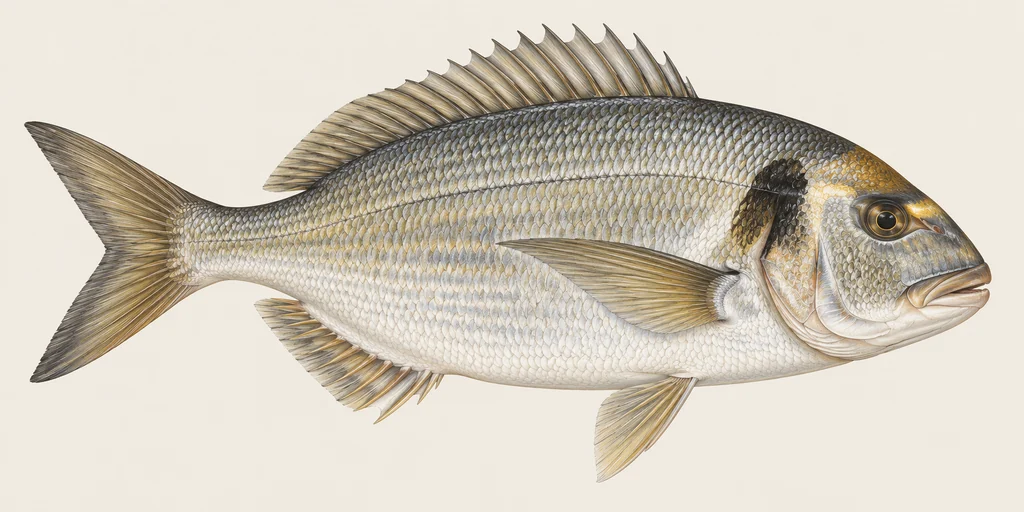
In short: Main range in the Mediterranean and the Atlantic from the Bay of Biscay southwards; only a rare visitor to the North Sea, hence no season in the calendar. Black spot on the gill cover and a golden band between the eyes. Step by step: Fishing for gilthead sea bream.
- Golden band on the forehead between the eyes
- Black spot at the upper end of the gill cover
- Deep body, flattened from the sides, with a deeply forked tail fin
Catch chances through the year
- Hardly any chance
- Possible
- Good
- Peak season
- Spawning (observe the closed season)
Editorial assessment for waters in Germany, not a measured value and no guarantee. Spawning time is not the same as the legal closed season.
Species profile and sources in the catch calendarAll species compared month by monthThe rules of your federal state
How to recognise it
The gilthead sea bream is deep-bodied, flattened from the sides and powerfully built. The back is grey, the flanks and belly silvery. A golden band runs between the eyes, which gives the species its name. At the upper end of the gill cover sits a black spot, together with a red spot and a red edge.
The dorsal fin has 11 hard rays and 13 to 14 soft rays, the anal fin 3 hard rays. In the mouth there are conical teeth at the front and several rows of round grinding teeth behind them. With these it breaks shells and carapaces.
According to FishBase the common length is around 35 centimetres. The largest known gilthead sea bream measured 70 centimetres, and the highest published weight is 17,2 kilograms. The highest known age is 14 years.
Side by side: gilthead sea bream, white seabream or saddled seabream?
| Feature | Gilthead sea bream | White seabream | Saddled seabream |
|---|---|---|---|
| Forehead | golden crossband between the eyes | forehead and snout darker, no golden band | no golden band, conspicuously large eye |
| Spot at the front | large dark spot at the start of the lateral line, reaching onto the gill cover | black spot at the top of the pectoral fin base | none |
| Flanks | silvery grey, without crossbands | nine crossbands, alternately dark and lighter | silvery grey with fine dark longitudinal lines |
| Tail base | without a saddle spot | dark saddle directly behind the dorsal fin | large black saddle spot with a white edge |
Many similar sea breams live in the Mediterranean, such as white seabreams, saddled seabreams and sargos. You can identify the gilthead sea bream reliably by the combination of a golden forehead band and a black spot on the gill cover.
Where it lives
The gilthead sea bream lives mainly in the Mediterranean and the eastern Atlantic from the Bay of Biscay to West Africa, and around the Canary Islands. FishBase gives the British Isles as the northern edge of its range.
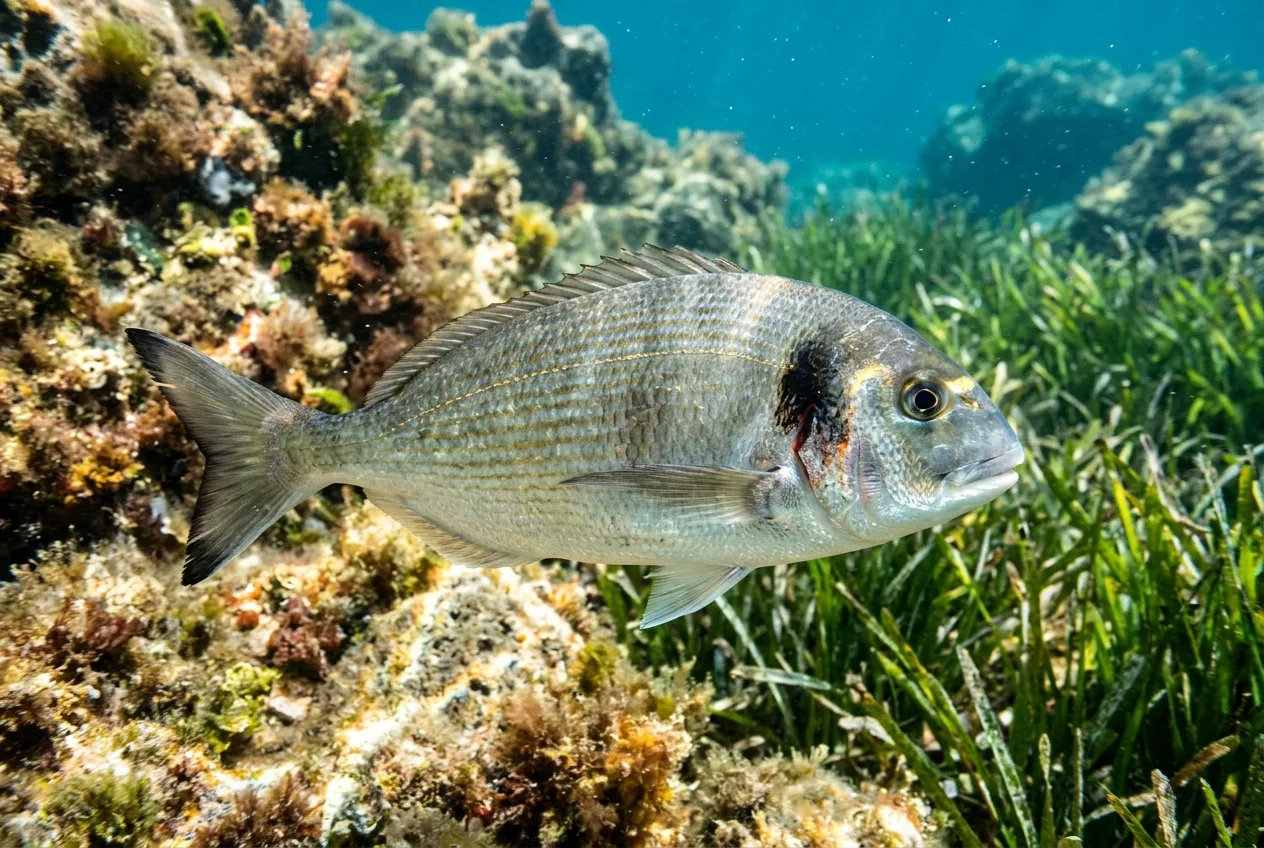
In the North Sea it is a rare visitor. Off the Belgian coast it was first recorded in 1990, probably having entered via the English Channel.
It stays over seagrass meadows and sandy ground and in the surf zone, mostly down to about 30 metres. Adult fish go down to 150 metres. In spring it often moves into brackish lagoons and river mouths. In summer it stays mainly close to the shore, in winter in deeper water.
Holding spots in the picture
Choose the season and time of day: the picture shows where the species stands then. Spots outlined in red apply only in the chosen season. Tap a fish or a spot in the list to bring it closer. The picture is schematic and AI-generated, every water is different.
No main time On the Mediterranean, dusk and night offer the best chances, because fewer small fish pluck at the bait then.
No main time On the Mediterranean, dusk and night offer the best chances, because fewer small fish pluck at the bait then.
Active time On the Mediterranean, dusk and night offer the best chances, because fewer small fish pluck at the bait then.
Active time On the Mediterranean, dusk and night offer the best chances, because fewer small fish pluck at the bait then.
On the coast
Surf close to the shore
Gilthead sea bream (dorade) sits here all year.
Seagrass, gravel and stones in the shallows
Gilthead sea bream (dorade) sits here all year.
Sandy bottom
Gilthead sea bream (dorade) sits here all year.
Deep, colder water
Gilthead sea bream (dorade) sits here only in winter.
The gilthead sea bream sits over seagrass and sandy bottom and in the surf zone. It lives alone or in small groups and stays loyal to its spot. In the North Sea it is only a rare visitor.
Spring: Many fish migrate into brackish lagoons and river mouths in spring.
Summer: In summer it stays mainly close to the coast.
Autumn: This is when spawning falls, so observe the closed seasons.
Winter: In winter it retreats into deeper water.
Depth: It mostly stays down to about 30 metres, and fully grown fish go down to 150 metres.
Size comparison: AI-generated drawing, schematic.
How it feeds and spawns
The gilthead sea bream stays in one place and lives alone or in small groups. It feeds mainly on animal food, above all mussels, including oysters, as well as snails and crustaceans. Mussel farmers regard it as a pest.
A peculiarity is the change of sex. The fish first mature as males, in their first or second year. After the second or third year they become females.
According to FishBase spawning takes place mostly from October to December, in several batches. At 16 to 17 degrees the larvae hatch after about two days.
When and where it bites
For the North Sea and Baltic there is no season, so the calendar shows zero throughout. The gilthead sea bream is fished for deliberately in the Mediterranean and on the Atlantic coast further south.
There, dusk and night are the best time. Then the restlessness caused by small fish that pick at the baits during the day eases off.
You will find the monthly overview of all species and the water temperature check in the catch calendar.
What to catch it with
Step by step: Fishing for gilthead sea bream: tips on bait, rig and tackle – season, spots, baits, tackle and rules on one page.
You can catch the gilthead sea bream from the shore with simple bottom rigs, for example a light surf rig with a size 6 hook. A rod with a fine tip shows the often cautious bites, and a feeder or picker rod from freshwater fishing also works.
Worms and tough strips of squid serve as bait. Blinker also recommends peanut worms, whose firm skin withstands small fish. You secure soft baits on the hook with elastic bait thread.
Good places are harbours and the vicinity of river mouths. A quiet bathing beach can also produce a gilthead sea bream after dark.
Start in the evening: During the day small breams strip the hook. Put the rig out at dusk and fish into the night.
Choose robust baits: Strips of squid or peanut worms stay on the hook longer than soft worms.
Suitable lures
Worms, peanut worms and squid strips on a light bottom rig.
AI-generated illustrations. A click opens the lure’s page.
Rigs for these lures: surf rig.
Caught mainly in the Mediterranean and the Bay of Biscay, very rarely in the North Sea.
How to prepare a gilthead sea bream from your holiday
Many people know the gilthead sea bream from the menu, as it is a sought-after food fish and one of the most important farmed saltwater fish. Traditionally it goes over the counter whole and fresh. It is eaten steamed, boiled, fried, grilled or from the oven. You can season one bream per person and cook it whole on a baking tray, and covered it does not dry out. On the grill a fish tong holds the whole fish together when turning. How to prepare it beforehand is shown in Gutting a fish and Scaling a fish.
At a warm holiday destination the catch belongs in a cool box and then straight into the fridge; more under Storage and hygiene. Like any sea fish, the gilthead sea bream can also carry roundworm larvae; heat and freezing kill them, and thoroughly cooked it is harmless in this respect.
What you need to observe
For catches in German coastal waters: closed seasons (Schonzeit), minimum sizes (Mindestmaße) and harvest slots are set by the federal states (Bundesländer) and by the fisheries authorities of the neighbouring coastal countries (Denmark, Norway, Poland). They vary with the type of water, the stretch of coast and the time of year. We give figures only with a date and source; the fishing regulation of your federal state and your fishing permit (Erlaubnisschein) are always the binding ones. You will find a list of links to the official sources in the Catch calendar.
A fish of legal size that you want to keep you stun and kill at once, in line with animal welfare rules. Protected, undersized fish or fish too large under a harvest slot you unhook, if possible still in the water and with wet hands, and release gently. What exactly applies is regulated by state law and your fishing permit (Erlaubnisschein).
Anyone fishing in the Mediterranean or the Bay of Biscay should first ask the country’s fisheries authority (Fischereibehörde) which minimum sizes apply and whether a permit is needed. The IUCN classes the gilthead sea bream as not threatened worldwide (Least Concern).
What closed season, minimum size and harvest slot mean and where to find them is explained on the page Closed season and minimum size explained.
Frequently asked questions (FAQ)
Is there gilthead sea bream in the North Sea?
Only as a rare visitor. Its centre lies in the Mediterranean and in the Atlantic from the Bay of Biscay southwards.
How do I recognise a dorade?
By the golden band between the eyes and the black spot at the upper edge of the gill cover.
When do dorade bite best?
In the Mediterranean mainly at dusk and at night. Then there are fewer small fish on the bait.
Sources
The rating of catch chances is an editorial assessment. The facts come from these sources, and the text is worded in our own words. The illustration is an original design by Angel Momente in the style of a natural history plate (AI-generated, see the AI notice).
- FishBase: Sparus aurata, Gilthead seabream (Größe, Alter, Lebensraum, Fortpflanzung)
- VLIZ, De Strandvlo 10(3), Eneman 1990: Goudbrasem an der belgischen Küste gefangen (PDF)
- Wikipedia: Goldbrasse
- Blinker: Angeln in Kroatien, von Dorade bis Thunfisch (Uferangeln auf Doraden, Köder, Zeiten)
- Blinker: Angeln am Mittelmeer, 10 Tipps für Urlaubsfänge vom Ufer
- Naturalis, Fishes of the NE Atlantic and Mediterranean: Sparus aurata (Goldbrasse)
- Naturalis, Fishes of the NE Atlantic and Mediterranean: Diplodus sargus (Geißbrasse)
- Naturalis, Fishes of the NE Atlantic and Mediterranean: Oblada melanura (Sattelbrasse)
- FishBase: Diplodus sargus (Geißbrasse, zur Unterscheidung)
- FAO: Marketing of aquacultured seabass and seabream from the Mediterranean basin (PDF)
- Bundeszentrum für Ernährung (BZfE): Fisch und Meeresfrüchte, vom Einkauf in die Küche
- Bundesinstitut für Risikobewertung (BfR): Korrektes Kühlen von Lebensmitteln im Privathaushalt (Fragen und Antworten)
- Bundeszentrum für Ernährung (BZfE): Fisch und Meeresfrüchte, Gesundheit und Umwelt
- LAVES Niedersachsen: Parasiten in Fischen und Fischereierzeugnissen – ein Problem?
Created with AI support from the sources listed. Figures only appear in the text if a source gives them. Last updated: 27 October 2026. Found a mistake? Write to us. Who is behind this site: About me.
More in the lexicon
- All fish species at a glance
- Catch calendar – month, water temperature and profile for 93 species
- Line calculator – breaking strain after the knot, drag guideline, backing
- Angling methods