
Knowledge · Tackle
Treble or single hook: Converting lures
A single hook instead of a treble on a crankbait, spinner or spoon can be removed faster and collects less weed. Whether this means more released fish survive is less clearly proven in studies. To make sure the lure still catches afterwards, hook size, position on the lure and a swim test are what count.
What the swap achieves and what studies show
Crankbaits, poppers, jerkbaits and stickbaits, hard baits for short, almost always come out of the packet with two trebles. A treble is three hook bends on one shared shank. Six points grip quickly, but also catch the outside of the fish, on the gills, head or eye, and tangle in the landing net and weed. A single hook, by contrast, usually sits cleanly in the corner of the mouth and is easy to remove, as Blinker describes.
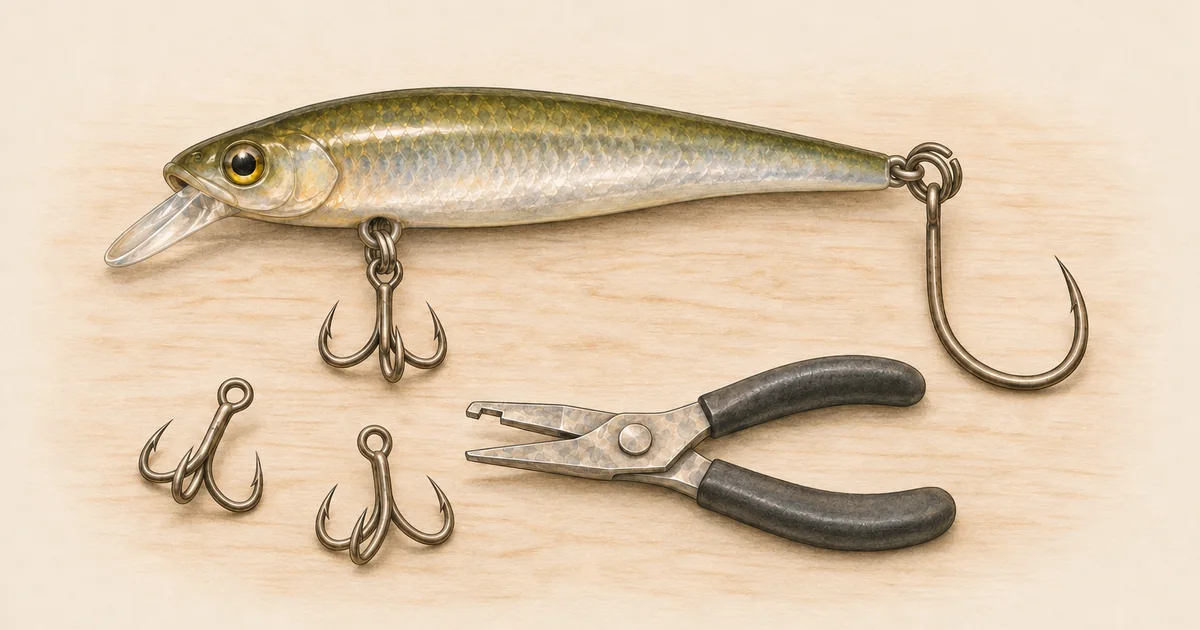
Researchers at Carleton University in Canada measured how much difference this makes on 569 fish: 220 pike, 103 smallmouth bass and 246 largemouth bass, caught in 2019 and 2020 on crankbaits, jerkbaits and lipless crankbaits. The lures carried either trebles or inline single hooks in turn, each with and without barbs. For all three species, unhooking took longest with barbed trebles and was quickest with barbless single hooks. How many points were stuck in the fish, on the other hand, did not differ clearly. Single hooks were also less often set deep. According to the authors, the biggest gain came from switching to a single hook; doing without the barb as well added hardly anything. Whether more fish survive as a result they leave open, because the fish were only observed until release.
A study on wild brown trout, rainbow trout and brook trout, published in 2004 in the North American Journal of Fisheries Management, comes to a more sober conclusion. The fish were caught on size 1 spinners fitted with trebles or single hooks, with and without barbs. In the first 48 hours after capture, fewer than 4 per cent of the trout died. For rainbow and brown trout, the hook type made no reliable difference either to mortality or to serious eye injuries; the researchers found such injuries in about one trout in ten. Trebles hooked and held more fish. Barbless single hooks were the quickest to remove, but that was not enough to lower mortality. The authors therefore see no biological advantage of single or barbless hooks when releasing wild brown trout.
Older studies cited by the Canadian researchers found that single hooks sometimes caused larger wounds and heavier bleeding than trebles, which were also said to be harder to swallow. A 2016 review considers fewer hooks, or single instead of treble hooks of a suitable size, effective against injuries and long unhooking times, as are hooks without barbs. That barbless hooks lower mortality, however, is hardly proven. More studies on this are covered under Fish-friendly tackle.
All in all, the single hook mainly saves time when unhooking. It is no guarantee of survival. It matters most where many fish have to go back. Rute & Rolle recommends the switch above all on trout waters with natural reproduction, where undersized fish keep taking the lure.
Which lure to convert and how
There is no one recipe for every lure. The table sorts out the common artificial lures.
| If you fish … | then switch to … | What to watch for |
|---|---|---|
| Crankbait, jerkbait, popper with two trebles | treble at the front, single hook at the back | on the belly a single hook grips less well |
| the same lures, almost all fish go back | single hooks on both eyes | expect a few more missed bites |
| Spinner | one single hook | usually still runs with the new hook size |
| Spoons, coastal spoons | one single hook | fewer snags on stones and weed |
| Soft plastic shad on a jig head | already carries a single hook | stinger only if you get missed bites |
| Water with a single-hook rule | whatever the rules specify | read the barb rule as well |
Why mixed: on the belly eye, a single hook can twist away on the bite and grips less well there than a treble. At the tail that does not happen, and big fish in particular are then often hooked on the rear single hook. If you only swap one treble, take the rear one first.
Required or voluntary: whether trebles, barbs or several hooks on a lure are allowed is governed by state law and the water rules (Gewässerordnung). Two examples in their exact wording: the 2024 water rules of the Landesverband Sächsischer Angler allow on each lure in its salmonid waters only “a single-shank, barbless single hook” („einen einschenkligen, widerhakenlosen Einzelhaken“); even barbs that have been pressed down are permitted there (point 4.2.2). The Fischereiordnung des Landes Brandenburg, in § 4 paragraph 1 (version retrieved in November 2026), prohibits using “artificial lures with fixed multiple hooks” („künstliche Köder mit feststehenden Mehrfachhaken“) when fishing. What “fixed” means here, the wording leaves open; the fisheries authority (Fischereibehörde) can advise. As exam material, the Bavarian exam questions rate artificial lures with single hooks as gentler on the fish than those with trebles. What applies on your water is stated in your fishing permit (Erlaubnisschein).
How big the single hook needs to be
The single hook must be bigger than the treble it replaces. As a rule of thumb, Blinker gives roughly twice the size of the treble. A reference point from the Canadian study: hard baits averaging 6,5 to 10 centimetres long carried inline single hooks in size 1/0 or 2/0 there, the smaller lures the smaller hooks. How hook numbers count is explained on the Fishing hooks page.
Inline single hooks are single hooks with the eye turned through 90 degrees, made for artificial lures. For freshwater, according to Blinker, thin wire is enough, because it penetrates the hard mouth of predatory fish more easily. At sea and with very hard-fighting fish, sturdy hooks and stronger split rings belong on the lure. The hook must not be too small: if the lure body covers the point, the lure slips out of the mouth on the bite without taking hold. On top of that, small hooks are more likely to be taken deep.
Converting step by step
- Check the rules. Read the water rules and your fishing permit: are trebles, barbs or a number of hooks specified?
- Record the factory set-up. Photograph the lure with its factory hooks or note down the sizes. Weigh the lure on precision scales now and after the conversion.
- Choose the single hooks. One inline single hook of a suitable size per eye; on lures with two eyes, swap the rear one first.
- Remove the treble. Open the split ring with the split-ring pliers and turn the hook eye all the way round and out. If the ring is bent, fit a new one, because a split ring that has been prised open costs fish.
- Fit the single hook. Turn its eye into the ring the same way. The bend must stand clear beside the lure body, and the point must not be covered.
- Press down the barb if the water rules require it or if you release almost all your fish (next section).
- Do a swim test. Run the lure a few metres through clear, shallow water and compare it with before. It should run straight and not veer off to the side; a suspending crankbait should hold its depth during the pause. Crankbaits, jerkbaits and swimbaits are balanced with their factory hooks, and even a few grams‘ difference can spoil the action. Spinners and spoons are more forgiving.
- Clear away old trebles. Whatever you no longer need goes into a tin and then in the bin, as described under Disposing of fishing line and hooks.
If the lure swims worse after the conversion, try the mixed set-up; it stays closer to the factory state. The rings themselves are covered on the page Swivels, snaps and split rings.
Crushing the barb
The barb is the small spike behind the point that faces against the direction of penetration. You crush it with flat-nose pliers: take the point between the jaws and squeeze until the spike lies against the wire. In the Canadian study the barbs were crushed with pliers in exactly this way, not removed completely.
Without a barb, the hook needs tension from the line throughout the fight. If you let the line go slack for a moment, it can slip out. In the trout study, barbed hooks hooked and held more fish than barbless ones. Unhooking, especially in a pike’s mouth, is easier with disgorger pliers.
Stinger on a soft plastic
A soft plastic on a jig head already carries a single hook. Often a stinger is added: an extra treble on a short piece of hooklength that sits in the rear part of the lure. It is meant to hook fish that only grab the lure by the tail, which according to Blinker is typical of cautiously biting zander. How it is fitted is explained under Jig head rig.
With a stinger, the lure with a single hook becomes one with a treble again. Whether this injures fish more has not been specifically examined in the studies evaluated here. Blinker advises fitting one only if you cannot convert bites, because every additional hook also means more snags. According to the same magazine, a soft plastic overloaded with hooks is more likely to foul-hook bream and other coarse fish from the shoal by accident. Keep disgorger pliers in your hand for unhooking, otherwise the free treble can end up in your finger when a fish shakes. If one does get stuck in your skin, Hook injury and first aid will help. How many hooks a lure may carry is set by state law and the water rules.
Common mistakes
- Single hook only on the belly. There it easily turns away when a fish bites. If only one single hook goes on the lure, put it at the tail.
- Hook too small. The point disappears behind the body of the lure and bites do not result in a hooked fish.
- Fishing without a swim test. A plug that runs crooked after the conversion or sinks during pauses gets fewer bites.
- Slack line without a barb. If you crush the barb, you have to keep tension throughout the fight.
- Stinger from old parts. A treble from a worn-out lure is a poor choice as an extra hook. A new, sharp treble belongs there.
Frequently asked questions
Will I catch fewer fish with single hooks?
Slightly fewer is possible. In the trout study with spinners, trebles hooked and held more fish. An author from Rute & Rolle says that for years he has fished single hooks on trout lures and catches just as well with them as with trebles. He admits that you will still miss the odd fish.
Do I also need to crush the barb?
It is only required where the water rules or state law demand it. In the Canadian study, the single hook alone already brought most of the advantage when unhooking. On the other hand, barbed hooks held more fish in the trout study.
Is it worth converting if I keep fish?
Yes, because even then undersized or protected fish bite and go back into the water. For them, what counts is that unhooking is quick. Minimum sizes and closed seasons are explained in Closed season and minimum size.
Can I hang any single hook on the split ring?
For lures there are special inline single hooks with the eye turned by 90 degrees. They are seen more and more often on lures, and hooks like these were also fitted to the lures in the Canadian study. Size matters most: clearly larger than the treble it replaces.
Related
- Split-ring pliers: opening rings and changing hooks in a few moves
- Fishing hook: hook shapes, size numbers and barbless hooks
- Fish-friendly tackle: studies on barbs, circle hooks and trebles
- Circle hook: the hook that takes hold in the corner of the mouth with natural bait
- Pike lures: which lure when, with hook sizes for pike
- Jig head rig: mounting a soft plastic and fitting a stinger
- Disgorger pliers and artery clamp: removing hooks safely from deep in the mouth
- Line calculator: working out the strength of line and knot
Sources
- Carleton University: Testing potential mitigation strategies for injuries in angled fish (Masterarbeit 2021, Kapitel 2, PDF) (569 Fische, Lösezeit nach Haken- und Widerhakenart, Größe der Einzelhaken, ältere Befunde zu Wunden)
- DuBois und Dubielzig: Effect of hook type on mortality, trauma, and capture efficiency of wild stream trout caught by angling with spinners (North American Journal of Fisheries Management 2004) (Sterblichkeit, Augenverletzungen, Hakquote, Lösezeit bei Forellen)
- Brownscombe und Kollegen: Best practices for catch-and-release recreational fisheries, angling tools and tactics (Fisheries Research 2016, PDF) (weniger Haken, Widerhaken, Sterblichkeit, kleine Haken tiefer)
- Landesverband Sächsischer Angler: Gewässerordnung Ausgabe 2024 (PDF) (Punkt 4.2.2, Einzelhaken in Salmonidengewässern)
- Land Brandenburg: Fischereiordnung des Landes Brandenburg (§ 4, Mehrfachhaken an künstlichen Ködern)
- Bayerische Landesanstalt für Landwirtschaft: Prüfungsfragen zur Fischerprüfung 2023/2024 (PDF) (Frage 4.188, Einzelhaken an Kunstködern)
- Blinker: Das kleine 1×1 der Haken-Wahl (2024) (Bestückung ab Werk, Fehlhaken, Einzelhaken an Bauch und Heck, Größenregel, Drahtstärke)
- Blinker: Drillinge am Kunstköder (2025) (Lauf nach dem Hakenwechsel, verdeckte Spitzen) und Blinker: Angeln mit Schonhaken (2022) (Fehlbisse, Kraut, Spannung im Drill)
- Blinker: Tuning-Tipps für Küstenköder (2016) (aufgebogene Sprengringe, Einzelhaken gegen Hänger) und Blinker: Das Fischwohl geht vor (2026) (Köder mit mehreren Drillingen, Umrüsten)
- Blinker: Angeln mit Stinger (2018) (Stinger, Lösezange, keine Altteile) und Blinker: Zeit für Zetti (2025) (Stinger nur bei Fehlbissen, mehr Hänger)
- Rute & Rolle: Köder auf Einzelhaken umrüsten (2024) (Erfahrung mit Einzelhaken an Forellenködern, Gewässer mit Jungfischen)
Text AI-assisted, drawing AI-generated. Sources opened and checked in November 2026; no graphics taken from the sources.
All information is a guide only, without guarantee. The study figures come from trials with particular species and lures and cannot be applied to every fish; which hooks are allowed on your lure is set by state law, the water rules and your fishing permit.