
Knowledge · Tackle
Pike baits: Which lure when for pike
A pike lure has to work where the pike is standing: over the weed, on the edge or in open water. This page sorts soft plastics (shads), jerkbaits, spoons, spinners, swimbaits and the dead bait by season, weed and depth, and leads to the lure pages.
Lure groups and sizes as a rough guide
The species profile in Blinker today counts jerkbaits, swimbaits and streamers among the strongest pike lures, alongside the classics spoons, crankbaits and spinners, as well as large soft baits and spinnerbaits. There are no fixed sizes, the table collects rough guides. They come from Blinker, only the soft plastic from the Bavarian exam questions and the jerkbait from Rute & Rolle. Which rod casts large lures is covered under Pike rod.
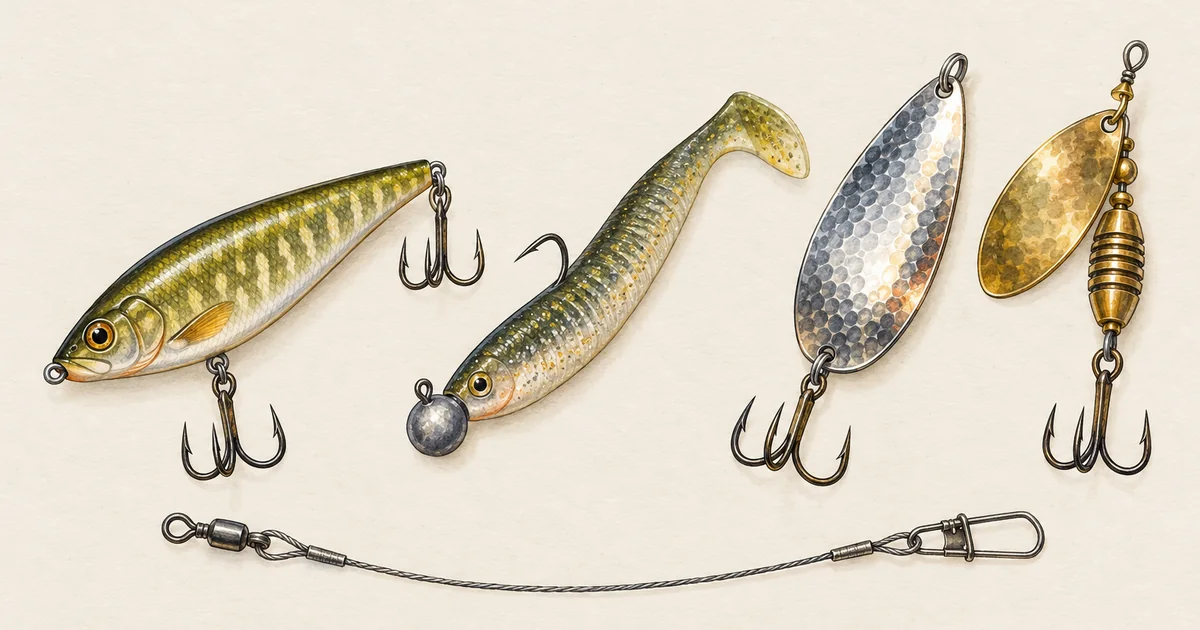
| Baits and lures | Size as a rough guide | Typical spot |
|---|---|---|
| Soft plastic (shad) | 15 to 20 cm in autumn (Bavarian exam questions) | edge, close to the bottom |
| Jerkbait | classic models often over 80 g | over the weed, along plants |
| Swimbait | mostly 10 to 20 cm | clear water |
| Spinner | size 3 to 5 and larger | shallow, over sparse weed |
| Spoon | in one article 9,5 cm | long casts, any depth |
| dead bait | about the length of a hand | bottom or float |
| Big lure | 20 to 40 cm for specimen pike | open water, winter |
In weed and shallow water
Weed beds are pike territory, but every exposed hook collects plants there. Most weed grows down to about 2,5 m deep, deeper in clear water. It is recommended to fish a bed from the outside in: first the sparse edges, where pike can see their prey better, then the middle.
- Jerkbait over the weed. If one to two metres stay clear between plants and surface, you work a floating or suspending jerkbait slowly across.
- Spinnerbait. An angled wire shaft carries the blade and shields the single hook, so it catches clearly less weed. More under Spinnerbait.
- Soft plastic (shad) on an offset hook. The hook point sits in the bait, so it can go right into the weed. Slim baits with a round cross-section hook better than deep-bodied ones.
- Surface. A floating stickbait can be drawn across the bed in slow motion. A soft frog carries its double hook so close to the body that hardly any weed catches on it.
With the offset hook you wait one to two seconds before striking, until the pike has turned away with the bait. Then the hook slides into the corner of the mouth.
On the edge and in open water
The weed edge is the drop from the shallow bank into deeper water. When pike move to the first edges in spring, Rute & Rolle names crankbaits with a running depth of one to two metres and lightly weighted soft plastics (shads). In autumn edges are worked with soft plastics (shads) on a lead head, without an extra treble, because the single hook collects less greenery. Distant edges are reached by the spoon, which flies hardly slowed by the wind and lands more quietly than a soft plastic.
In large, deep lakes most big pike stand in open water from June, usually 2 to 5 m deep rather than on the bottom. They are sought from a drifting boat or by trolling with large spinners or deep-bodied crankbaits, the crankbaits. Whether you may troll is regulated by the state: in Brandenburg § 4 para. 2 of the Fischereiordnung prohibits trolling from vessels under sail or motor.
Which lure in which season
Closed season and minimum size are set by each state, the values are in the state regulation and the fishing permit (Erlaubnisschein), the terms under Closed season and minimum size explained.
Spring
After spawning, pike stay for a while in the shallow, quickly warming water, according to Rute & Rolle: in bays, along reed edges, on flooded meadows. In the reeds the magazine names spinnerbaits and soft plastics (shads) with a hidden hook, in the adjoining shallows jerkbaits and shallow-running soft plastics (shads). You work slowly and with pauses.
Summer
In summer smaller lures are called for, because the pike then hunt among the fry. Over the beds jerkbaits and surface lures work, and in large lakes open water is worth a try.
Autumn
After the first night frosts the plants turn soft and die back. In October and November shallow areas from half a metre to three metres are worked with sinking jerkbaits and small soft plastics (shads) close to the bottom, because lots of small fish are on the move now. The Bavarian exam questions see it differently: for autumn pike a soft plastic (shad) of 15 to 20 cm is the correct answer there. By November at the latest the pike retreat into somewhat deeper water, often to edges.
Winter
The colder the water, the slower and deeper the lure belongs, and big lures catch in the cold because the pike conserves energy. For winter, soft plastics (shads) and crankbaits from 20 cm or large deadbaits are named; the pike then usually stand deeper, at edges, sunken trees and underwater plants. Some anglers sit in winter with a dead bait on deep spots.
The dead bait
Anyone fishing for pike with a float or bottom rod takes a dead bait. A fish about the length of a hand is named, such as roach, herring or smelt, mainly for autumn and winter. On a rig of two trebles it can also be retrieved like a spinning lure. Presenting and rigging are explained under Deadbait and Deadbait rig.
Many federal states expressly ban live baitfish, such as Bavaria, Hesse and North Rhine-Westphalia; in Brandenburg the fisheries authority (Fischereibehörde) can allow an exception in individual cases. Where dead baitfish may come from is regulated by the state. In Brandenburg, for example, under § 6 para. 2 of the Fischereiordnung they are only allowed in the water or water system they were caught from; deep-frozen or preserved baitfish and dead sea fish are exempt.
Hooklength, trebles and gentle unhooking
Every pike lure needs a hooklength that the teeth cannot cut through. The Bavarian exam questions name a bite-proof hooklength of suitable strength between lure and main line, for example wire. The Saxony-Anhalt question catalogue sets at least approx. 30 cm for pike fishing. Materials are compared under Pike trace, and what the knot still holds is shown by the Line calculator.
With hooks, size counts. In the Saxony-Anhalt question catalogue, trebles of sizes 1 to 3 are considered usual for pike fishing. A study by IGB Berlin and Carleton University on 415 pike found that lures under 75 mm hooked in the gills more often than larger ones. The authors also cite an older study in which pike bled more often on small trebles than on large trebles or a single hook. With natural bait the researchers struck immediately after the bite so that the pike would not swallow. Deep-set hooks are removed with unhooking forceps, a wet unhooking mat protects the fish, the procedure is shown under Landing and unhooking a fish.
More hooks does not mean more legal: in the Saxony-Anhalt question catalogue, asked which artificial lure is banned, the crankbait with four trebles is the correct answer. Brandenburg bans artificial lures with fixed multiple hooks in § 4 of the Fischereiordnung. What applies at your water is in the state regulation and the fishing permit (Erlaubnisschein), and if in doubt the fisheries authority (Fischereibehörde) knows.
Common mistakes
- Casting without a bite-proof hooklength. The teeth can cut through ordinary line, and the Bavarian angling exam (Fischerprüfung) already asks about it.
- Trebles straight into the weed. A treble catches more plants than a single hook. Spinnerbait, offset hook or soft frog belong in the thicket.
- Winding too fast in cold water. Even if you usually like to fish briskly, slow down below 10 °C water temperature.
- Changing lures constantly. You fish one lure for one to two hours without good reason before changing.
Frequently asked questions
Which lure colour catches pike?
In clear water natural colours are called for, in murky water bright ones. In autumn white, silver and blue are named, which stand out against the fallen leaves.
Is a big lure always better?
Not always. For specimen pike 20 to 40 cm is named, for autumn other articles advise smaller lures.
May I fish for pike with live baitfish?
In many federal states not: Bavaria, Hesse and North Rhine-Westphalia, for example, expressly ban live baitfish. What counts is the regulation of your state. In Brandenburg, for example, § 6 para. 1 of the Fischereiordnung bans live fish as bait, and exceptions for certain waters can only be allowed by the fisheries authority (Fischereibehörde) in individual cases.
Related
- Pike: haunts, feeding times and spawning in profile
- Pike trace: wire, titanium and fluorocarbon compared
- Pike rod: which rod suits which lure weight
- Jerkbait: gliders, divers and how to work them
- Spoon: controlling running depth through speed and rod position
- Unhooking forceps: removing trebles safely from a pike’s mouth
- Zander lures: the guide to the second big predator
- Line calculator: breaking strength after the knot and a rough guide for the clutch
Sources
- Blinker: Steckbrief Hecht (Köderarten, Größe nach Jahreszeit, Führung bei Kälte, toter Köderfisch)
- Blinker: Hechtangeln im Kraut, mitten im Gemüse fangen (Krauttiefe, Köder fürs Kraut, Anhieb am Offsethaken), Blinker: Hechtangeln, drei Tipps bei Kraut (Drilling, Gummifrosch) und Blinker: Top Hechtköder für Kraut (Spinnerbait)
- Blinker: Hechtangeln im Herbst, Tipps vom Experten (Herbst im Flachwasser, kleine Köder, Kanten) und Blinker: Hechtangeln im Herbst (Farben gegen Falllaub)
- Blinker: Die 10 größten Fehler beim Hechtangeln (Großköder, Freiwasser, Winter, Tempo) und Blinker: Einsteiger-Guide Hecht (Farbe, Köderfisch)
- Blinker: Hecht mit Blinker (Größe, Wurfweite), Blinker: Spinnfischen mit dem Spinner (Spinnergröße) und Blinker: Swimbaits (Größe, klares Wasser)
- Rute & Rolle: Spinnfischen auf Hecht im Frühjahr (Köder im Frühjahr), Rute & Rolle: Hecht-Tipps fürs Frühjahr (Standplätze, Führung), Rute & Rolle: Tipps fürs Hechtangeln im Winter (Köder und Plätze im Winter) und Rute & Rolle: Grundkurs Jerken (Gewicht von Jerkbaits)
- Carleton University mit IGB Berlin: Hooking Mortality in Recreational Angling for Northern Pike (2008, PDF) (Ködergröße und Hakensitz, kleine Drillinge, Anhieb)
- Bayerische Landesanstalt für Landwirtschaft: Prüfungsfragen zur Fischerprüfung 2023/2024 (PDF) (Gummifischgröße im Herbst, Vorfach)
- Land Sachsen-Anhalt: Fragenkatalog zur Fischerprüfung (PDF) (Vorfachlänge, Drillingsgröße, verbotene Köder)
- Land Brandenburg: Fischereiordnung (BbgFischO) (§ 4 und § 6) und Bundesjustizministerium: Tierschutzgesetz § 17 (Strafvorschrift)
Text AI-assisted, drawing AI-generated. Sources opened and checked in October 2026; no graphics taken from the sources.
All figures are rough guides without guarantee. Which lure catches depends on the water and weather; for hooks, baitfish and closed season, state law and the fishing permit (Erlaubnisschein) are binding.