
Knowledge · Lures
Spinnerbait
Metal lures · Spin fishing
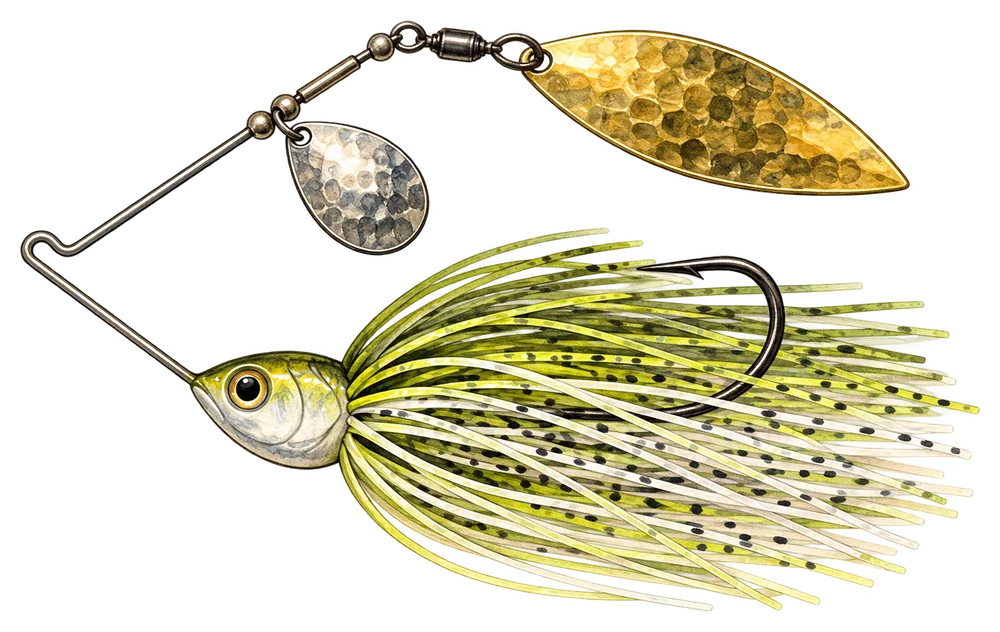
A spinnerbait consists of an angled wire: at the top one or more spinner blades turn, at the bottom sits a weighted single hook with a skirt. It creates a lot of pressure in the water and can be worked through weed without the hook clogging up straight away. That makes it a lure for pike and larger perch in difficult spots.
- Water depth
- Near the surface to mid-water
- Retrieve
- Active: retrieve steadily, even slowly
- Fishing method
- Spinning
- Category
- Metal lures
How a spinnerbait works
The angled wire acts like a guard. It shields the single hook, so that hardly any weed settles on it, and the hook still sits free. With lures that have a concealed hook, on the other hand, the chance of hooking the fish cleanly drops. The blade turns on a swivel. On good models it is ball-bearing mounted, so that the blade also turns cleanly on the sink. At the bottom sit the lead head with the hook and usually rubber strands, called a skirt.
The blades create swirls and pressure waves, and pike pick up these signals. Broad blades make more racket, slim ones less, because they offer the water less resistance. There are models with up to five blades. They give the predator the impression of several prey fish. The price is high water resistance: a pike guide finds it tiring to fish large models all day.
A spinnerbait can be worked at any depth. If you wind it in straight after the cast, it runs below the surface. If you let it sink, you work it just above the bottom. Unlike a simple spinner, its blade also turns on a slow retrieve. You can also troll it.
Sometimes fish grab the freely turning blade instead of the hook. Single hooks reduce such missed bites. A soft bait on the hook, the trailer, adds stimulus. With a long trailer, especially when fishing for perch, an extra hook helps. The spinnerbait was developed in the USA for fishing for black bass in weedy, shallow waters.
How to work the lure
Active: retrieve steadily, even slowly
Schematic illustration, AI-generated.
- Cast
- dives on the retrieve
- keeps running steadily
- Reached the bank
Anatomy
The points on the picture above explain the most important parts – on hover or tap.
- Bend in the wire arm: This is where you knot or clip on. The wire shields the hook from weed.
- Broad blade: Offers more resistance and makes stronger pressure waves.
- Slim blade: Offers less resistance and produces weaker pressure waves.
- Weighted head: Gives casting weight and carries the single hook.
- Skirt: Dresses the hook and pulses on the retrieve.
- Single hook: Sits free, yet hardly any weed catches on it, because the wire shields it.
Rig in three steps
- 1. Bite-proof hooklengthPike sit in weed: put steel or titanium in front of the lure.
- 2. Attaching to the armKnot the trace into the eye at the bend in the wire. If the eye is open at the back, a small rubber sleeve ring holds a clip in place.
- 3. Optional: soft bait as a trailerA soft bait on the hook gives more stimulus. With a long trailer, an extra hook prevents missed bites.
Drawings: AI-generated, schematic.
When the target fish are in season
Hardly any chancePossibleGoodPeak seasonValues from the catch calendar.
When and where
Its domain is weedy waters in which pike hide among plants. Many anglers do not fish there, yet these are the classic areas of use: weed beds, gaps between plants and stretches full of obstacles. After spawning, pike stand deep in dense reeds, where lures with weed protection such as spinnerbaits are in demand. In spring, after the closed season (Schonzeit), pike are hungry but save energy. The closed season runs in most federal states (Bundesländer) from February to April or May, in Bavaria from 15 February to 30 April (as of October 2026). Then you work the lure slowly, with long sinking phases and deliberate pauses.
A pike guide gives rules of thumb: in spring 1 to 3 metres deep with a double willow blade, in summer a single willow blade at 4 to 7 metres, in clear winter water 1 to 7 metres with a single willow blade. In wind the heavy metal lures cast well. Perch react too: a team angler caught the better perch in Holland in shallow water over weed, best with longer spinning pauses, during which they attacked the lure as it sank.
How to choose blade, colour and tackle
- Bite-proof leader Pike lurk in the weed, so steel or titanium goes in front.
- Into the eyelet at the bend Tie the leader into the eyelet at the bend in the wire. If the eyelet is open at the back, a small rubber tubing ring holds a snap in place.
- Soft bait as a trailer If you like, thread a soft bait onto the hook for more stimulus. With a long trailer, an extra hook prevents missed bites.
Depending on size, you fish the spinnerbait for perch or pike. If you need pressure, choose broad blades or two blades; if you want to fish more quietly, slim ones. As a rule of thumb, as with other lures: in murky water bright colours score, in clear water rather subdued patterns. For clear water the pike guide names silver or gold with a semi-transparent skirt, for murky water loud blades and skirts. Take several colours with you and try them out.
For large models the guide recommends a strong rod with a casting weight of at least 100 grams and a length of around 2,40 metres, plus a robust reel. His main line is a thick 0,25 braid. Another author uses monofilament line, because the stretch reduces hook pulls. For pike, a bite-proof trace of steel or titanium belongs in front of the lure.
How to get free of weed
Spinnerbaits get snagged all the same. Point the rod tip at the snag and hold the line. If you feel weed contact again, wind in line quickly. The weed comes free, and you stay at the same speed so that the lure does not immediately settle again. If you rip it free with a strongly bent rod, the lure shoots forward and hangs in the next weed trail.
The bites are usually spectacular: a bow wave follows the lure, then the water explodes. Fight firmly between the plants so that the fish does not flee into the weed. Release the fish using a disgorger and an unhooking mat. What applies to hooks, the number of hooks and bait bans is set by the water regulations (Gewässerordnung).
Which colour?
Starting points to try, not rules. Depth and speed are usually more important than colour.
Spinnerbait or another lure?
| Baits and lures | Depth | Retrieve | Take this lure if … |
|---|---|---|---|
| Spinnerbait | Near the surface to mid-water | Active: retrieve steadily, even slowly | this page |
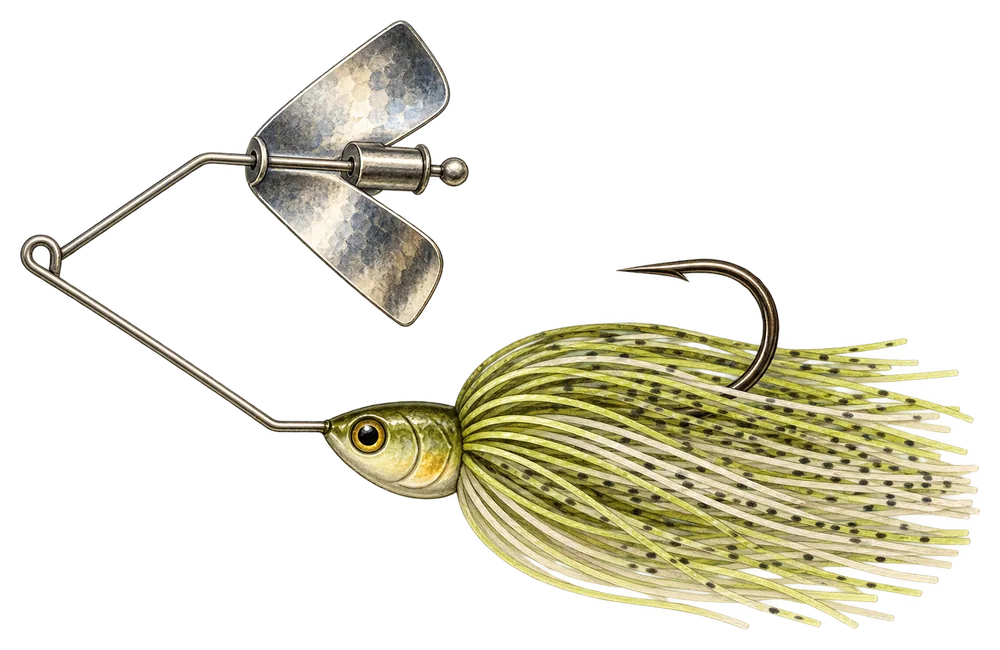 Buzzbait | Surface | Active: retrieve briskly at the surface | you want to fish directly at the surface and want noise instead of pressure under water |
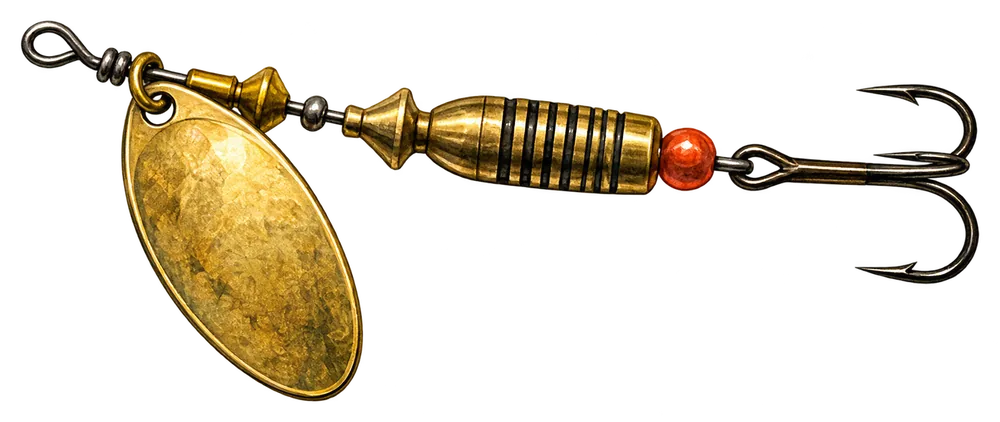 Spinner | Near the surface to mid-water | Active: retrieve steadily, speed up when fish follow | no weed is in the way and you can retrieve briskly |
What you need
- Strong rodFor large models at least 100 grams casting weight and around 2,40 metres. It must withstand vibrations and allow the strike. More on this
- LineThick braid, alternatively monofilament with more stretch to prevent hook pulls. More on this
- Pike traceSteel or titanium, because a bite-proof trace protects fish and lure. More on this
- ConnectionKnottable steel into the eye, because a clip would otherwise slip quickly. More on this
More on the method: Spinning.
At a glance
Editorial assessment, not measured values.
If it does not work
Point the rod tip at the snag, hold the line and, on fresh contact, wind in briskly. Then keep winding at the same speed.
Do not rip it free with a strongly bent rod. The rod springs back and the lure lands in the next weed trail.
Put on a soft trailer and, with a long trailer, an extra hook. Single hooks reduce missed bites.
Choose a model with a ball-bearing swivel. The blade must run cleanly on the sink as well.
Use knottable steel. With an open eye, a rubber sleeve ring that holds the clip in place helps.
For pike, take a steel or titanium trace. A thin mono trace is not enough for this.
Frequently asked questions
Why does a spinnerbait hardly ever snag in weed?
The angled wire shields the free single hook, and the skirt dresses it. That way hardly any weed settles there. It is not completely snag-free, though.
Which fish is the spinnerbait suitable for?
For pike and perch, depending on size. The Landesfischereiverband Baden-Württemberg also names the wels catfish as a target fish. It is mainly pike that sit in weed.
How fast do you retrieve a spinnerbait?
It also works slowly. In cold spring water slow working and pauses prove their worth, and with perch longer spinning pauses. On windy days you can go faster.
Do I need a trailer?
No, it is optional. A soft bait on the hook adds stimulus. With a long trailer you should fit an extra hook so that fewer bites are missed.
Which blade should I choose?
Broad blades create more pressure, slim willow blades less. As a rule of thumb, a guide names double willow blades in spring and single ones in summer and winter.
Before fishing, the current permits, state rules and water rules apply: bait bans, number of hooks, closed seasons, protected species and catch limits can differ. Many federal states expressly ban live baitfish. Take bait remains and packaging away with you. All details are guide values without guarantee and do not replace legal advice.
Sources
- Blinker: Angeln auf Hecht, Top-Hechtköder für Kraut
- Blinker: Angeln mit Spinnerbait, Druckmacher im Kraut
- Blinker: Licht im Blätterwald, Tandemspinner, Bucktailspinner, Spinnerbaits
- Rute & Rolle: Spinnerbaits, Gib Gummi auf Hecht
- Rute & Rolle: Spinnerbaits für Barsche
- Rute & Rolle: Spinnfischen auf Hecht im Frühjahr
- Rute & Rolle: Hecht, Tipps fürs Frühjahr
- Landesfischereiverband Baden-Württemberg: Gerätekunde, Präsentation 2022
- Fisch & Fang: Zielfisch Hecht, Stahl der Wahl
- Bayern: Ausführungsverordnung zum Fischereigesetz (AVBayFiG), Anlage zu § 11: Schonzeiten und Mindestmaße
The sources explain terms and basic principles. Retrieve, colour choice and values are editorial starting points and depend on water, weather and lure.
More metal lures
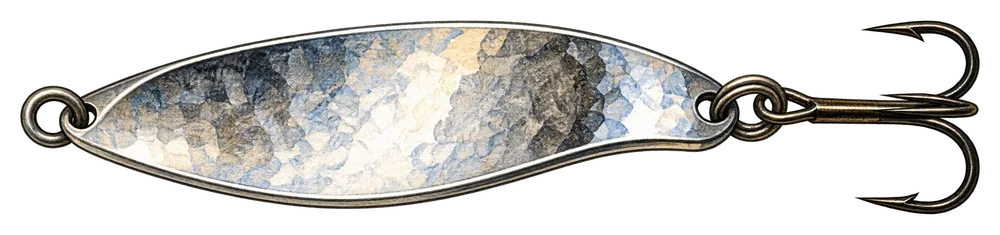 Spoon
 Bladed Jig
 Pilker
 Tailspinner
Created with AI support from the sources listed (AI notice). Last updated: 31 October 2026. Found a mistake? Write to us. Who is behind the site: About me.