
Knowledge · Tackle
Storing fishing tackle for winter: Storing rods, reels, line and lures
When you put your fishing tackle away for winter, it is mainly about moisture, light and frost. Wet hooks develop surface rust in a closed box, monofilament becomes brittle under UV light, and a lithium battery is damaged in a cold garage. Then there is pressure: a reel stored with the drag screwed down presses on the drag washers for months.
What harms your tackle during the winter break
A lot of damage does not happen at the water but in the weeks afterwards. Rute & Rolle describes the typical case: after a wet trip, lures and used hooks stay in the lure bag, and when you unpack them the trebles, jigs, swivels and snaps are covered in surface rust. Damp textiles suffer just as much. According to Blinker, fungi and bacteria grow wherever it is damp and the temperature is right. On waders hung up wet, mould gradually breaks down the seams.
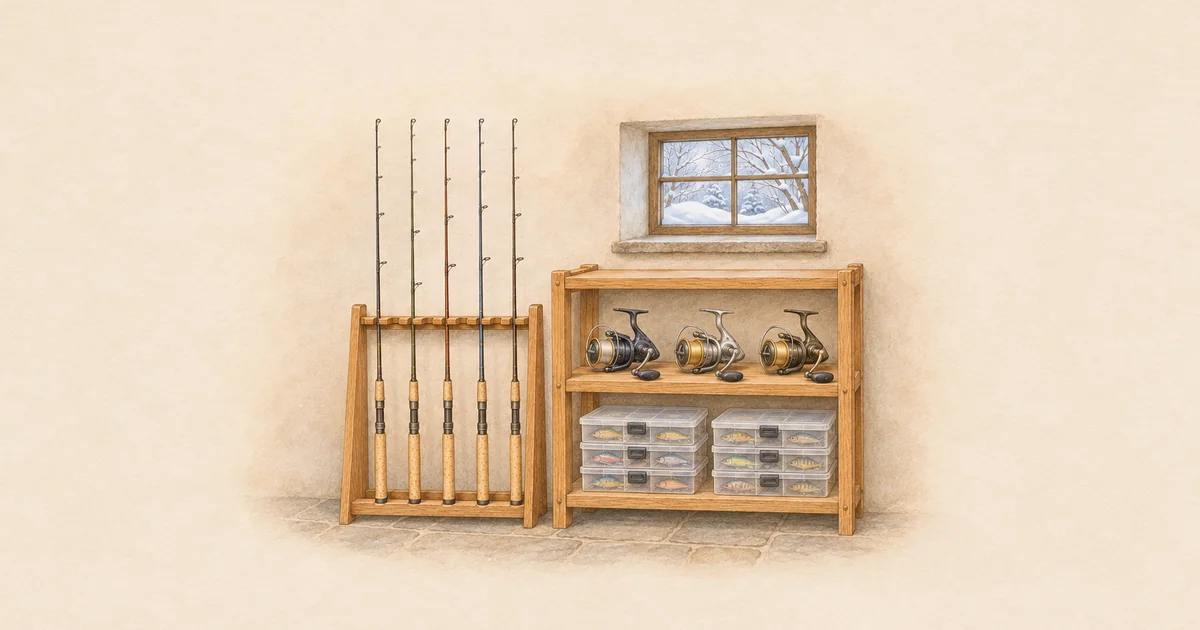
Light and temperature add to this. Constant UV light makes fishing line brittle and costs breaking strain, writes Blinker. Lithium batteries tolerate neither heat nor long periods of frost: the Umweltbundesamt (UBA, German Environment Agency) counts the sunny garden shed and the shelf behind the windscreen among the unsuitable storage places, and the Institut für Schadenverhütung und Schadenforschung (IFS) of the public insurers advises against the unheated garage in winter. Knocks count too: a rod that falls over in the cellar can end up with a crack in the guide insert.
Checklist after your last fishing day
Clean and dry first, then check, and put everything away last. Rinse tackle used in salt water with fresh water beforehand, as described under Cleaning a fishing reel.
- Wash and dry the rods. Rute & Rolle cleans blank and handle with lukewarm water, a mild soap solution and a soft brush, paying attention to the joints, reel seat and rings. Then rinse with clean water and let everything dry completely. The article leaves the cork handle untreated: wax, varnish or oil seal it, and if water does get in at a damaged spot, it can go mouldy. More on care under Fishing rods.
- Check the rings with cotton wool. Pull a piece of cotton wool or a cotton bud through each ring and run it all the way round the insert. If fibres catch, it is damaged (Fig. 2). Blinker describes such hairline cracks as often invisible and yet sharp enough to cut braid on the strike. The question catalogue for the angling exam (Fischerprüfung) in Saxony-Anhalt names worn grooves and cracks as what rings should be checked for regularly. How to replace a ring is explained under Rod repair.
- Dry the reel, back off the drag. Blinker advises reducing the pressure on the drag washers after every fishing day and storing the reel with the drag backed off, so the washers wear less. How to clean and grease the spool, washers and handle thread is explained under Cleaning a fishing reel. A note on the reel foot reminds you in spring to set the drag again.
- Check the line and keep it in the dark. Run a longer length of line through a ball of cotton wool. If cotton fibres stick, the line is damaged, says Blinker. Another Blinker article names damage over a longer stretch and line that has been on the spool for many years as reasons for a complete change, because it loses breaking strain even when unused. Store it cool, dry and dark. The tackle guide of the Fischereiverein Löningen, a study aid for the angling exam (Fischerprüfung), explains this with the UV sensitivity of synthetic line; Blinker recommends a dark linen or leather bag for reels loaded with monofilament. More under Monofilament line.
- Separate soft lures by material and colour. According to Blinker, soft plastics only belong in boxes marked PE (polyethylene) or PP (polypropylene), which are not attacked by the plasticisers. Lures with and without plasticisers clump together in the same compartment within a few days, and different colours stain each other. Before long-term storage, pull the soft plastics off the jig hooks and rinse the hooks with tap water, otherwise they rust under salted lures. Plugs and winders are covered on the Lure box page.
- Dry hook boxes open. Blinker advises leaving hook boxes open in a dry room for at least 24 hours after each fishing day, so that rust sets in later. Before winter this applies to every box with hooks, swivels, split rings and jig heads. Put rusty parts in a separate tin and replace them before the season. Shapes and coatings are covered under Fishing hook.
- Dry the landing net, for the sake of the water too. A net packed away wet goes mouldy and smells, so Blinker advises drying the landing net after every session and rinsing rubberised nets with water. The same drying helps crayfish: the Bayerisches Landesamt für Umwelt (LfU) recommends disinfecting fishing tackle and clothing that has been in contact with water, or letting it dry completely, so that crayfish plague is not spread. A leaflet for anglers from the Sächsische Landesstiftung Natur und Umwelt gives more than 48 hours of complete drying for this. Why this matters is explained in Not spreading species and diseases.
- Hang waders up until completely dry. Blinker considers one to three hours wet acceptable if the waders then dry straight away. Before winter, wash breathable waders according to the care label without fabric softener; according to Blinker, neoprene parts do not go in the tumble dryer. What to bear in mind when patching and with the stocking feet is explained under Waders.
- Bring batteries to storage charge. For overwintering, the UBA passes on the manufacturers’ recommendation: about 40 to 50 per cent charge, stored at 10 to 25 °C. Because the battery discharges itself, top it up after six months at the latest. Avoid damp rooms and the fridge, where condensation is a risk. According to the IFS, longer periods of frost can permanently cost capacity and make the next charge dangerous. This applies to power banks, echo sounder batteries, bite indicators and head torches with a built-in battery. Charging and disposal are explained in Batteries and power banks.
- Only pack the tent and umbrella when dry. After a trip, the Deutscher Alpenverein (DAV) advises wiping off dirt with just water and a sponge, without harsh cleaners, washing machine or tumble dryer, then letting every part dry and repairing any damage. According to the DAV, the tent should be kept out of strong UV light while doing so, so do not hang it in blazing sun. If the tent came back wet from your last session, pitch it again at home or hang it up loosely. The DAV’s advice applies to tents; for the fishing umbrella, take from it the thorough drying before packing. On setting up and overwraps, see Fishing tent and Fishing umbrella.
Check batteries when putting things away: According to the UBA, a lithium battery that is swollen, deformed, leaking or has a greasy film on the terminals is defective. Stop using it and do not open it; tape over the terminals and take the battery to a collection point in a jar with a lid.
The right place in the house
Rute & Rolle sends the cleaned rods into their winter break in a cool, dry room. The same goes for line, plus darkness. The overview shows which place suits what.
| Storage place | What harms there | Not there |
|---|---|---|
| unheated garage | Frost (IFS) | Batteries, power bank |
| sunny shed, car | Heat (UBA) | Batteries, line |
| damp cellar | Moisture, mould | Batteries, rods, waders, tent |
| Windowsill, bright shelf | UV light | Line, spare spools |
| Fridge | Condensation (UBA) | Batteries |
| cool, dry, dark room | none of these | suits everything, batteries at 10 to 25 °C |
Rod stands and wall racks
Rods should not fall over during the winter. According to Blinker, ceramic inserts in the rings are sensitive to knocks: if the rod tips over or bumps into something, the insert can crack or a piece can chip off. A rod stand or wall rack gives each rod a fixed place. A reader’s DIY tip in Blinker shows a simple design: at the bottom a strip screwed to the wall in which the handles stand, higher up spacer clips that hold each blank separately. Rods only stay in the rod bag, on the other hand, if bag and rods have been dried separately beforehand.
In spring before your first fishing day
Respooling in winter saves time: according to Blinker, fresh monofilament needs at least 24 hours to adjust from the shape of the large bulk spool to the small reel spool. If you fish it straight away, you risk bird’s nests and line twist. How to get the line neatly onto the spool is shown in How to spool a reel properly, and the Line calculator works out how much line and backing will fit.
Before your first cast, reset the drag you backed off over the winter, see Setting the reel drag, and do the pull test. The Bavarian question catalogue for the angling exam (Fischerprüfung) calls it the most important tackle test before you start fishing, because it checks the strength of the whole rig. According to Blinker, check jig hooks under salted soft plastics for corrosion before fishing. Recharge batteries before your first session, and if a rod fell over, run the cotton wool through the rings once more. What you must have with you at the water is regulated by your federal state (Bundesland); the overview is under Mandatory equipment.
Common mistakes
- Leaving the box closed after the last wet day. In spring, hooks and small parts are covered in surface rust.
- Storing the reel with the drag screwed down. The constant pressure wears the drag washers faster.
- Tipping all the soft plastics into one compartment. Lures with and without plasticisers stick together, and colours bleed.
- Forgetting the power bank, empty or full, in the cold garage. The UBA gives 40 to 50 per cent charge, the IFS a frost-free place.
- Leaning rods in the corner of the room. A rod that has fallen over can have a crack in the ring insert that only the cotton wool reveals.
Frequently asked questions
Does the line have to come off the reel over winter?
None of the specialist sources we evaluated requires this. What matters is a cool, dry and dark place. Replace it according to its condition: if it is damaged over a longer stretch, if there is too little line on the spool or after many years.
How much should I charge batteries for winter?
To about 40 to 50 per cent; that is the manufacturers’ recommendation as passed on by the UBA. Store them at 10 to 25 °C and top them up after six months at the latest. If your device’s instructions say something different, follow the instructions.
Can fishing tackle spend the winter in the garage?
Batteries cannot; the IFS expressly advises against the unheated garage. For rods, reels and line, what counts is that the room stays dry and the line is kept in the dark. If the garage is damp, the cool room in the house is the better choice.
Why should the drag be loose over winter?
A drag that is screwed down presses the washers together for months. Blinker therefore advises storing the reel with the drag backed off to reduce wear. Before your first fishing day, reset it with the pull test.
Related
- Cleaning a fishing reel: grease instead of oil, drag washers and salt water
- Rod repair: fixing rings, tip ring and breaks in winter
- Batteries and power banks: charging, storing and disposing of old batteries
- Lure box: twister-proof compartments, plugs and rust
- Waders: drying, washing and patching holes
- Not spreading species and diseases: landing net and boots between two waters
- Setting the reel drag: starting value and spring scale after the winter break
- Line calculator: amount of line and backing for the new fill
Sources
- Rute & Rolle: Looking after fishing rods: how to do it right (Rute waschen, Kork unbehandelt, kühl und trocken lagern) und Tipp gegen rostige Haken (Flugrost durch nasse Köder und Haken in der Box)
- Blinker: Rutenringe reparieren (Watteprobe, Haarrisse, Keramik schlagempfindlich), 9 Profitipps zur Rollenpflege (Bremse gelockert lagern) und Bastel-Tipp: Der Rutenhalter für die Wand (Leiste und Schellen)
- Blinker: Haltbarkeits-Datum (Wattebausch-Probe, dunkler Beutel), Richtiger Umgang mit monofiler Schnur (kühl, trocken, UV, 24 Stunden Ruhe) und Alles neu: Mit frischer Schnur in die Saison (Anlässe für den Wechsel)
- Blinker: Gummifische aufbewahren (PE und PP, Weichmacher, Farben, Jighaken), Offset-Haken (Hakenbox 24 Stunden offen), Kescher fürs Angeln (trocknen gegen Schimmel) und Pflege der Wathose (Feuchtigkeit, Schimmel, Waschen, Neopren)
- Prüfungsunterlagen: Fischereiverein Löningen: Zusammenfassung Gerätekunde (PDF) (Schnur dunkel aufbewahren), Land Sachsen-Anhalt: Fragenkatalog zur Fischerprüfung (Export) (Ringe auf Rillen und Risse prüfen) und Bayerische Landesanstalt für Landwirtschaft: Prüfungsfragen 2023/2024 (PDF) (Zugprobe als wichtigster Gerätetest)
- Umweltbundesamt: Lithium-Batterien und Lithium-Ionen-Akkus (40 bis 50 Prozent, 10 bis 25 °C, ungünstige Lagerorte, Kühlschrank, defekte Akkus) und Batterien und Akkus richtig nutzen (Nachladen nach sechs Monaten)
- IFS, Institut für Schadenverhütung und Schadenforschung: Lithium-Ionen-Akkus (Frost, ungeheizte Garage)
- Bayerisches Landesamt für Umwelt: Die Krebspest (PDF) (Gerät desinfizieren oder vollständig trocknen) und Sächsische Landesstiftung Natur und Umwelt: Invasive Krebse, Hinweise für Angler (PDF) (Trocknung über 48 Stunden)
- Deutscher Alpenverein: Materialkunde Zelte (Zelt reinigen, trocknen, UV beim Trocknen meiden)
Text AI-assisted, drawings AI-generated. Sources opened and checked in November 2026, no graphics taken from the sources.
All figures are guide values without guarantee. What your tackle can cope with is stated in the manufacturer’s instructions; for batteries, the device’s manual applies.