
Knowledge · Tackle
Fishing tent and carp bivvy: Shelter for the session
A fishing tent protects you from rain, wind and cold during a long session and leaves your view of the rods clear. Carp anglers call it a bivvy. This page covers the types available, how to pitch the tent on the bank, why a stove inside is life-threatening and what state law and water rules say.
What makes a fishing tent different
During a session the fishing tent stands directly behind the rods, with room inside for a bedchair. In the English of the carp scene the tent is called a bivvy and the bed a bedchair, as the Blinker glossary translates it. How the bedchair is built is covered under Carp bedchair.
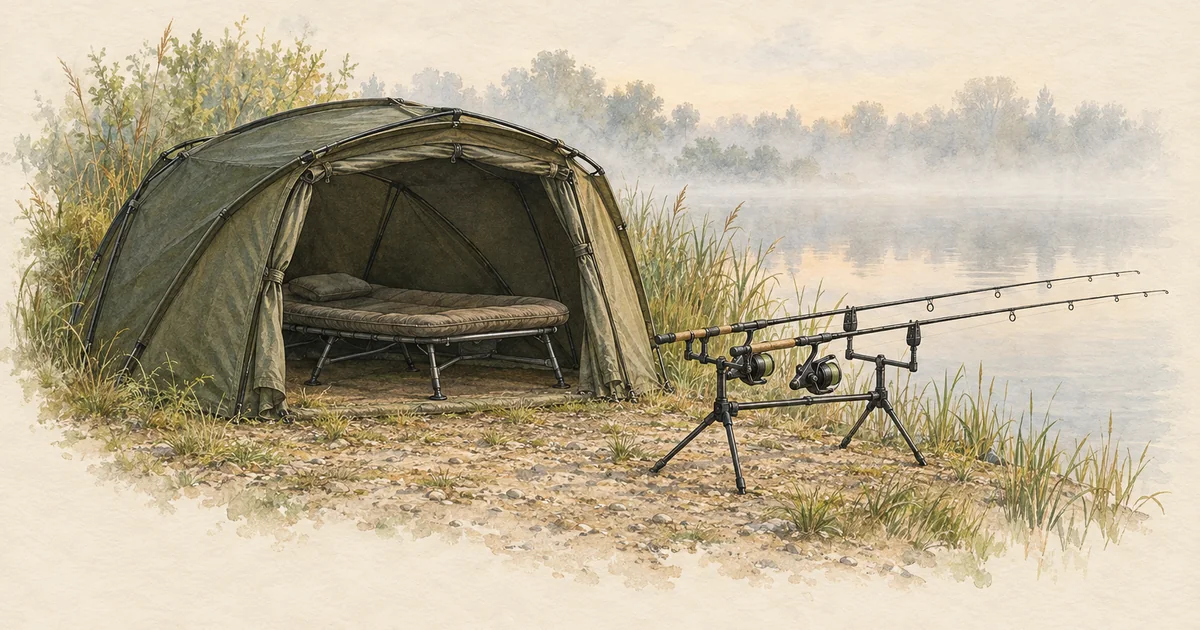
The open front has a reason: you should be able to see from the tent what is happening at the rods. In Brandenburg the fisheries regulation requires that hand-held rods that are set out be supervised „constantly and directly“ (§ 7 Abs. 3 BbgFischO, as at 24 August 2026). Further examples are on the page Carp fishing.
Types: brolly, bivvy and overwrap
Brolly
With a brolly, the frame of a large fishing umbrella carries the roof. The water rules of the Landesanglerverband Brandenburg list the fishing tent and the brolly side by side as weather protection. How the umbrella itself is built is explained on the page Fishing umbrella.
Bivvy
The bivvy is a self-contained tent, for example dome-shaped, known as a dome. According to Blinker, a „1 Man Dome Bivvy“ is simply a carp tent for one person. In winter, a groundsheet is one of the things that noticeably helps.
Overwrap
The overwrap is a second outer skin pulled over the tent. A layer of air stays between the two layers. According to Angling Times, it keeps the tent warmer and reduces the condensation that would otherwise drip from the inner wall onto your sleeping bag at night. In winter it also prevents ice on the inside.
Position and pitching on the bank
- Back to the wind: Fisch & Fang advises pitching the carp tent with its back to the wind where possible and anchoring it firmly in the ground with pegs. The entrance is best pointed at the rods. Tighten the guy lines that come with the tent too.
- Clear paths: Before pitching, clear away thick branches and anything you could trip over. When you get a bite at night, you run to the rod in the dark. The rods themselves then rest on bank sticks or a rod pod.
- Morning sun: In winter it pays to turn the front to the east, if the wind allows it. The first sun then warms the inside a little.
- Pitch quietly: Angling Times counts hammering in pegs while others are already fishing among the biggest annoyances at the water.
Storm and thunderstorm: trees and tent
Under trees it becomes dangerous in a storm. The Bezirksamt Pankow points out that falling branches and toppling trees threaten life and limb, even after the storm. The Bundesamt für Bevölkerungsschutz und Katastrophenhilfe (BBK) advises avoiding places where objects swept along by the storm can hit you. If you are outdoors, you should find a building. According to the BBK this expressly applies even if you are in a tent.
In a thunderstorm, anglers should, according to the VDE, leave the water and the bank zone as soon as the storm approaches. According to the VDE, tall trees do not protect against lightning. The Federal Office of Civil Protection (Bundesamt für Bevölkerungsschutz) advises not touching objects with metal parts, such as umbrellas, during a thunderstorm. According to the German Weather Service (Deutscher Wetterdienst), a vehicle with a metal body gives protection. When to pack up is covered under Thunderstorms and weather.
Heating and cooking: carbon monoxide
Wherever wood, charcoal, oil or gas burn, carbon monoxide (CO) is produced. The Feuerwehr Dortmund describes it as invisible, with no smell and no taste. First come headaches or dizziness; at high concentrations you lose consciousness and do not wake up. According to its guidance, camping stoves, patio heaters, and charcoal and gas barbecues are not suitable for heating enclosed spaces.
On charcoal barbecues indoors, the Bundesinstitut für Risikobewertung (BfR) writes that dangerous CO levels can occur even with windows and doors wide open. The Berliner Feuerwehr puts it bluntly: never use gas and charcoal barbecues in enclosed spaces. Angling Times also expressly warns carp anglers against running gas or charcoal appliances in the bivvy.
The stove stays outside: Cook and heat water in front of the tent, never inside it, and do not heat the tent with a flame or embers. If you feel dizzy or get a headache in the tent, get into the fresh air immediately. If carbon monoxide is suspected, the fire service advises calling the emergency number 112. This text is no substitute for medical advice.
Against the cold, a winter sleeping bag, a well-insulated bedchair, a hot-water bottle and a dry unhooking mat under the bedchair help.
What state law and water rules say
Whether you may pitch a tent on the bank and sleep in it is governed by nature conservation law and the fisheries law of the states, plus the water rules (Gewässerordnung) of the water’s manager. Two examples from Brandenburg, as at October 2026:
- Nature conservation act: Tents in open countryside outside public roads and squares may only stand on a tent site or campsite. For walkers on foot, by bike, horse or boat, the act also lists bivouac sites designated by the municipality (§ 22 Abs. 4 BbgNatSchAG, last amended on 24 July 2025).
- The association’s water rules: On waters of the Landesanglerverband Brandenburg, a fishing tent or brolly as weather protection is „generally permitted“ if it is not mainly used for sleeping. It may hold two people at most, must not have a waterproof floor and must be in muted colours. It may stand in the same place for no more than 12 hours at a stretch. Among other places, it is not permitted on natural, unmodified stretches of stream and river, at small waters, on wet meadows, in bogs and in floodplain forests (Gewässerordnung, 2019 edition, no. 6.3).
How the act and the association’s rules work together on a particular bank is something neither text says. Clarify it with your club or the lower nature conservation authority (Untere Naturschutzbehörde). Also watch the tent floor: the association’s rules require weather protection without a waterproof floor. So check whether your tent has a fixed groundsheet.
Note, as at October 2026: The examples come from Brandenburg only. What applies in your federal state (Bundesland) is set by state law, fishing permit and water rules. Whether you may fish at night at all is explained on the page Night fishing.
Common mistakes
- Pointing the front into the wind. It is better to have the back to the wind and the tent firmly anchored with pegs.
- Staying under trees when a storm is forecast. Branches and trees can come down. The BBK advises even people in a tent to find a building.
- Sitting out a thunderstorm in the tent on the bank. The VDE advises leaving the bank zone as the storm approaches, and the DWD names vehicles with a metal body as protection.
- Heating with a stove, gas heater or barbecue. You do not notice carbon monoxide until you feel dizzy. These appliances stay outside.
- Not reading the water rules. Tent floor, colour, length of stay and closed banks may be regulated there, as the Brandenburg example shows.
Frequently asked questions
What is the difference between a bivvy and a brolly?
The bivvy is a self-contained tent, for example dome-shaped. With a brolly, a large fishing umbrella carries the roof. The water rules of the Landesanglerverband Brandenburg name both as weather protection.
May I sleep in a fishing tent?
That depends on the state and the water. In Brandenburg, under the nature conservation act, tents in open countryside may only stand on tent sites or campsites, and the association’s water rules allow only weather protection that is not mainly used for sleeping. Ask the club or authority beforehand.
Is it enough to leave the door open with a gas heater?
You should not rely on that. The Feuerwehr Dortmund calls camping stoves, patio heaters and gas barbecues unsuitable for heating enclosed spaces. For charcoal, the BfR writes that dangerous levels are possible even with windows and doors wide open.
Related
- Carp fishing: fixed leads, baited area and supervision of the rods
- Night fishing: setting up the swim in daylight, lighting and state rules
- Thunderstorms and weather: the lightning-thunder rule and DWD warning levels
- Carp bedchair: the bed that belongs in the tent
- Fishing umbrella: weather protection for short sessions
- Rod pod and tripod: a rod rest in front of the tent
- Bite indicators: so you hear the bite in the tent
- Line calculator: breaking strain and backing for the session rod
Sources
- Blinker: Englisch beim Angeln (Bivvy, Dome Bivvy, Bedchair)
- Fisch & Fang: So fange ich! (Ausrichtung, Heringe, Stolperfallen)
- Angling Times: Winter fishing warning, how to keep your bivvy safe and warm (Überwurf, Ausrichtung, Gas und Kohle im Bivvy, Kälte), The best winter carp fishing edges (Überwurf gegen Eis, Bodenplane) und The Ten Commandments of carp fishing (Heringe nicht einschlagen)
- Land Brandenburg: Fischereiordnung (§ 7, Aufsicht) und Naturschutzausführungsgesetz (§ 22 Abs. 4, Zelte)
- Landesanglerverband Brandenburg: Gewässerordnung (Nr. 6.3, Wetterschutzvorrichtungen)
- Bundesamt für Bevölkerungsschutz und Katastrophenhilfe: Empfehlungen bei Sturm/Orkan (PDF) (Gebäude aufsuchen, auch aus dem Zelt) und Bezirksamt Pankow: Vorsorgen und Handeln bei Stürmen (Äste und Bäume)
- VDE: Blitzschutz beim Wassersport (Uferzone verlassen, Bäume), BBK: Was tun bei Sturm, Gewitter und Hagel? (Schirme) und DWD: Gewitter im Anmarsch (Fahrzeug mit Metallkarosserie)
- Feuerwehr Dortmund: Kohlenstoffmonoxid (Anzeichen, Campingkocher, Notruf), BfR: Fragen und Antworten zum Grillen (Holzkohle im Innenraum) und Berliner Feuerwehr: Grillen (keine Grills in geschlossenen Räumen)
Text AI-assisted, drawing AI-generated. Sources opened and checked in October 2026; no graphics taken from the sources.
All figures are guidelines without guarantee. Whether you may pitch a tent at the water and stay overnight in it is decided by state law, fishing permit and water rules; the text is no substitute for legal or medical advice.