
Knowledge · Tackle
Bedchair: Rest for long nights at the water
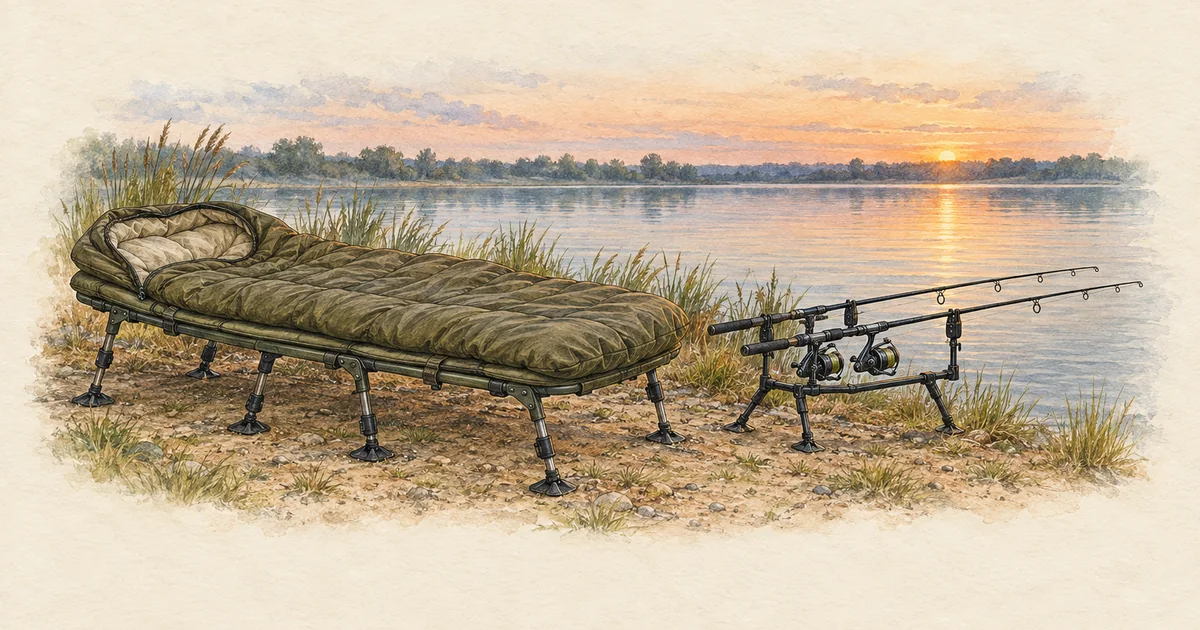
A carp bedchair is the bed for a session lasting overnight: you sleep a few steps from the rods and are quickly at the rod pod when you get a bite. This page covers the types available, how to set up the bedchair, what helps against cold and damp, and where state law has a say.
What the bedchair is for at the water
In English it is called a bedchair; the Blinker glossary translates it simply as a lounger for sitting out a session. It is used on a long session, for example when carp fishing, when the rigs stay out overnight and an electronic bite indicator signals the bite. During the day it doubles as a seat. For a single night with light luggage, a light bedchair counts as basic kit, because you can also sit on it and save taking a chair.
Not every session needs a night. If you only fish in the warmest hours of the day in winter, you leave the tent, bedchair and sleeping bag at home. For short sessions a fishing chair or seat box is enough.
Types: legs, feet, sleeping surface
A bank is rarely level, and soft ground gives way under weight. The first two features aim at that:
- Adjustable legs: If the legs can be extended individually, you level out a slope until the sleeping surface is flat. Some chairs can be extended into a bedchair with an add-on part, with four adjustable legs. On others, adjustable front legs are enough to make them stand level on steep banks.
- Mud feet: wide plates at the lower end of the legs. According to Rute & Rolle, large mud feet also find a grip on soft ground, and movable ones adapt to the surface.
- Insulated sleeping surface: Heat is not only lost upwards, writes Angling Times. A well-insulated bedchair holds the warmth and lets no cold air reach the body from below.
- Weight: With every kilo that comes off the trolley, the distance you can manage to a remote swim grows, according to Blinker. How to get a heavy load to the water is covered under Fishing trolley.
The sleeping bag goes with the bedchair. For winter, Angling Times recommends a five-season sleeping bag that warms up quickly and keeps the heat when you have to get out for a bite. According to the Deutscher Alpenverein (DAV), many manufacturers state three temperatures:
| Specification | Meaning according to the DAV |
|---|---|
| T(Com), comfort | a rather cold-sensitive person sleeps comfortably through the night |
| T(Lim), limit | a rather cold-resistant person sleeps comfortably through the night |
| T(Ext), extreme | sleep is out of the question, it is about survival without lasting damage |
On the filling, the DAV names a difference that matters right at the bank: down no longer insulates when it gets too damp and clumps, while synthetic fibre keeps you warm even when damp.
Setting up: close to the rods, hearing bites reliably
Place the bedchair so that you are at the rods within a few steps of the sleeping bag, and level it before you lie down. Scout the swim while it is still light, so that you can find your way to the rods safely at night even without a light (this is what Fisch & Fang advises). You clear away stones and branches; whatever cannot be removed, you mark with a white cloth or a glow stick.
Keeping order around the bedchair includes this: the head torch hangs above the bedchair in the umbrella’s frame, the shoes stand open in front of it, still under the umbrella and so dry. A bucket at the head end serves as a bedside table. Unhooking mat, scales, wet weigh sling and a filled water bucket lie together.
You have to hear the bite half-asleep. If you sleep, use wireless bite alarms with a receiver, so that at the first beep you are standing at the rods out of your sleeping bag. Settings are explained on the page Bite indicators, and resting the rods on hard ground on the page Rod pod.
If the baits lie close to snags in the water, that is not enough. Keeping a fast carp away from them at night is hardly possible unless you are awake beside the rods. It is better not to leave such rods out during sleeping time.
Cold and damp at night
Cold also comes from below. The Deutscher Alpenverein explains that your own body weight compresses the filling of the sleeping bag and so the insulating layer of air is lost; that is why an insulating mat is part of the kit. In addition, the unhooking mat can be slid under the bedchair, as long as it is not wet. It then forms a layer between the cold ground and the bedchair.
Damp comes from above. If objects cool at night through radiation below the dew point of the air, dew settles, according to the Deutscher Wetterdienst preferably on horizontal surfaces. First the fabric turns clammy, later droplets form. A sleeping bag under open sky is such a surface. In a tent, condensation can form and drip on you; an overwrap reduces it. Designs are covered under Fishing umbrella and Fishing tent.
- Clothing: Do not wear too little in the sleeping bag, advises Blinker, because at a bite you may be standing at the bank in the wind at zero degrees.
- Sweat: Angling Times warns of the opposite when setting up. If you sweat under all your layers, you cool down quickly afterwards. Set up first, then put on layers, and leave spare clothing in the car.
- Sleeping: The DAV advises sleeping in dry functional clothing with a hat and avoiding alcohol.
Hypothermia: The Deutsches Rotes Kreuz (DRK) describes it as a state in which the body gives off more heat than it produces over a long time. A first sign is shivering. Anyone lying on cold ground loses additional heat, according to the DRK. At signs of hypothermia, the DRK names the emergency number 112 as the first step. This text is no substitute for medical advice. How to heat the tent safely is covered under Fishing tent; in a thunderstorm, the page Thunderstorms and weather applies.
Staying overnight at the water: state law and water rules
Whether you may sleep at the water is governed by state law, fishing permit and water rules. Two examples, as at October 2026:
- Saxony: Hand-held rods must be supervised constantly, and electronic bite alarms do not replace supervision (§ 4 Sächsische Fischereiverordnung, version from 1 June 2022). Whether sleeping on the bedchair next to the rod counts as supervision, the wording does not say. Clarify it with the fisheries authority (Fischereibehörde) or the manager.
- Brandenburg, association waters of the Landesanglerverband: The water rules (2019 edition) name the fishing tent, brolly and similar devices as weather protection that is not mainly used for sleeping, and attach conditions: room for two people at most, no waterproof floor, muted colours. They may stand no more than 12 hours at a stretch in the same place. On natural stretches of stream and river, on wet meadows, in bogs and in floodplain forests, weather protection is not permitted there.
In other states and at other waters, something different may apply. Further examples on night fishing, tents and fires are under Night fishing, the paperwork under Fishing permit and water map. If the swim is in a protected area, ask the lower nature conservation authority if in doubt.
Common mistakes
- The way to the rods is blocked. Bags, stones and branches between the bedchair and rod pod cost time at a bite, and in the dark you trip over them.
- Relying on the sleeping bag alone. Under your body its filling is squashed flat and insulates hardly at all. The cold then comes up through the bed surface.
- Down with no protection from damp. Dew and condensation make it clammy, and according to the DAV damp down no longer insulates.
- Climbing into the sleeping bag sweaty. Sweat on your skin chills you. Wear little while setting up and put the warm layers on only afterwards.
- Sleeping while the baits lie near snags. Hardly anyone gets out of a sleeping bag fast enough to keep the carp away from the snag.
Frequently asked questions
Can I use a chair instead of a bedchair?
For a day session a fishing chair is enough. For one night with light luggage, some anglers do the opposite and take only a light bedchair that they sit on as well.
Does the unhooking mat under the bedchair really help?
It works as long as the mat is not wet. It then lies as an extra layer between the cold ground and the bedchair. When a fish comes, you pull it out and wet it before laying the fish down, as described under landing and unhooking fish.
May I sleep next to the rods?
That is up to your federal state (Bundesland), plus the fishing permit (Erlaubnisschein) and the water regulations (Gewässerordnung). In Saxony, electronic bite alarms expressly do not replace supervision. Whether sleeping within earshot is enough is something the fisheries authority (Fischereibehörde) or the water manager can tell you.
Related
- Night fishing: biting times, a swim chosen in daylight and the rules of the states
- Carp fishing: self-hooking rig, baited area and playing the fish
- Bite indicators: sound, light and receiver on a session
- Fishing tent and carp bivvy: designs, pitch and heating
- Landing and unhooking fish: landing net, wet mat and removing the hook
- Line calculator: what the line holds after the knot, before the rods stay out overnight
- Wound disinfectant for fish: what is documented about wound treatments after unhooking
Sources
- Blinker: Englisch beim Angeln (Bedchair) und Blinker: Karpfen-Spots im Verborgenen (leichte Liege, Gewicht)
- Blinker: Nachtangeln auf Hecht (Funkbissanzeiger) und Blinker: 10 Mythen zum Karpfenangeln im Winter (Kleidung im Schlafsack)
- Fisch & Fang: Nachtangeln auf Karpfen (Weg zu den Ruten, Ordnung am Platz)
- Rute & Rolle: Der richtige Angelstuhl (Beine, Schlammfüße) und Rute & Rolle: Erfolgreich auf Winterkarpfen (Winter ohne Nacht)
- Angling Times: How to keep your bivvy safe and warm (Dämmung, Schlafsack, Überwurf, Schweiß) und Angling Times: How to fish for carp in snags (Hindernisse nachts)
- Deutscher Alpenverein: Materialkunde Schlafsäcke (Temperaturangaben, Füllung, Unterlage)
- Deutscher Wetterdienst: Wetterlexikon, Tauerscheinungen (Strahlungstau)
- Deutsches Rotes Kreuz: Erfrierungen und Unterkühlungen (Unterkühlung)
- Freistaat Sachsen: Sächsische Fischereiverordnung (§ 4, Aufsicht und Bissanzeiger) und Landesanglerverband Brandenburg: Gewässerordnung (Nr. 6.3, Wetterschutz)
Text AI-assisted, drawing AI-generated. Sources opened and checked in October 2026; no graphics taken from the sources.
All figures are rough guides without guarantee. Whether you may stay overnight at the water is decided by state law, fishing permit and water regulations; the text is no substitute for medical advice.