
Knowledge · Tackle
Fishing trolley: A cart for heavy luggage
A fishing trolley is a wheeled cart that carries the seat box, bags and rods from the car park to the swim instead of you carrying them. This page explains which design and which wheels suit which path, how to load and secure the kit, and where to look up the rules for paths, dykes and protected areas.
When a trolley is worth it
A carp session means a bedchair or chair, brolly, rods, landing net, bait and food all come together. If you feeder fish or float fish, you also bring a seat box, a bait bucket and groundbait. The advantage: the whole kit sits on one trolley, the walk from the car to the water is quick, and remote, quiet spots become reachable too.
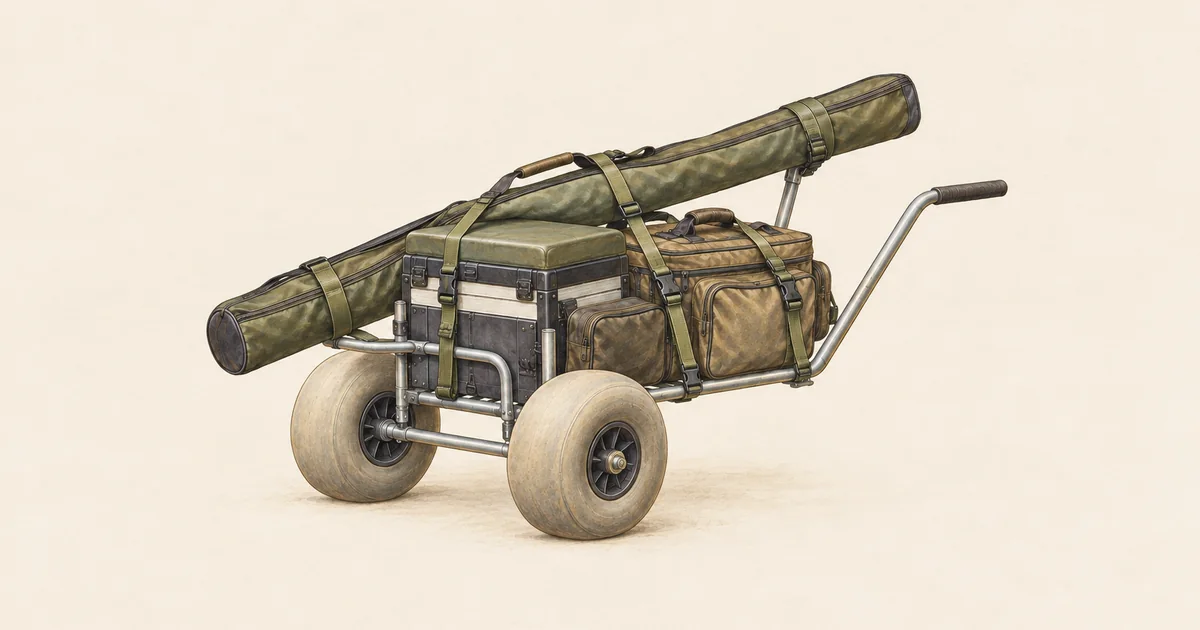
According to Blinker, the distance you can manage grows with every kilo you leave at home. For a day at the water a rod holdall with the essentials is often enough, no trolley at all. For surf fishing, a beach trolley with big, wide wheels is seen as a means of making even a long walk to the swim manageable. A short gravel track therefore calls for different kit than a kilometre over wet meadow or sand.
Designs: one, two or four wheels
- One wheel: You lift the cart by two handles and push it like a wheelbarrow. The BG BAU, the German employers’ liability insurance association for the construction industry (Berufsgenossenschaft der Bauwirtschaft), gives two rules: when you lift, the load’s centre of gravity sits over the axle, and you lift from a split stance with a straight back and put down the same way.
- Two wheels: It stands on one axle while moving and is pulled or pushed by the handle, much like a sack truck. The load is spread over two wheels instead of one.
- Four wheels: A cart with a pull handle or drawbar, the long pulling rod at the front. It stands by itself even when loaded, the load resting on four wheels.
- With electric drive: An electric trolley brings even distant spots within reach for a night. What the law says about that is in the questions below.
Wheels and tyres for soft ground
It gets difficult on wet meadow, sand and mud. A DLG leaflet for agricultural machinery, provided by the Bayerische Landesanstalt für Landwirtschaft, explains what happens there: wider tyres, a larger diameter or lower pressure increase the contact area, that is the area with which the wheel touches the ground. With the same load per wheel, the pressure on the ground then falls. A heavy load on a small area makes a vehicle sink into damp ground. The Bayerische Landesanstalt für Wald und Forstwirtschaft also names more wheels as a way to less load per wheel.
Applied to the trolley: for sand and wet banks, big, wide wheels such as those on a beach trolley suit best. Two or four wheels share the load, a single one carries it alone. The pressure of a pneumatic tyre can be adjusted, that of a solid tyre cannot. The load capacity is the manufacturer’s figure for how much weight the frame and wheels may carry. There is no general number, the figure on your trolley applies.
Loading and securing
- One-wheeled cart: Pack so that the centre of gravity sits over the wheel when you lift the handles. This is how the BG BAU describes it for the wheelbarrow.
- Securing: Run ratchet straps over the seat box, bags and rod bag right down to the frame so that nothing shifts on the way.
- Fixing the rods on top: The rod bag lies on top of the load and goes under the strap too. Which bag suits made-up rods is explained there. It must be long enough for the rods to fit in completely: a tip sticking out catches easily and snaps off. After fishing, the protective sleeve belongs over the rings of a trout rod.
- Plan the route: The DGUV, the German Statutory Accident Insurance (Deutsche Gesetzliche Unfallversicherung), advises thinking about slopes and gradients on the route while you load, so that you do not overload yourself.
Look up first: Carbon rods conduct electricity very well. The question catalogue for the angling exam (Fischerprüfung) in Saxony-Anhalt therefore urges caution when a thunderstorm is approaching or a power line is nearby. A made-up rod is in your hand at full length the moment you unpack it. Check what runs above you before you pull it out of the bag. Distances and pylon heights are given under Power lines and fishing rods.
Pulling instead of carrying: what strains the back
According to the DGUV it is an advantage to load heavy loads onto a cart or sack truck and move them that way instead of carrying them (DGUV Information 208-052). According to the DGUV, how much carrying strains you depends mainly on the weight and size of the load, the number of lifts, your posture and the length and condition of the route. When pulling and pushing a loaded cart, the strain arises mainly when starting off, braking and changing direction.
The BG BAU puts it briefly: pushing is better than pulling, with both hands, a straight back and force from the shoulders. Loads over 10 kilograms, such as the filled seat box, you lift onto the platform from a squat and close to the body, according to the BG BAU. The advice comes from occupational safety and is no substitute for medical advice.
Paths, dykes and protected areas
Where you may take the trolley is governed by the federal government, the states and the manager of the land. Examples, as of October 2026:
- Open countryside: Under § 59 Bundesnaturschutzgesetz, anyone may enter open countryside for recreation on roads, paths and unused land. State law may treat other uses as equivalent to entering, or restrict entering. Whether a cart counts is regulated by your federal state (Bundesland).
- Forest: § 14 Bundeswaldgesetz permits cycling, riding and driving invalid carriages only on roads and paths. The law does not mention hand carts, the details are regulated by the states.
- Dykes: In Lower Saxony, § 14 of the Deichgesetz prohibits any use of the dyke except for dyke maintenance by its operator. The dyke authority (Deichbehörde) may approve exceptions. As an example, the state agency NLWKN names driving motor vehicles outside approved paths. The dyke authority will tell you which paths on the dyke are open.
- Nature reserves: Under § 23 Bundesnaturschutzgesetz, actions that could destroy, damage, alter or lastingly disturb the area are prohibited there, subject to more detailed provisions. These provisions are in the area’s ordinance. Information is given by the lower nature conservation authority (Untere Naturschutzbehörde).
- Bank: The water regulations of the Landesanglerverband Brandenburg (2019 edition) prohibit, with reference to § 15 of the state’s fisheries regulation, entering or driving on the vegetated bank zone. The rights of access to the bank there give no right to drive motorised vehicles.
A guide without guarantee: the examples come from federal law, from Lower Saxony and from Brandenburg. For your water, state law, the fishing permit and water regulations apply. If in doubt, ask the club, the dyke authority or the lower nature conservation authority.
Pull-along wagon instead of a trolley
If you already have a pull-along wagon for days out, you can take it to the water too. The Digitale Wörterbuch der deutschen Sprache describes it as a two-axle handcart with a drawbar; Wikipedia calls it four-wheeled and distinguishes it from the hand barrow with one to three wheels. By that definition, one- and two-wheeled fishing trolleys are barrows, and the wagon is the four-wheeled type from the list above. They are built in very different ways, from a tubular frame with plastic wheels to a wooden cart with large metal wheels on ball bearings.
Terrain, sand and tyres
On soft ground, the same things count for a wagon as for a barrow: the width and diameter of the wheels. The DLG leaflet sums it up in a sketch: under the same load, a wide tyre presses less on the ground than a narrow one. If a wheel digs itself a rut, rolling resistance rises according to the same leaflet, and you feel that at the handle with every metre. How deep wheels sink in depends, according to the Bayerische Landesanstalt für Wald und Forstwirtschaft, on moisture, soil type and slope, among other things, and the wetter the ground, the less it bears. So the same meadow gives way more after a week of rain than in a dry summer.
Pneumatic tyres have an advantage that plastic and solid wheels don’t offer: the pressure can be adjusted. The DLG leaflet advises farmers not to drive on the field with high tyre pressure, and refers to the tyre manufacturer’s figures for the permissible value. Applied to a wagon or trolley, this means: a little less air for sand and wet meadows, but only within the range the manufacturer gives for the tyre and load.
Pros and cons compared with the trolley
In favour of the wagon:
- It stands on its own. You can pack in peace, without support legs and without the load tipping over when you let go.
- Four wheels share the load. According to the Landesanstalt für Wald und Forstwirtschaft, more wheels mean less load per wheel, which helps on soft ground.
- You don’t lift anything. You lift the one-wheeled barrow by its handles like a wheelbarrow, whereas with the wagon the whole load rests on the wheels.
Against it:
- It is pulled. The drawbar is built for pulling. You push the one-wheeled barrow, and the BG BAU considers pushing the better way to move a load.
- Basic models roll on plastic wheels. If these are narrow and small, they sink into sand and wet meadows. For beach and meadow the wagon needs wide wheels with a large diameter.
At night on the road: § 17 of the Straßenverkehrs-Ordnung governs lighting at dusk, in darkness and in poor visibility. Under paragraph 5, anyone on foot pushing or pulling a hand vehicle needs at least one lamp with white light on the left that is clearly visible from front and rear and does not dazzle. Whether your trolley or wagon counts as a hand vehicle, the section doesn’t say; the road traffic authority can tell you. As of November 2026.
Common mistakes
- Packing too much. Every kilo costs distance. What you do not need for one night stays at home.
- The rod bag is too short. The tip sticks out, catches on the way and snaps.
- Narrow wheels on sand and wet banks. With a small contact area they sink into soft ground.
- Forgetting the slope. What rolls well on a flat path can become too heavy on an embankment. Plan the route when you load.
- Raising the rod under a power line. Look up first, then unpack.
Frequently asked questions
One wheel or two wheels?
The one-wheeled cart is pushed and lifted like a wheelbarrow, and the BG BAU rules apply to it. With two wheels the load is spread over two contact areas, which helps on soft ground. Which form runs better on your path is shown by a trial run with a full load.
May I use a trolley with electric drive?
The water regulations of the Landesanglerverband Brandenburg exclude driving motorised vehicles from the rights of access. They do not say explicitly whether an electric trolley falls under that. Ask the association or manager beforehand, on other waters their rules apply.
How heavily may I load the trolley?
At most up to the load capacity the manufacturer states. Below that the route decides: the DGUV advises allowing for slopes and gradients while loading, so that you do not overload yourself.
Does a pull-along wagon work as a fishing barrow?
Yes, if the wheels suit the path. On sand and wet meadows it needs wide, large wheels; narrow plastic wheels dig in. Loaded, it stands on its own, but it is pulled by the drawbar, and the BG BAU considers pulling less favourable than pushing.
Related
- Seat box and fishing bag: what usually lies on the trolley
- Rod bag: carrying rods to the water protected
- Carp fishing: rig, bait and kit for the long session
- Feeder fishing and float fishing: methods with lots of bait and accessories
- Surf fishing: long walks over sand
- Power lines and fishing rods: distances from overhead lines
- Night session packing list: what belongs on the barrow for a night
- Line calculator: check the line’s breaking strain before the session
Sources
- Blinker: Karpfen am Parksee (ganzes Gerät auf dem Trolley, abgelegene Plätze) und Blinker: Karpfen-Spots im Verborgenen (weniger Gewicht, längere Wege, Tag ohne Trolley, Elektro-Trolley)
- Blinker: Brandungsangeln (Strandwagen mit großen, breiten Rädern)
- Blinker: Viele Ruten brechen durch falsche Handhabung (herausragende Spitzen, Futteral lang genug) und Blinker: Forellenrute (Schutzhülle über die Beringung)
- Land Sachsen-Anhalt: Fragenkatalog zur Fischerprüfung (Kohlefaserruten leiten Strom, Vorsicht an Stromleitungen)
- BG BAU: Heben und Tragen, Datenblatt (PDF) (Schubkarre anheben, Schieben statt Ziehen, schwere Lasten aus der Hocke)
- DGUV Information 208-052: Personengebundene Tragehilfen und Rückenstützgurte (PDF) (ziehen oder schieben statt tragen) und DGUV Information 208-035: Zustellen von Sendungen (PDF) (Belastung beim Tragen, Ziehen und Schieben, Steigungen beim Beladen)
- DLG-Merkblatt 344: Bodenschonender Einsatz von Landmaschinen (PDF, bei der LfL Bayern) (Aufstandsfläche, Reifenbreite, Durchmesser, Luftdruck, Einsinken, Rollwiderstand durch Spuren, Reifendruck nach Herstellerangabe) und Bayerische Landesanstalt für Wald und Forstwirtschaft: Merkblatt 22 Bodenschutz (PDF) (mehr Räder, weniger Last je Rad; Spurtiefe nach Feuchte, Bodenart und Hangneigung)
- Bundesnaturschutzgesetz, § 59 und § 23; Bundeswaldgesetz, § 14
- Landkreis Stade: Merkblatt Benutzung von Deichen (PDF) (Wortlaut § 14 Niedersächsisches Deichgesetz) und NLWKN: Deichrechtliche Genehmigungen (Beispiele genehmigungspflichtiger Nutzung)
- Landesanglerverband Brandenburg: Gewässerordnung (bewachsene Uferzone, keine Fahrt mit motorisierten Fahrzeugen)
- Wikipedia: Handwagen (Bollerwagen mit vier Rädern und Deichsel, Handkarren mit einem bis drei Rädern, Ausführungen; nur ergänzend)
- Digitales Wörterbuch der deutschen Sprache (DWDS): Bollerwagen (zweiachsiger Handwagen mit Deichsel)
- Straßenverkehrs-Ordnung, § 17 Beleuchtung (Leuchte für Fußgänger mit Handfahrzeug)
Text AI-assisted, drawing AI-generated. Sources opened and checked in October and November 2026, no graphics taken from the sources.
All figures are guidelines without guarantee. Where you may take the trolley is governed by state law, the fishing permit and the water regulations of your water.