
Knowledge · Tackle
Rod bag: Transporting rods safely
A rod bag gets your rods to the water and back home in one piece. Which design suits depends on whether the rod travels in sections or made up, how long its longest section is and whether it goes in the boot, on the trolley or on a plane.
Three designs: sleeve, bag, tube
In the equipment guide of the Fischereiverein Löningen, a teaching text for the angling exam (Fischerprüfung), rod sleeves and rod bags appear in the list of other accessories. Why, Blinker says briefly: rods and their rings are delicate, and for transport a rod bag protects against damage. Three designs can be told apart.
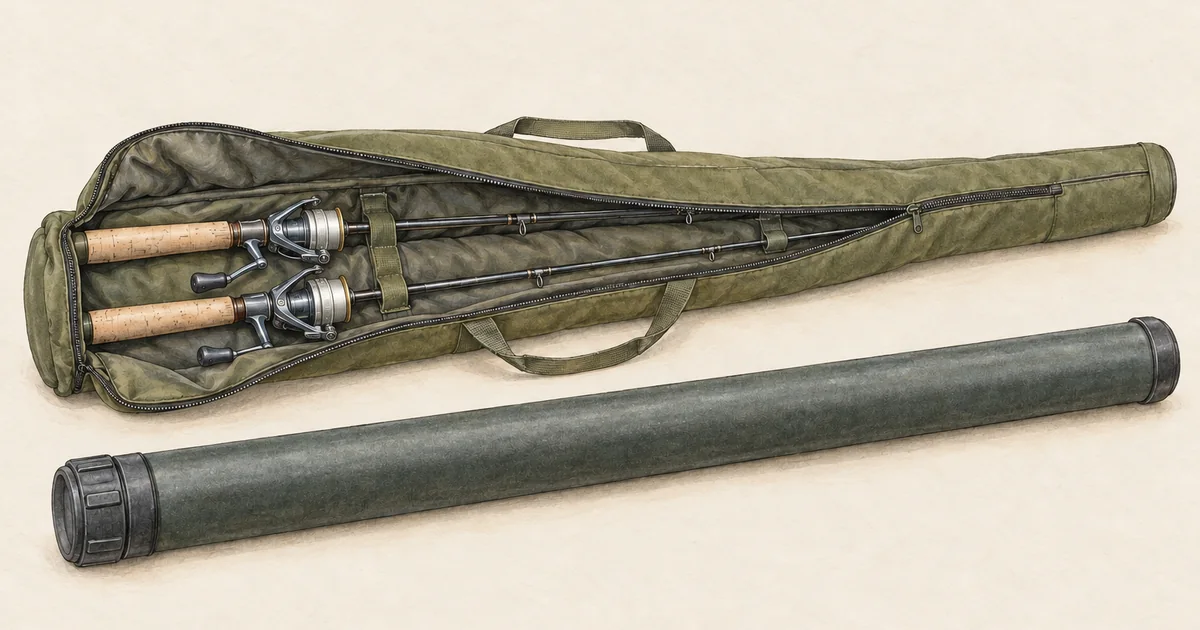
- Fabric sleeve: a soft cover for a single, usually broken-down rod. Ideally it has separate compartments for each section. That way the rod sections do not rub against one another and damage each other, writes the US magazine Game & Fish.
- Padded rod bag: a long bag with padded compartments for several rods. Small items travel too: spare tips for the feeder rod, for example, go in small hard cases, sorted in the bag. For the long walk to the beach a comfortable rod sleeve is part of the kit, together with a seat box and a beach trolley with wide wheels.
- Hard tube: a rigid tube with a lid, mainly for air travel. There are dedicated transport tubes, but a plastic pipe from the DIY store serves the same purpose. Not even the tube is completely safe. Rute & Rolle points out that one- and two-piece sea rods can be damaged on flights despite a tube and must be checked in as additional special baggage.
The length depends on the longest section
A rod bag must take the longest piece that is to go in it, which for broken-down rods means the transport length. That is often more than you think. According to Blinker, a two-piece carp rod can still measure more than 1.80 m broken down, and one-piece rods are usually only up to about 2 m long because of their transport length. How short travel rods get and which split fits in a suitcase is covered under Travel rod.
A sleeve that is too short is a breakage trap. If the tip sticks out at the top, it catches easily when you carry the bag over your shoulder, put it down or lay it down. The thick handle section is not harmed by that, but the thin tip snaps off quickly. So the rule is: use only sleeves into which the rods fit completely.
With a hard tube, room for padding is added. In a build guide for a home-made tube, Game & Fish cuts the pipe at least 2 inches longer than the rod sections, which is a good 5 cm, and puts a layer of foam at least 1 inch thick, about 2.5 cm, at the bottom.
Where rods break on the way
Much damage does not happen to the fish at all. With fine trout rods, according to Blinker, most of it happens while setting up and taking down and during transport, not in the fight, the battle with the hooked fish.
Car doors and boot lids come first. Loose rod sections slip unnoticed into the gap, and the rod breaks as you shut it. The same threatens a rod you lean against the car for a moment. So put the rods in a bag or tube, and before slamming, check that everything is fully in the car. According to Rute & Rolle, one- and two-piece sea rods are best stowed in a roof box.
At the water your own foot is the threat. Lean rods upright, tips angled upwards, and do not lay spare rods in the grass either, because other anglers could tread on them. If you have set up a rod rest, put the rod down there straight away.
Made-up rods: secure the tip, hook and line
Made up means: reel screwed on, line threaded through the rings, rig tied on. The easiest way is with the telescopic rod, which can be stowed fully made up and compactly. Transporting a four-piece travel rod made up and compact, on the other hand, is rather difficult. For made-up multi-piece rods the bag needs a compartment with room for the reel as well.
- Tip: For trout rods the rule is to slide the supplied protective sleeve over the rings after fishing. The fine spare tips of the feeder rod belong in their own hard case.
- Hook: Some rods have a hook keeper on the handle, in which you hang hooks or artificial lures for transport. Not every rod has one. Then a thin cable tie around the reel foot helps.
- Line: Before the first turn of the handle, check that the line runs freely through all the rings. Quivertips usually break because the line has wrapped around one of the upper rings and the handle is then turned. If the line has wrapped unnoticed around the tip, a hard cast is more likely to wreck the tip than the line.
Look up first: Carbon rods conduct electricity very well. The question catalogue for the angling exam (Fischerprüfung) in Saxony-Anhalt therefore advises taking particular care in thunderstorms and under power lines. A made-up rod is in your hand at full length at once. Check what runs above you before you pull it out of the bag and raise it. More under Power lines and fishing rods and Thunderstorms and weather.
Packed wet: drying rods and bag
After a rainy day a lot ends up in the bag wet. After cleaning, rods go through the winter break in a cool, dry room.
For a cork handle, according to Rute & Rolle, it is better to use no wax, varnish or oil. They seal the surface, and if moisture does get in through small flaws, the handle can go mouldy. Few reels tolerate salt water. After sea fishing, rinse them with fresh water and let them dry. At home the rule is therefore: open the bag, take the rods out, let bag and rods dry separately and only then pack again.
Common mistakes
- The sleeve is too short. The tip sticks out and snaps when carried or put down. Measure the longest section before you choose a bag.
- Loose rod sections in the boot. They slip into the gap of the door or lid. Everything belongs in a bag or tube.
- Laying the rod in the grass while unpacking. One step while setting up is enough. Lean it with the tip up or put it straight on the rest.
- Packing it made up without protection. With no sleeve over the tip and the hook hanging free, the rod travels unsecured.
- Packing it wet and leaving it shut for weeks. For storage, rods belong dry in a cool room.
Frequently asked questions
How long does my rod bag need to be?
Long enough for the longest section to fit in completely and no tip to stick out. For a home-made hard tube, Game & Fish allows at least a good 5 cm extra so that there is room for padding at the bottom. If in doubt, measure rather than relying on the rod’s overall length.
Is a fabric sleeve enough for air travel?
For short travel rods in a suitcase, often yes: many come with a reinforced, shock-resistant sleeve. Longer rods travel in a tube as special baggage. What the airline requires is in its baggage rules, more under travel rod.
Where do I put the spare tips of the feeder rod?
In a small hard case that goes into the rod bag. That keeps the tips sorted and clean, and the thin tips do not break in transport.
Related
- Travel rod: transport length, sleeve in a suitcase and building your own rod tube
- Telescopic rod: pushed together, on the move even when made up
- Fishing rods: parts of the rod from blank to tip ring
- Carp rod: long rods with length given in ft
- Feeder rod: spare tips, classes and set-up
- Fishing trolley: wheeling heavy kit over long distances
- Surf fishing: long rods and lots of kit on the beach
- Line calculator: work out breaking strain and backing
Sources
- Blinker: Viele Ruten brechen durch falsche Handhabung (Autotüren und Klappen, zu kurzes Futteral, Ruten am Boden, Zitterspitzen beim Kurbeln)
- Blinker: Angeln: Alles Wichtige für Deinen Einstieg (Rutentasche schützt beim Transport, Rollen und Salzwasser) und Blinker: Die richtige Angelrute: Darauf kommt es an (einteilige Ruten bis etwa 2 m)
- Blinker: Ruten-Kompaktklasse: Reise- oder Telerute? (Transportlänge über 1,80 m, Telerute montiert, Reiserute montiert schwierig) und Blinker: Mit Angelausrüstung auf Flugreisen (stoßfestes Futteral, Transportrohre, Kunststoffrohr)
- Blinker: Forellenrute: Entscheidende Faktoren für die richtige Rutenwahl (Schäden bei Auf- und Abbau und Transport, Schutzhülle), Blinker: Feederspitzen: Für jede Situation gewappnet (Hartschalen für Wechselspitzen) und Blinker: Bastel-Tipp: Kabelbinder als Hakenöse (Hakenöse, Kabelbinder am Rollenfuß)
- Blinker: Brandungsangeln: Alles, was man über diese Angelmethode wissen muss (Rutenfutteral und Strandwagen) und Blinker: Die 7 häufigsten Fehler, die Ihre Angelrute zerstören (Ersatzruten nicht ins Gras, Schnur um die Spitze)
- Rute & Rolle: Gerätetipps für Norwegen (Rutenrohr, Sperrgepäck, Dachbox) und Rute & Rolle: Angelruten pflegen: So geht’s richtig (Kork und Schimmel, Lagerung kühl und trocken)
- Game & Fish: Make Your Own Rod Tube That Can Withstand a Lawnmower (Stoffhülle mit Fächern, Rohrlänge, Polster, Kontaktdaten auf dem Rohr)
- Fischereiverein Löningen: Gerätekunde zur Fischerprüfung (PDF) (Rutenfutterale und Rutentaschen als Zubehör) und Land Sachsen-Anhalt: Fragenkatalog zur Fischerprüfung (PDF, Stand 28.04.2022) (Kohlefaser leitet Strom)
Text AI-assisted, drawing AI-generated. Sources opened and checked in October 2026; no graphics taken from the sources.
All figures are guidelines without guarantee. How to break down, protect and store your rod is also covered in the manufacturer’s instructions.