
Knowledge · Tackle
Rod rest: Rod holders front and back
A rod rest carries the rod while you sit and wait, usually in a V at the front and at the handle at the back. The shape and spacing of the two rests decide whether the line runs off freely on a bite and the tip stays still. They also decide whether a hard bite pulls the rod off the holder.
What the rest is for
In bottom fishing and feeder fishing the rod lies still most of the time, often for hours. According to Rute & Rolle, a rod holder keeps the rod out of the mud and determines whether it stands steep or flat. On a bite it should let the line run off freely while withstanding a fair amount of pull.
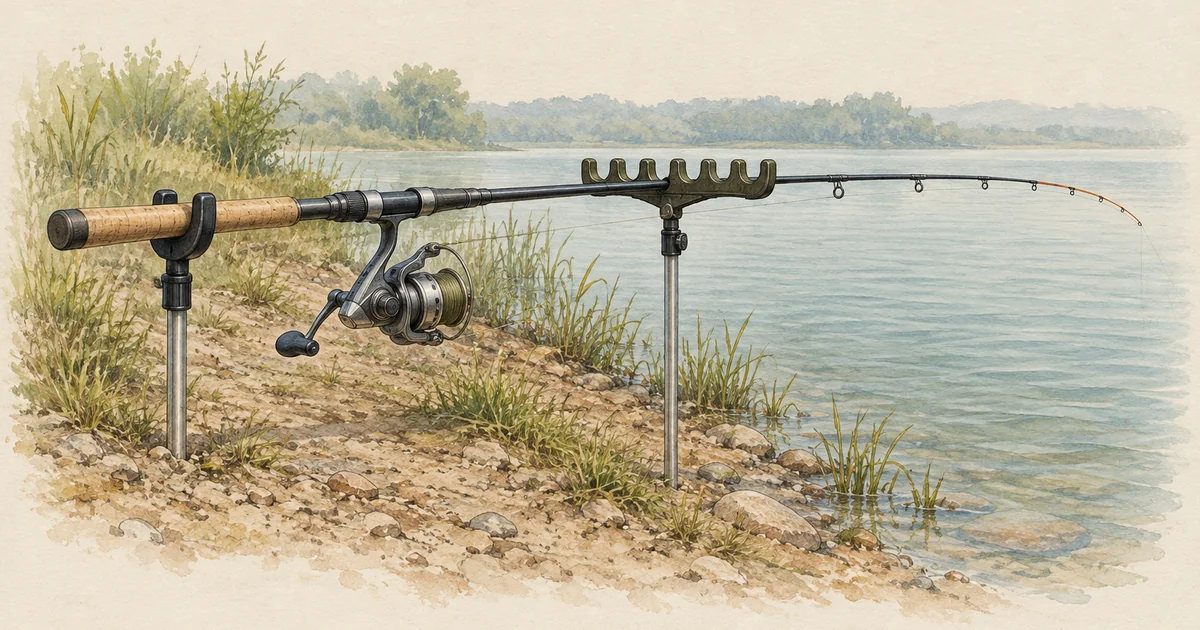
For bite indication, calm is what counts most. Bottom anglers usually lay the rod horizontally on two rests. The firmer it lies there, the finer the bites you can detect on the tip or indicator. The rest can itself be part of the indication. According to the angling exam teaching material of the Fischereiverein Löningen, the electronic bite alarm doubles as the front rod rest: the line runs over its trigger, and the signal is usually light and sound. Which indicators exist is explained under Bite indicators.
Designs for front and back
The simplest rest is a bought forked stick: a pole sharpened at the bottom with a V as the support. For a start and for float fishing that is enough. Better are spikes right away that can be adjusted in length and are sturdy, because cheap ones bend quickly. Ground spikes of aluminium or stainless steel, called banksticks among carp anglers, have a thread at the top onto which you screw the suitable rest at the front and back.
| Design | Position | Job |
|---|---|---|
| V rest | front | carries the blank, the line runs freely underneath |
| U rest | back | takes the handle |
| Butt clamp | back | clamps the handle, for hard bites |
| Feeder rest | front | elongated and flat, sideways strike possible |
| Buzzer bar | on the bankstick | carries two or three rods side by side |
| Electronic bite alarm | front | rest and bite signal in one |
The blank, the load-bearing tube of the rod, lies in the V rest. The line has to run freely underneath. Clamping butt holders make sense when hard bites are expected. The buzzer bar, a wide support for two or more rods, is screwed onto the thread like a single rest.
Spacing of the two rests
Blinker has shown the spacings on a 3.90 m rod. At the back the rod rests close to the end of the handle, and the reel always sits in front of this rest. The front one stands far enough ahead that the rod lies straight and balanced and a long length of tip sticks out freely at the front. This tip shows bites more finely and cushions a violent tug before it pulls the rod off the rest. If the rests stand further apart, the rod sags in the middle without lying any more securely.
Guide values according to Blinker for a 3.90 m rod: rear rest about 20 to 30 cm in front of the end of the handle, depending on the handle length, front rest 1.20 to 1.50 m further forward. Then around 2.10 to 2.50 m of rod stick out freely. If you are unsure, look at the spacings on a rod pod, where they are usually right.
High, flat or sideways
In bottom fishing the rod should point roughly in the direction in which the rig lies. Then the fish feels less resistance when pulling off, and the indication reacts most finely. For carp fishing there is a second reason: if the rod points at the bait, it is not pulled sideways off the rest on a bite. Why the rod stands high on a river and flat on a lake is explained on the page Bottom rod.
In strong crosswinds it helps to dip the tip slightly into the water so that the wind does not catch the line. With two rigid spikes of equal length that hardly works, especially since they do not go equally deep into the ground everywhere. That is why adjustable spikes are better. Conversely, you point the tip upwards in tall bank grass.
If you want to set the rod steeply, you can use just one spike and rest the end of the handle on the ground. On thin spikes or in soft ground that is wobbly: when pull comes on the rod, the spike twists. Holders built for rods set high, as you know them from fishing for wels catfish and from the surf, stand more firmly.
Rests for feeder fishing
In feeder fishing the rod does not point at the rig. Line and tip should form roughly a right angle. That is why the rod either stands steeply or lies flat and sideways to the feeding spot, as in Fig. 1 below. How you then tension the tip is explained under Feeder rod.
There are dedicated feeder rests for the front. They are elongated so that the rod can be pulled sideways on the strike without a detour. If it lies in a V rest instead, you first have to lift it out, and according to Rute & Rolle many bites are lost that way. For the short picker rod too, a flat, wide rest at the front is recommended.
A match angler describes his set-up on the river. The rig lies directly in front of him, but the rod lies in the holder downstream of it. To keep it as high as possible, he sets the feeder arm, an extension on his seat box, correspondingly high. His rest clamps the rod so that a bite cannot pull it out.
Banksticks, rod pod and tripod
Banksticks are ground spikes with a thread onto which rests or bite indicators are screwed. For carp fishing they are regarded in many situations as the more flexible solution: they can be placed freely, even with a large gap between two rods, are cheap, quick to set up and easy to carry. More on this under Banksticks.
On jetties, sheet piling, rock armouring, gravel or hard clay, spikes do not hold. There you need a frame with its own feet. On the rod pod the rods lie side by side on a frame of plastic or metal. A tripod is the choice for rods set high, for example in the surf or when fishing for wels catfish; some rod pods can do both, high and flat. In surf fishing a sack of sand hung in it holds the tripod against wind and fish. On rock armouring, where people fish for barbel, you weigh it down with a sack of stones (Fisch & Fang).
Common mistakes
- Rests too far apart. The rod sags, hardly any tip sticks out at the front, and a hard bite is no longer cushioned.
- Reel behind the rear rest. It belongs in front of it; the rod rests close to the end of the handle.
- Line jams at the front. In the V rest the line must run freely under the blank, otherwise the fish cannot take line on a bite.
- Rod across the rig when sitting and waiting. A bite can then pull it sideways off the rest.
- Steep on a thin spike in soft ground. Under pull the spike twists away and the rod ends up in the mud.
Frequently asked questions
Do I need a rod rest for float fishing?
Not necessarily, because the float shows the bite. A holder still makes sense: if the rod lies in the grass, the line easily snags in the bank plants, and from a comfortable gripping height you strike faster. More on the method under Float fishing.
Banksticks or rod pod, which first?
Where spikes can be pushed into the ground, banksticks are the more flexible and cheaper choice. If you mainly fish from jetties, stones or concrete, you need a rod pod. For jetties a simple model is enough; for uneven ground one with more adjustment options is worth it.
What are snag ears?
These are small pins that stick up vertically on the bite indicator. They stop a fish pulling the rod off the holder against a tightly set free spool. In addition, the handle can be secured with clips. How the free spool works is explained under Free-spool reel.
Related
- Banksticks: ground spikes with a thread for rests and indicators
- Rod pod and tripod: frames for jetties and hard ground
- Bite indicators: how a bite is signalled on a rod laid down
- Swingers and hangers: drop-in indicators between reel and first ring
- Feeder rod: tips and set-up on lake and river
- Carp rod: length and test curve for sitting and waiting with a fixed lead
- Line calculator: what the line still holds after the knot
Sources
- Rute & Rolle: Rutenhalter, welche gibt es und wofür? (Aufgaben, Bauformen vorn und hinten, Buzzer Bar, Ausrichtung beim Grundangeln und Feedern, Seitenwind, steiler Aufbau, Rod Pod und Dreibein, Posenangeln)
- Blinker: Rutenauflage, so legst du deine Angelrute richtig ab (Abstand der Auflagen an einer 3,90-m-Rute, Rolle vor der hinteren Auflage, freie Spitze federt Bisse ab, Rod Pod als Maß)
- Blinker: Karpfen-Kickstart (Banksticks und Rod Pod, zwei Banksticks je Rute, Winkel bei Vegetation und Wind, Rute zeigt auf den Köder) und Blinker: Rosenkrieg, Karpfen an der Krautkante (Snag Ears, Klammern am Griff)
- Rute & Rolle: Einfach mal feedern (längliche Feederauflage, Anhieb zur Seite) und Rute & Rolle: Der Winklepicker, ein sensibler Klassiker (flache, breite Ablage vorn)
- Blinker: Feederangeln im Fluss, Tipps vom Weltmeister (Rute stromab, Feederarm an der Sitzkiepe, Klemmauflage)
- Blinker: Bodenblei und Futterkorb, eine Übersicht (zwei Auflagen, ruhige Lage für feine Bisse) und Blinker: Englisch beim Angeln (Bankstick, Buzzer Bar, Rod Pod)
- Blinker: Brandungsangeln (Dreibein mit Sack Sand) und Fisch & Fang: 50 Barben-Tipps (Dreibein auf der Steinpackung, Sack Steine)
- Fischereiverein Löningen: Gerätekunde (PDF) (elektronischer Bissanzeiger als vorderer Rutenhalter)
Text AI-assisted, drawing AI-generated. Sources opened and checked in October 2026; no graphics taken from the sources.
All figures are guide values without guarantee. Which rest suits depends on bank, ground, method and rod length.