
Knowledge · Tackle
Swingers and hangers: Making drop-backs visible
A swinger or hanger is a small weight that hangs in the line under the rod when you sit and wait and keeps it under tension. When a fish takes line it rises; if it swims towards the rod it drops. That makes drop-backs visible too, and audible with the electronic bite alarm.
How the weight shows a bite
When sitting and waiting, the rod lies flat on the rest and points in the direction of the rig. You hang a weight in the line between reel and rod tip. The sequence: when the fish takes line the indicator rises, when it comes towards the angler it drops. For both to work, the weight hangs roughly midway between rod and ground according to Rute & Rolle, with room to move up and down. Fisch & Fang names the stretch between reel and first ring as the place.
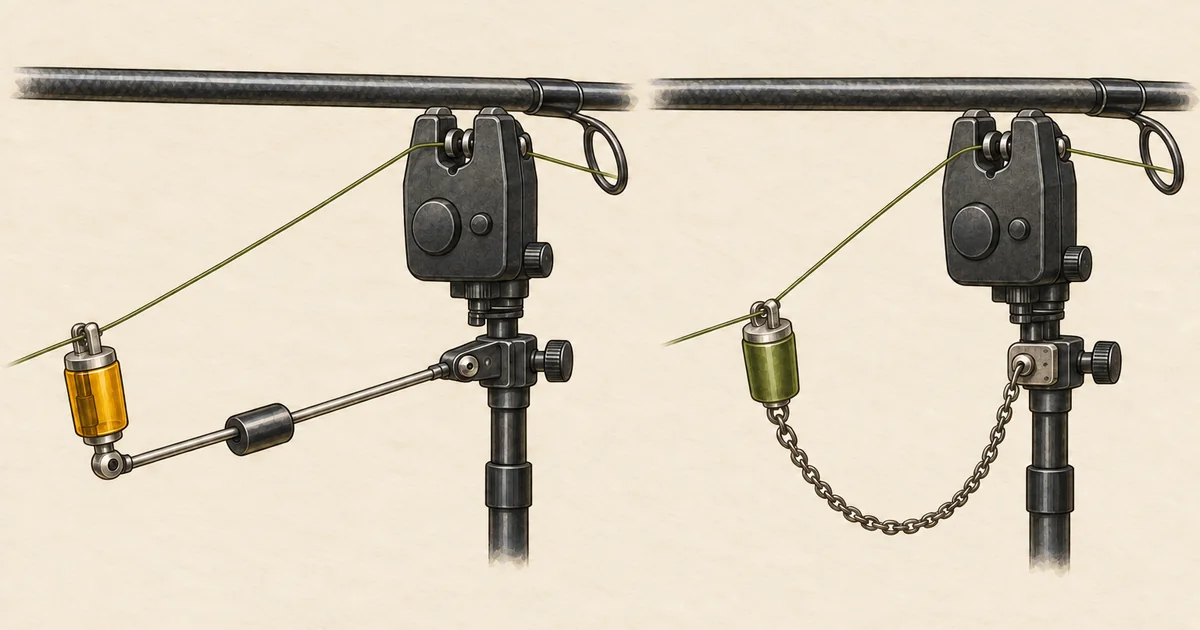
The weight has two jobs. It makes every movement of the line visible, and it keeps the main line taut. Only with taut line do you recognise fine plucks and drop-backs. A forerunner is the monkey climber: a plastic body climbs up a metal rod on a bite and releases the line at the top. Among carp anglers it has been displaced by electronic bite indicators and swingers.
Run and drop-back
On a run (Abzugsbiss) the fish swims away from the bank. Anglers call this a run, meaning the fish bolts after taking the bait. The line pulls out and the swinger rises up to the blank, the tube of the rod. On a drop-back (Fallbiss) the fish comes towards you. The line goes slack and the weight sinks down.
Drop-backs are common when carp fishing with a heavy fixed lead. According to Blinker, a hooked carp cannot bolt forwards and therefore usually swims towards the angler. If you then pick up the rod, you often have no contact with the fish. Bream often bite like this as well. The same goes for grass carp: the angler strikes there as soon as the swinger drops briefly (Fisch & Fang).
How clearly a drop-back shows depends on line tension. If the line hangs slack from the tip, the weight also hangs straight down and can hardly fall any further. English carp anglers use slack line mainly at short range, up to about 46 m (50 yd) (Angling Times). Close to the bank drop-backs are rare, as most fish swim off sideways there. One carp angler thinks they only make sense right at the bank: with sagging line he had clearly more missed bites, because he saw drop-backs too late or not at all. If the rod points at a nearby bait, on the other hand, a drop-back is rather unlikely. Anyone casting to the far bank needs a swinger.
Swinger and hanger: the differences
A swinger (in German Hängebissanzeiger) has a mount that you push onto the thread of the bite indicator and screw together onto the bankstick, a single rod rest with a thread. The weight sits on an arm and can be moved. This lets you adjust line tension very precisely to wind and current. For long distances there are versions with a long arm.
A hanger, in English a bobbin, hangs directly on the main line as a visual indicator. One carp angler we asked prefers them to the swinger and leaves them half slack where possible. That way they show the slightest twitch, on drop-backs and runs alike. Only in wind or current does he tighten the line more, so the bite alarm does not bleep constantly.
The simplest form is a plastic ring that you hang on the line between two rod rings. It is considered cheap and sensitive, but prone to wind. It stays on the line while playing the fish and can damage delicate rings. Hanging indicators made from a small plastic capsule can be weighted with water or shot in wind, and at night a glow stick fits inside.
Choosing the weight for the situation
A light weight offers the fish little resistance, a heavy one keeps the line steady in wind and current. Match the weight to the conditions: in strong wind you need heavy models (Fisch & Fang). The angling press advises, depending on the situation:
| Time | Weight and line |
|---|---|
| Wind or current | heavier, line tighter |
| Bream on a running lead | free-moving swinger |
| deadbait for zander, eel with the bail arm open | hanging indicator as light as possible |
| Tench in weed | light swingers, leave heavy ones out |
| Line with a sinking weight | very light, the lead must not lift |
| Obstacles close to the bait | line tight with no sag, clutch closed |
On a running lead the fish should take line with as little resistance as possible. A bream does not run as fast as a carp, so the swinger has to show even the first twitches. When fishing deadbait for zander, one angler pulls his hanging indicators almost down to the ground. That leaves time to strike before they hit the blank.
With a fixed lead the carp runs against the lead and hooks itself, see hair rig. For half-tight line, the usual setting (Angling Times), the weight hangs only about 7,5 cm (3 inches) below the blank. Then it shows bites in both directions. If you have pulled the line tight in front of lilies or branches and wound the clutch right down, first check in the line calculator what your line can still take after the knot.
Working with the electronic bite alarm
The electronic bite alarm monitors line pulling out. When the line runs, it turns a vane that breaks a light beam, and the unit gives a signal. On a drop-back, though, the fish does not pull line. The weight does the rest: when the line goes slack, the swinger pulls it backwards through the bite alarm and the drop-back becomes audible. That is why bank anglers combine audible and visual indicators.
The order: cast the rig, tighten the line, lay the rod in the bite alarm, then hang on the swinger. Set the tension so that it moves freely but does not swing too much in the wind. A freespool reel or a slackened clutch helps with fine adjustment. In wind and rain it is worth adjusting the sensitivity on the unit so that false alarms are less frequent.
Supervision: swingers and bleepers are no substitute for paying attention. The Saxon fisheries regulation (Sächsische Fischereiverordnung) requires in § 4 that hand lines are supervised constantly and that electronic bite alarms do not replace supervision. What applies in your federal state (Bundesland) is set by state law and the fishing permit (Erlaubnisschein).
Common mistakes
- Weight too heavy for cautious fish. Extremely light hanging indicators show even the finest twitches, heavier ones lead to missed bites with eels. For tench in weed, anglers advise against heavy swingers altogether.
- Slack line at distance. The weight hangs straight down and can no longer fall. Drop-backs go unnoticed.
- No room to move. If the weight is already stuck to the blank, it no longer shows a run. If it lies on the ground, it cannot fall on a drop-back.
- Striking at once on a drop-back. The fish is swimming towards you, so according to Angling Times you first wind in the slack line.
- Ignoring single bleeps. In winter the swinger often rises only a little, and wild runs are rare. Even a few bleeps are worth a strike before the carp throws the hook.
Frequently asked questions
Do I need a swinger if I have an electronic bite alarm?
In most cases yes. Without a weight the bite alarm only signals when line runs out, and a drop-back stays silent. Only if the rod points straight at a nearby bait can you do without a swinger.
Which is more sensitive, swinger or hanger?
The sources give no fixed ranking. With the swinger you fine-tune the tension with the sliding weight. According to one carp angler we asked, a hanger hanging loosely shows even the smallest twitches.
Does a hanger also work on a river?
Only to a limited extent. Hanging indicators suit still and slow-flowing waters, and on a river only at close range. In stronger current anglers turn to the quiver tip of a feeder rod.
Related
- Bite indicators: electronic and mechanical indicators at a glance
- Banksticks and rod pod: what the rod and bite indicator stand on
- Free-spool reel: releasing line without opening the bale arm
- Bottom rod: length, casting weight and rest when bank fishing
- Carp fishing: fixed lead, feeding spot and fight
- Line calculator: breaking strength after the knot and line quantity
Sources
- Blinker: Bissanzeiger richtig nutzen und mehr fangen (Schnurspannung, Kletteraffe, Einhänge-Ring, Kapsel, Elektronik) und Blinker: Hanger statt Swinger (halb durchhängender Hanger, straffer bei Wind und Strömung)
- Blinker: Brassen angeln, alle Grundlagen (Fallbisse, Swinger zieht Schnur durch den Bissanzeiger), Blinker: Angeln auf Brassen (leichtgängige Swinger am Laufblei) und Blinker: Karpfenangeln, Tipps für eine erfolgreiche Fangstrategie (Festblei, Selbsthakeffekt und Fallbiss)
- Blinker: Karpfenangeln in klaren Gewässern (durchhängende Schnur, Absenkblei), Blinker: Schleienmontagen fürs Kraut (leichte Swinger) und Blinker: 10 Mythen zum Karpfenangeln im Winter (vorsichtige Bisse)
- Blinker: Zanderangeln mit Köderfisch (Einhänger tief und leicht), Blinker: Angeln auf kapitale Aale (leichte Einhänger, offener Bügel), Blinker: Graskarpfen angeln (Bobbins in die Hauptschnur) und Blinker: Englisch beim Angeln (Swinger, Run, Bankstick)
- Fisch & Fang: Achtung, Biss! (Platz in der Schnur, verschiebbares Gewicht, Einsatzbereich), Fisch & Fang: Karpfen am Kanal (Swinger beim Angeln zum anderen Ufer) und Fisch & Fang: Graskarpfen (Fallbisse, Anhieb beim Durchsacken)
- Rute & Rolle: Grundangeln, so gelingt der Einstieg (Rute flach, Einhänger steigt oder fällt, halbe Höhe)
- Angling Times: When to use tight or slack lines for carp fishing (Schnurspannung, 3 Zoll Durchhang, Anhieb beim Fallbiss) und Angling Times: How to set up a bite alarm (Halterung am Gewinde, Spannung, Empfindlichkeit)
- Freistaat Sachsen: Sächsische Fischereiverordnung (§ 4, Aufsicht und Bissanzeiger) und Wikipedia: Bissanzeiger (Flügelrad und Lichtschranke, nur ergänzend)
Text AI-assisted, drawing AI-generated. Sources opened and checked in October 2026; no graphics taken from the sources.
All figures are rough guides without guarantee. Which weight and line tension suit depends on wind, current, rig and target fish.