
Knowledge · Tackle
Seat box: Seat and tackle box in one
A seat box is seat and tackle box in one: under the cushion are drawers and compartments, the legs can be adjusted individually, and the footplate, side tray and rod rests hang from them. Here you can read why pole anglers and feeder anglers use one, how to set it level on a sloping bank and how high the seat should be for a long rod.
From carrying basket to seat box
A „Kiepe“ was originally a basket carried on the back. The etymological dictionary in the Digital Dictionary of the German Language traces the word to Middle Low German kīpe, a large carrying basket. At the water it has become a box to sit on. The training material of the Löningen angling club for the angling exam (Fischerprüfung) lists seat boxes under other accessories, next to a tackle box, bait tubs and a rod bag.
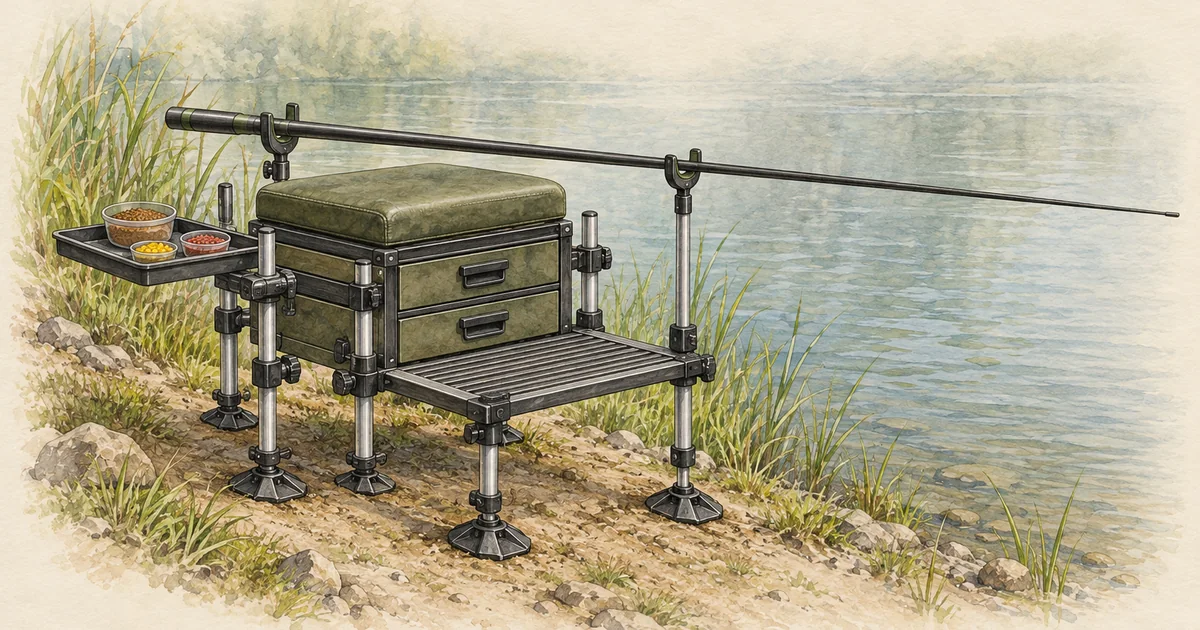
In the 1970s every experienced pole angler had such a box, according to Fisch & Fang, with floats, hooklengths, weights and groundbait inside. Today the old box is rare, according to the same article, replaced by the more comfortable fishing chair. It has not vanished, though: Blinker counts a seat box with adjustable legs or a built-in platform as basic kit for pole fishing, and for feeder fishing it carries the rod rest.
Design: compartments, seat, legs and footplate
Under the padded seat, compartments and drawers sit one above the other. What matters is described by the British Angling Times in a guide:
- Drawers: drawers at the front hold small accessories, but they must open without you getting up. Drawers that run sideways or right across the box are easier to use.
- Seat: firm but comfortable, because you often spend more than five hours on it. The rod support that almost every seat carries in the middle is mainly useful in flowing water, where it holds the rod perfectly still.
- Legs: telescopic legs that are extended individually and fixed with clamps. Round legs are regarded as the most stable, and most attachments fit them too. At the bottom are swivelling mud feet, at the top threaded end caps for accessories.
- Footplate: a non-slip plate that slides out from under the front of the box. Because almost every bank slopes towards the water, it has its own telescopic legs, like the front legs. On a platform in the water it tends to be in the way and should be easy to remove.
You get more seat height with additional stacked compartments. So that the box does not become top-heavy and tip over when you lift it by the shoulder strap, the bottom section should be deep and in one piece.
Attachments on the legs
You clamp to the legs whatever should be within reach. Arrange everything for the day so that you can reach it from the seat. Anyone who keeps getting up scares fish off the swim, especially close to the bank.
- Side tray: a small table for bait tubs and the groundbait bowl. It hangs lower than the seat: the contents stay within reach, and on this side you can still fish close to the bank. How the groundbait gets into the bowl is described under groundbait bucket and groundbait riddle.
- Landing net holder: laid across the side tray, the landing net blocks the tubs or gets in the way of the rod. It is better on its own rest next to the tray.
- Rod rest for the pole: in strong wind you support the long rod on your knees and thighs or on a rest at the platform. Or you shorten the rod by one or several sections.
- Feeder arm: a boom with a rod rest. On a river you attach it to the box so high that the rod lies as high as possible downstream, and you clamp the rod in so that a bite cannot pull it out. How the rod sits in relation to the baited area is explained under feeder rod and rod rest.
For a short session after work, according to Rute & Rolle a small box without a footplate and with a fixed side tray is enough.
Setting up level on a sloping bank
- Plumb first, then set up. Plumb the swim before you put the platform down for good in the rock armour. If there are snags, moving is still quick. How to plumb the depth is described under pole fishing.
- Adjust leg by leg. On a slope you extend the front legs further than the back ones until the seat is level (Fig. 1). Then tighten every clamp firmly.
- Adjust the footplate. Pull the plate out and set its legs so that your feet stand flat on it. How high is explained in the next section.
- Look up. Where the box stands decides where the long rod reaches. Distances from overhead lines are described under Power lines and fishing rods, behaviour in thunderstorms under Thunderstorms and weather.
Stability test: sit down and shift your weight backwards. If a leg slips in its clamp, it will slip while you fish too. Then stand right at the front of the footplate. If the box tips forward, you will sooner or later end up in the water, according to Angling Times. The test is worth doing when you buy; on the bank it takes half a minute.
Seat height for the long rod
When fishing with the pole, your thighs carry most of the weight, not your arms. In the classic position the rod lies across your thighs, according to Angling Times, with forearm and elbow keeping it balanced. For the strike you lift your knees sharply.
For this your feet stand flat on the footplate and your knees are bent at a right angle. Your thighs are then level, parallel to the water, and the rod rests on them without the tip dipping in (Fig. 3). If the seat is too high, you end up on tiptoe and lean back, which is hard on your back.
| What you notice | Cause | Remedy |
|---|---|---|
| Heels lift, you sit on tiptoe | Seat too high | Shorten the box legs or raise the footplate |
| Thighs slope forwards | Seat too high | as above, if need be take off a compartment |
| Rod tip dips in when you lay the rod down | Thighs not level | Readjust seat and footplate |
| Rod cannot be held steady in the wind | full length, no support | Shorten the rod, use a rest on the box |
At fisheries with level, firm swims you set the height once. On a natural bank you readjust it at every swim.
Weight, transport and care
With full drawers a big box gets heavy. Check before you buy whether it fits your trolley; more on that under tackle trolley. And take only what you need. Many seat boxes hold a huge number of different floats, yet according to Blinker four shapes in different carrying capacities are enough for all pole fishing (see floats).
Care includes the following: when packing up you rinse the footplate with a few bait tubs of water so that no sand stays in the runners, wash the mud off the legs, treat the clamps with spray oil now and then and look behind the drawers for jammed hook packets.
Common mistakes
- Seat set too high. You end up on tiptoe, lean back, and after a few hours your back lets you know.
- Stepping onto the footplate without a test. Otherwise you only notice slipping legs while fishing, and a box tipping forwards only in the water.
- Drawers that only open when you stand. Every time you get up it brings disturbance to the swim.
- Landing net across the side tray. It blocks the bait tubs and gets in the way of the rod.
- Setting up first, plumbing afterwards. If the plummet finds a snag, you have to move the whole box with all its attachments.
Frequently asked questions
Seat box or fishing chair?
The chair is more comfortable and, according to Fisch & Fang, has largely replaced the classic seat box. In favour of the box is that compartments, side tray and rod rests sit on one frame and everything is within reach from the seat. That counts above all for pole fishing and for feeder fishing.
Do I need a footplate?
On a sloping natural bank it is worth it: with its own telescopic legs it evens out the slope. On a platform in the water it can get in the way instead, and then you take it off.
What do left-handed anglers need?
Drawers that run right across the box, or a compartment unit that can be turned round so that the drawers open to the left. Left-handed anglers look for that when buying.
Related
- Pole rod: whip, elastic and breaking down with a pole roller
- Pole fishing: rig, plumbing the depth and sparing feeding
- Feeder fishing: feeder, feed trail and how the session runs at the water
- Rod rest: rest at the front and back, for the feeder rod too
- Tackle trolley: taking box and gear to the swim on wheels
- Fishing chair: the more comfortable seat with a backrest
- Line calculator: comparing the breaking strain of mainline and hooklength
Sources
- Angling Times: How to pick the right seatbox (Sitzhöhe, Schubladen, Beine, Fußplatte, Standprobe, Trolley, Pflege)
- Angling Times: Pole Fishing Masterclass, Teil 3: Set your seatbox to get you sitting comfortably (Füße flach, rechter Winkel, Seitenablage, Kescher, alles in Reichweite) und Angling Times: Pole fishing tips, how to hold a pole properly (Rute über den Oberschenkeln)
- Blinker: Kopfrute für Anfänger (Kiepe zur Grundausrüstung) und Blinker: Windkraft ausschalten (Halter, Rute kürzen)
- Blinker: Feederangeln im Fluss, Tipps vom Weltmeister (Feederarm) und Blinker: Fehler beim Stippangeln (zu viele Posen)
- Fisch & Fang: Die alte Sitzkiepe (früher Standard, heute selten) und Fisch & Fang: Strom-Stippen (erst loten)
- Rute & Rolle: Feedern mit Wurm und Kralle (kleine Kiepe für kurze Ansitze)
- Fischereiverein Löningen: Gerätekunde (PDF) (Kiepe als Zubehör) und Digitales Wörterbuch der deutschen Sprache: Kiepe (Wortherkunft)
Text AI-assisted, drawing AI-generated. Sources opened and checked in October 2026; no graphics taken from the sources.
All figures are rough guides without guarantee. How high and how sloped your box needs to stand depends on your height, the bank and the rod length, and where you may set up is stated in the water regulations (Gewässerordnung) and the fishing permit (Erlaubnisschein).