
Knowledge · Tackle
Fishing umbrella: Protection from rain, wind and sun
A fishing umbrella keeps off rain, wind and some of the sun during a session lasting hours. This page covers the types available, how to set the umbrella against the wind and guy it down, and why it gives no protection in a thunderstorm.
Why anglers put up an umbrella
When bottom fishing, feeder fishing or carp fishing you stay in one place for a long time, waiting for the bite. An everyday umbrella is little help there, since you need both hands for the rod and bait. The fishing umbrella therefore stands by itself: according to Blinker, it always has a strong ground spike that holds it in the soil.
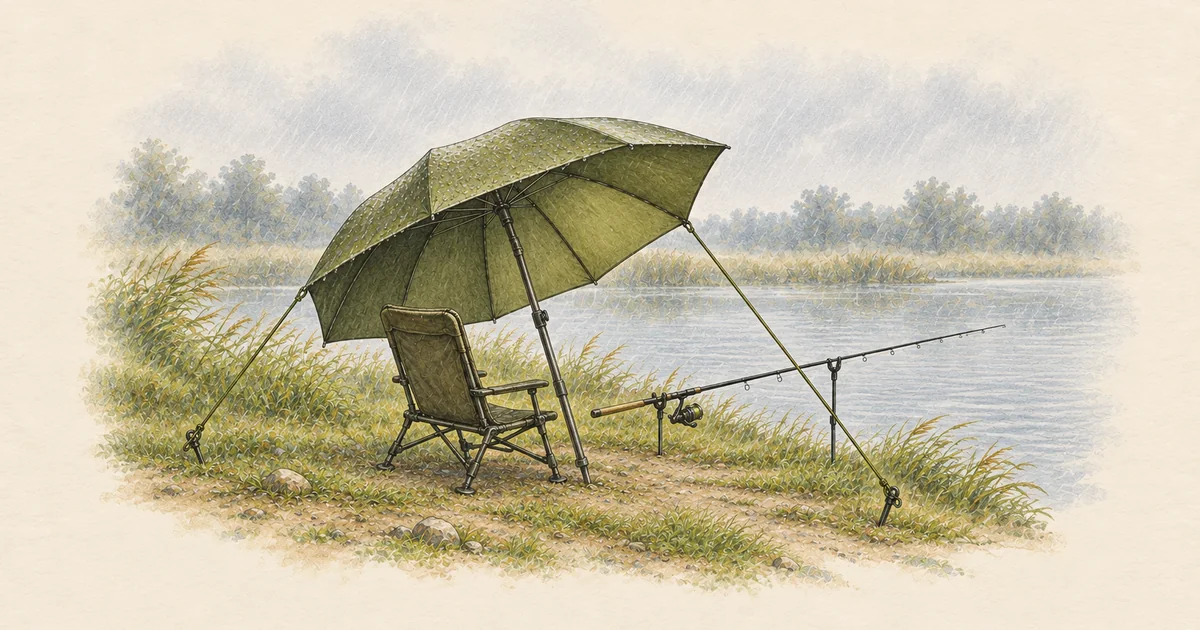
It is set up at an angle, with the open side towards the water. This has two advantages: your view of the water stays clear, and under the tilted roof you have more room for the rod. Reeling in, rebaiting and watching for the bite can all be done sitting down. You only need to stand up to cast. Where you sit is covered on the page about the fishing chair.
Types: ground spike, tilt joint and side walls
- Ground spike: The centre pole ends in a point at the bottom that you push into the ground. Without a joint you push it in at an angle straight away, so that the roof sits tilted.
- Tilt joint: Some umbrellas have a joint in the pole. It lets you bend the top section over while the spike stays straight in the ground. This way the roof can be turned against rain, wind or sun without re-pushing the umbrella in.
- Rings on the edge: There are several rings on the hem of the umbrella. The guying runs through them, that is, cords that pull the edge down to the ground.
- Side walls and overwrap: For nights and long rainy days there are umbrellas that can be closed at the sides or completely. In the specialist press they are called brollies. An overwrap is a second cover over the frame. According to Angling Times, on tents it holds a layer of air between inside and outside, which is warmer and produces less condensation. A fully closed umbrella is almost a fishing tent.
The choice between an umbrella and a brolly is often about weight. For long walks Blinker recommends a light umbrella rather than a two-man tent, and for one night a light brolly is part of the basic kit. In strong wind, however, some carp anglers reach for a tent instead: the frame of many brollies is said to be too thin and bends.
Setting up against the wind
In wind, the curved back of the umbrella belongs into the wind. If a gust gets under the roof from the front, the umbrella can, according to Blinker, fly away or bend outwards and break. If the umbrella is big enough, you may tilt it so far that the edge on the windward side touches the ground. That makes it steadier.
It gets difficult when the wind comes off the water. If you point the back strictly into the wind, you sit facing the hinterland and lose sight of the rods. The solution is guying down. A firmly anchored umbrella can stand slightly at an angle to the wind, and you can still see the water.
It is best to check the wind direction before setting up. How wind and air pressure are linked at the water is covered under Weather, air pressure and wind, and a forecast for your fishing day is given by Weather at the water.
Guying down with line and peg
A ground spike alone is not enough in gusty wind. The umbrella then turns despite a sturdy pole and sways back and forth. Ordinary camping pegs and a few cords help. You run the cord through a ring on the edge and tension it outwards at an angle to the peg. This pulls the edge down and holds the roof against the pressure.
- Pack pegs and cords with the umbrella permanently, not only when a storm warning comes.
- Rod rests need just as firm a footing in wind. A sturdy rod pod or bank sticks pushed deep into the ground are suitable, with more under Rod pod.
- Anything light that could blow away, you stow or fasten down.
Thunderstorm: the umbrella is not a shelter
Under the umbrella you stay dry, but you are not safe from lightning there. The VDE writes that anglers should leave the water and the bank zone as soon as a thunderstorm approaches. The Federal Office of Civil Protection (BBK) advises not touching objects with metal parts, such as umbrellas, during a thunderstorm. According to the German Weather Service (DWD), buildings with a lightning conductor and vehicles with a metal body give protection. Anyone stuck in open terrain without a car should, according to the BBK, look for a hollow and crouch down with feet close together.
The Ausschuss für Blitzschutz und Blitzforschung in the VDE classes the umbrella as follows: someone standing with an open umbrella is somewhat more likely to be struck than someone crouching. If lightning strikes the umbrella, the current probably takes the path from the arm through the upper body into the legs, and so through the heart too. For a fishing umbrella stuck in the ground, the sources give no separate rule. The advice stays the same: away from the umbrella, away from the bank.
Then there are the rods. Carbon conducts electricity very well, say the course materials for the angling exam (Fischerprüfung) of the Fischereiverein Löningen, so fishing stops during a thunderstorm. According to the VDE, the danger is only over when no thunder has been heard for half an hour. How to estimate the distance of a thunderstorm and read the warnings of the Deutscher Wetterdienst is covered under Thunderstorms and weather.
Note: The fishing umbrella keeps off rain, not lightning. If a thunderstorm approaches, you leave umbrella and rods behind and leave the water and bank (VDE), ideally for a car with a metal body (DWD). This page is no substitute for safety training; in an emergency, call 112.
Sun: shade with gaps
In summer the umbrella works as a shade provider, and the tilt joint can be turned to follow the sun. It does not block much UV radiation, though. The Bundesamt für Strahlenschutz (BfS) states that a sunshade reduces UV radiation by about 10 to 30 per cent. On the bank there is a further effect: water and sand reflect UV radiation and intensify it, so the exposure can, according to the BfS, exceed the stated UV index.
The umbrella is therefore one building block, not complete protection. The order the BfS recommends for clothing, sunglasses and sun cream, and what applies in the heat, is covered under Sun, heat and ticks.
Accessories: side panel, windbreak and groundsheet
Side panel and water rules
Guy lines and pegs hold the umbrella in place. But if the wind whistles in at an angle from the side under the canopy, you still sit in a draught. That is where a side panel helps: a piece of fabric that reaches from the edge of the umbrella to the ground on the weather side and is pegged down at the bottom. The front facing the water stays open, so you can still see your rods. How far an umbrella can be closed is covered above under designs.
With every panel, the umbrella turns a little more into accommodation, and some associations have their own rules for that. Two examples, retrieved in November 2026:
- East Frisia, association waters: The Bezirksfischereiverband für Ostfriesland prohibits wild camping, tents and camping on its waters. In suitable weather, according to its rules, it tolerates an open fishing umbrella with side protection (Fischerei- und Gewässerordnung No. 2.14, valid from 1 June 2023).
- Saxony, association waters: The Landesverband Sächsischer Angler allows a fishing umbrella, a fishing tent or a weather tarp as weather protection, but only one of these at a time. It must not primarily serve for sleeping overnight, may offer room for at most two people and must be in muted colours. Anyone using awnings or gazebos immediately loses their fishing permit (Erlaubnisschein), according to the rules (Gewässerordnung edition 2024, No. 1.19a and 1.19b).
Before you put up a pop-up gazebo or an extra tarp as a windbreak next to the umbrella, read your club’s water rules and the fishing permit (Erlaubnisschein). The examples only apply to the waters of these associations. An overview is given in Night fishing and weather protection at the water, and the states‘ rules on camping are under Camping and staying overnight at the swim.
Securing a windbreak on the beach
In its brochure “Gefahren am Meer”, the DLRG writes that sun and wind protection must be set up and secured in strong wind so that no gust can catch it and carry it away. According to the DLRG, a flying sunshade with its partly pointed ribs can injure other people’s eyes. When surf fishing, you therefore secure the umbrella, side panel and tarp each separately, even if the spot is only set up for a few hours.
Wind when pole fishing
If you sit on your seat box with a pole, you keep the umbrella over you for rain and sun. In wind, though, the problem is the long pole, and that sticks out far beyond any canopy. In answer to a reader’s question, Blinker advises fishing one or more sections shorter in strong wind. If the water isn’t too shallow and is a little coloured, the tip may dip in up to the second section, so the wind can’t catch it. You can support the pole on your knee and thigh or in a rest on the fixed platform.
The Angling Times also mentions the pole support bar in front of the seat box, on which the pole rests while you sit on its butt end. In their example, if you normally fish at 13 metres, you come in to around 11 metres in strong wind. A float one size heavier brings more stability to the rig, even if presentation suffers a little. More on the pole is under Pole rod, and on the method under Pole fishing.
Groundsheet under umbrella and tent
At night and in winter the cold creeps up from the ground. The Angling Times points out that heat isn’t only lost upwards: a well-insulated bedchair keeps the cold air off from below. As an extra, it names the unhooking mat, which you slide under the bedchair, but only if it is dry. In a guide to winter carp fishing, the same magazine counts the groundsheet, alongside the overwrap, among the things that make a big difference. What a mat does against cold from the ground is explained on the page Sleeping mat and air mattress, and the bedchair itself is under Bedchair.
The ground under the umbrella can also be covered by the water rules. The Landesanglerverband Brandenburg only allows weather protection on its waters if it has no waterproof floor, and gives the tent floor as an example in brackets (Gewässerordnung edition 2019, No. 6.3). Whether a loose groundsheet laid underneath counts, the rules don’t say. Ask the association before you take one along. What the same rules otherwise say about tents, colour and how long they may stand is summed up on the page Fishing tent.
Checklist for wind and cold
- Check the wind direction before setting up, with the back of the umbrella and the side panel on the weather side.
- Pack enough pegs: for the umbrella edge, the side panel and the corners of the groundsheet.
- Read the water rules: side protection, tarps, gazebos, tent floor.
- For the night, an insulating layer under the bedchair or sleeping mat, with the unhooking mat underneath only if it is dry.
- If a thunderstorm is forecast, no panel will help: leave the bank, as described above.
Common mistakes
- The open side faces the wind. If a gust gets under the roof, it bends the umbrella open or carries it off.
- Trusting the ground spike alone. Without lines, the umbrella turns and sways in wind; pegs and cords belong in every umbrella bag.
- Waiting out the thunderstorm under the umbrella. It does not protect against lightning. You leave the water and bank as soon as the storm announces itself.
- Taking shade for sun protection. According to the BfS, a sunshade reduces UV radiation by only about 10 to 30 per cent, and the water reflects extra radiation.
- Gear too heavy for the walk. If you have to walk far, a light umbrella serves you better than a big tent.
Frequently asked questions
Can I wait out a thunderstorm under the fishing umbrella?
No. The VDE advises leaving the water and bank, and the BBK advises not touching umbrellas during a thunderstorm. A car with a metal body gives protection. According to the VDE, you only return to the water once no thunder has been heard for half an hour.
How do I keep the umbrella in place in strong wind?
Back into the wind, windward edge tilted low, and guyed down through the rings on the hem with cords and pegs. If the frame bends, the umbrella is reaching its limit. Some carp anglers therefore take a tent with a strong frame and long pegs in strong wind.
May I stay overnight under the umbrella?
No umbrella can tell you that; the local rules do. Night fishing, overnight stays and camping on the bank are governed by state law, water rules and fishing permit. If in doubt, ask the water’s manager or the lower nature conservation authority; more under Fishing permit and water map.
May I put a groundsheet under the umbrella?
That is decided by the water rules. The Landesanglerverband Brandenburg only allows weather protection on its waters without a waterproof floor. Whether a loose groundsheet already counts as such a floor, the text leaves open, so ask the association beforehand.
Related
- Thunderstorms and weather: the lightning-thunder rule and DWD warning levels
- Power lines and fishing rods: why carbon needs a safe distance
- Sun, heat and ticks: UV protection and drinking on a long day’s fishing
- Fishing tent and carp tent: when the umbrella becomes a night camp
- Carp bedchair: what has to fit under an umbrella or tent
- Night fishing: preparing a session in the dark
- Seat box and platform: a solid seat for pole anglers in wind
- Line calculator: breaking strain and knots for the session rig
Sources
- Blinker: Wie stelle ich einen Angelschirm richtig auf? (Erdspieß, Gelenk, schräges Aufstellen, Rücken gegen den Wind, Ringe am Rand, Heringe und Schnüre)
- Blinker: Kann man Karpfen auch noch bei Frost fangen? (Gestänge von Schirmzelten bei Sturm, Rutenhalter bei Wind, loses Gerät sichern) und Blinker: Karpfen-Spots im Verborgenen (leichter Schirm statt Zelt für lange Wege)
- Angling Times: How to safely keep a bivvy warm (Zweck eines Überwurfs)
- VDE: Blitzschutz beim Wassersport (Angler verlassen Wasser und Uferzone) und VDE-Ausschuss für Blitzschutz und Blitzforschung: Empfehlungen mit Erläuterungen (aufgespannter Regenschirm, halbe Stunde ohne Donner)
- Bundesamt für Bevölkerungsschutz und Katastrophenhilfe: Was tun bei Sturm, Gewitter und Hagel? (Mulde und Hocke, Regenschirme nicht berühren) und Deutscher Wetterdienst: Thema des Tages, Gewitter im Anmarsch: So verhalten Sie sich richtig (Fahrzeuge mit Metallkarosserie)
- Fischereiverein Löningen: Gerätekunde (PDF) (Kohlefaser leitet, bei Gewitter Angeln einstellen)
- BfS: Was ist UV-Strahlung? (Sonnenschirm verringert UV um etwa 10 bis 30 Prozent) und BfS: Was ist der UV-Index? (Reflexion an Wasser und Sand)
- Bezirksfischereiverband für Ostfriesland: Fischerei- und Gewässerordnung (Nr. 2.14, offener Schirm mit seitlichem Schutz)
- Landesverband Sächsischer Angler: Gewässerordnung, Ausgabe 2024 (PDF) (Nr. 1.19a und 1.19b, Schirm, Zelt oder Plane, Markisen und Pavillons)
- Landesanglerverband Brandenburg: Gewässerordnung (Nr. 6.3, Wetterschutz ohne wasserundurchlässigen Boden)
- DLRG: Gefahren am Meer (PDF) (Sonnen- und Windschutz bei Wind befestigen, Spanndrähte)
- Blinker: Windkraft ausschalten (Kopfrute bei Wind verkürzen, eintauchen, abstützen) und Angling Times: How to fish a pole in the wind (Stützbügel, kürzer fischen, größere Pose)
- Angling Times: Winter fishing warning, how to keep your bivvy safe and warm (Wärmeverlust nach unten, trockene Abhakmatte unter der Liege) und The best winter carp fishing edges (Bodenplane im Winter)
Text AI-assisted, drawing AI-generated. Sources opened and checked in October and November 2026, no graphics taken from the sources.
All figures are guidelines without guarantee. How firmly an umbrella stands depends on ground, wind and frame; in a thunderstorm the advice of the VDE and the weather service applies, not the umbrella.