
Knowledge · Tackle
Seat box and platform: A stable base for pole and feeder anglers
A seat box is the box with drawers that pole and feeder anglers sit on all day. Whether it stands level and safely on a natural bank depends on what it stands on: legs with mud feet, a footplate or a separate platform, plus holders for the feeder rod, bait and the long pole.
Sitzkiste, Sitzkiepe, seatbox
There is no fixed line between a ‘Sitzkiste’ and a ‘Sitzkiepe’, the two German words for it. Blinker and Fisch & Fang mostly write Sitzkiepe, the British Angling Times seatbox. They mean the same box with drawers on individually adjustable legs. According to Angling Times, most accessories can be clamped to round legs, for example a side tray and feeder arm (Fig. 1).
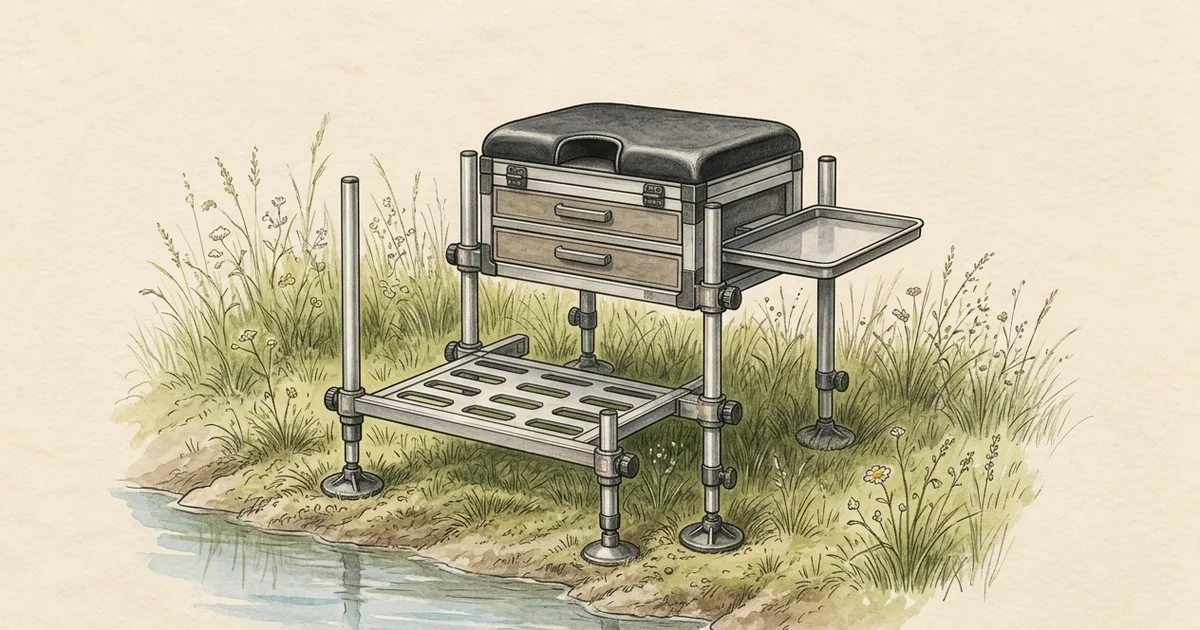
The origin of the word, drawers, accessories, stability test and seat height are described on the Seat box page. As a guide for the height, it uses the Angling Times rule of thumb: feet flat on the footplate, thighs horizontal. What it stands on, on the other hand, has to be adjusted to every bank: footplate, platform, legs and rollers.
Setting up the inside to suit the water
If you mainly fish rivers, lakes and canals, a single deep compartment does the job well, according to Angling Times. Tubs of floats and feeders fit in there, plus spare spools for the feeder rod. For commercial fisheries with fixed pegs, the magazine suggests two to three shallow trays for winders holding ready-tied rigs, or stackable modules.
Footplate or platform
The footplate stands on its own telescopic legs and, together with the front legs of the box, levels out a bank that slopes down to the water, as described step by step under Seat box. That is enough as long as all the legs find firm ground and the slope does not get too steep.
A platform is more than that: a separate standing surface on legs on which you put the whole box. Blinker names a built-in platform as an advantage on uneven ground. Fisch & Fang describes a pole angler on the Rhine who sets a sturdy platform on the riprap. In strong wind, Blinker recommends a solid platform as a seat, and you then support the long pole on a rest attached to the platform.
If the platform stands in the water in front of the bank, the footplate is more of a hindrance than a help, according to Angling Times. For such swims, the magazine recommends a box whose footplate can be removed easily (Fig. 1).
Platform and bank: Where you may set up a platform is governed by state law, the water rules and the fishing permit (Erlaubnisschein). One example is the water rules of the Landesanglerverband Brandenburg (2019 edition) for the association’s waters: with reference to § 15 of the Brandenburgische Fischereiordnung, they prohibit entering or driving through the Gelege, i.e. the vegetated bank zone on the water side. The rules allow fishing the Gelege from the firm bank, from a jetty or from a boat lying in front of it. To build a fishing jetty, they require the consent of the landowner and the association as well as official approval. The rules do not say whether a mobile platform counts as a structure. If in doubt, ask the club or the fishery manager; more on reed beds under Nature conservation on the bank.
Transport
With a platform and rollers, the amount of kit grows. Angling Times advises checking when you buy whether the box fits on your own barrow. How to load and secure it, and which wheels run on sand and grass, is covered under Fishing trolley.
Which bank, which base
The table sorts the most common swims. It does not replace looking at the swim itself: if a stone wobbles or the ground gives way, rebuild before you sit down.
| Bank | Base | What to look for |
|---|---|---|
| firm, level peg at a commercial fishery | box with footplate | set the height once |
| sloping natural bank | extend the front legs and footplate further | stability test before fishing |
| soft, muddy ground | swivelling mud feet on all legs | wash the legs after fishing |
| Rock armouring | platform or long legs, each on a firm stone | stones are slippery, plumb first |
| Sheet piling, bank wall | box set back from the edge | only way out is via ladders |
| Shallow water in front of the swim | platform in the water, footplate off | only where the water rules allow it |
On soft ground, wide swivelling mud feet spread the load; according to Angling Times they belong on every leg of the box. If you step into shallow water to set up, you should know that the DLRG names steeply shelving banks and muddy bottoms as hazards at still waters. No bank stick holds on stone, concrete or a jetty; which rod rest works there is covered under Rod pod and tripod.
Rock armouring, sheet piling and shipping
On rivers and canals, pole and feeder anglers often sit on reinforced banks. On the Wesel-Datteln-Kanal, for example, according to Fisch & Fang, steel sheet piling lines one side and rock armouring the other. The two banks call for different set-ups.
Rock armouring: How sharp-edged and slimy the stones of a bank reinforcement are, and that they continue under water, is described in a document from the DLRG local group in Burscheid; more on this under Bank and waders. So place each leg of the platform on a stone that does not rock when you press down on it, and do not walk over wet stones down to the waterline when setting up.
Sheet piling and bank walls: They stand vertically in the water. The same DLRG document says that a swimmer can only get out at harbour and bank walls via built-in metal ladders, and that their rungs can be very slippery. The situation is the same at sheet piling. Before you put the box at the edge, check where the nearest ladder or shallow spot is. Keep your distance from the edge and keep a rescue throw line to hand. For landing fish, the wall has an advantage: a canal angler in Fisch & Fang chooses the sheet-piling side because that is where he can net hooked fish most easily.
Shipping: According to the DLRG document, a passing commercial vessel draws water in, so that parts of the riverbed at the edge fall dry. The water then returns in waves and rises briefly well above the normal level. This backwash can still come when the ship is already far away, especially when it is travelling downstream on the opposite bank. So do not set up your platform and groundbait bowl just above the waterline, and leave nothing lying loose on the lower stones. Fisch & Fang also describes how shipping in the canal creates current.
With 13 metres of carbon fibre in your hands, what is said under Power lines and fishing rods and Thunderstorms and weather also applies.
Setting up rollers for the pole
When pole fishing, you ship the pole back to land a fish and unship sections (see Pole). To stop the rear sections sagging or hitting the ground, they run over rollers: rollers on a stand with adjustable legs. Angling Times considers a flat, wide roller with a divider in the middle to be the best design. If there is little room behind your swim and you unship twice, both sections lie side by side without knocking against each other. Folding stops at the ends keep them on the roller in wind. According to the magazine, one roller is enough up to about 11 m fishing distance; further out you use two.
This is how to set up two rollers following a guide from Angling Times, example 13 m:
- First roller: Ship the pole back as if you were landing a fish. The end of the fifth section should then lie on the first roller, usually 4 to 5 m behind the box.
- Second roller: roughly the same distance again behind it. If a long piece sticks out freely beyond a roller, a section is under too much tension and can break.
- Line them up: In the magazine’s example, seen from behind, the left legs of both rollers stand in line with the right leg of the box. Then, while playing a fish, a quick glance is enough to push the pole straight back onto the rollers.
- Slightly higher at the back: Set the rear roller a few inches, that is a few centimetres, higher than the front one. The pole then slopes slightly down towards the water, the top section stays low as you push back, and the hook pulls out of the fish less often.
- Check the height on the spot: If the rollers are too low or too high, playing a fish becomes harder. Because every bank slopes differently, push the pole back once before your first cast and adjust.
- Secure the butt end: Even a slight slope lets the pole slide down the rollers towards the water. In the magazine’s example, a pole sock on the right leg of the footplate takes the butt end. It sits at about knee height and on the outside so that it does not get in the way when you net a fish.
How the pole runs back when you break it down and how long the line may be is explained in Pole fishing and Pole rod.
Common mistakes
- Standing a platform leg on a wobbly stone. On smooth stones the platform then gives way as soon as you move. Test each foot by pressing down on it before you sit down.
- Setting up just above the waterline where ships pass. The backwash briefly lifts the water level noticeably and then reaches your groundbait and bait tubs.
- Setting up on a sheet-pile wall without knowing the way out. Without a ladder you can hardly get out of the water at a vertical wall.
- Placing the roller by eye. If a long length of pole sticks out unsupported behind the roller, a section can break under the strain.
- Packing the box for the wrong water. On a river you then lack space for feeders and spare spools, on a commercial fishery for pole winders.
Frequently asked questions
Is a footplate enough, or do I need a platform?
On fixed pegs and moderately sloping banks, the footplate with its telescopic legs is enough. A platform is worth it on stone revetments, on very steep banks and wherever you are allowed to, and have to, sit in the water in front of the bank.
How many pole rollers do I need?
Up to about 11 m out, one is enough according to Angling Times. If you fish further out, say at 13 m, take two and set them up as described in the instructions above.
Seat box or fishing chair?
The box carries drawers, side tray, feeder arm and footplate on one frame, which counts in pole fishing and feeder fishing with lots of small items. According to Fisch & Fang, the fishing chair is more comfortable and has largely replaced the classic seat box.
Related
- Seat box: drawers, seat height and setting up on a slope
- Pole rod: whip, elastic and breaking down
- Feeder rod: how the rod points towards the feed spot
- Tackle trolley: wheeling box and platform to your swim
- Rod pod and tripod: rod rests for stone and jetty
- Bank and waders: safe footing at the edge and in the current
- Rescue throw line: help from the bank
- Line calculator: checking the breaking strain of main line and hooklength
Sources
- Angling Times: How to pick the right seatbox (Plattform im Wasser, abnehmbare Fußplatte, Teleskopbeine, Anbauteile, Schlammfüße, Fächer nach Gewässer, Sitzhöhe, Karre)
- Angling Times: Pole Fishing Masterclass, Teil 2: How to use pole rollers (Bauform, Abstand, Höhe und Linie der Abroller, Köcher am Fußplattenbein) und Angling Times: How to set up your pole rollers correctly (ein Abroller bis 11 m)
- Blinker: Kopfrute für Anfänger (Kiepe mit verstellbaren Beinen oder Plattform) und Blinker: Windkraft ausschalten (feste Plattform, Halter an der Plattform)
- Fisch & Fang: Strom-Stippen (Plattform in der Steinschüttung) und Fisch & Fang: Der Wesel-Datteln-Kanal (Spundwand und Steinpackung, Strömung durch Schiffe, Keschern an der Spundwand) und Fisch & Fang: Die alte Sitzkiepe (Angelstuhl bequemer)
- DLRG Ortsgruppe Burscheid: Gefahren an Fließgewässern (PDF) (glatte Steine der Uferbefestigung, Ufermauern und Leitern, Sog und Rückschwall durch Berufsschiffe) und DLRG: Gefahren in stehenden Gewässern (steile Ufer, schlammiger Grund)
- Landesanglerverband Brandenburg: Gewässerordnung, Ausgabe 2019 (Gelege, Errichtung von Angelstegen)
Text AI-assisted, drawing AI-generated. Sources opened and checked in November 2026; no graphics taken from the sources.
All figures are guide values without guarantee. How you set up box, platform and rollers depends on the bank, the pole length and your height, and where you may set up at the water is stated in the water rules and your fishing permit (Erlaubnisschein).