
Knowledge · Tackle
Rescue throw line and lifebuoy: Help from the bank
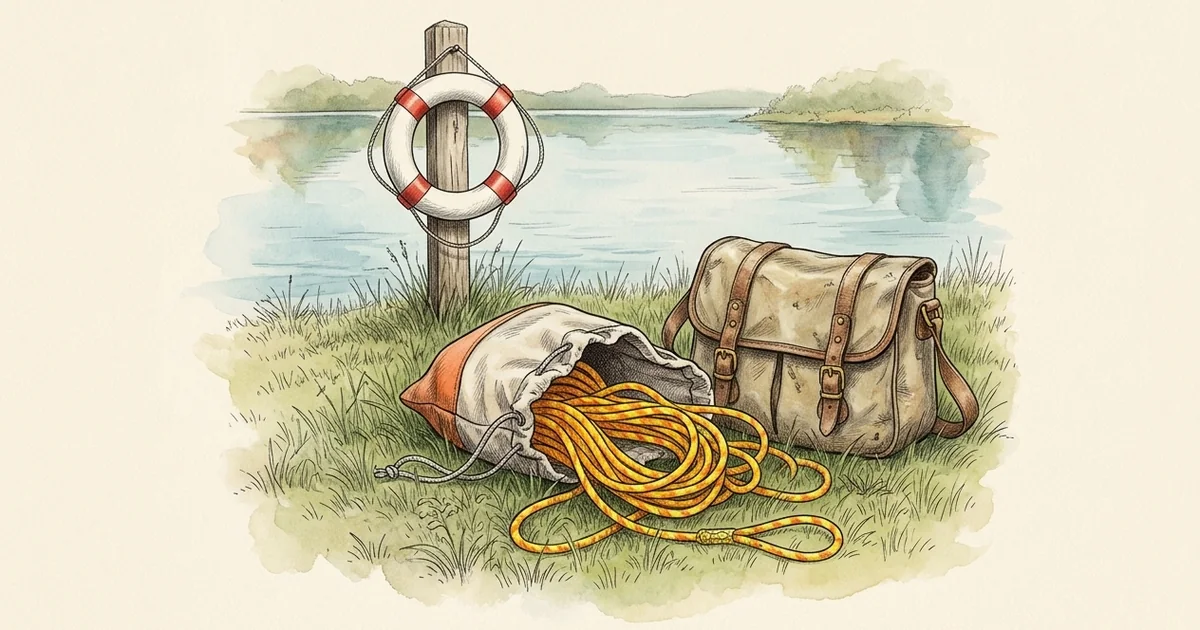
A rescue throw line lies loosely in a throw bag and reaches a person in the water from the bank without anyone jumping in after them. Throw bag, lifebuoy and rescue ball have one thing in common: the helper stays on land. According to the DLRG and the DRK, your own safety and the 112 emergency call come first.
In an emergency: 112 According to the DLRG, this number reaches the ambulance service and fire brigade around the clock. First get yourself out of danger, then call or have someone call, and help from the bank.
Secure first, then call, then help from the bank
For helping others, known as rescuing a third party, the DLRG gives one principle: your own safety comes first. Only once you are outside the danger zone do you make the emergency call and give first aid. The German Red Cross (DRK) puts the emergency call at the start for swimming accidents. If there are two of you, one phones and the other grabs the throw bag.
Why not simply jump in after them is explained by the DRK: a person in fear of death thrashes wildly and clings to anything that comes within reach, including the helper. Without lifeguard training, you therefore keep your distance, start at the bank and throw a lifebuoy or something else that floats. In § 323c, the Strafgesetzbuch (German Criminal Code, as of November 2026) makes it a criminal offence not to help in accidents when help is necessary and can reasonably be expected in the circumstances, “in particular without considerable danger to oneself”.
Which aid is right depends on how far out the person is and how much strength they have left.
| Time | What helps | What to look for |
|---|---|---|
| Close to the bank, can still grab | A pole or branch is enough | stand securely, no body contact |
| Further out, still strong | Throw bag, ring or ball with line | throw beyond the person |
| Exhausted, barely holding on | Lifebuoy or rescue ball | Throw bag gives little buoyancy |
| In the current | Throw bag, two people hold the line | do not pull against the current |
| Fallen through the ice | from the bank: ring, ball, line, board | never walk upright onto the ice |
| No rescue aid to hand | Beach ball, rope, branch | Keep your distance, call 112 |
If there is no rescue aid, an information sheet from the DLRG local group Grünstadt says that anything that floats and at the same time keeps you at a distance from the person will do, such as a beach ball, a rope or a branch. The DLRG’s junior lifesaver brochure puts it more briefly: anything that does not sink in water. The sources used do not say whether a landing net handle or a fishing rod is suitable for reaching out. For ice, the local group also names a scarf and a jacket for reaching out.
Throw bag and throw line: design and length
Rescue throw line, throw line and throw bag all mean the same device. A DLRG participant brochure for the water rescue service describes it as an elongated bag, sometimes with a float in the bottom. Depending on size, it holds 15 to 35 metres of line, with only a handle end sticking out, and a Velcro or press-stud fastener keeps the bag closed. The line goes in in loose loops, because otherwise it tangles during the throw. Because of its handling and low price, the DLRG now counts the throw bag among the preferred standard devices for water rescue.
According to the brochure, distances of over 20 metres are possible after just a few practice throws. As advantages, it names that the bag flies well even in a light wind, is ready quickly and takes up little space. The disadvantages follow straight away: the person in the water has to hold on themselves, the bag gives only little buoyancy, and it reaches no further than the line. The Swedish Ice Safety Council describes its rescue line as a 23-metre floating line with a soft throwing weight that does not injure the person it hits. Which equipment your federal state (Bundesland) requires when fishing is covered under Mandatory equipment.
Lifebuoy and rescue ball
Rings and balls are thrown to the person. According to the Grünstadt local group’s information sheet, a line of 25 to 30 metres is attached to the rescue ball. You throw it a little beyond the person and pull it towards them on the line, allowing for wind and current when aiming. For accidents on the ice, the DLRG even considers a rescue ball or lifebuoy with a line better than boards, ladders or branches held out in an emergency.
According to the information sheet, lifebuoys and rescue balls often hang at locks, bridges and lidos. In a swimming pool, according to the junior lifesaver brochure, you will usually find a ball or a ring. For construction work at and over water, the Berufsgenossenschaft der Bauwirtschaft (the construction industry’s employers‘ liability insurance association) requires lifebuoys and rescue poles to be kept clearly visible and easy to reach. There, rings to the EN 14144 standard must be attached to a floating line. When you arrive at your fishing spot, look around for where the nearest ring hangs and remember the way to it.
Anyone who intentionally or knowingly removes, alters or renders unusable rescue equipment intended for giving help in accidents faces, under § 145 para. 2 of the Strafgesetzbuch (German Criminal Code, as of November 2026), up to two years‘ imprisonment or a fine, unless the act is already punishable under § 303 or § 304 (criminal damage). If a ring is missing or its line is torn, tell whoever runs the site.
Throwing step by step
The steps follow the DLRG brochure on the throw bag and the DLRG page on emergency calls:
- Emergency call: Call 112 or have someone call. The control centre first asks where it happened. Describe the way there; according to the DLRG, distinctive buildings, signs or a visible lake also help. Someone can meet the emergency services and guide them in.
- Stance: Find a safe spot where your swing and the flight path are clear.
- Open: Undo the fastener, hold the line end in the hand that does not throw.
- Contact: Look at the person and shout “Rope!” loudly so they know what is coming.
- Throw: Better to aim a moment longer than to throw hastily and miss. The bag flies beyond the person; the brochure says five metres too far is better than half a metre too short.
- Hold: Once the person has the line, pull them in carefully. In a current the line pulls hard, so two of you hold it (next section).
- Missed: Gather the line in quickly in coils, two or three of them in the throwing hand and the rest in the other. Restuffing takes too much time. According to the brochure, another option is to fill the empty bag with water, squeeze the top shut and throw it like a rescue ball.
The brochure describes three throws. The underarm shock throw is the standard with the greatest range: one leg forward, the arm stays straight, the bag swings in a semicircle close past the body forwards and upwards and is released at roughly shoulder height. The overarm throw is faster and flies straighter. The arm comes from behind and above, close past the head, and you let go when the arm is horizontal. For the sling throw, you hold the bag behind your head and flick it from the wrist in a high arc. It flies less steadily, but gets over bushes and reeds and also works when you are standing deeper in the water yourself.
Practise: Throw the bag a few times on a meadow and then stuff the line back in loosely. That way you know how far it flies for you before it really matters.
Current and ice
In a river, according to the DLRG brochure, strong forces act on the line. If necessary, secure it with two people and do not pull against the current. It is better to simply hold the long line and let the current do the work: the water pushes the person downstream, and because the line is held on the bank, they swing round in an arc towards it. What makes eddies, stoppers and groynes dangerous and how to rescue yourself from the current is covered under Bank and waders.
The same principle applies on ice. The DLRG rescues from land wherever possible and reaches, pushes or throws aids to the person. How a helper who does have to go onto the ice should behave, and which ice thicknesses serve as guide values, is covered under Walking on ice. How to pull yourself out with ice claws and how ice anglers carry their throw line is covered under Ice claws.
After the rescue: According to an article in Spektrum der Wissenschaft, even someone who seems fine must be examined by a doctor, because life-threatening complications can still occur hours later. The DRK advises carefully removing wet clothing and covering the person with the rescue blanket from the first-aid kit, silver side facing in. Unconscious people who are breathing normally go into the recovery position. If the person is not breathing normally, according to the DRK resuscitation begins with five rescue breaths. This does not replace a first-aid course or medical advice.
Checklist for groups and children at the water
- One adult keeps the children in view at all times. The DRK advises sharing supervision among several adults, because children usually drown silently.
- According to the DLRG’s safety tips, non-swimmers stay within arm’s reach, even with a buoyancy vest or armbands. According to the DRK, swimming aids do not protect reliably.
- According to the DLRG and DRK, a child only counts as a safe swimmer once they have the bronze swimming badge. The Seepferdchen beginner badge is not enough.
- Explain the rules at the spot and repeat them. Younger children forget a one-off briefing, the DLRG writes.
- Practise the emergency call with the children; the DLRG expressly recommends this. Everyone knows the name of the place and the way there.
- Throw bag ready to hand at the spot, not in the car, and the nearest lifebuoy has been located.
- On jetties and boats, children wear a suitable life jacket, see Life jacket.
- A first-aid kit with a rescue blanket is in the bag, and the phone is charged.
The list does not replace a course, and throwing is best learned with instruction. The DLRG offers first-aid and lifeguard courses through its local branches. The bronze lifeguard badge is available from age 12, with the junior lifesaver as a preliminary stage from age 10, which requires the gold swimming badge. The DRK’s Wasserwacht offers swimming courses in many towns. What children are allowed to do when fishing in your federal state is covered under Fishing with children.
Common mistakes
- Jumping in without training: According to the DRK, a person in panic will cling to the rescuer too. Throwing from the bank is safer.
- Line stuffed in too tightly: The DLRG brochure calls for loose loops in the bag, otherwise the line tangles during the throw.
- Thrown too short: A bag that lands in front of the person does not help. Throw beyond them and pull the line to them.
- Pulled against the current: Strong forces then act on the line. The DLRG brochure advises securing it with two people and letting the person drift to the bank.
- Restuffed after a missed throw: That takes too long. Gather the line in coils and throw again straight away.
Frequently asked questions
How long should a rescue throw line be?
The DLRG brochure gives 15 to 35 metres for throw bags depending on size, and the Grünstadt local group gives 25 to 30 metres for the rescue ball. The Swedish Ice Safety Council describes 23 metres of floating line. The sources do not give a mandatory length for anglers.
Do I have to jump into the water to help?
§ 323c of the Strafgesetzbuch (German Criminal Code) makes failing to help a criminal offence when help is necessary and can reasonably be expected, and expressly states “in particular without considerable danger to oneself”. The wording does not say how this is to be judged in an individual case. The DLRG and DRK advise calling 112 first and helping from the bank with objects that float. According to Spektrum der Wissenschaft, only someone who will not put themselves in danger and is able to do it, such as a trained lifeguard, should carry out a rescue themselves.
Which is better, a throw bag or a lifebuoy?
The throw bag flies far, is ready quickly and fits in your luggage. According to the DLRG brochure, however, it gives only little buoyancy, and the person has to hold on. Rings and balls are floats in themselves, but hang in fixed places. You take the bag with you; you will only find a ring where one hangs.
From what age can you learn lifesaving?
Children can start the DLRG junior lifesaver from age 10 if they have the gold swimming badge. The bronze lifeguard badge is available from age 12. The DLRG expressly recommends practising the emergency call with children too.
Related
- Ice claws, ice picks and throw line: self-rescue and throw line on the ice
- Bank and waders: current, stoppers and self-rescue on the river
- Life jacket: buoyancy levels and children’s life jackets
- Walking on ice: guide values for ice thickness and help if the ice gives way
- First-aid kit for fishing: what belongs in the bag
- Family fishing day: gear for children, with an overnight stay
- Fishing with children: what children may do in each federal state
- Line calculator: calculate the breaking strain of your fishing line
Sources
- DLRG: Selbst- und Fremdrettung, Notruf richtig absetzen, Fremdrettung aus dem Eis (eigene Sicherheit, Notruf, Rettung aus dem Eis)
- DLRG: Teilnehmerbroschüre AV 402, Umgang mit Rettungsmitteln und Überwachung von Wasserflächen, Stand 2017 (PDF) (Wurfsack, Wurftechnik, Strömung)
- DLRG-Ortsgruppe Grünstadt: Baderegeln, Selbst- und Fremdrettung (PDF) (Ring, Ball, Fundorte, Behelfsmittel)
- DLRG: Teilnehmerbroschüre Juniorretter (PDF), Sicherheitstipps, Rettungsschwimmabzeichen (Rettungsgeräte, Kinder, Abzeichen)
- Deutsches Rotes Kreuz: Baderegeln und Tipps gegen Badeunfälle (Notruf, Rettung vom Ufer, Kinder, Erste Hilfe)
- Spektrum der Wissenschaft: Sicher helfen, wie hilft man Ertrinkenden? (ärztliche Untersuchung nach der Rettung)
- BG BAU: Baustein C 480, Arbeiten am Wasser, 07/2019 (PDF) (Rettungsringe mit Leine)
- Strafgesetzbuch: § 323c Unterlassene Hilfeleistung und § 145 Beeinträchtigung von Nothilfemitteln (Wortlaut)
- Issäkerhetsrådet (schwedischer Eissicherheitsrat): Räddningslina (Leine von 23 Metern)
Text AI-assisted, drawings AI-generated. Sources opened and checked in November 2026, the Swedish source translated by meaning, no graphics taken from the sources.
All information is a guide only and without guarantee. You learn water rescue on a course; this text does not replace training or medical advice. In an emergency, call 112.