
Knowledge · Tackle
First-aid kit for fishing: Contents, hooks and ticks
A first-aid kit for fishing belongs at your fishing spot, not in the boot of the car in the car park. The contents of a car first-aid kit to DIN 13164 make a good basic stock. On the bank, add a tick card, an emergency card and a plan for the emergency call, all in a sealed bag that can withstand rain and spray.
What the standards put in the kit
The contents of the car first-aid kit are set by the DIN 13164 standard. The German Social Accident Insurance (DGUV) lists the quantities in an overview dated February 2022. Compared with the previous version, two medical face masks were added, while there is one triangular bandage fewer and the small dressing cloth has gone entirely. In § 35h (paras. 1 and 3, version accessed in November 2026), the Straßenverkehrs-Zulassungs-Ordnung (German road vehicle licensing regulations) still refers to the January 1998 or January 2014 editions.
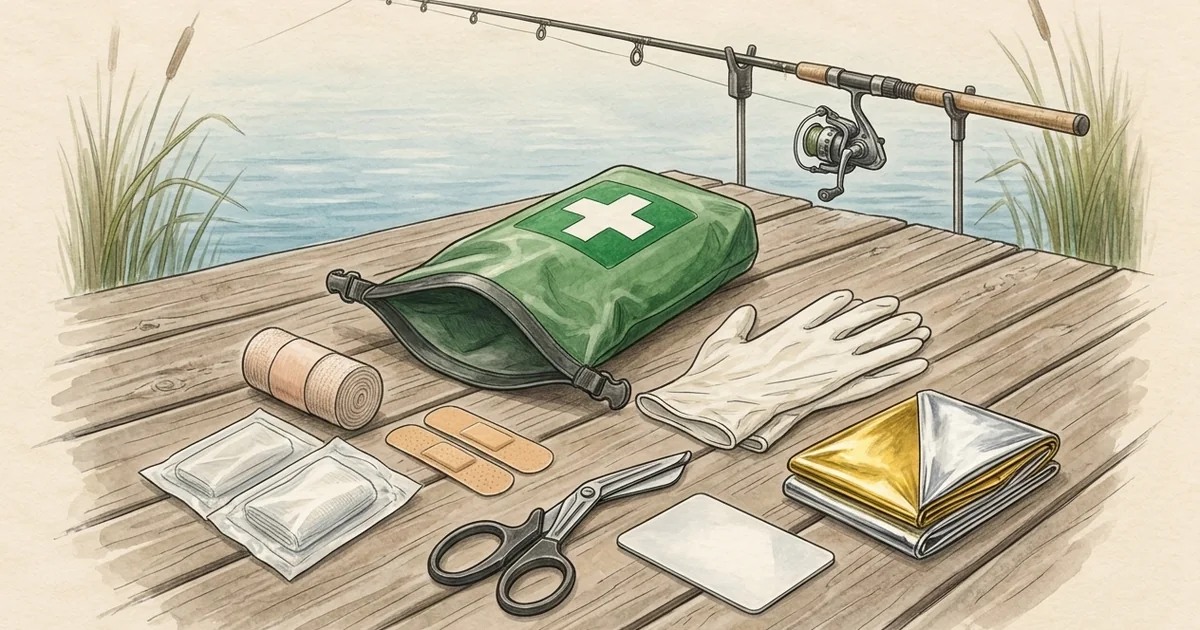
| Part | In the car kit DIN 13164 | What it’s for at the water |
|---|---|---|
| Adhesive tape and plaster set | 1 roll, 14 plasters | small cuts and grazes |
| Wound dressing pack | 4 (small, 2 × medium, large) | quickly cover a bleeding wound |
| Compresses 10 × 10 cm | 6 | padding around an embedded hook |
| Rescue blanket | 1, at least 210 × 160 cm | keeping warm after falling into the water |
| Disposable gloves | 4 | self-protection with blood, removing a tick |
| First-aid scissors | 1 | cutting open clothing over the wound |
The DGUV calls the wound dressing pack a good aid for bleeding wounds: the sterile wound pad is already fixed to the bandage. According to the Malteser’s description, the rescue blanket is a tear-resistant foil with one transparent and one reflective aluminium side. It keeps out wet and wind and protects against getting chilled. According to the Malteser, the scissors are for cutting open clothing over a wound.
The first-aid pouch to DIN 13167, intended for motorcyclists, is smaller. The Institut für Zweiradsicherheit (motorcycle safety institute) lists as its contents a rescue blanket of 210 × 160 cm, two pairs of disposable gloves, eight adhesive dressings, two wound dressing packs, a dressing cloth, scissors and a narrow roll of adhesive tape. At the water it fits in a tackle bag or rucksack. The list comes from a 2017 article and may differ from the current version of the standard.
A standard is not the same as a requirement on the bank: DIN 13164 and DIN 13167 describe what goes in a kit. Which equipment your federal state requires when fishing is covered under Mandatory equipment; a club’s own rules are in the fishing permit (Erlaubnisschein). This page does not replace medical advice or a first-aid course.
What to add for the fishing spot
Tick card and disinfection
In bankside grass you easily pick up ticks. The DRK recommends tick cards from the pharmacy because they are handy and fit in your trouser pocket, and advises wearing disposable gloves when removing a tick. Afterwards the bite site is disinfected, and the DRK advises seeing a doctor. How to grip the tick correctly and which signs to watch for afterwards is covered under Sun, heat and ticks; how to avoid picking them up in the first place under Mosquito and tick protection.
The disinfectant in the kit is mainly for the bite site after a tick, not for every wound. In its first-aid handbook, the DGUV writes that wounds should not be treated with powder or ointment, nor with spray or disinfectant, without a doctor’s instructions. It only provides for rinsing in exceptional cases, such as burns, chemical burns and bite wounds. The same applies to a hook in the skin: pad it, do not move it, and have a doctor remove it. All the steps are covered under Hook injuries and first aid.
Insect stings and allergies
The DRK advises covering food and drinks outdoors, drinking from cans only through a straw and looking at every mouthful first. According to the DRK, wasp stings are dangerous mainly for people with allergies and in the mouth and throat, where swelling can narrow the airways. If a wasp is swallowed, the DRK says to call 112 immediately in every case. Anyone with an insect venom allergy should, according to the DRK, get medical advice and if necessary carry an emergency kit with the prescribed medication. It belongs in the same bag as the dressings; the doctor sets the dose.
Against swelling after an ordinary sting, the DRK recommends cooling with wrapped cold packs. According to the DGUV overview, an instant cold pack is included in the small workplace first-aid kit to DIN 13157, but not in the car kit. If you want one at the water, pack it yourself.
On the coast
If you fish over sand on the North Sea or Baltic Sea, you may catch a weever. It has venomous spines on its dorsal fin and gill covers. The Giftzentrale Bonn (poison centre) advises anglers to wear gloves when unhooking, so sturdy gloves belong in your coastal bag. What the poison centres advise after a sting is on the fish page.
Pack it watertight and check the expiry dates
For cars, § 35h StVZO requires a container that adequately protects the contents from dust and moisture. At the water, moisture is the norm: wet grass, rain, spray in the boat. A roll-top dry bag or a sealed box keeps the material dry. Sun and heat do damage too. The Johanniter point out that conforming bandages lose their stretch through temperature changes and that plasters eventually stop sticking. So the kit stays in the shade in your bag, not out in the open on the jetty.
Sterile items have a printed expiry date. According to the DGUV, sterile dressing material usually lasts five years from manufacture. The Institut für Zweiradsicherheit (ifz) gives shelf lives for the contents of kits ranging from only four to as much as 20 years, and points out that the dates are often printed on the individual items rather than on the pouch. If the date has passed or the packaging is damaged, the item is replaced, according to the Johanniter.
Check it once a year
- Empty the kit completely and lay it out next to the contents list.
- Read the expiry dates on compresses, wound dressing packs and dressing cloth, and replace anything out of date.
- Check the packaging: if the wrapper of a sterile compress is torn, replace it.
- Check that the plasters still stick and count the gloves.
- Update the emergency card and saved numbers.
- Check the bag is watertight and pack everything away dry.
Replace anything you use straight away.
The 112 emergency call and your location at the water
On the bank there is rarely a house number. But the control centre asks first for the location of the emergency, and the DRK asks for details that are as precise as possible, including access routes.
- Location from the phone. Some smartphones send their position along with a call to 112; the service is called Advanced Mobile Location (AML). Whether your device can do this depends on the model and operating system, according to the Berlin Fire Brigade. The Berlin control centre still asks first exactly where the emergency is, and advises against switching off the transmission.
- The federal states‘ emergency app. The official app nora sends your location to the responsible control centre and lets you make an emergency call without speaking. It needs an internet connection, although the slow EDGE network is enough, and registration beforehand with your mobile number and name. So set it up at home, not when you are already at the water.
- Forest rescue points. These are places near woodland whose coordinates serve as a meeting point for the emergency services, with a sign in the forest or only as a data record. The Kuratorium für Waldarbeit und Forsttechnik (KWF) provides them for download in one collection. If your fishing spot is on a forest lake, note down the nearest point beforehand.
On long trips in unfamiliar surroundings, the Johanniter advise not going alone. Then one person can give care, one can phone and one can guide the emergency services from the access road to the spot. For a night session this means agreeing on a meeting point beforehand and keeping a head torch to hand to bring the rescuers in in the dark. On a boat there are other channels, see Marine radio and emergency calls on the water.
Emergency card and poison control
If the injured person can no longer speak, the rescuers lack information on allergies and medication. An emergency data record can be stored on the electronic health card for this. It is voluntary, and according to gematik your health insurer answers questions. A representative of emergency doctors names details of allergies, heart conditions and blood thinners as particularly helpful there. In the nora app you can voluntarily store pre-existing conditions. They are initially stored only on the device and are only passed to the emergency services in a medical emergency that affects you yourself.
A paper card in the kit works even with a flat battery. It should list your name, a contact person, known allergies, regular medication and where any emergency kit prescribed by a doctor is kept.
According to the list from the Federal Office of Consumer Protection and Food Safety (BVL), you can reach most poison control centres with the city’s area code and 19240, for example in Berlin, Bonn, Göttingen or Munich. The centre in Göttingen covers Bremen, Hamburg, Lower Saxony and Schleswig-Holstein. The exception is Erfurt, which serves Mecklenburg-Western Pomerania, Saxony, Saxony-Anhalt and Thuringia jointly, on 0361 730 730. Save the number for your region. If life is in danger, according to the DRK always dial 112.
Small safety accessories
- Signal whistle. The DGUV counts it as part of a life jacket. If you sit on the bank without a life jacket, you can hang a small whistle on your bag or key ring to draw attention to yourself.
- Document pouch. In a waterproof pouch, your fishing licence (Fischereischein), fishing permit (Erlaubnisschein) and emergency card stay readable. Which papers you must carry at the water is set by your federal state, more under Fishing licence and angling exam.
- Floating key ring. On a jetty or in a boat, it keeps the car key at the surface if it falls into the water.
- Power for the phone. No battery, no emergency call and no app. How to carry a power bank safely is covered under Rechargeable batteries and power banks.
Checklist for your bag at the water
To tick off as you pack:
- plasters as a roll and as individual strips
- two to four wound dressing packs in different sizes
- sterile compresses 10 × 10 cm, also as padding
- conforming bandage and triangular bandage
- rescue blanket, at least 210 × 160 cm
- disposable gloves, several pairs
- first-aid scissors
- tick card or tick tweezers and disinfectant for the bite site
- instant cold pack
- emergency kit prescribed by a doctor, if you have a known allergy
- emergency card with contact, allergies and medication
- phone charged, emergency app set up, poison control number saved
- nearest rescue point or meeting point at the access road noted down
- signal whistle and waterproof pouch for papers
- on the coast: sturdy gloves
Which tools also belong in the bag is shown in Multitool and fishing pliers.
Common mistakes
- The kit stays in the car. If the car park is far away, it is no help for a bleeding hand on the bank. Even in the car, according to the Johanniter, it should be within easy reach, not under the luggage.
- Left open in the sun or in a wet boat. Moisture and temperature changes spoil bandages and plasters. A sealed bag in the shade prevents this.
- Never looked inside. Out-of-date items are only noticed when you need them. Check once a year and restock after every use.
- Disinfectant on the wound. The DGUV does not provide for this without a doctor’s instructions. What gets disinfected is the bite site after a tick; what applies after a weever sting is on the fish page.
- Downloading the emergency app only in an emergency. Without registering beforehand and without a signal, that will not work. Set it up while you are at home.
Frequently asked questions
Is the car first-aid kit enough for fishing?
The Johanniter think it makes sense to take the car kit along on hikes, for example, as long as anything used is restocked afterwards. At the water the problem is more the location, because the kit stays in the car park. Take it with you to your spot or pack a bag of your own with a tick card and emergency card.
Does disinfectant belong in a first-aid kit?
For the bite site after removing a tick, yes, the DRK says so. According to the DGUV it does not go on wounds without a doctor’s instructions, not even for a hook injury.
How long does a first-aid kit last?
According to the DGUV, sterile material usually lasts five years from manufacture; the date is on the packaging.
Do I have to carry a first-aid kit when fishing?
That is not set by the DIN standard but by your federal state (Bundesland) and, where applicable, the club’s rules for its waters. What the federal states require is covered under Mandatory equipment; club rules are in the fishing permit (Erlaubnisschein).
Related
- Hook injuries and first aid: hook in the skin, tetanus and emergency calls
- Sun, heat and ticks: removing a tick, heat warning signs and UV protection
- Mosquito and tick protection at the water: clothing and repellents
- Rescue throw line and lifebuoy: help from the bank
- Night session packing list: everything for a night at the water
- Multitool and fishing pliers: tools that belong next to the dressings
- Mandatory equipment at the water: what the federal states really require
- Line calculator: check the breaking strain of line and knots before your fishing day
Sources
- DGUV, Fachbereich Erste Hilfe: Erste-Hilfe-Material, Übersicht nach DIN-Normen (Inhalt DIN 13164 und 13157)
- Bundesministerium der Justiz: § 35h StVZO, Erste-Hilfe-Material in Kraftfahrzeugen (Normausgaben, Behältnis)
- Johanniter-Unfall-Hilfe: Was gehört 2026 in den Verbandkasten im Auto? (Lagerung im Auto)
- Johanniter-Unfall-Hilfe: Erste-Hilfe nicht nur an Bord (Nachfüllen, Haltbarkeit, Touren)
- DGUV Arbeit & Gesundheit: Was gehört in den Verbandkasten im Betrieb? (Haltbarkeit)
- Malteser: Der Erste-Hilfe-Kasten, Inhalt und Anwendung (Rettungsdecke, Schere)
- Institut für Zweiradsicherheit: Verbandkasten und Verbandtasche für Motorradfahrer (Inhalt DIN 13167)
- Institut für Zweiradsicherheit: Verband(s)kasten (Haltbarkeit)
- DGUV-Information 204-007, Handbuch zur Ersten Hilfe: Wundversorgung (Wunden, Verbandpäckchen)
- DRK: Zeckenstich vorbeugen (Zeckenkarte)
- DRK: Insektenstiche (Allergie)
- DRK: Erste-Hilfe-Handgriffe für den Sommer (Wespen)
- DRK: Notruf 112 (Angaben zum Notfallort)
- DRK: Erfrierungen und Unterkühlungen (nasse Kleidung, Rettungsdecke)
- Berliner Feuerwehr: Standortdaten beim Notruf 112 (Advanced Mobile Location)
- nora, die offizielle Notruf-App der Bundesländer (Standort, Registrierung)
- nora: häufig gestellte Fragen (Internet, Vorerkrankungen)
- KWF: Forstliche Rettungspunkte (Treffpunkte)
- gematik: Notfalldaten auf der Gesundheitskarte (Notfalldatensatz)
- Informationszentrale gegen Vergiftungen Bonn: Petermännchen (Handschuhe)
- BVL: Giftnotrufzentralen in Deutschland, Österreich und der Schweiz (Nummern)
- DGUV Information 212-004: Rettungswesten und Schwimmhilfen (Signalpfeife)
Text AI-assisted, drawings AI-generated. Sources opened and checked in November 2026, no graphics taken from the sources.
All information is a guide only and without guarantee. This text does not replace medical advice or a first-aid course; in an emergency, call 112.