
Knowledge · Tackle
Mosquito and tick protection at the water
When it comes to insect protection for anglers, the first thing that matters is what bites on the bank: mosquitoes by still water, blackflies by streams and rivers, biting midges on beaches and moors, plus ticks in the grass. Clothing is the first line of defence against all four. You choose repellents by the active ingredient on the label, and devices and candles by what the authorities say about them.
What bites by the water and when
Mosquitoes spend their entire youth in the water, as larvae and pupae. That is why, according to the German Environment Agency (UBA), you meet them mainly by still waters and in wetlands. Some species lay their eggs on ground that is flooded from time to time; after heavy rain or summer floods, they can then appear in masses. Only the females suck blood; they need it for their eggs. The common house mosquito tends to fly at night, while the Asian tiger mosquito also bites by day.
According to the UBA, when looking for a host, mosquitoes react to dark, moving outlines, warmth, humid air, exhaled carbon dioxide and body odour such as sweat. If you sit by the pond sweaty and in a dark jacket after a long walk, you offer several of these cues at once.
On a trout stream it is often other insects. Blackflies are two to six millimetres small and greyish black, and their larvae grow up exclusively in flowing water. The females cut the skin with saw-like bristles and lap up the blood. The UBA describes swelling, redness and itching up to allergic reactions, and on flowing waters also mass occurrences. Biting midges, also known as no-see-ums, are only a few millimetres in size and often appear in masses on beaches and in moors. Their piercing mouthparts are short and cannot get through fabric. They look for thin, exposed skin on the neck, around the eyes and at the hairline; the bites bleed heavily and itch intensely.
The table follows the UBA fact sheets.
| What | Where by the water | When | What helps |
|---|---|---|---|
| Mosquito | Pond, lake, still water at the river’s edge, wetland | House mosquito mainly at night | light, loose clothing, repellent on exposed skin, net |
| Blackfly | Stream and river | during the day | closed, close-fitting clothing, headwear, fish early or late |
| Biting midge | Beach, moor | in masses in favourable weather | long, close-fitting clothing, net with mesh under 1 mm |
| Tick | Bankside grass, bushes | all year round, especially spring and autumn | Trousers tucked into socks, check yourself |
According to the UBA, blackflies and biting midges do not transmit any significant pathogens in this country.
Clothing and nets: the first layer of protection
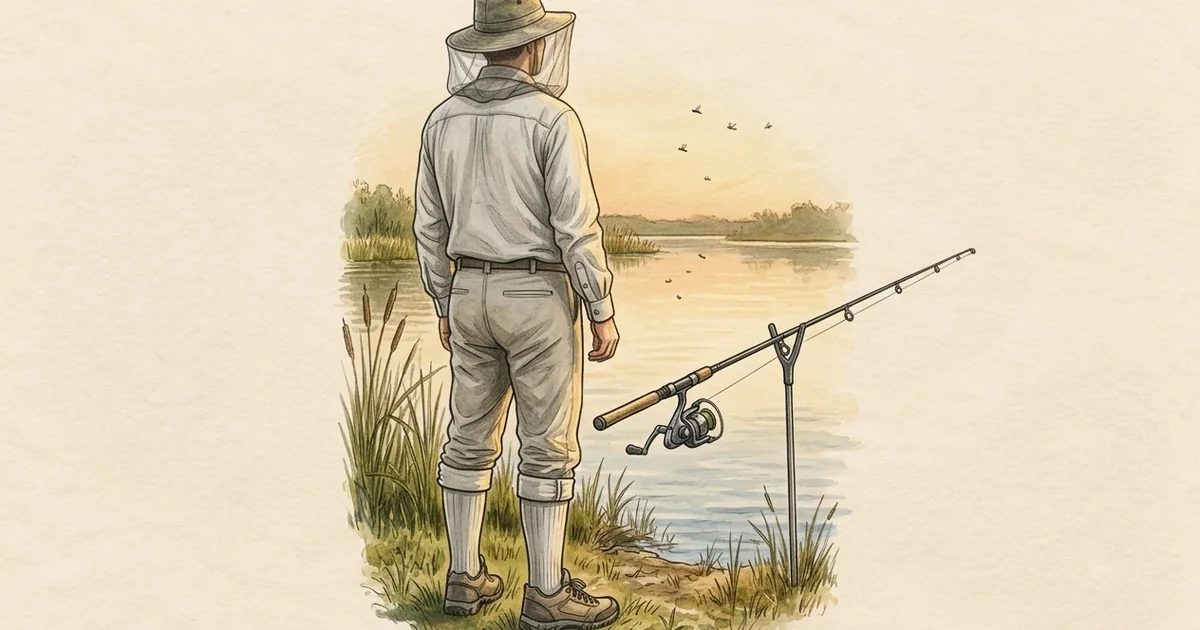
Against mosquitoes, the UBA recommends light, loose clothing, because the insects prefer to fly at dark colours. Against blackflies and biting midges, it recommends closed, close-fitting clothing, headwear and closed shoes. Blackflies like to bite where the fabric ends: at sleeves and trouser legs, the neck, the neckline and the hairline. A light, long layer with snug cuffs at wrist, neck and ankle takes something from both recommendations. More on layering under Fishing jacket.
Against ticks, tuck your trouser legs into your socks; the Robert Koch-Institut’s reasoning is given under Fishing trousers. The Federal Foreign Office’s leaflet on insect protection also mentions sturdy, light-coloured socks and advises treating the transition to bare skin with repellent. It names ankles and neck as particularly vulnerable areas.
Impregnated clothing
For long days outdoors, the UBA names clothing treated with repellents as additional protection. The Federal Foreign Office describes fabrics impregnated with pyrethroids such as permethrin. These active ingredients not only keep insects away, they kill them on contact. Care is needed with DEET (explained below) on fabric: the leaflet then recommends cotton, and the BfR counts clothing made from synthetic fibres among the plastics that DEET attacks.
Head net and mosquito net
A net over your hat keeps mosquitoes off your face, and then you need no repellent around your eyes. The Federal Foreign Office’s rules for mosquito nets carry over to the head net: if the net rests on bare skin, the mosquitoes bite through it, and no gap may be left open. A wide brim keeps the net away from your face, and the lower edge goes into your collar. Finer mesh protects better. Against tiny biting midges, the UBA gives a mesh size of under one millimetre for insect nets. When you stay overnight, the net in the inner tent takes on this job, see Tent for fishing trips.
Repellents by active ingredient
Repellents do not kill. According to the German Federal Institute for Risk Assessment (BfR), they block or disrupt the insects‘ scent receptors, so the insects can no longer follow the smell of breath and sweat. Legally they are biocidal products of product type 19; products that kill insects belong to product type 18. Both need authorisation. In Germany, according to the UBA, this is coordinated by the Federal Office for Chemicals at the Federal Institute for Occupational Safety and Health (BAuA), with the UBA and BfR also assessing. An authorised product carries a number on the label beginning with “DE” or “EU-”. According to the BfR, older products already notified before May 2000 may, under certain conditions, stay on the market without authorisation for a transitional period.
- DEET (diethyltoluamide): according to the BfR one of the most effective active ingredients; the Bernhard Nocht Institute for Tropical Medicine (BNITM) calls it the most effective repellent. It works better against mosquitoes than against ticks, can irritate mucous membranes at high concentrations and attacks plastics, such as sunglasses, phones and synthetic clothing.
- Icaridin: works much like DEET, is considered better tolerated and protects against the mosquitoes and ticks of Central Europe, though usually for a shorter time than DEET. It does not attack plastics.
- IR3535 (ethyl butylacetylaminopropionate): similarly effective, but works for a shorter time than the other two. According to the BfR it is kinder to the skin, hardly irritates mucous membranes and is gentle on plastics.
- PMD (p-menthane-3,8-diol): according to the Federal Foreign Office it occurs in lemon eucalyptus oil and has a proven repellent effect. For plant-based active ingredients in general, the BfR writes that they evaporate from the skin more quickly and work more weakly and for a shorter time; there are also reports of irritation to skin and mucous membranes in sunlight. Not all of them have been assessed by the authorities.
The Federal Foreign Office’s information sheet calls wristbands with repellent, vitamin B1 or B6, garlic, citronella candles and tea tree oil completely ineffective.
Health: The information follows the BfR, UBA, Robert Koch Institute, BNITM and the health service of the Federal Foreign Office. It does not replace medical advice, least of all for small children, during pregnancy or if you have skin problems.
Children at the fishing spot
Not every product suits children. According to the BfR, DEET is out of the question for children under two, Icaridin is suitable from two years, and for children from one year the institute names IR3535 as the more suitable choice. For children under twelve, parents apply the product, never on the hands of small children, who put them in their mouths. If you want to be on the safe side, the BfR suggests doing without it entirely under the age of two and relying on nets, long sleeves and not spending dusk outdoors. More under Family fishing day.
Applying it on the bank
- First apply sun cream and let it soak in, then the repellent. This is the order the Federal Foreign Office gives.
- Apply thinly to every bit of exposed skin, including ankles, neck and the gap between sock and skin.
- Leave out wounds, sunburn and mucous membranes, avoid eyes and mouth.
- Wipe your palms. With DEET, only then touch polarised glasses, phone and plastic gear.
- Reapply as the instructions say, sooner if you sweat a lot. The RKI advises putting tick repellent on clothing too, as long as it does not stain it.
If your skin does not tolerate a product well, the Federal Foreign Office says one with a different base often helps: frequently it is the lotion that causes trouble, not the active ingredient.
Vaporisers, candles, ultrasound and the bank
Devices that vaporise an active ingredient from a mat or a liquid do not protect the skin, they fill the air. According to the Federal Foreign Office, electric biocide vaporisers release an insecticide that slowly spreads through the air. The UBA cannot recommend such vaporisers without reservation, because the active ingredients get into the air you breathe, and wants their use limited to certain situations. According to the UBA, a device may only be used as the label specifies under its authorisation. According to the information sheet, sensitive people can get irritation of the eyes, skin and airways, and the device should only run in rooms with no one in them. Applied to a sleeping tent, that means no vaporiser next to the sleeping bag. According to the information sheet, mosquito coils belong outdoors only and work more weakly.
According to the UBA, ultrasonic devices are subject to no testing or authorisation, and there is no official recommendation. The Federal Foreign Office calls them generally ineffective. According to the UBA, UV lamps with an electric grid belong indoors only, not on the bank: mosquitoes are hardly attracted to UV light, and instead moths and other, often endangered insects die. Which light makes sense at a night swim is covered under Lantern and tent lamp.
Water bugs, water beetles, dragonfly larvae and fish feed on mosquito larvae and pupae, while frogs, toads, birds, bats and spiders eat the adult mosquitoes (UBA). According to the UBA, anyone spraying insecticide outdoors also hits beneficial and protected species, and biocides may only be used to the minimum necessary. So at the fishing spot, no spray over the reeds, into the grass or onto the water: clothing and nets come first. More under Nature conservation on the bank.
Tick tweezers, tick card and checking yourself
How to remove a tick step by step and when to see a doctor is covered under Sun, heat and ticks. When choosing a tool, the guidance of the Robert Koch Institute (RKI) applies: it must grip the tick close to the skin by its mouthparts, never by its engorged body. The RKI names tweezers or a special tick removal tool. Tick pliers, cards and loops are designs of such tools. The tool and disinfectant belong in the first-aid kit so that they are to hand at the water.
Ticks do not bite straight away; they first wander around looking for a sheltered spot. If you check yourself after fishing, you catch many before they bite. After contact with low bushes, ferns or tall grass, the BNITM also considers checking worthwhile. A shower can wash off wandering ticks, but according to the RKI it does not replace checking. On a multi-day session, a tip from the UBA helps: do not take off or put down clothing that has been outdoors where you will be spending time afterwards. At the water that is the sleeping tent, so the fishing trousers stay in the porch.
Packing list against bites
- light-coloured shirt and light-coloured trousers, long, with tight cuffs
- sturdy, light-coloured socks and closed shoes
- hat with brim and head net, with very fine mesh on the coast
- repellent with DEET, Icaridin, IR3535 or PMD and an authorisation number on the label
- for children, a product that the package leaflet says suits their age
- tweezers or tick remover and disinfectant
- tent with a net in the inner tent if you stay overnight
Common mistakes
- Dark jacket at the pond in the evening. According to the UBA, mosquitoes prefer dark colours.
- Open sleeves by the stream. Blackflies bite at the edges of clothing. There, a tight seal helps more than any colour.
- DEET on a technical jacket and polarised glasses. The active ingredient attacks plastics. According to the BfR, Icaridin and IR3535 do not.
- Citronella candle or ultrasound instead of repellent. According to the Federal Foreign Office’s information sheet, neither works.
- Vaporiser in a closed sleeping tent. The active ingredient ends up in the air you breathe; such devices should run when no one is in the room.
Frequently asked questions
Does mosquito repellent also work against ticks?
Partly. According to the BfR, DEET works better against mosquitoes than against ticks, while Icaridin is effective against both. The RKI says protection from products on the skin is limited in time. That is why trousers in socks and checking yourself in the evening remain necessary.
Can mosquitoes at a fishing lake transmit diseases?
Possible, but rare. The UBA considers the risk in Germany low despite increasing cases of West Nile fever. A mosquito can only pass on what it has previously picked up from an infected host. According to the BNITM, some native house mosquito species can transmit the West Nile virus, for example, which circulates mainly in birds and only rarely causes severe illness in humans.
Can I use mosquito repellent from a fishing holiday abroad?
The Federal Foreign Office advises using products from home, because products from other countries can contain worrying amounts of active ingredients. You can recognise products authorised in Germany by the number beginning with “DE” or “EU-”. Before fishing trips to the tropics, a travel medicine practice can advise you.
Related
- Sun, heat and ticks: removing a tick, Lyme disease, TBE risk areas
- Fishing trousers: fabrics, layers and the trouser leg in the sock
- First aid kit for fishing: contents, hooks and ticks
- Tent for fishing trips: inner tent with a net on a damp bank
- Lantern and tent lamp: light at your swim without glare
- Night session packing list: everything for a night at the water
- Night fishing: setting up your swim in daylight, spotting bites in the dark
- Line calculator: work out breaking strain and line capacity for your session
Sources
- Umweltbundesamt: Stechmücken, ein Überblick (Lebensraum, Anlockung, Nahrungsnetz, Risiko, Kleidung, Verdampfer, Zulassungsnummer, Ultraschall, UV-Fallen)
- Umweltbundesamt: Gemeine Stechmücke (Kleidung, behandelte Kleidung bei langen Aufenthalten draußen)
- Umweltbundesamt: Kriebelmücken (Fließgewässer, Biss, Kleidung, Tageszeit)
- Umweltbundesamt: Gnitzen (Vorkommen, Stiche, Kleidung, Maschenweite)
- Umweltbundesamt: Schildzecken (Jahreszeit, Kleidung nicht in Aufenthaltsräumen ablegen)
- Umweltbundesamt: Insektizide (Nichtzielorganismen, Mindestmaß) und Umweltbundesamt: Zulassungsverfahren (Zulassungsstelle in der BAuA)
- Bundesinstitut für Risikobewertung: Gibt es gesundheitliche Risiken bei der Verwendung von Repellentien? (Stand 15.07.2026: Wirkstoffe, Kunststoff, Kinder, Übergangsregel) und BfR: Einteilung von Biozid-Produkten (Produktarten 18 und 19)
- Auswärtiges Amt, Gesundheitsdienst: Expositionsprophylaxe (PDF, Stand 03/2019) (PMD, wirkungslose Mittel, Auftragen, Imprägnierung, Netze, Verdampfer)
- Robert Koch-Institut: Antworten auf häufig gestellte Fragen zu Zecken (Werkzeug, Absuchen, Duschen, Mittel auf Kleidung)
- Bernhard-Nocht-Institut für Tropenmedizin: FAQ zu Stechmücken in Deutschland (DEET, West-Nil-Virus) und BNITM: FAQ zu Zecken (Absuchen)
Text AI-assisted, drawing AI-generated. Sources opened and checked in November 2026; no graphics taken from the sources.
All information is a guide only and without guarantee. The notes on repellents, mosquitoes and ticks do not replace medical advice; for products and devices, the label always applies.